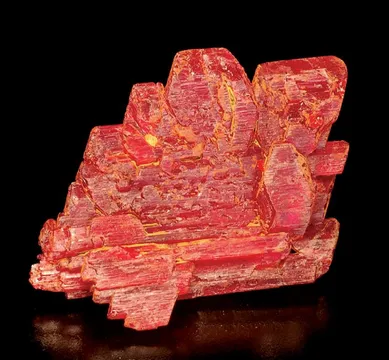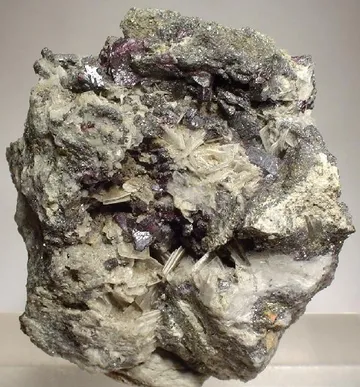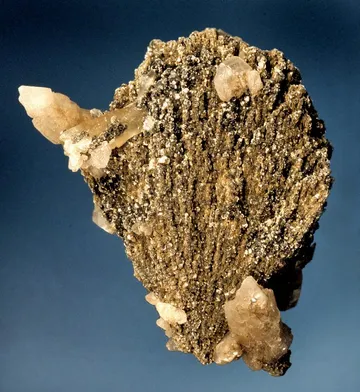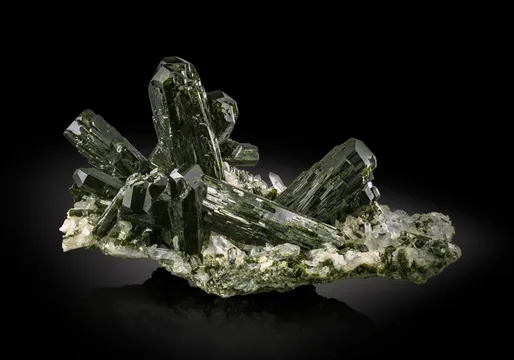
Julcani Mine, Peru — a high-Andean polymetallic silver district famed for metallic sulfides and sulfosalts, especially enargite blades and arsenopyrite.
Key facts
Julcani is one of Peru’s great old polymetallic silver districts: a high-Andean, underground, narrow-vein mine in Angaraes Province, Huancavelica, and the founding operation of Compañía de Minas Buenaventura. For collectors, its importance is not simply that it produced silver. Julcani is a textbook example of a zoned, late-Miocene magmatic-hydrothermal system in which fracture-filling veins cut a dacitic to rhyolitic volcanic-dome complex. The district’s mineralogy records a vivid inward-to-outward chemical progression: gold-bismuth-tungsten in the central Tentadora area, copper-arsenic sulfosalts and pyrite along hotter inner pathways, then complex silver-bismuth and lead-antimony sulfosalts, galena, sphalerite, realgar, and orpiment farther out.
Specimen collectors know Julcani first for metallic sulfides and sulfosalts rather than for colorful oxidized minerals. Its best pieces have a distinctly Andean elegance: dark, lustrous enargite blades and prisms; bright arsenopyrite crystal groups; brown to honey-green siderite rhombs with an odd silky or metallic shimmer; tetrahedrite-family crystals with iridescent chalcopyrite; fluorapatite perched among sulfides; and, for the advanced collector, rare bismuth sulfosalts that often demand analysis before a confident species name can be attached. The locality sits at the intersection of classic cabinet-mineral collecting and serious ore-mineral microscopy.
Regional View
Country View
The mine’s reputation rests especially on contrast and texture. A fine Julcani enargite is not a dull ore fragment: it is a cluster of black to steel-gray, lustrous blades or prisms, commonly with pyrite, baryte, quartz, chalcopyrite, or tetrahedrite-group minerals. Fine arsenopyrite examples are brassy-silver, sharp, and architectural, often accompanied by quartz or fluorapatite. Siderite from the district is less common on the market than the ore sulfides, but the better pieces show stacked, blocky, disc-like, or rhombic crystals in tan, olive-brown, honey-brown, or greenish-brown tones, sometimes glowing warmly when backlit.

Photo: Wikimedia Commons
Search for specimens: View all specimens from Julcani Mine, Peru
Julcani is in the Ccochaccasa District of Angaraes Province, Huancavelica, at roughly 4,200 meters elevation. Buenaventura describes it as a 100%-owned underground silver mine in narrow veins, and that practical description matches the specimen story: this is a vein camp, not a broad open-pit collecting locality. The mine has worked multiple zones during its long life, with historically important mines and sectors including Herminia, Nueva Herminia, Mimosa, Manto, Tentadora, Acchilla, and Estela.
Geologically, Julcani is a fracture-filling, argentiferous epithermal deposit hosted by a Tertiary dacitic to rhyolitic dome complex. Academic descriptions place the district within a late-Miocene calc-alkalic volcanic center, where eruptive and intrusive activity, doming, fracturing, hydrothermal alteration, and vein mineralization were closely linked in time. Repeated magmatic doming and movement along regional structures produced networks of faults and fractures that acted as channels for ore fluids. Mineralization is overwhelmingly vein-controlled, with subordinate replacement where wall rock was sheared within the vein structures.
The district is strongly zoned. The central Tentadora dome area is characterized by a gold-bismuth-tungsten association, while peripheral parts trend toward silver-lead mineralization. In the Herminia system, ore fluids moving away from Tentadora deposited early enargite-pyrite-tennantite/tetrahedrite assemblages, followed by complex silver and bismuth sulfosalts with bismuthinite, and farther outward by galena, lead sulfosalts, orpiment, and realgar. In the Mimosa vein system, tennantite/tetrahedrite is more typical of lower or inner zones, while galena becomes more prominent outward. In Estela, early pyrite-wolframite mineralization was followed by tennantite/tetrahedrite, chalcopyrite, arsenopyrite, bismuthinite, and finally galena-sphalerite mineralization.
The ore minerals listed by the operator include tetrahedrite, argentite, silver sulfosalts, galena, sphalerite, and chalcopyrite; common gangue minerals include siderite, pyrite, baryte, silica, and calcite. That is the collector’s assemblage in miniature: sulfides and sulfosalts on carbonate, quartz, and baryte, with many visually appealing combinations coming from only a narrow portion of a much larger metallogenic system. Julcani also has documented acid-sulfate alteration, including alunite-bearing assemblages and vuggy silica zones, tying the mine to broader discussions of magmatic-hydrothermal acid-sulfate systems in epithermal geology.
Mining history is unusually central here. Buenaventura traces its origin to the acquisition of Julcani in 1953, and the company still calls the operation its “alma mater.” The mine began modern operations that year and remains part of Buenaventura’s identity more than seven decades later. Today the active operation is underground, with Acchilla and Estela described as operating zones. Buenaventura reports conventional overhand cut-and-fill mining, multiple operating levels, shafts in Acchilla, mine-water pumping, acid-water treatment capacity, flotation processing, and production of a bulk lead-silver concentrate.
For collectors, access should be understood accordingly: Julcani is an active industrial mine, not a public collecting site. Specimens in circulation generally come from historical production, old collections, mine-related channels, or later dealer dispersals, rather than from casual field collecting. The best-known specimen pockets include enargite-rich material from the Julcani/Herminia-Lucrecia part of the district, siderite pockets from Julcani and Mimosa, arsenopyrite-fluorapatite combinations from the wider district, and bismuth-sulfosalt material from Herminia, including the type occurrence of terrywallaceite on Level 390, Vein 14.
Julcani enargite is the locality’s signature collector species: lustrous black to dark steel-gray blades and prisms, commonly in thumbnail to small-cabinet specimens but with individual crystals documented from about 1 cm to 2 cm on typical pieces and exceptional reported examples reaching several centimeters. It belongs to the early inner-zone copper-arsenic stage of the district, associated especially with pyrite and tennantite/tetrahedrite, and on collector specimens it may occur with baryte, quartz, chalcopyrite, calcite, or pyrite. The most desirable pieces are sharp, freestanding, undamaged crystal clusters with bright metallic luster, strong bladed or prismatic form, and attractive contrasts against pale quartz, baryte, or glittering pyrite; ordinary pieces tend to be massive, bruised, poorly separated, or heavily coated.
Siderite at Julcani is both a gangue mineral and a collectible species in its own right, appearing as tan, caramel-brown, olive-greenish brown, honey-brown, or dark brown rhombs, blocky stacked crystals, discs, and occasional stalactitic or stepped growths. Fine pieces are known from Julcani Mine and Mimosa Mine, with reported crystals in the 1–3 cm range and small-cabinet specimens showing larger isolated rhombs on earlier siderite generations, chalcopyrite, pyrite, sphalerite, galena, baryte, or apatite. The best examples are not judged merely by size: collectors prize the unusual silky to metallic shimmer, translucent greenish-brown interiors when backlit, sharp rhombic form, and clean contrast with brassy chalcopyrite or dark sulfide matrix; many lesser examples are compact brown carbonate masses with little crystal definition.
Julcani arsenopyrite occurs as metallic silver-gray to brassy prismatic crystals, needlelike groups, coatings of lustrous small prisms, and occasional twinned or star-shaped trillings, most often as a combination mineral with fluorapatite, quartz, pyrite, sphalerite, chalcopyrite, galena, siderite, or calcite. Dealer and photo records show crystals commonly around 1 cm to 1.3 cm, while indexed collector literature notes Julcani arsenopyrite coatings of lustrous prismatic crystals to about 1 cm and fluorapatite crystals to about 2 cm on arsenopyrite. Excellent examples are sharp, bright, damage-free, three-dimensional groups with visible associated fluorapatite or quartz; a recurring problem is confusion with dark enargite or other metallic sulfides when crystal habit and associations are not read carefully.
Julcani’s broader mineral list is unusually rich for a silver-polymetallic vein camp. Documented species include tetrahedrite-(Cu), tetrahedrite-(Fe), tetrahedrite-(Zn), tennantite-subgroup minerals, galena, sphalerite, chalcopyrite, pyrite, baryte, calcite, quartz, fluorapatite, fluorite, hübnerite, ferberite, scheelite, bismuthinite, boulangerite, bournonite, cosalite, freieslebenite, galenobismutite, geocronite, jordanite, luzonite, miargyrite, polybasite, pyrargyrite, realgar, orpiment, stibnite, and a suite of rare Bi-Pb-Ag-Cu-Sb sulfosalts. The standout type-locality mineral is terrywallaceite, AgPb(Sb,Bi)3S6, described from Level 390, Vein 14 of the Herminia Mine, where it occurs with tetrahedrite, gustavite, baryte, and pyrite. For collectors of rare ore minerals, Julcani is one of those localities where the label may be less certain than the specimen looks: several bismuth sulfosalt series members require polished-section work, electron microprobe analysis, or single-crystal X-ray diffraction for confident identification.
Julcani specimens reward careful buying. The most obvious authenticity concern is not widespread artificial manufacture, but misidentification. Dark metallic species from this district can be visually deceptive: enargite, arsenopyrite, tetrahedrite/tennantite, bismuthinite-series material, and other sulfosalts may all appear as steel-gray to black metallic crystals or aggregates. At least one documented dealer listing for Julcani arsenopyrite with quartz noted that earlier collection labels had misidentified the specimen as enargite. Conversely, tennantite after enargite and other replacement or pseudomorphous material can complicate older labels. For high-value sulfosalts, especially anything labeled as a rare bismuth species, a provenance-only identification should be treated as provisional unless supported by analytical work.
Condition issues are typical of sulfide-rich vein specimens. Enargite blades and prisms can be bruised on edges and terminations, and their dark color may hide damage until the specimen is rotated under strong light. Arsenopyrite groups can have rubbed tips, missing small crystals, or quartz coatings that obscure the true habit. Siderite from Julcani cleaves readily and may show contacted or chipped rhombs; the most attractive specimens depend strongly on intact luster and the peculiar shimmering stepped growths, so surface abrasion matters. Realgar and orpiment from the district, when encountered, should be stored away from strong light and handled as arsenic sulfides. Enargite and arsenopyrite also contain arsenic, so avoid cutting, grinding, ultrasonic cleaning of friable pieces, or producing dust; ordinary dry handling is reasonable, but washing hands after handling is good practice.
Fluorescence is not the main reason most collectors buy Julcani specimens, but fluorapatite-bearing pieces can show fluorescence, with dealer descriptions noting bright response on some apatite-arsenopyrite combinations and lilac shortwave response on some fluorapatite specimens. Always test gently and separately: many Julcani pieces are sulfide-rich, and water, acids, and aggressive cleaning can create more problems than they solve.
Market availability is uneven. Enargite is the most recognizable Julcani collectible and appears periodically in old collections, online dealer inventories, and auction archives. Fine, sharp, undamaged enargite clusters remain desirable, especially larger crystals with an old label. Arsenopyrite-fluorapatite combinations surface less often but are still obtainable. Siderite is surprisingly scarce in fine form relative to the mine’s long life, and the distinctive early-1990s shimmering siderite material is especially sought after when undamaged. Rare bismuth sulfosalts and terrywallaceite belong to the specialist market and are more often microscopic, analytical, or reference-grade than decorative cabinet specimens.
Julcani’s greatest story is corporate as much as mineralogical. In 1953, Alberto Benavides de la Quintana and his partners acquired a high-grade silver mine in Huancavelica, and from that single mountain operation Buenaventura was born. The company’s own historical language is telling: “Nacimos en Julcani” — “We were born in Julcani.” For collectors, that matters because it places many Julcani specimens in a deeper Peruvian mining context. These are not anonymous sulfides from a short-lived boom; they come from the mine that gave one of Latin America’s most important precious-metal companies its start.
The geological story has its own drama. Early investigators did not simply map veins; they followed metal ratios through the mine as if tracing fluid pathways through a fossil hydrothermal machine. In the Herminia system, the trail led back toward Tentadora, where pyritic gold-tungsten mineralization marked an inner, hotter part of the system. From there, ore solutions moved into named veins — Lucrecia, Docenita, Luz-82, Año-2NW — depositing one mineral suite after another. First came enargite-pyrite-tennantite/tetrahedrite, then silver-bismuth sulfosalts, then galena and lead sulfosalts, and finally the outer arsenic sulfides realgar and orpiment. A Julcani specimen label can therefore be more than a place name: it can mark a position in an ore-fluid journey.
A smaller, modern episode belongs to terrywallaceite. The new species was not found as a showy cabinet crystal, but on a rock sample from Level 390, Vein 14 of the Herminia Mine. Under scientific examination, metallic-black lath-shaped crystals associated with tetrahedrite, gustavite, baryte, and pyrite proved to be a new lillianite-group sulfosalt. Its name honors Terry C. Wallace Jr., linking a tiny silver-lead-antimony-bismuth sulfide from a Peruvian vein to a broader community of mineral collectors, museum curators, crystallographers, and ore-mineral specialists.