






Russia - a vast locality guide highlighting Dalnegorsk calcite, Mir and Udachnaya diamonds, Kamchatka fumaroles, and rare minerals prized by collectors.
Key facts
Russia is not a single locality in the ordinary collector’s sense; it is a continent-scale mineral kingdom. Its best specimens come from a chain of profoundly different geological settings: kimberlite pipes punched through the Siberian craton in Yakutia; skarn, vein, and polymetallic systems of the Urals and Russian Far East; alkaline massifs of the Kola Peninsula and Murun area; active fumaroles of Kamchatka and the Kurile Islands; and old arsenic, lead-zinc, emerald, platinum, and gold districts whose names have been on specimen labels for generations. For the serious collector, “Russia” means both production and discovery: commercial diamonds from Mir, Udachnaya, Zarnitsa, Aikhal, Yubileinaya, Nyurbinskaya, and Lomonosov; classic Dalnegorsk calcite, quartz, fluorite, datolite, danburite, ilvaite, sphalerite, galena, and pyrrhotite; Polar Ural smoky quartz and gwindels; El’brusskiy orpiment on baryte; Murun charoite; Kola rare-element minerals; and volcanic oddities such as rheniite from Kudriavy.
The historical weight is just as broad. The Urals fed imperial gemstone lore with emerald, alexandrite, demantoid, topaz, and amethyst. The 1954–1955 Yakutian kimberlite discoveries transformed the Soviet Union from a diamond importer into a major producer. Dalnegorsk, once better known to industry than to Western collectors, became one of the signature sources of post-Soviet specimen material in the 1990s. Kamchatka and the Kuriles, meanwhile, remain among the world’s most productive natural laboratories for fumarole minerals, where new species form in modern volcanic gases rather than ancient ore veins.
At their best, Russian specimens have a recognizable look: icy Dalnegorsk calcites rising over sugary quartz; brassy pyrrhotite plates perched like shields; bitter-orange orpiment spherules and blades on pale baryte; lemon sulfur in calcite vugs from the Samara region; flattened smoky quartz gwindels from the Subpolar Urals; and dark volcanic rock dusted with metallic rheniite from the hot vents of Kudriavy. The country’s mineralogy is too large to reduce to one style, but the strongest Russian pieces share clarity of locality, dramatic contrast, and a sense of geological place.
Regional View
Country View

Photo: Wikimedia Commons

Photo: Wikimedia Commons

Photo: Wikimedia Commons

Photo: Wikimedia Commons
Search for specimens: View all specimens from Russia
Russia’s collectible mineral output is best understood by province. The Siberian craton hosts the great diamond pipes of Yakutia, where kimberlite, mantle xenoliths, pyrope garnet, chromite, ilmenite, olivine, and diamonds define the specimen and ore story. The first Soviet primary diamond pipe, Zarnitsa, was found in 1954 by Larisa Popugaeva using pyrope indicator-mineral tracing; Mir followed on 13 June 1955, and Udachnaya two days later. Industrial development created the diamond towns and mining divisions of western Yakutia, while later production expanded to additional Yakutian fields and to the Lomonosov deposit near Arkhangelsk, Russia’s major diamond source outside the Siberian craton.
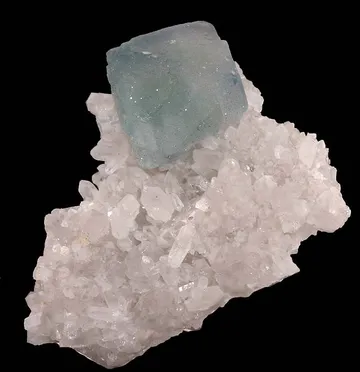
Dalnegorsk, in Primorsky Krai, is the country’s great specimen district for skarn and polymetallic material. The district includes boron skarns, lead-zinc-silver deposits, and related hydrothermal bodies that yielded superb cabinet specimens from mines such as Nikolaevskiy, 2nd Sovetskii, Verkhnii, and the Bor Pit area. Collectors know Dalnegorsk less for ore tonnage than for cavities: calcite in glassy scalenohedra and complex twins, fluorite cubes and modified forms, datolite and danburite crystals, quartz sprays, tabular pyrrhotite, lustrous sphalerite, galena, arsenopyrite, ilvaite, axinite-(Fe), and borosilicate assemblages. Much of the famous material reached Western collections during the late Soviet and early post-Soviet specimen boom, when Dalnegorsk suddenly became a staple of international mineral shows.
The Urals and Subpolar Urals form another deep collecting belt. The Murzinka and Adui pegmatite fields are tied to Russia’s gemstone history, especially topaz, beryl, quartz, and feldspar. The emerald-alexandrite deposits near the Tokovaya area in the Middle Urals helped define alexandrite as a gem variety of chrysoberyl. The Subpolar Urals, especially around Puiva, Dodo, Zhelannoye, and neighboring alpine-type quartz occurrences, are famous for smoky quartz, rock crystal, amethyst, citrine, and rare gwindel growths in quartz veins and alpine clefts. Farther north and east, the Vorontsovskoe gold deposit in the Northern Urals is notable mineralogically for Au-Hg-As-Tl-Sb sulfosalt and arsenic sulfide assemblages, including realgar and orpiment in ore-bearing breccias.
The Kola Peninsula and adjacent alkaline provinces are among the world’s richest regions for rare-element mineralogy. Khibiny and Lovozero, both alkaline intrusive complexes, are names collectors associate with loparite-(Ce), eudialyte-group minerals, astrophyllite-group minerals, rinkite-group minerals, natrolite, aegirine, microcline, sodalite, and an extraordinary list of type-locality species. Murun, on the Aldan Shield in eastern Siberia, is the home of charoite-bearing rocks, where purple charoite occurs with tinaksite, canasite, aegirine, quartz, K-feldspar, and other unusual Ca-K-Na silicates in alkaline metasomatic rocks.
The volcanic Far East adds an entirely different class of specimens. Kamchatka, Uzon Caldera, Tolbachik, Mutnovsky, and the Kurile volcanoes produce native sulfur, alunite-group minerals, sulfates, halides, oxides, and rare fumarole species deposited directly from volcanic gas. Kudriavy volcano on Iturup Island is the type locality of rheniite, ReS2, and one of the most celebrated modern fumarole mineral localities because its specimens are not relics of an ancient hydrothermal system but products of active high-temperature volcanic degassing.
Access varies sharply. Active industrial diamond, base-metal, boron, gold, and polymetallic mines are not casual collecting sites; they require operator permission and involve real underground, pit-wall, blasting, ventilation, and contamination hazards. Protected volcanic areas such as Uzon Caldera are managed for conservation and tourism, not specimen removal. In practice, most collectible Russian material reaches the market through old collections, mine-run lots released historically, dealer inventories, museum exchanges, and limited modern field recovery where legal and safe access exists. Provenance is therefore especially important: a Russian specimen labeled only “Siberia” or “Ural” may be attractive, but it is far less meaningful than one tied to El’brusskiy, Puiva, Dodo, Nikolaevskiy, Vodinskoe, Kudriavy, Murun, Lovozero, Mir, Udachnaya, or another precise locality.
Russian orpiment is most prized from the El’brusskiy Pb-Zn/arsenic mine in the Elbrus region of the northern Caucasus, where brilliant yellow-orange to orange-red As2S3 forms crusts, spherulitic aggregates, dense fan-like blades, and sparkling microcrystalline carpets on pale baryte and dolomitic vein material; the finest pieces show intense color, fresh luster, undamaged crystal faces, and sharp contrast against white to colorless baryte rather than dull powdery masses or bruised crusts. The Vorontsovskoe gold deposit in the Northern Urals adds a more ore-mineralogical style of Russian orpiment, occurring with realgar, native gold, pyrite, arsenopyrite, cinnabar, Tl-bearing sulfosalts, and carbonate breccias; these are important scientifically, but the display specimens most collectors recognize are the vivid El’brusskiy baryte-orpite combinations, ranging from thumbnails and miniatures to cabinet pieces and exceptional crusts reported in the tens of centimeters.
Russian diamond specimens are chiefly tied to Yakutia’s kimberlite fields, especially Mir, Udachnaya, Zarnitsa, Aikhal, Yubileinaya, and related pipes, with additional modern production from the Lomonosov area in Arkhangelsk Oblast. Collector pieces may be loose octahedra, rounded dodecahedral crystals, distorted or resorbed forms, frosted gray to brown stones, colorless to pale yellow crystals, or rarer diamonds preserved in kimberlite or mantle xenolith matrix; the most desirable mineral specimens are not simply high-carat rough but well-formed crystals with visible octahedral habit, trigons, good transparency or distinctive natural surface texture, and reliable mine-level provenance. Udachnaya material is especially important to mineralogists because of its diamondiferous mantle xenoliths and microdiamond-bearing peridotites, while Mir is historically iconic as the 1955 discovery that anchored Soviet diamond production and gave Russia one of the world’s defining kimberlite stories.
Russian native sulfur occurs in two collector-relevant modes: bright, glassy to translucent crystals in calcite vugs from the Vodinskoe deposit near Samara, and volcanic sulfur from Kamchatka and the Kurile Islands, including Uzon Caldera and Iturup occurrences. Vodinskoe sulfur is the classic display style, with lemon-yellow crystals set in brownish to tan calcite cavities; good pieces have saturated color, intact glassy faces, transparency, and undamaged crystals standing clear of the calcite rather than chalky, heat-damaged, or cleaved fragments. Volcanic sulfur from Uzon and other fumarolic or hydrothermal settings is geologically compelling, often associated with alunite, opal, pyrite, quartz, and acid-sulfate alteration, but specimen removal from protected or hazardous volcanic areas is highly restricted, so market pieces with old, precise labels deserve special attention.
Russian barite, more formally baryte in current mineral nomenclature, is a strong supporting actor in two of the country’s better-known specimen stories: colorless to white blades and plates with orpiment at El’brusskiy, and hydrothermal baryte in polymetallic districts such as Dalnegorsk and Vorontsovskoe. At El’brusskiy the most desirable examples show transparent, complete baryte crystals perched visibly on intense orange orpiment, a combination that is far scarcer and more condition-sensitive than simple orpiment crusts. Because baryte is soft, heavy, and easily bruised along edges and terminations, quality Russian pieces are judged by intact blades, transparency, clean contrast, and unambiguous association rather than size alone.
Rheniite from Russia is locality-defining material: ReS2 from the high-temperature fumaroles of Kudriavy volcano on Iturup Island in the Kurile chain, where it occurs as metallic silvery to dark red-black microcrystalline coatings, films, crusts, and small wedge-like crystals on volcanic rock. The species was approved as a valid mineral after work on Kudriavy fumarole material, with type material preserved at the Fersman Mineralogical Museum in Moscow; associated fumarole minerals include andradite, grossular, magnetite, wollastonite, wurtzite, greenockite, halite, and rare Cd-In-Bi phases. For collectors, the difference between a token rheniite specimen and an excellent one is richness: visible, bright metallic coverage over multiple surfaces, credible Kudriavy provenance, and matrix size large enough to display the occurrence while still making clear that the rheniite itself is a delicate fumarolic crust rather than a large massive ore mineral.
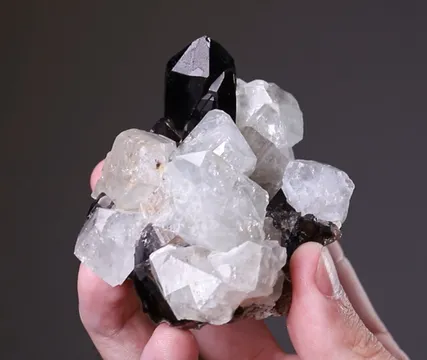
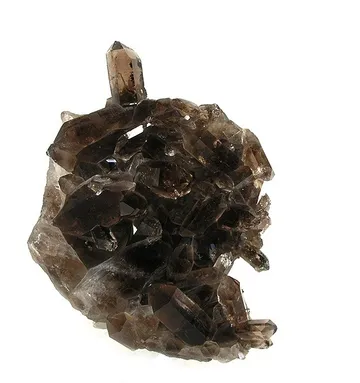
Russian quartz collecting spans several distinct traditions, but the strongest specimen names are the Subpolar Ural alpine-cleft localities Puiva and Dodo, the Zhelannoye quartz deposit, and the quartz-rich skarn and polymetallic assemblages of Dalnegorsk. Puiva and Dodo produced smoky quartz, rock crystal, amethyst, citrine, and coveted gwindels—flattened, twisted quartz growths familiar from Alpine collecting but rare enough in Russia to be locality signatures; good pieces show sharp terminations, luster, transparency, smoky zoning, chlorite or albite association where present, and the unmistakable geometry of a true gwindel rather than a merely flattened cluster. Dalnegorsk quartz is typically valued in combination, as snowy or glassy sprays carrying pyrrhotite, sphalerite, calcite, fluorite, or sulfides, and the best examples use quartz as an aesthetic stage for the district’s metallic and carbonate minerals.
Baryte-labeled Russian specimens usually reflect the same BaSO4 species as barite-labeled pieces, but the name often appears on European and modern labels, especially for El’brusskiy and Dalnegorsk material. At El’brusskiy, baryte may occur as white, colorless, or pale transparent crystals intergrown with, underlying, or perched on fiery orpiment, and a fine specimen depends on the intactness of the baryte as much as the color of the arsenic sulfide beneath it. In Dalnegorsk and Vorontsovskoe contexts, baryte belongs to broader hydrothermal and ore assemblages with sulfides, sulfosalts, quartz, calcite, and arsenic minerals; these pieces appeal most when the baryte is well crystallized and precisely labeled rather than merely present as a heavy pale gangue mineral.
Other Russian minerals of major collector and scientific importance include charoite from the Murun massif, demantoid and alexandrite from the Urals, eudialyte-group and loparite-(Ce) minerals from the Kola alkaline complexes, datolite and dalnegorskite from the Dalnegorsk boron skarns, and a remarkable suite of type-locality fumarole minerals from Tolbachik, Kudriavy, and other volcanic centers. Vorontsovskoe deserves special notice for rare Tl-Hg-As-Sb sulfosalts such as vorontsovite and ferrovorontsovite, while Khibiny and Lovozero remain among the world’s great name-rich localities for collectors who prize rare species over display aesthetics.
Russian specimens reward careful label work. Many older labels use shifting political, administrative, or transliteration conventions: Dal’negorsk, Dalnegorsk, Tetyukhe, Tetjuche, Primorskiy Kray, Primorsky Krai, Far-Eastern Region, USSR, Russia; Elbrus, El’brusskiy, Elbrusskii, Kabardino-Balkaria, Karachay-Cherkessia; Yakutia, Sakha Republic, Siberia; and Subpolar or Polar Urals for quartz localities. These variations are normal, but vague labels such as “Siberia,” “Ural,” “Russia,” or “Caucasus” should be treated as incomplete unless the specimen is inexpensive or the species-locality combination is unmistakable.
Orpiment and realgar-bearing specimens require respect. El’brusskiy orpiment is arsenic sulfide: it should not be cut, ground, licked, soaked, or handled by children, and loose powder should be avoided. Store it away from strong light and heat, both for safety and preservation of luster and color. The best orpiments are often composed of delicate crusts and spherulitic sprays; bruised high points, dull abraded faces, and orange dust in the box can markedly lower value.
Sulfur is soft, brittle, heat-sensitive, and surprisingly easy to damage. Russian Vodinskoe sulfur crystals should be kept out of hot display lights and direct sun, and they should never be cleaned with heat or aggressive solvents. Because synthetic or laboratory-grown sulfur exists in the marketplace, a convincing Vodinskoe piece should show the expected calcite-vug context, natural attachment, and older reputable provenance rather than an isolated “too perfect” yellow crystal with no matrix or history.
Diamond specimens need a different kind of caution. Russian industrial rough and specimen diamonds are both legitimate, but a mineral specimen is strongest when the mine or pipe is named and the stone’s natural surfaces are preserved. Be wary of faceted stones, acid-cleaned rough, or parcel diamonds retroactively assigned to a famous pipe without documentation. Diamonds in kimberlite matrix are especially collectible, but matrix specimens are uncommon and should be examined for artificial mounting, glue, or a loose diamond inserted into a convenient cavity.
Rheniite is one of the most frequently misunderstood Russian rarities because it is visually subtle. Good Kudriavy specimens are not large crystals of a shiny black mineral; they are volcanic rocks bearing microcrystalline metallic films and crusts. The label and analytical confidence carry much of the value. Rich coverage, old reputable stock, and precise Kudriavy provenance matter far more than a large matrix with only a small unverified dark stain.
Dalnegorsk material is abundant enough that quality standards should be high. Calcite cleaves and bruises, fluorite corners chip, pyrrhotite plates dent and may tarnish, and quartz sprays break at their tips. The best Dalnegorsk combinations are architectural: a balanced main crystal, clean matrix, visible association, and little restoration. Russian-market repairs are not inherently different from repairs elsewhere, but older show specimens should be checked under magnification for reattached calcite, glued sulfides, and trimmed bases.
For market availability, Russia is uneven. Dalnegorsk specimens remain available from old stock and collection dispersals. El’brusskiy orpiment on baryte appears less frequently and good undamaged pieces command a premium. Vodinskoe sulfur is obtainable but not common in top condition. Russian diamonds are commercially abundant as rough, but true mineral specimens with mine-level provenance are selective. Rheniite is genuinely rare and should be bought from sellers who understand fumarole minerals and can stand behind the locality.
The Siberian diamond story begins not with a spectacular gem but with tiny ruby-red grains in river sediment. In 1954, Larisa Anatolyevna Popugaeva and her assistant Fyodor Belikov were tracing pyrope garnets through the Daldyn area of Yakutia, using the same logic that had guided diamond prospectors in other kimberlite terrains: follow the indicator minerals back to the pipe. Their field kit was painfully simple—bucket, shovel, pick, hand washing pan, and loupe. They sampled stream deposits at intervals of about 500 meters and advanced no more than two kilometers in a day, studying fragments grain by grain. After nearly two months, on 21 August 1954, Popugaeva picked up an unimpressive bluish-gray piece of rock. It was the first Siberian kimberlite sample from what became the Zarnitsa pipe, the first primary diamond deposit found in the Soviet Union.
The discovery carried human complications as well as geological triumph. Popugaeva had been working within a search program shaped by Natalya Sarsadskikh, whose pyrope method was central to the work. Accounts of the discovery preserve the tension between field discovery, institutional credit, and Soviet geological bureaucracy. Popugaeva’s formal “discoverer of a deposit” recognition came much later, in 1970. The field image that survives is less ceremonial than physical: a young geologist living in a tent, wearing men’s boots, and working through taiga mud. A Russian account quotes her own lines about the profession: “I live in a tent, like a man,” and the boots carrying clots of clay into the water.
The next summer brought the message that entered geological folklore. On 13 June 1955, Yuri Khabardin, Ekaterina Elagina, and Viktor Avdeenko of the Amakinskaya expedition found the Mir kimberlite pipe. Their radio message was coded as a pun on the Russian word trubka, meaning both a smoking pipe and a geological pipe: “We lit the pipe of peace; the tobacco is excellent.” The phrase did more than report a find. It announced that the pipe was diamondiferous and significant. Two days later, on 15 June 1955, the Udachnaya pipe was discovered. Within a year of Zarnitsa, the diamond map of Yakutia had changed from possibility to industrial future.
Kudriavy volcano tells a stranger, hotter story. In the early 1990s, researchers working at the summit fumarole fields of the Iturup volcano were dealing not with ancient ore but with gases hot enough to remake the rock around them. Reports from 1992 recorded fumarole temperatures as high as about 910–940°C, with shallow rocks glowing red at depths of only 20–30 centimeters. Samples from cavities at the edge of a fumarole field were lined with a glittering mineral that first resembled molybdenite. Under the microscope and through later analytical work, it proved to be rhenium disulfide, ReS2. For collectors accustomed to minerals weathering out of old veins, rheniite is a reminder that new mineral species can still crystallize in the present tense, directly from volcanic gas.
Dalnegorsk’s story is less a single discovery than a long, repeated revelation of cavities. The district’s ore bodies were industrial assets—boron, lead, zinc, silver, and associated metals—but collectors remember the “pockets” and “breathing spaces” in skarns and veins: places where calcite, quartz, fluorite, datolite, danburite, ilvaite, sphalerite, and pyrrhotite had the room to grow. When Dalnegorsk specimens began reaching Western markets in quantity in the 1990s, they changed the visual vocabulary of Russian minerals. The best pieces did not look like old Ural gem rough or Soviet teaching specimens; they looked crisp, modern, lustrous, and architectural, with the combination aesthetics that collectors now instantly recognize as Russian Far East.

_1.jpg)

