Sherlova Gora, Russia — historic greisen locality yielding topaz and smoky quartz, blue-green beryl, fluorite; dual gem-ore heritage and zavaritskite locality.
Key facts
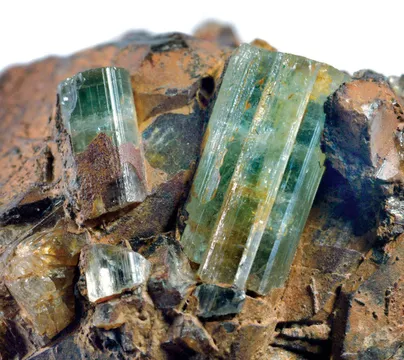
Sherlova Gora is one of the great old names in Russian mineral collecting: a Transbaikalian greisen gemstone-and-ore locality where aquamarine, topaz, smoky quartz, fluorite, ferberite, cassiterite, bismuth minerals, and a later suite of colorful arsenates all converge in a remarkably compact mining landscape. The collector locality is centered on the Sherlova Gora massif in the Adun-Cholon area of southeastern Zabaykalsky Krai, where mineralized greisen bodies cut an apical cupola of Mesozoic, lithium-fluorine, rare-metal granite related to the Kukulbei complex. In hand specimen, the locality is immediately recognizable: pale blue to colorless topaz in sharp prismatic crystals, smoky to morion quartz, blue-green and banded beryl, brown iron-stained clay from miarolitic pockets, and occasional green fluorite or arsenate crusts from the oxidized ore zones.
Historically, Sherlova Gora belongs to the old Nerchinsk gem-mining world. Its gemstone workings were known from the eighteenth century, long before the locality was appreciated as a complex Sn-W-Bi-Be-Pb-Zn system. That dual identity is what makes Sherlova Gora unusually interesting to serious collectors. It is not simply a “Russian topaz” occurrence, nor merely an aquamarine source: it is a greisen deposit whose mineralogy records early fluorine-rich granite alteration, cavity-stage gem crystallization, later ore brecciation, and finally a supergene overprint rich enough to produce the type locality of zavaritskite, (BiO)F.
Regional View
Country View
The best Sherlova Gora specimens have a look quite unlike pegmatite material from the Urals or Pakistan. The crystals are typically arranged on greisen plates and fissure linings rather than in feldspar-rich pegmatite cavities. Fine topaz specimens show glassy, sharply terminated, pale blue to colorless crystals clustered with dark smoky quartz or morion; fine beryl specimens show the famous blue-green to green tones, often with transverse color banding and with small topaz crystals dusting aquamarine faces. Quartz can be highly collectible when lustrous, smoky, undamaged, and in balanced association with topaz or beryl, but most of the deposit’s quartz is valued as context rather than as stand-alone gem rough.
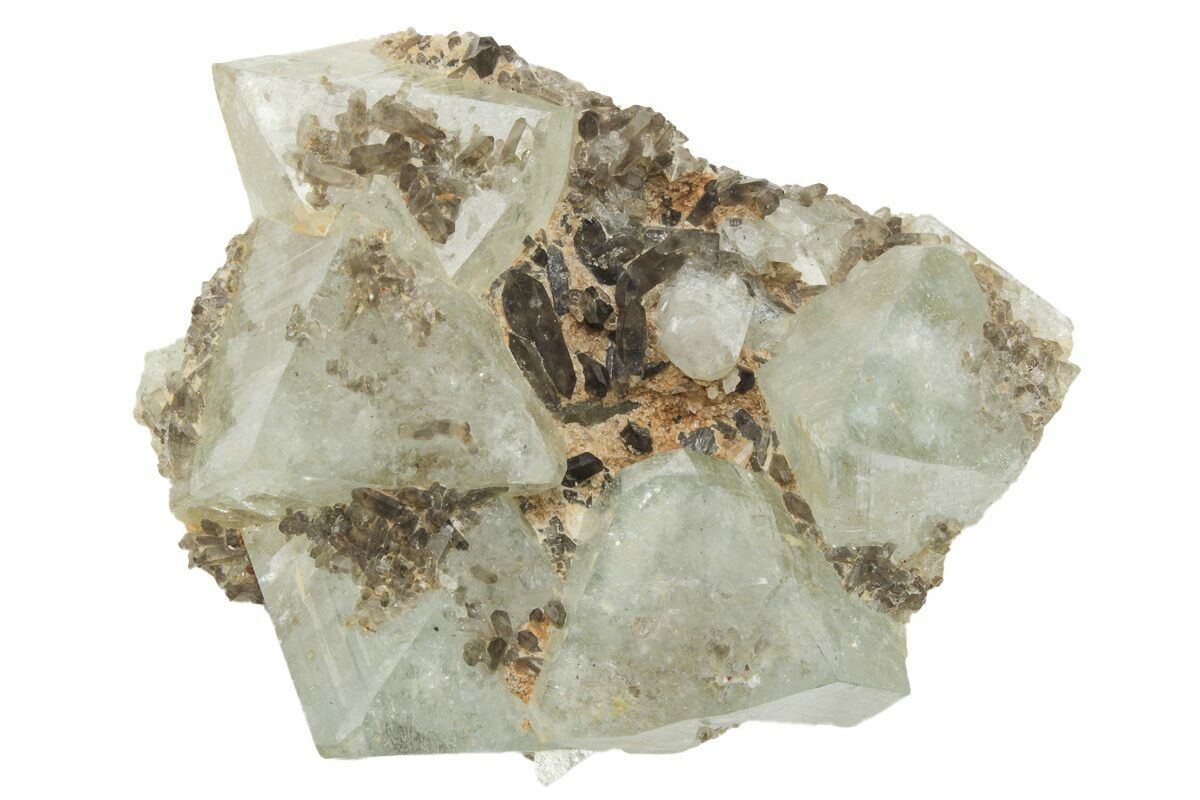
Photo: FossilEra
Search for specimens: View all specimens from Sherlova Gora, Russia
Sherlova Gora is a greisen-hosted rare-metal and gemstone deposit associated with an apical granite cupola in southeastern Transbaikalia. The Sherlovogorsky granite massif is described as part of a larger Mesozoic plutonic system of the Jurassic Kukulbei complex, intruding Lower Carboniferous sand-shale rocks near the junction of the Paleozoic Achinsk plate and the Jurassic East Transbaikalian trough. On the deposit itself, porphyritic granites and granite porphyries are altered along fracture systems into mica-quartz, topaz-quartz, quartz, and beryl-topaz-quartz greisens. These greisen bodies are commonly lens-shaped, pinching and swelling along strike, grouped into elongated mineralized zones tens of meters wide and, in some cases, hundreds of meters long.
The pocket-bearing parts of the system are structurally controlled. Productive bodies occur where steep and flat fracture systems intersect, creating bulges and miarolitic cavities. A typical greisen body grades inward from greisenized granite to mica-quartz and topaz-quartz aggregates, and then to a quartz-rich central part that may contain beryl, topaz, fluorite, ferberite, cassiterite, molybdenite, bismuthinite, arsenopyrite, and related sulfides. In the Novaya vein and the Podnebesny workings, cavities in vein swellings are reported with reddish-brown clay, bluish earthy scorodite, broken smoky quartz, beryl, and topaz. This explains the typical condition of many specimens: good crystals occur, but pocket collapse, clay filling, and post-ore fracturing are part of the locality’s natural history.
The major gemstone workings include the Podnebesny mine area, the Millionnaya mine, the Novaya vein, and older pits on the Sherlova Gora massif, including the slopes and saddles among Lukavaya, Obvinskaya or Goppeevskaya, and Melekhinskaya hills. Historic accounts emphasize that gemstone pockets were small, irregular, and easily missed by broad exploration grids. That is a key point for collectors: Sherlova Gora produced important specimens not because the whole deposit is uniformly rich, but because isolated greisen pockets yielded remarkable combinations of aquamarine, topaz, smoky quartz, and fluorite.
Mining history falls into several distinct phases. The gemstone story begins in 1723, when the locality was opened as an aquamarine occurrence. Eighteenth- and nineteenth-century work was intermittent and often primitive, focused on color stones rather than systematic ore extraction. In 1912 the locality was leased to the Irkutsk merchant N. Podnebesny, and P. P. Sushchinsky studied the field from 1914 to 1917, identifying the host “quartzy rock” as greisen in the modern sense. From 1918 to 1932, tungsten, beryllium, and bismuth ores were worked by the Redelement and Redmet trusts. Cassiterite was recognized in the 1920s, and by 1932 tin-ore mining had begun; the later Sherlovogorsky mining and processing combine became the principal industrial operation in the district. Archival records place the creation of the Sherlovogorsky ore administration in 1935, the renaming of the tin combine as the Sherlovogorsky GOK in 1959, and the liquidation decision for the state enterprise in 1995.
The planned Soviet gemstone evaluations tell a more nuanced story than the old labels suggest. In 1954–1955, Chita geological workers cleared old underground workings at Millionnaya and Podnebesny and cut trenches and small pits for aquamarine search. In 1966, 107 greisen bodies were opened by pits and trenches without finding commercial-quality aquamarine and topaz nests, leading to a pessimistic assessment. Yet subsequent work in 1969 noted that the old Podnebesny and Millionnaya veins were heavily pocketed, judging from mined-out cavities in underground workings, and that earlier exploration was too coarse for small, irregular greisen bodies. From 1971 to 1973, geochemical work outlined beryllium anomalies on Lukavaya hill and in the saddle between Lukavaya and Obvinskaya, with W-Li-Be-B correlation used as a search guide. In 1976–1980, work on the Novaya vein exposed pocketed greisen with gem-quality beryl and topaz and recovered more than 180 kg of conditioned gemstone raw material.
Collecting access today should be regarded as difficult and not equivalent to an organized public dig. The historical workings include old pits, trenches, underground openings, an abandoned ore quarry, dumps, and tailings; some areas are industrial or post-industrial ground with obvious physical and environmental hazards. The best surface exposures and dumps have been worked repeatedly for generations, while modern collecting is constrained by land status, safety, and the small, irregular nature of the remaining pockets. Loose specimens continue to circulate from older collections, past Soviet work, local finds, and post-mining dumps, but truly fine matrix topaz, beryl-quartz-topaz combinations, and intact classic aquamarines are scarce.
Sherlova Gora topaz is a greisen-pocket mineral rather than a pegmatite-pocket mineral, and that distinction is visible in good specimens: sharp, glassy prismatic crystals occur as druses and clusters in topaz-quartz and quartz-topaz-siderophyllite greisens, commonly with smoky quartz, morion, aquamarine or other beryl, fluorite, ferberite, cassiterite, and iron-stained clay from collapsed cavities. Most crystals are small, commonly around 0.5–2 cm, while reported collectable crystals reach roughly 6–7 cm high and about 5 cm wide; older museum and dealer descriptions also record classic clusters of well-shaped crystals to about 3 cm. Colors are chiefly colorless, pale blue, and pale yellow to golden, but the gem value is limited because many crystals are fractured or inclusion-rich, with only thin outer zones fully transparent; a peculiar “horse tooth” variety has been described, showing kaolin-rich outer zones reminiscent of enamel. The best pieces are not simply the largest: they are balanced greisen plates with sharp terminations, good luster, pale natural blue or clean colorless transparency, smoky quartz contrast, and minimal cleavage bruising on the topaz edges.
Quartz is the dominant gangue and cavity mineral at Sherlova Gora, occurring as rock crystal, smoky quartz, morion, citrine, and locally color-zoned crystals in the same greisen swellings that yielded topaz and beryl. Ordinary quartz is abundant, but collector-grade quartz is selective: the desirable specimens are lustrous smoky to morion crystals in attractive association with pale topaz, aquamarine, fluorite, or siderophyllite-rich greisen, or zoned crystals showing citrine, smoky-lilac, and smoky bands along the c-axis. Most quartz crystals described from the deposit are modest, commonly not exceeding about 4–8 cm long and 1.5–3 cm thick, though rarer crystals are reported to about 50 cm long and around 10 cm thick, and older mineral-literature indexes cite smoky quartz from Sherlova Gora to still larger sizes. Good pieces are judged by undamaged terminations, depth of smoky color, contrast against blue or colorless topaz, and intact pocket aesthetics; quartz alone is usually less important than quartz as the architectural matrix for the locality’s classic topaz and beryl specimens.
Beyond topaz and quartz, Sherlova Gora is best known to collectors for beryl, especially aquamarine and heliodor, commonly in blue-green, green, and yellow tones and often with transverse color zoning. The deposit is also important for fluorite, ferberite, cassiterite, molybdenite, bismuthinite, native bismuth, arsenopyrite, scorodite, and a broad oxidation-zone suite. Zavaritskite, (BiO)F, was first described from Sherlova Gora as pseudomorphs with bismutite after bismuthinite in quartz-topaz-siderophyllite greisen, making the locality a type locality as well as a classic gem locality. Modern supergene work has documented a very large secondary assemblage, including arsenates and sulfates such as goudeyite, agardite-(Y), carminite, clinoclase, olivenite, pharmacosiderite, beudantite, bayldonite, and related species, many of which occur as micro-collecting material rather than cabinet display specimens.
The principal authenticity issue for Sherlova Gora is locality accuracy. Old Russian and European labels may say “Nerchinsk,” “Adun-Chilon,” “Adun-Chelon,” “Siberia,” “Transbaikal,” or even assign banded beryl and topaz to the wrong nearby field. Experienced collectors have long separated Sherlova Gora greisen material from true Adun-Cholon pegmatite material: Sherlova Gora specimens are commonly greisen plates, fissure linings, or pocket aggregates with topaz, smoky quartz, aquamarine, fluorite, siderophyllite, ferberite, and iron staining, while pegmatite specimens from nearby districts have a different matrix and pocket style. Transverse color banding in beryl is a strong Sherlova Gora clue, especially on older Russian beryl specimens with vague “Adun-Chilon” labels.
No locality-specific, widely documented fake industry is associated with Sherlova Gora in the way some classic gem localities have glued, irradiated, or color-enhanced problems. The more realistic risks are repaired terminations, reattached crystals, trimmed plates, and optimistic locality attributions. Topaz cleaves perfectly and is easily bruised; smoky quartz points chip; beryl terminations commonly show edge wear; and pocket clays can conceal contacts, fractures, and repairs. A good loupe examination of topaz terminations and contact points is essential, especially on specimens with prominent, isolated crystals perched on matrix.
Condition standards should be adjusted to the locality. Many Sherlova Gora topazes are naturally fractured or included, and much aquamarine is only partly transparent. A cabinet specimen with several undamaged pale blue or colorless topaz crystals on smoky quartz may be more desirable than a single larger but cloudy or chipped crystal. For beryl, color zoning, strong blue-green tone, glassy zones, and association with topaz or quartz matter greatly, but fully transparent, clean crystals are genuinely rare. Old collection labels add value, particularly when they preserve a nineteenth- or early twentieth-century Russian provenance.
Color stability deserves attention. Pale yellow and golden topaz from Russian localities can fade with prolonged light exposure, and older descriptions note color loss in historic topaz specimens. Store topaz out of direct sunlight and avoid strong display lighting. Fluorite can be fragile and cleavable, and secondary arsenates from the oxidized ore zones should be handled with the usual caution: avoid dust, keep specimens dry unless professionally stabilized, and wash hands after handling. Radioactive species such as uraninite, torbernite, metazeunerite, and zeunerite are documented from the broader Sherlova Gora mineral list, but they are specialist micro or ore-zone material rather than typical topaz-quartz display specimens.
Market availability is uneven. Small pale blue or colorless topaz clusters appear from time to time, often as older stock, and good topaz with smoky quartz is always more desirable than loose, damaged crystals. Classic aquamarine and heliodor from Sherlova Gora are scarcer and command a premium when the locality and provenance are credible. Supergene arsenate specimens are available mostly to micromount and rare-species collectors, and the best examples require analytical confirmation.
In 1723, Sherlova Gora entered mineral history as an aquamarine locality. The discovery is credited in Russian gem literature to the Nerchinsk Cossack Ivan Gurkov, who found the deposit roughly 40 km northwest of Borzya. The old workings were not large modern mines but small, determined attacks on hard greisen and pocket-bearing quartz. The prize was not tonnage; it was a blue-green beryl crystal clean enough to travel westward into aristocratic and institutional collections.
A particularly vivid episode comes from 1796, when a member of the Nerchinsk Mining Expedition named Tomilov ordered trenching across the Adun-Chilon ridge and down into what was described as plow-land. In only three days, the operation recovered more than 4 kg of aquamarine crystals, and by the end of that field season more than 80 kg had been collected. Those numbers explain why, by the end of the eighteenth century, Sherlova Gora and the adjoining Nerchinsk gem district had become known far beyond Transbaikalia. The methods remained primitive: shafts were sunk to no more than about 6 meters, a few short crosscuts were driven, and workings were often abandoned when they filled or ceased to pay.
By 1830, the excitement had cooled. The governor-general A. Lavinsky wrote to the head of the Nerchinsk works, Tatarinov, advising that development should not be renewed unless it promised real profit, especially at a time when the works were short of labor. Then a foreign visitor, Gustav Fiedler, reported successful exploration and production of aquamarine and topaz, and the official mood changed. On August 24, 1831, Lavinsky reversed course in a directive that treated the beryls of “Odon-Shelon” as a state opportunity: the stones, he argued, had become rare, and the best examples were highly valued for purity and color. He asked that a knowledgeable and reliable mining officer be sent the next summer with enough workers to examine the mountain scientifically and prospect its most promising points.
The later story is less romantic but just as revealing. Twentieth-century geologists repeatedly declared the gemstone deposit marginal or exhausted, and just as repeatedly the old ground produced reasons to look again. In 1966, trenches and pits opened 107 greisen bodies without finding commercial nests of aquamarine and conditioned topaz. On paper, that seemed damning. But in 1969, the East Siberian party of the “Tsvetnye Kamni” trust sampled the old Podnebesny and Millionnaya dumps and, despite poor results from the dumps themselves, drew the opposite practical conclusion from the underground workings: the veins were strongly pocketed, the old cavities had clearly held aquamarine, beryl, and topaz, and the previous exploration grid was too coarse for such small and irregular bodies.
That insight paid off in the late 1970s. At the Novaya vein, work by the Sherlovogorsk party of the East Sayan Expedition No. 123, under the Baikalkvartssamotsvety organization, exposed greisen with nest-like accumulations of gem-quality beryl and topaz. Sampling of the vein yielded more than 180 kg of conditioned gemstone raw material. The lesson for collectors is fundamental: Sherlova Gora’s riches were not uniform ore shoots of gemstone crystals, but small, structurally controlled pockets hidden in a complicated greisen system.
There is also a modern collecting story, repeated in labels and display cases rather than in mine ledgers. Experts comparing old Russian beryls have pointed out that many specimens in museums and private collections were labeled “Adun-Chilon” even when their banding, matrix, and greisen associations point to Sherlova Gora. One experienced field collector remarked that in principle “all old collections” contain Sherlova Gora beryl labeled as Adun-Chilon. That is not just a clerical inconvenience. It is the kind of historical blur that changes value, scientific meaning, and the way a specimen should be understood on the shelf.