Murmansk Oblast, Russia — locality famed for eudialyte, astrophyllite, and rare Zr‑Ti‑Nb‑REE silicates; prized by collectors for displays and micromounts.
Key facts
Murmansk Oblast is the mineralogical heart of the Kola Peninsula: an Arctic province where Devonian alkaline magmatism, carbonatites, rare-metal ores, and pegmatite-hydrothermal systems produced one of the densest concentrations of rare species on Earth. For collectors, the name is inseparable from the neighboring Khibiny and Lovozero alkaline massifs. Khibiny is the great apatite-nepheline mining district around Kirovsk and Apatity, a ring-like peralkaline complex whose pegmatites and hydrothermal veins have supplied classic eudialyte, astrophyllite, aenigmatite, aegirine, wadeite, fersmanite, yuksporite, lorenzenite, lamprophyllite, and dozens of type-locality species. Lovozero, immediately to the east across Lake Umbozero, is the layered agpaitic-to-hyperagpaitic massif famous for eudialyte-rich lujavrites, loparite ore, natrolite-filled pegmatites, and an astonishing suite of sodium-rich Zr-Ti-Nb-REE silicates. To the southwest, Kovdor adds a very different collector language: carbonatite, phoscorite, magnetite, apatite, baddeleyite, forsterite, phlogopite, dolomite, and rare scandium- and phosphate-bearing species.
The best Murmansk specimens have a look that is difficult to confuse with any other district. Eudialyte appears as crimson to raspberry-red crystals or masses in black aegirine and pale feldspathoid matrix; astrophyllite from Eveslogchorr forms metallic bronze blades, suns, and fan-shaped aggregates on white albite, grey natrolite, or feldspar; Khibiny aenigmatite stands as black, sharp, high-relief prisms; Lovozero pegmatites can carry violet-pink murmanite, pale natrolite, soda-rich alteration minerals, and rare microscopic species whose formulas read like maps of the alkaline melt itself. This is a locality where cabinet display specimens and research micromounts are equally serious collecting categories.
Regional View
Country View
The region’s historical importance is just as large as its mineral list. The early Soviet expeditions of Alexander Fersman and Alexander Labuntsov turned the Khibiny tundra from a remote, difficult mountain country into a mining and scientific center. Apatite-nepheline ore development began in 1929, and the specimens that came out with exploration, mine work, and academic study shaped the way Western collectors learned the word “agpaitic.” Lovozero was slower to become familiar outside Russia, but the English-language literature and dealer circulation of the late twentieth century revealed it as a major world locality for rare alkalic minerals, not merely a source of red eudialyte rock.
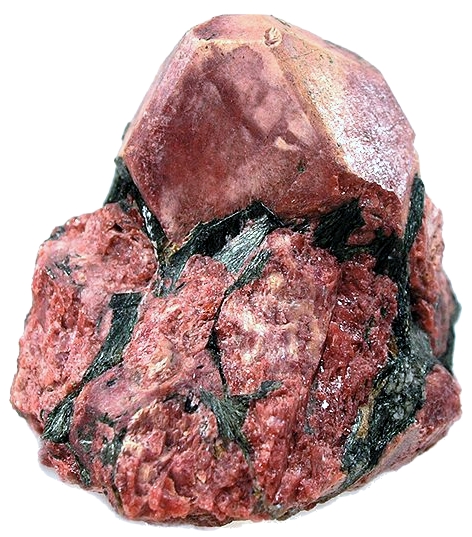
Photo: Wikimedia Commons

Photo: Wikimedia Commons
Search for specimens: View all specimens from Murmansk Oblast, Russia
Murmansk Oblast’s collector minerals come principally from the Kola alkaline province, where Paleozoic intrusions cut older Archean and Proterozoic rocks of the Fennoscandian Shield. The Khibiny massif is a large, multiphase alkaline intrusion dominated by nepheline syenitic rocks and related urtites, foyaites, rischorrites, ijolites, and apatite-nepheline ores. Its industrial ore bodies occur around the arcuate Khibiny structure and include famous mining areas such as Kukisvumchorr, Yukspor, Rasvumchorr, Apatitovy Tsirk, Koashva, Nyorkpakhk, and related deposits. The collector material is not simply “apatite ore”; it is largely the late pegmatitic and hydrothermal mineralization cutting or associated with these alkaline rocks, especially in mountain localities such as Eveslogchorr, Yukspor, Kukisvumchorr, and Rasvumchorr, and in mine exposures where fresh rock revealed species otherwise locked in inaccessible cliffs.
Lovozero is geologically different in texture and architecture. It is a layered alkaline laccolith, commonly described in terms of its Layered, Eudialyte, and Poikilitic complexes. The Layered complex is built of repeated lujavrite–foyaite–urtite rhythms; the Eudialyte complex occupies the upper part of the massif and contains eudialyte-rich lujavrites; the Poikilitic complex consists of feldspathoid syenites that host many pegmatites and replacement bodies. Collector localities include Karnasurt Mountain, Kedykverpakhk Mountain, Alluaiv Mountain and the Umbozero mine area, Selsurt Mountain, Sengischorr, Engporr, Suoluaiv, and the Seidozero-area pegmatites. The Shkatulka, Sirenevaya, Palitra, Yubileinaya, Natrolite Stock, and numbered pegmatites are names that matter on old Russian labels and in specialist collections.
The ore history is divided between industrial mining and scientific collecting. In Khibiny, the Apatit enterprise was founded in 1929 and became the dominant producer of apatite-nepheline ore in the district. Today the Kirovsk branch of Apatit, part of PhosAgro, works multiple Khibiny fields by underground and open-pit methods, with the Kirovsky mine developing the Kukisvumchorr and Yukspor deposits and newer production focused increasingly on underground levels as older horizons are depleted. In Lovozero, loparite ore has been mined principally from the Karnasurt area, with underground workings associated with the Lovozersky mining operation. Kovdor, in the southwestern oblast, is a separate carbonatite-phoscorite mining district known for magnetite, apatite, baddeleyite, and phlogopite-vermiculite resources.
For field collectors, Murmansk Oblast is not a casual roadside locality. Active mines are controlled industrial sites; underground workings, open pits, dumps, and quarries require permission from operators and can be dangerous or legally closed. Parts of the Khibiny and Lovozero mountain areas are within or adjacent to protected landscapes, including Khibiny National Park, created to protect mountain tundra, northern taiga, and cultural and geological heritage. Russian regulations also treat the collection and export of mineralogical collection material as a controlled activity in specified circumstances. In practical collector terms, modern specimens on the international market usually come from older stocks, authorized collecting, mine-associated recoveries, Russian collections dispersed through dealers, or estate material that left the region years ago.
The notable specimen finds are closely tied to pegmatites and veins rather than bulk ore. Eveslogchorr’s Astrophyllite Stream area yielded the emblematic bronze astrophyllite fans with aegirine, aenigmatite, albite, natrolite, eudialyte, and wadeite. The Shkatulka pegmatite at the Umbozero mine is one of the best-known Lovozero sources of eudialyte and associated rare minerals. Karnasurt and Kedykverpakhk are important for eudialyte-group minerals, loparite, lomonosovite, murmanite, natrolite, ussingite, and many rare Zr-Ti-Nb silicates. Kovdor’s collector pieces tend to be heavier and more carbonatite-like: magnetite-rich, apatite-bearing, baddeleyite-bearing, phlogopitic, or dolomitic, with rarities more often appreciated under magnification than across a show table.
Murmansk Oblast eudialyte is collector shorthand for the red heart of the Kola alkaline province, but the best labels separate Khibiny from Lovozero. Lovozero provides the great eudialyte-rich lujavrites and many pegmatitic specimens, especially from Alluaiv, Karnasurt, Kedykverpakhk, Umbozero, Shkatulka, Sirenevaya, and Palitra material, where cherry-red to raspberry, brownish-red, or pink eudialyte occurs as grains, massive patches, crude crystals, and locally well-exposed crystals with aegirine, albite, natrolite, lomonosovite, murmanite, lamprophyllite, sodalite, terskite, and other rare sodium silicates. Khibiny specimens are less an “ore rock” category and more a sharp-crystal collector category: a good piece shows saturated red color, a distinct exposed crystal rather than a sawn decorative mass, and a strong contrast against black aegirine or pale feldspathoid matrix; ordinary pieces are dull, fractured, granular, or simply red patches in syenite without crystal definition.
Astrophyllite from Murmansk Oblast is most prized from the Khibiny Massif, especially Eveslogchorr Mountain and the Astrophyllite Stream area, where bronze to golden-brown metallic blades form radiating suns, sheaves, rosettes, and broad foil-like aggregates in albite, natrolite, orthoclase, nepheline, and feldspathoid-rich matrix. Associated minerals include black aegirine, aenigmatite, eudialyte, wadeite, fluorapatite, paraumbite, leucophanite, microcline, and altered feldspathoids; the finest pieces show a complete fan or sunburst with strong luster and minimal crushing, while lesser examples are simply brown micaceous streaks in pale matrix or loose cleaved plates. Large Eveslogchorr aggregates can be dramatically cabinet-sized, but the serious value lies in intact sprays with a clear center, undamaged blade terminations, bright bronze flash, and a label specific enough to distinguish Eveslogchorr from broader “Khibiny” or vague “Kola Peninsula” material.
Beyond eudialyte and astrophyllite, Murmansk Oblast is a type-locality engine. Lovozero and Khibiny have produced a long list of first-described species and rare collector minerals, including lomonosovite, murmanite, lovozerite, vlasovite, loparite-(Ce), fersmanite, yuksporite, eveslogite, arctite, chivruaiite, ikranite, raslakite, dualite, voronkovite, selsurtite, ferronordite-(Ce), ferronordite-(La), and many members or relatives of the eudialyte, labuntsovite, astrophyllite, and seidozerite groups. Kovdor contributes a separate suite of type and rare minerals tied to phoscorite-carbonatite evolution, including kovdorskite, juonniite, yonaite, pakhomovskyite, gladiusite, pyrochlore-supergroup minerals, baddeleyite, magnetite, apatite, forsterite, phlogopite, dolomite, calcite, and scandium-bearing phases. For micromounters, Murmansk is less a single locality than a lifetime specialty.
Murmansk labels need scrutiny. “Kola Peninsula” is a broad regional label, not a locality; “Khibiny” and “Lovozero” are better, but serious specimens deserve a mountain, mine, quarry, pegmatite, or vein name when that information is known. Astrophyllite from Eveslogchorr, eudialyte from Lovozero’s named pegmatites, and rare minerals from Karnasurt or Umbozero carry far more locality value than generic Russian material. Old transliterations vary widely: Khibiny may appear as Khibina or Chibiny; Lovozero as Lovozer, Lujavrurt, Lujaur-Urt, or Lovozerskiye Tundry; Eveslogchorr may be rendered Evesloggchor, Eweslogtschorr, or similar forms. These spelling differences are normal, but a vague label should not be upgraded without evidence.
Mislabelling is more common than deliberate fakery. Massive red eudialyte-bearing syenite is sometimes sold simply as “eudialyte,” “Russian eudialyte,” or decorative “eudialite,” with no distinction between true crystals, eudialyte-group minerals, and red eudialyte-rich rock. Dense red patches can be confused by non-specialist sellers with garnet, rhodonite, or other pink-red silicates when the matrix is not recognizably alkaline. Conversely, some attractive astrophyllite-bearing ornamental stones are marketed under loose names such as “fireworks stone” or with incorrect associated species; genuine Eveslogchorr material usually shows bronze blades with a Khibiny assemblage of albite, aegirine, aenigmatite, eudialyte, natrolite, or feldspathoids rather than the amphibole-rich look of unrelated “arfvedsonite” trade stones.
Condition matters greatly. Eudialyte from Kola can be brittle, fractured, altered, or matte; chips along exposed crystal faces are common, and polished or sawn material should not be valued like a crystallized specimen. Astrophyllite has perfect cleavage and flakes easily, so even fine-looking fans may have bruised blade edges, missing plates, or glue-stabilized areas if they have been handled roughly. Aenigmatite and aegirine sprays can be sharp but fragile. Natrolite, albite, and feldspathoid matrices may be granular or crumbly, especially around weathered pegmatite material.
Handling is straightforward for most specimens, but a few Kola minerals require extra caution. Villiaumite, known from hyperagpaitic Lovozero and Khibiny assemblages, is sodium fluoride and should be kept dry, not washed, and handled with common-sense hygiene. Some eudialyte-group and REE-bearing specimens may show low radioactivity from trace uranium or thorium; this is generally a storage and labeling consideration rather than a display problem for ordinary small specimens, but rare-metal micromount collections should be kept organized, dust-free, and away from unnecessary abrasion. Fluorescence can occur in associated sodalite or hackmanite from alkaline pegmatites, and red eudialyte specimens with sodalite-bearing matrix are worth checking under longwave and shortwave UV.
Market availability is uneven. Common eudialyte-bearing rock from Kola remains available, especially as slabs, tumbled pieces, and inexpensive chunks, but sharp, well-exposed Khibiny crystals or named Lovozero pegmatite specimens are much scarcer. Eveslogchorr astrophyllite is still seen in collector circulation, yet the best old pieces with broad, intact bronze fans and strong locality data command a premium. Rare Lovozero and Khibiny species are often micromounts, analytical fragments, or older Russian dealer material; for these, provenance and identification are more important than size.
The great Khibiny story begins not with a mine but with exhausted geologists and greenish blocks on a northern mountainside. In the early 1920s, Fersman’s expeditions pushed into country that was still difficult enough for boots, food, and transport to shape the science. During the 1922 field season, Alexander Labuntsov joined Fersman’s Khibiny expedition. In 57 days, the party covered about a thousand kilometers and collected roughly 1,500 kilograms of rocks and minerals. Their provisions were remembered in almost domestic detail — cocoa, chocolate, canned meat — but footwear remained a serious problem, the sort of mundane weakness that can decide whether a geological idea becomes a mapped deposit.
In 1926, Labuntsov examined the Rasvumchorr plateau and recognized that the scattered apatite-nepheline boulders were not just float. Beneath them lay bedrock mineralization over an area reported at about 10,000 square meters. The find was risky enough that Labuntsov later described choosing a more reliable block and fastening a rope to it before continuing. His line has the chill of the Khibiny cliffs in it: “If I had fallen then, they wouldn’t have found my bones.” He telegraphed the discovery to the Academy of Sciences, to Fersman, to the geologist Shcherbakov, and to the Arctic Institute. A verification commission arrived in September 1926, examined the district, and confirmed the discovery.
The first extraction was almost symbolic. In November 1926, agronomist Johann Eichfeld, together with German Kreps and Pyotr Semerov, organized the removal of 100 poods of apatite-nepheline ore from Rasvumchorr by reindeer to the railway. Before that, the mountains had supplied mineralogical specimens; now they were beginning to supply industrial raw material. In 1927, Labuntsov’s group surveyed Kukisvumchorr in detail, climbed Yukspor, and found another rich apatite deposit. Early reserve figures were reported at 11 million tonnes for Kukisvumchorr and 4 million tonnes for Yukspor — numbers that, in the language of the time, transformed a difficult Arctic mineral locality into the first major mining district of the Murmansk region.
Eveslogchorr has its own collector romance. The Astrophyllite Stream area is not simply a name on labels; it is a route through a mineralized mountain slope, with old veins, talus, and pegmatite exposures marking the places where the Khibiny’s rare-element fluids froze into specimens. One described route begins near the Vuonnemijok stream, where a pegmatite vein in rischorrites sits about 17 meters above the stream bed and can be recognized by talus of large feldspar blocks. Higher on the west side of Astrophyllite Stream, a wadeite-bearing pegmatite about 2 meters thick shows zoning from aegirine-rich margins with altered crystalline eudialyte into blocky feldspar and nepheline. In the axial zone, bright blue and white radial natrolite is penetrated by astrophyllite, and wadeite appears as pink hexagonal crystals lining small cavities or replacing eudialyte. Most are only 1–2 mm, but rare crystals to about 2 cm are the kind of find a Khibiny collector would remember for life.