






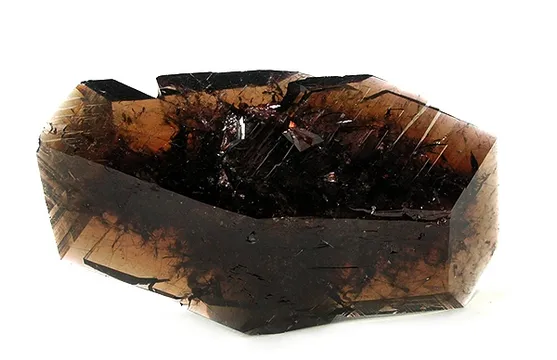
Dodo Mine, Russia - Alpine-cleft quartz locality in the Subpolar Urals, yielding rock crystal, smoky quartz, axinite and titanite; prized by collectors.
Key facts
Dodo is one of the great Alpine-cleft quartz localities outside the European Alps: a Subpolar Ural rock-crystal deposit whose best specimens have the glass, twist, and poised architecture that collectors normally associate with Switzerland, the Mont Blanc massif, or the Dauphiné. The mine lies near Saranpaul in the Berezovo district of Khanty-Mansi Autonomous Okrug, on the eastern slope of the Subpolar Urals, in the Neroika crystal-bearing belt. Its collecting fame rests on steep hydrothermal quartz veins and clefts developed in greenschist-facies metasedimentary and metavolcanic rocks of the Puiva Suite, cut and locally controlled by dikes. In those open spaces Dodo produced rock crystal, smoky quartz, gwindels, lustrous clove-brown axinite, brown to greenish-brown titanite, anatase, brookite, rutile, ilmenite, calcite, chlorite, mica, and a suite of small but mineralogically important rare species.
For collectors, the locality matters because it joins two usually separate worlds: industrial high-purity quartz and cabinet-quality Alpine-cleft mineralogy. Dodo quartz was not just attractive; it was sufficiently clean to be treated as a strategic source of vein quartz and rock crystal for high-purity quartz concentrate. At the same time, the clefts yielded specimens with a very different value system: transparent smoky gwindels with dramatic twisting, doubly terminated quartz crystals, titanite V-twins set on quartz or mica-rich schist, glassy axinite floaters, and Ti-oxide accessories perched on or enclosed in quartz. The best pieces have a cold, northern look—bright faces, pale to medium smoky tones, green chloritic inclusions, and sharply contrasting brown titanite or axinite.
Regional View
Country View
Dodo’s classic collecting period is generally associated with the late Soviet and early post-Soviet decades, especially the 1980s and early 1990s, when significant Alpine-cleft material entered Western collections. Many superior specimens on today’s market are old pieces with 1990s export histories or collection pedigrees; fresh material of comparable quality is scarce. The locality is sometimes grouped in trade labels with nearby Puiva and Neroika-area finds, so a serious Dodo specimen should be judged not only by its beauty but also by the quality of its label history.
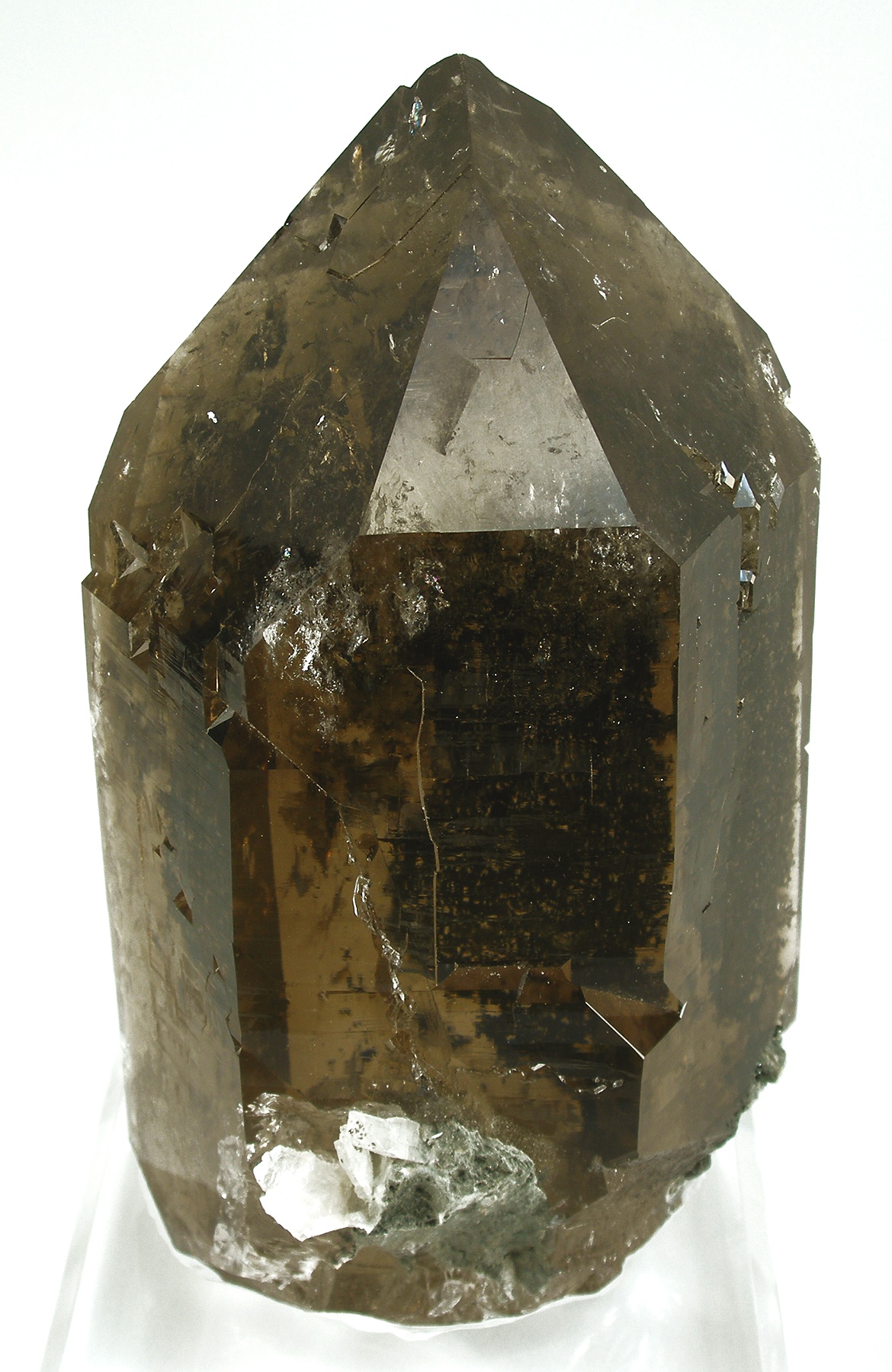
Photo: Wikimedia Commons
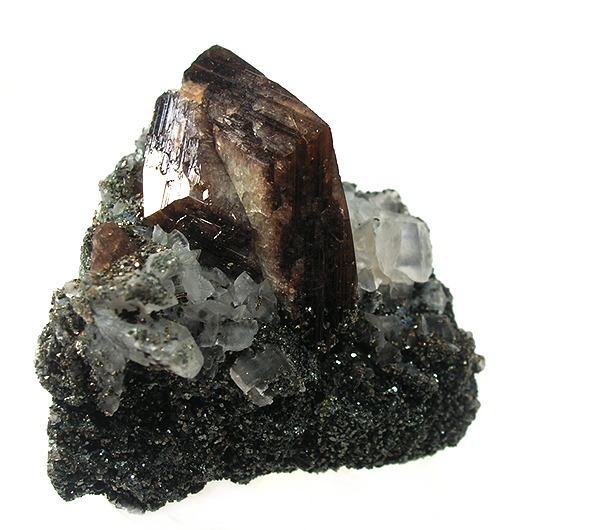
Photo: Wikimedia Commons
Search for specimens: View all specimens from Dodo Mine, Russia
Dodo is a hydrothermal, Alpine-cleft-style quartz-vein deposit in the central part of the Neroika crystal-bearing belt of the Subpolar Urals. Russian geological summaries place it in the basin of the Shchekurya River, near the village of Saranpaul and the Neroika area, within a second-order anticlinal structure on the eastern slope of the Urals. The enclosing rocks are dislocated, greenschist-facies, Middle Riphean volcanogenic-sedimentary rocks of the Puiva Suite—chiefly quartz-sericite, quartz-sericite-chlorite phyllitic schists, and quartzites. The structure is associated with the lower side of the Neroika-Patok granitoid massif and is complicated by numerous dikes of intermediate, acidic, and basic composition.
The productive bodies are not metal ore veins in the usual sense, but steeply dipping, nominally barren quartz veins grouped into vein zones. Reported vein dimensions are commonly 20–30 to 70–100 m along strike, down-dip persistence to about 35 m, and thicknesses from roughly 2–3 m to 10–15 m. The veins are composed overwhelmingly of transparent metamorphosed and translucent recrystallized quartz—more than 95% in published Russian descriptions—with small amounts of associated chlorite, sericite, muscovite, biotite, calcite, apatite, ilmenite, titanite, and related accessory minerals. Xenoliths of the host rocks may occur within the recrystallized quartz, and these inclusions, together with chlorite and oxide minerals, give many Dodo specimens their distinctive internal “landscape” character.
The specimen-producing clefts are the key to Dodo’s collector importance. Crystal-bearing pockets are linked to quartz veins, mineralized fractures, and crushed zones. Russian descriptions give pocket forms as wedge-shaped, lens-like, pipe-like, or roughly equant, with dimensions from about 1 to 40 m along strike, down-dip extent to 16 m, and thickness from 0.3 to 5 m. The richest crystal production came from large and very large cavities, exactly the scale one would expect for the large rock crystal, gwindel quartz, and associated Alpine-cleft minerals for which Dodo became famous.
Modern geochronological work on Dodo and Puiva quartz-crystal deposits gives a Permian age for the quartz-crystal mineralization, with 40Ar/39Ar mica dates averaging about 255 ± 2 Ma. The same work estimated metasomatite formation temperatures of about 339–364°C and interpreted the deposits in the context of post-orogenic extension of the Urals, uplift of crustal blocks, and a sharp drop in fluid pressure at depth. For collectors, that model explains the Alpine-cleft character very well: open-space growth, rapid pressure-temperature changes, and clean quartz-dominated fluids capable of growing large, transparent crystals.
The discovery history is reported in more than one way. Russian popular and locality summaries commonly credit A. N. Aleshkov with discovery in 1923. A later mineralogical paper describes the deposit as opened in 1934 by an Academy of Sciences expedition led by A. N. Aleshkov. Both dates appear in the Russian literature, and the discrepancy likely reflects different stages of recognition, exploration, or formal study rather than a meaningful disagreement about Aleshkov’s central role.
Dodo later became part of the industrial high-purity quartz story in Khanty-Mansi Autonomous Okrug. OAO/AO “Polyarny Kvarts” has been cited as the operator or license holder for the Neroika group of quartz deposits, including Dodo, Nester-Shor, and Khus-Oika. Project descriptions from the 2000s and 2010s describe mining and beneficiation of quartz raw material, with primary processing at Ust-Puiva and further processing in Nyagan for high-purity quartz concentrate used in optical, lighting, electronic, chemical, and semiconductor-related industries. Published project figures refer to annual extraction on the order of 18,000–20,000 tonnes of quartz raw material for concentrate production, although collectors should not confuse industrial quarrying or underground development with routine specimen access.
Collecting access today should be considered restricted and uncertain. Dodo is remote, industrially significant, and tied to licensed quartz extraction rather than casual field collecting. The classic market supply is dominated by older specimens, not by steady modern production. Serious collectors should expect to acquire Dodo pieces through established dealers, old collections, or occasional estate and auction offerings, and should favor specimens with old Russian, European, or American collection labels.
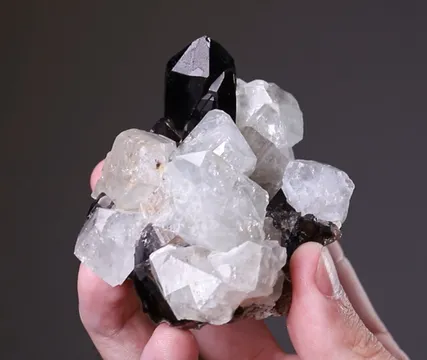
Quartz is the identity mineral of Dodo: clear rock crystal, slightly smoky crystals, doubly terminated groups, and especially gwindels from Alpine-style clefts in the quartz veins. The best Dodo quartz is bright and glassy, often water-clear to pale smoky, with sharp terminations, lightly frosted faces on some examples, and chlorite inclusions or “worms” that tie the pieces visually to their schistose host environment. Good cabinet specimens may reach the 8–13 cm range as gwindel groups, while exceptional old pieces include large smoky crystals such as an 18 x 9 x 8 cm, roughly 2 kg gem crystal attributed to the 1980s heyday. Ordinary Dodo quartz can be merely clean rock crystal, but the collector-grade pieces are those with dramatic twist, complete terminations, fine luster, aesthetic matrix placement, or attractive associations with titanite, anatase, brookite, calcite, chlorite, or mica.
Axinite from the Dodo field is best known as thin, sharp, lustrous brown to clove-brown crystals and floaters, usually in thumbnail to miniature sizes and occasionally on matrix. The best examples show the classic axinite blade form with glassy faces, transparency at the edges, rich smoky-brown color, and minimal edge wear—condition is crucial because the thin bladed crystals chip easily. Several Dodo-labeled axinites in the market trace to the 1980s and 1990s Alpine-cleft finds, and some have old collection pedigrees; however, collectors should be alert to the broader Saranpaul/Neroika labeling problem, because nearby Puiva is especially famous for world-class ferroaxinite, and Dodo, Puiva, and regional labels have sometimes been loosely combined in commerce.
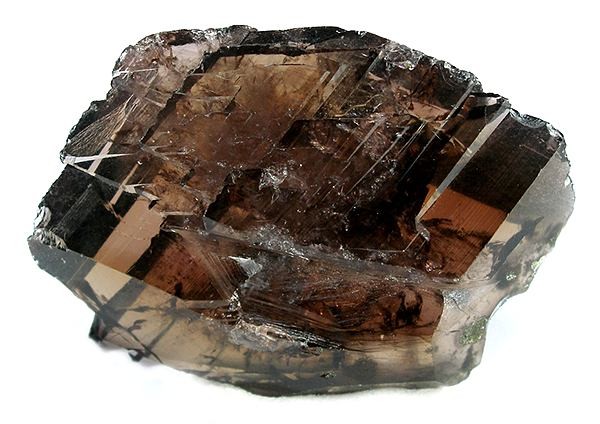
Photo: Wikimedia Commons
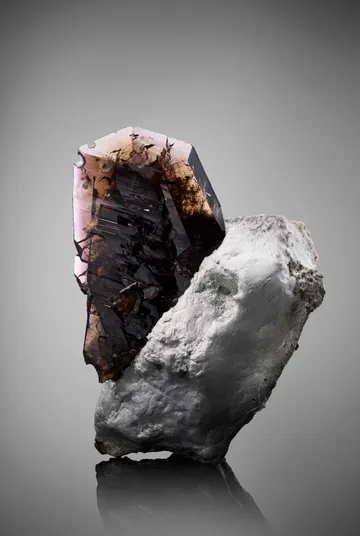
Titanite is one of Dodo’s signature Alpine-cleft species, occurring as sharp wedge-shaped crystals, lustrous brown to greenish- or yellowish-brown individuals, and highly collectible V-twins on quartz, smoky quartz gwindel, calcite, mica, or quartz-sericite-chlorite schist. Fine miniature crystals around 2–3 cm are well represented in old collections, while literature and index references record exceptional Dodo titanite crystals and twins far larger, with cited sizes reaching roughly 15–16 cm. The best titanites are sharply formed, lustrous, undamaged, and aesthetically isolated on contrasting matrix; ordinary examples are more embedded, dulled by chlorite or mica, or show the edge bruising common to brittle Alpine-cleft titanite.
Dodo smoky quartz is most prized in gwindel form: transparent, subtly gray to medium smoky crystals with a visible twist, often rising from or perched on more ordinary upright quartz. The locality’s best smoky gwindels are compared in the trade to Swiss Alpine examples because of their gemminess, brightness, and dramatic twisting style; one documented cabinet specimen measured 11 x 11 x 5.5 cm and showed an estimated 15–20 degrees of twist, while other recorded gwindels fall around 55–60 mm, 8.3 cm, 12 cm, and 13 cm. Strong Dodo smoky quartz should be transparent rather than muddy, complete on both ends if a floater, lively in luster, and preferably accompanied by quartz matrix, chlorite inclusions, anatase, brookite, calcite, or titanite; excessively contacted bases, chipped termination edges, and vague regional labels are the main drawbacks.
Beyond these four headline species, Dodo has a much richer Alpine-cleft suite than many collectors realize. Anatase occurs as sharp, striated, translucent crystals on quartz and smoky gwindels, with documented examples to about 1 cm. Brookite from Dodo is a serious rarity, occurring as brownish-red to clove-brown blades on quartz or calcite; published collecting notes and newsletter references describe fine crystals to several centimeters, and market examples commonly show brookite blades in the 1–2 cm range. Rutile, ilmenite, and other Ti oxides occur as inclusions or crystals in the clefts, with ilmenite described as lustrous thin tabular crystals to about 4 cm. Calcite is a recurring but less common matrix and pocket mineral, sometimes forming rosettes beside titanite. Rare and small species reported from Dodo include kainosite-(Y), allanite-(Ce), monazite-(Ce), xenotime-(Y), ancylite-(Ce), calcioancylite-(Ce), parisite-(Ce), cosalite, clinozoisite, epidote-group minerals, apatite, apophyllite-group minerals, sulfides such as galena, sphalerite, chalcopyrite, pyrite, and tetrahedrite-group minerals, plus chlorite, muscovite, biotite, albite, adularia, and other low-temperature cleft accessories.
The main authenticity problem with Dodo specimens is not widespread fakery, but locality discipline. Dodo, Puiva, Neroika, Saranpaul, “Polar Urals,” “Prepolar Urals,” and older Tyumenskaya Oblast or Western-Siberian Region labels have all appeared in commerce, sometimes with imprecise or overlapping usage. This matters most for axinite and gwindel quartz: Puiva is especially celebrated for ferroaxinite, while Dodo is a classic source of smoky gwindels, titanite, Ti oxides, and quartz combinations. A specimen labeled simply “Dodo/Puiva” or “Saranpaul” may be perfectly legitimate as a regional piece, but it should not command the same confidence as one with a precise old label, publication history, collection pedigree, or matched photograph.
Condition is a major value driver. Quartz and smoky quartz should be checked carefully for chipped terminations, bruised gwindel ridges, rehealed contacts mistaken for damage, and hidden repairs at the base. Dodo gwindels often have some contact where they grew against the cleft wall or quartz matrix; that is acceptable when the display face, twist, and terminations are strong. Titanite and axinite are more vulnerable. Titanite edges bruise easily, and axinite blades commonly show small dings around the perimeter; a fine Dodo axinite with sharp, glassy edges is much scarcer than a simply representative one.
No Dodo-specific, well-documented treatment problem is prominent in the collector literature consulted. Smoky quartz in general can be artificially irradiated, but the classic Dodo material is valued for natural Alpine-cleft form, not for extremely dark color. In fact, many desirable Dodo smokies are pale to medium smoky rather than black. Be cautious of unnaturally dark loose crystals without matrix or provenance, but do not assume treatment solely from smoky color.
Fluorescence is not a major selling point for the classic Dodo suite. Handling concerns are practical: keep axinite and titanite away from hard quartz points in the same box, avoid ultrasonic cleaning of composite pieces, and use mechanical cleaning conservatively where chlorite, mica, calcite, or small accessory crystals are present. Brookite, anatase, rutile, and ilmenite on quartz can be minute but important; aggressive cleaning may remove the very features that make the specimen a Dodo locality piece.
Market availability is limited. Representative quartz and smoky quartz appear periodically, but highly aesthetic gwindels, titanite-on-gwindel combinations, good axinite floaters, and brookite-on-quartz specimens are scarce. Auction records and dealer descriptions repeatedly point to the 1980s–early 1990s as the classic production window, and notable pieces often carry old names such as Herb Obodda, Richard Kosnar, Charlie Key, Bob Lauf, Lloyd Tate, or European dealer histories. Expect to pay a premium for clean provenance, an undamaged twist, and a specimen that looks unmistakably Alpine rather than merely “quartz from Russia.”
One of the best Dodo stories is a specimen story: an 18 x 9 x 8 cm smoky quartz crystal weighing about two kilograms, described from the 1980s heyday as a gem crystal of Alpine smoky quartz quality. Its history reads like the route by which many great Russian specimens entered Western cabinets after the Soviet period. The piece was exported from Russia by dealer Daniel Trinchillo in the 1990s, then acquired by his father before it ever reached the open market. Instead of disappearing into stock, it became a quartz collector’s quartz—large, bright, complete all around except for contact at the lower base, and mounted on a custom lucite base. It is the kind of Dodo specimen that explains why collectors compare the locality not to ordinary vein-quartz mines, but to the Alps.
Another memorable Dodo piece passed through the Richard Kosnar collection: an 11 x 11 x 5.5 cm smoky quartz gwindel on quartz matrix, purchased in Russia by Brad and Star van Scriver and traded to Kosnar in the early 1990s. The gwindel was described as having an estimated 15–20 degrees of twist, with gem-clear smoky quartz rising from a paler quartz base. That detail—the smoky twisted crown perched on ordinary upright quartz—is exactly what makes Dodo gwindels so desirable. After Kosnar’s death, the specimen carried a collection valuation of $8,500 and later sold in a benefit auction for $3,050, a reminder that even in a softer market, the best Dodo gwindels remain serious objects.
The Dr. Bob Lauf titanite-on-smoky-gwindel specimen adds another layer: a 5.6 x 4.3 x 2.7 cm small cabinet piece with a brown V-twinned titanite set on smoky quartz gwindel and a little gray schist on the back. It was not just another attractive combination; it had been pictured in the Russian magazine World of Stones in 1996 and later in Lauf’s own collector literature on silicates. When it came to auction from his collection, the description noted that such pieces came out in the 1980s–1990s and had become “almost never seen for sale today.” That phrase captures the modern Dodo market better than any price guide: the mine is famous, the best pieces are known, and most of them are already in cabinets.


-163269.jpg)