Miass, Russia — Ilmen Mountains pegmatites yield blue to grey-blue corundum and historic specimens; a protected locality with limited collecting.
Key facts
Miass matters to mineral collectors because the city sits at the western foot of the Ilmen Mountains, one of the classic mineral provinces of the Urals and the namesake district for a remarkable suite of alkaline-rock pegmatites. The collecting identity of Miass is inseparable from the Ilmenogorsky complex: a densely mineralized assemblage of granitic, miaskitic, and syenitic pegmatites emplaced into older metamorphic and plutonic rocks on the eastern side of the Southern Urals. These pegmatites are famous not merely for species count, but for the caliber of their historic specimens—amazonite, topaz, beryl, phenakite, zircon, ilmenite, samarskite, aeschynite, monazite, cancrinite, and, for the present guide, blue to grey-blue corundum in feldspar-rich syenitic and miaskitic pegmatites.
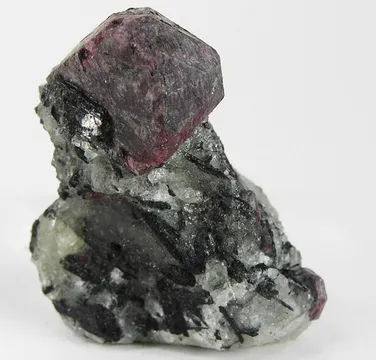
For corundum collectors, Miass is a primary sapphire locality rather than just a placer name. The best-known Ilmen corundums occur as blue, grey-blue, or zoned sapphire-like crystals and megacrysts enclosed in pale feldspar-rich matrix, commonly with muscovite, columbite-group minerals, zircon, ilmenite needles, diaspore, and rare-earth accessory minerals. The finest pieces have the severe, old-Ural look: dark blue hexagonal or flattened prismatic corundum set into cream to buff feldspar, sometimes showing blue rims, brownish cores, parting, or asterism, and often more valued as mineral specimens than as cutting rough.
Historically, the district is one of the monuments of Russian mineralogy. Miaskite takes its name from Miass; ilmenite takes its name from the Ilmen Mountains; and the Ilmen Mountains are credited with the discovery of a long list of minerals that later became worldwide species names. In 1920 the area was protected as a State Mineralogical Reserve, and today the best-known corundum occurrences lie inside a strict reserve where commercial collecting is forbidden. That legal and historical fact is central to how specimens should be understood: older pieces, museum specimens, and documented research material carry particular weight, while modern “fresh” offerings require careful provenance.
Regional View
Country View
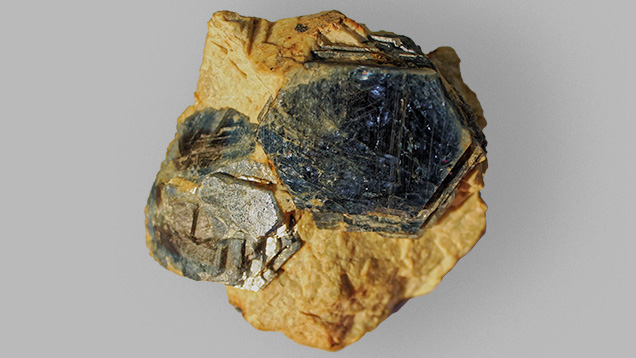
Photo: GIA, Gems & Gemology
The locality’s scientific importance is unusually high for a collector district. Modern work on Ilmen sapphires has treated the corundum-bearing syenite pegmatites as records of Uralian collision and post-collisional evolution, with zircon geochronology tying some sapphire-bearing pegmatites to Permian tectonism. That gives Miass corundum a double appeal: it is a handsome cabinet mineral from a classic pegmatite province, and it is also an unusually well-studied sapphire occurrence whose inclusions, trace chemistry, and isotopic signatures have been used to discuss the geological assembly of the Urals.
Search for specimens: View all specimens from Miass, Russia
The mineral locality “Miass” in specimen commerce normally refers to the Ilmen Mountains and adjacent Ilmen State Reserve area north and east of the city of Miass, Chelyabinsk Oblast, Southern Urals. The geology is dominated by the Ilmenogorsky complex, a heterogeneous association of metamorphic rocks, granitoids, ultramafic bodies, syenites, nepheline syenites, fenites, carbonatite-related rocks, and numerous pegmatites. The pegmatites are the core of the locality’s fame. They include granitic pegmatites, nepheline-bearing miaskitic pegmatites, quartz- and nepheline-free syenitic feldspar pegmatites, corundum-feldspathic pegmatites, and amazonite pegmatites.
The corundum-bearing bodies belong chiefly to late alkaline pegmatitic activity in syenitic and miaskitic settings. In the Ilmen Mountains, the sapphire-bearing syenite pegmatites are reported mainly along the western slope of the range, roughly 10–15 km north of Miass. They are not broad ore deposits in the modern mining sense, but individual veins, lenses, plates, and old open workings identified by pit or mine numbers—most notably 298, 299, 311, 345 or 349 in the modern corundum literature, with additional work on no. 210 and no. 418. The host assemblage is feldspar-dominant, commonly K-Na feldspar and perthite, with muscovite, biotite or annite in some occurrences, columbite-(Fe), zircon, ilmenite, diaspore, monazite, pyrochlore, samarskite, aeschynite, spinel, garnet, chrysoberyl, and other accessory minerals depending on the pegmatite type and internal zone.
The ore and specimen mineralization is best imagined as a set of chemically specialized pegmatite systems rather than a single vein. The miaskitic pegmatites, in which nepheline is dominant, are noted for cavities containing large and well-formed accessory crystals such as cancrinite, sodalite, vishnevite, ilmenite, magnetite, zircon, pyrochlore, aeschynite, columbite, and apatite. The corundum-feldspathic pegmatites are simpler lens- or plate-like bodies, sometimes visibly zoned, in which corundum may be abundant enough to have been worked historically as abrasive material. In these corundum pegmatites, specimen interest depends on crystal size, color zoning, contrast against feldspar, and the survival of crystal form after deformation and parting.
Mine no. 298 is the best-known corundum occurrence in the recent literature. It has yielded blue sapphire crystals in feldspar matrix, transparent to translucent material, and unusually large flat prismatic zoned crystals. Research and museum examples document dark to grey-blue crystals, blue rims with brown cores, and corundum associated with K-Na feldspar, columbite-group minerals, zircon, muscovite, diaspore, ilmenite needles, and rare uraninite or monazite inclusions. No. 299 is also significant, especially for flattened and tabular corundum crystals and contact twins in feldspar-rich rock. Mine no. 210 is mineralogically distinctive because its miaskite pegmatite contains abundant sapphire-like corundum in all pegmatite zones, together with Th-bearing minerals and alteration products such as cancrinite and sodalite. Mine no. 418 has been studied for inclusions in corundum.
Mining in the modern commercial sense is not active in the protected Ilmen localities. Before reserve protection, parts of the Ilmen Mountains were worked for collectors’ minerals, gem material, amazonite, topaz, beryl, phenakite, and in some corundum bodies for abrasive material. The 19th century was the great period of commercial and descriptive exploration; the 20th century shifted the area increasingly toward scientific study and museum collecting. The decisive break came on May 14, 1920, when the Ilmen Mountains near Miass were declared a State Mineralogical Reserve. In 1935–1936 the reserve regime was strengthened as the area became a broader natural reserve, and the rules ultimately prohibited mining and casual mineral collecting. Today, collecting inside the reserve requires official permission and is essentially scientific or educational, not commercial.
For collectors, that means most legitimate market specimens should be old material, historic museum duplicates, pre-reserve pieces, or specimens with a clear chain of ownership from Russian collections. Labels may read “Miass,” “Miask,” “Ilmen Mountains,” “Ilmeny,” “Ilmen State Reserve,” or a specific pit number. The most valuable labels are those that identify the pit—especially no. 298, 299, 210, or 418—and state whether the piece came from a syenite pegmatite, miaskite pegmatite, or feldspathic pegmatite. Unspecific “Ural sapphire” labels should be treated cautiously, because the Southern Urals contain other corundum occurrences outside the Ilmen Mountains.
Corundum from Miass is best known as blue to grey-blue, sapphire-like material from Ilmen syenite and miaskite pegmatites, usually embedded in pale feldspar rather than occurring as loose alluvial pebbles. The characteristic habits are flattened prismatic, tabular, pseudohexagonal, and locally zoned crystals; mine no. 298 is especially noted for transparent to translucent blue megacrysts and blue-rimmed, brown-cored crystals, while no. 299 is known for tabular and twinned corundum in feldspathic rock. Published research on no. 298, 299, 311, and 345/349 records crystals and megacrysts up to about 6 cm in studied material, while Russian museum and collector records document larger embedded or split crystals from older finds. Associations that matter diagnostically include K-Na feldspar, perthite, muscovite or annite, columbite-(Fe), zircon, diaspore, ilmenite needles, monazite, and locally spinel; good specimens show distinct crystal form, strong blue color or zoning, clean contrast against feldspar, and a locality-specific pegmatitic context, whereas ordinary pieces are often blocky, dark, fractured corundum masses with little crystal definition.
Miass is also one of the great names for rare-element mineralogy. The Ilmen Mountains are credited with discoveries or type-locality status for such minerals as ilmenite, aeschynite-(Ce), monazite-(Ce), cancrinite, chevkinite-(Ce), chiolite, samarskite-(Y), ilmenorutile, fergusonite-beta-(Ce), ushkovite, svyazhinite, makarochkinite, fluororichterite, fluor-magnesioarfvedsonite, potassic-sadanagaite or potassic-ferrisadanagaite, polyakovite-(Ce), potassic-magnesiohastingsite, and ferriwinchite. For cabinet collectors the great classics beyond corundum are ilmenite crystals, amazonite microcline, zircon, cancrinite in miaskite, monazite, samarskite, aeschynite, columbite, pyrochlore, topaz, beryl including aquamarine, phenakite, and the mica-rich pegmatite material historically described from the Ilmen workings.
The first authenticity issue with Miass specimens is locality precision. A label reading simply “Miass” may be perfectly traditional, but it can hide several possibilities: an Ilmen Mountains specimen, a specific numbered reserve pit, material from the broader Miass-Zlatoust district, or unrelated Ural corundum generalized by a dealer. For corundum, the strongest labels mention Ilmen Mountains or Ilmeny, a pit number such as 298 or 299, and a matrix of feldspar-rich syenite or miaskite pegmatite. Labels using “sapphire” should not be assumed to mean facetable gem rough; much Ilmen sapphire is specimen-grade, fractured, parted, or suitable only for very small stones.
The second issue is legality and provenance. The key corundum localities lie within the Ilmen State Reserve, where commercial exploitation is forbidden and collecting requires reserve permission. Newly mined-looking specimens without older labels, collection history, or research provenance deserve scrutiny. This does not mean all market material is suspect—older specimens from Russian and European collections do circulate—but a good Miass piece should be sold with enough documentation to explain how it entered commerce.
Condition is a normal and important grading factor. Ilmen corundum is hard, but the crystals commonly show parting, fissuring, polysynthetic twinning, and brittle deformation. These are not automatically damage; they are part of the locality’s geological signature. Still, collectors should distinguish natural parting and healed fractures from fresh breaks, sawed blocks, acid-cleaning scars, and stabilized cracks. On matrix specimens, the feldspar is more vulnerable than the corundum, so edge bruising, friable matrix, and old repairs are common on larger cabinet pieces.
Color can be deceptive under display lighting. The best Miass corundum is a sober blue to grey-blue, sometimes zoned or nearly black in thick sections. Thin edges and broken windows may show better translucency than the full crystal. Asterism has been reported from some Ilmen corundum, but star material is not the normal market form and should not be assumed unless demonstrated under a point light on a properly oriented polished surface.
Rare-element associates raise one further practical concern: some Ilmen pegmatite specimens containing samarskite, pyrochlore, aeschynite, monazite, thorianite, or uraninite inclusions may be measurably radioactive. Most corundum-in-feldspar pieces pose no special hazard in ordinary handling, but collectors of rich rare-earth or Nb-Ta accessory minerals from the Ilmen pegmatites should store and label them sensibly, avoid grinding or sawing without precautions, and keep radioactive specimens away from prolonged close contact.
Market availability is modest. Compared with Sri Lankan sapphire, Mogok corundum, or common emery localities, true Miass corundum specimens are specialized and sporadic. The most desirable pieces are old-label cabinet specimens with blue crystals in feldspar from no. 298 or no. 299, or documented museum-style specimens showing large tabular corundum. Small, dark, fractured corundum fragments are much more common and should be priced as locality representatives rather than gem specimens.
The story of Miass mineralogy begins with an unusually Russian kind of paradox: a place became famous because it was too rich to leave alone, and then became even more famous because it was protected from being worked out. In the 19th century the Ilmen Mountains were an active mineral field—amazonite pegmatites for collectors, topaz and beryl for cutting, corundum bodies for abrasive material, and rare-element pegmatites that yielded minerals new to science. By the time formal protection arrived, the old workings had already become a field library of named pits and veins.
On May 14, 1920, the Soviet government set aside part of the Ilmen Mountains near Miass as a State Mineralogical Reserve. The decree was signed by Vladimir Ulyanov—Lenin—and it treated the mineral wealth not as ore to be exhausted, but as a scientific object to be guarded. That decision is why the locality now feels different from most classic pegmatite districts. The old pits are still there in the literature, in museum labels, and in the memory of collectors, but the ground itself belongs to a reserve tradition rather than to modern commercial digging.
The museum history is just as dramatic as the geology. The first mineral and rock collections of the Ilmen Reserve were begun in 1925 under Dmitry Ivanovich Rudenko, the reserve’s founder and first director. At first, minerals were shown in the Miass local-history museum and even in display cases on the verandas of staff houses. In 1936 a purpose-built wooden museum opened; by 1940 it held about 4,500 exhibits, including 4,345 mineral specimens. Then, on February 1, 1941, a fire destroyed the building and the collections. During the war years, from 1941 to 1944, the museum was rebuilt on the old foundation and the collections were reconstructed. It reopened to visitors on June 18, 1944, with three halls, 300 square meters of display space, and about 1,500 exhibits.
The Ilmen Mountains also became a refuge for mineralogical memory during the Second World War. Valuable specimens from the Academy’s Mineralogical Museum were evacuated from Moscow to the Urals, and V.I. Kryzhanovsky—one of the great investigators of the Ilmen Mountains—was associated with systematic mine-by-mine exploration and the delivery of discoveries to museum collections. Professor G.P. Barsanov, later director of the Mineralogical Museum of the USSR Academy of Sciences, recovered from battle wounds in the Ilmen Mountains and made the area a focus of his scientific work. The result was not just saved specimens, but a long institutional bond between the Fersman Mineralogical Museum and the Ilmen Reserve; the Fersman Museum is reported to hold more than 5,000 Ilmen samples.
One collector-story detail deserves special notice because it has the feel of the old Urals. In 1974, two young geologists, S. Kolisnichenko and A. Dovgopol, recovered a large feldspar-rich specimen with a split corundum crystal from mine no. 299 and passed it to the Ural Geological Museum in Ekaterinburg. The recorded specimen size is 35 × 25 cm, with a corundum crystal of about 10 cm. G.N. Vertushkov later used the crystal in his work on tabular corundum from feldspathic veins of the Ilmenogorsky alkaline rocks. It is exactly the sort of find that explains why Miass corundum is collected as a mineral specimen, not merely as sapphire rough: a large blue-grey crystal locked into a feldspar mass, scientifically interesting because of its form, and historically interesting because of the people and institutions attached to it.
In August 2015, the locality entered the modern gemological literature in a very different way. Researchers visited an Ilmen corundum deposit inside the reserve to collect sapphire in situ for laboratory study. At GIA in Carlsbad, six sapphire wafers and nine thin sections from corundum-bearing rocks were examined. The sapphires yielded a microscopic record of their history: columbite-(Fe), zircon, and feldspar inclusions formed with the corundum; muscovite and diaspore recorded later alteration; CO2-bearing fluid inclusions were studied by Raman spectroscopy; and the fractured blue crystals told the story of brittle deformation that reduced their value as cutting rough. The modern image of Miass sapphire is therefore not a romantic alluvial gem field, but a primary pegmatite occurrence whose crystals still sit in the rock, carrying the chemistry and strain history of the Urals.
Sorokina, E.S., Karampelas, S., Nishanbaev, T.P., Nikandrov, S.N., and Semiannikov, B.S. (2017). “Sapphire Megacrysts in Syenite Pegmatites from the Ilmen Mountains, South Urals, Russia: New Mineralogical Data.” The Canadian Mineralogist, 55, 823–843. DOI: 10.3749/canmin.1700016. The key modern mineralogical paper on Ilmen sapphire-bearing syenite pegmatites, documenting mines 298, 299, 311, and 345/349, crystal sizes, inclusions, alteration, and deformation.
Sorokina, E.S., Koivula, J.I., Muyal, J., Karampelas, S., Nishanbaev, T.P., and Nikandrov, S.N. (2016). “Multiphase Fluid Inclusions in Blue Sapphires from the Ilmen Mountains, Southern Urals.” Gems & Gemology, Summer 2016, Vol. 52, No. 2. GIA report on in situ blue sapphire from the Ilmen Mountains, including crystal-in-matrix imagery, trace chemistry, inclusions, and the reserve-access context.
Rassomakhin, M.A., Sorokina, E.S., and Somsikova, A.V. (2020). “Mineralogical-geochemical features of corundum miaskite-pegmatite from mine no. 210 (Ilmeny mountains, South Urals): preliminary results.” Mineralogiya, 6(2). DOI: 10.35597/2313-545X-2020-6-2-4. Focused study of the unusual no. 210 miaskite pegmatite, with sapphire-like corundum in all zones and Th-bearing accessory minerals.
Nikandrov, S.N., Rassomakhin, M.A., and Nishanbaev, T.P. (2017). “List of minerals of the Ilmeny mountains (data for 2017).” Mineralogiya, 3(1), 52–60. The essential modern mineral list for the Ilmen Mountains, recording 306 mineral species as of 2017 and summarizing additions and nomenclature refinements.
Sorokina, E.S., Botcharnikov, R.E., Kostitsyn, Y.A., Rösel, D., Häger, T., Rassomakhin, M.A., Kononkova, N.N., Somsikova, A.V., Berndt, J., Ludwig, T., Medvedeva, E.V., and Hofmeister, W. (2021). “Sapphire-bearing magmatic rocks trace the boundary between paleo-continents: A case study of Ilmenogorsky alkaline complex, Uralian collision zone of Russia.” Gondwana Research, 92, 239–252. DOI: 10.1016/j.gr.2021.01.001. Regional tectonic and geochronological treatment of the Ilmenogorsky sapphire-bearing pegmatites, including U-Pb zircon ages of about 275–295 Ma for the initial formation stage.
Mendeley Data: “Data for: Sapphire-bearing magmatic rocks trace the boundary between paleo-continents: a case study of Ilmenogorsky alkaline complex, Uralian collision zone of Russia.” Raw analytical data associated with the Gondwana Research paper, including LA-ICP-MS trace-element chemistry, zircon dating, isotopic data, and oxygen-isotope measurements.
Matvienko, E.N. (2010). “On 90th Anniversary of Ilmeny State Reserve.” New Data on Minerals, Vol. 45, 166–167. Short historical account connecting the Ilmen Reserve, the Fersman Mineralogical Museum, wartime evacuation, and the long tradition of Ilmen mineralogical research.
Geo.web.ru / A.A. Evseev: “Ilmen Mountains (= Ilmeny), South Urals, Russia.” Rich illustrated Russian locality page with specimen photographs, museum references, older citations, and notes on corundum, ilmenite, cancrinite, makarochkinite, and other Ilmen minerals.
Webmineral.ru gallery: Ilmen Mountains corundum specimens. Russian specimen gallery documenting corundum from pits including no. 298 and no. 299, with sizes, museum attributions, and collector notes.
“Заповедные места” — OTV / 1obl.ru — Regional video feature on the Ilmen State Reserve, presenting the reserve as a classic mineralogical and natural-history site near Miass.
“Ильменский заповедник. Музей. 2.09.2017г.” — OK.ru user video — Visitor video of the Ilmen State Reserve museum, useful for seeing the style of the public mineral displays in Miass.
Mindat: Ilmen Nature Reserve, Chelyabinsk Oblast, Russia — Broad locality entry for the reserve, including mineral lists and type-locality notes.
Mindat: Miass, Chelyabinsk Oblast, Russia — General Mindat locality page corresponding to the Miass locality used in specimen records.
UNESCO World Heritage Tentative List: The Ilmensky Mountains — Valuable English summary of the Ilmenogorsky complex, pegmatite types, mineral diversity, reserve status, and protected-access restrictions.
Ilmen State Reserve / Ilmeny official site — Official institutional portal for the reserve and associated scientific center.
Natural Science Museum of the Ilmen State Reserve — Current museum site for visitor information, exhibitions, and educational programs at Miass.
Russian Academy of Sciences archive page for the Natural Science Museum of the Ilmen State Reserve — Concise museum history, including the early collections, 1941 fire, postwar reopening, and present holdings.
GIA: Multiphase Fluid Inclusions in Blue Sapphires from the Ilmen Mountains, Southern Urals — Best accessible gemological account of in situ Ilmen sapphire and its inclusions.
Mineralogiya: Mineralogical-geochemical features of corundum miaskite-pegmatite from mine no. 210 — Focused article page for the unusual corundum-bearing miaskite pegmatite at no. 210.
Mineralogiya: List of minerals of the Ilmeny mountains, data for 2017 — Modern scholarly mineral inventory for the Ilmen Mountains.
Gondwana Research / ScienceDirect: Sapphire-bearing magmatic rocks trace the boundary between paleo-continents — Technical paper placing the Ilmen sapphire pegmatites into the tectonic history of the Uralian collision zone.
Geo.web.ru illustrated Ilmen Mountains locality page — Image-rich Russian collector and museum reference for classic Ilmen specimens.