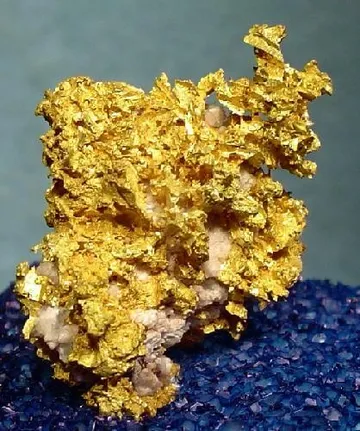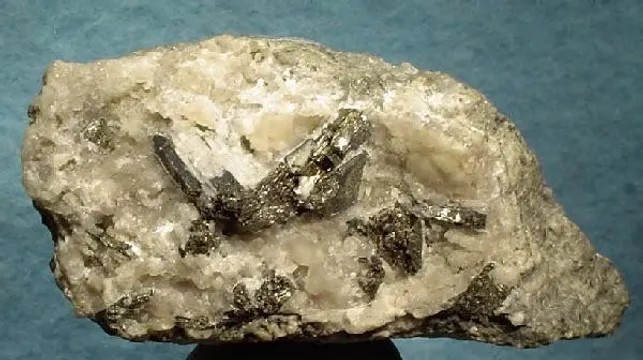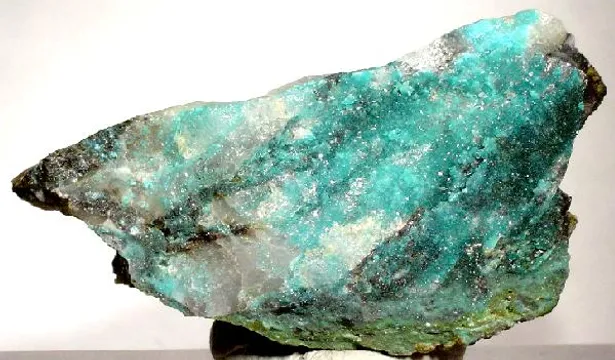
Round Mountain Mine, USA; a Nevada locality famed for crystallized native gold: leaves, wires, herringbone growths, spinel-law twins, and electrum-rich pieces.
Key facts
Round Mountain is one of the great modern paradoxes of American specimen gold: a huge bulk-tonnage, low-sulfidation epithermal gold-silver mine whose ordinary ore is commonly so visually unremarkable that it can look like pale, altered volcanic rock, yet whose best saved pieces rank among the most distinctive crystallized native golds produced anywhere in the United States. The mine lies in the Round Mountain mining district on the western side of the Toquima Range in Nye County, Nevada, where Oligocene rhyolitic ash-flow tuffs, older Paleozoic metasedimentary rocks, and later structural preparation combined to make a very large volcanic-hosted precious-metal system. In mining terms, Round Mountain is a long-lived open-pit and heap-leach operation. In collector terms, it is the source of bright leaves, wires, herringbone growths, spinel-law twins, stacked crystal aggregates, electrum-rich pieces, and rare gold-on-quartz matrix specimens with a look that is instantly recognizable once seen.
The signature Round Mountain specimen is not a rounded nugget. It is crystalline: flattened and elongated gold crystals, sharp cuboctahedral and octahedral forms, delicate parallel wires, arborescent sprays, and thin leaflike plates whose edges show the crystallographic story. The richest pieces may be lustrous, light yellow to buttery gold, sometimes reflecting the gold-silver alloy nature of the material and later surface enrichment. Good matrix pieces show gold on quartz, adularia-bearing epithermal vein material, altered rhyolitic tuff, or pale clayey wall rock; most specimens available to collectors, however, are essentially native gold liberated from the host.
Historically, Round Mountain matters twice over. It began as an early 20th-century Nevada lode and placer camp, with underground mining at the Sunnyside and related workings and energetic dry-washing, hydraulicking, and dredging of placers below the mountain. Then, after modern open-pit mining began in the late 1970s, a locality once known chiefly for production became a serious collector locality when coarse crystalline gold was encountered in high-grade zones and selectively saved. The result is a suite of specimens that bridges mining history and modern mineral collecting: native gold born in a low-sulfidation epithermal system, recovered from a world-class industrial mine, and prized for form rather than bullion weight.
Regional View
Country View
The best Round Mountain golds are collectible because they are architectural. A fine thumbnail may be little more than a light, fragile-looking trigon, a blade, or a feathery spray, but if the surfaces are bright and the crystal edges are crisp it can be more desirable than a heavier but rounded mass. The locality’s finest miniature and cabinet pieces carry both sculptural volume and crystallographic precision: stacked gold crystals standing off matrix, sheets edged with sharp crystal forms, or tangled wire groups that remain visibly ordered rather than merely spongy.

Photo: Wikimedia Commons

Photo: Wikimedia Commons
Search for specimens: View all specimens from Round Mountain Mine, USA
Round Mountain Mine is in the Round Mountain mining district, Toquima Range, Nye County, Nevada, approximately 90 km north of Tonopah and on the western margin of the range above Big Smoky Valley. The modern locality is generally recorded as Round Mountain Mine, or Round Mountain Mine (Sunnyside Mine), and older records tie the same ground to the Round Mountain/Sunnyside area, including the Los Gazabo vein, Keane vein, Mariposa vein sheeted zone, Great Western sheeted zone, Black Hawk sheeted zone, Sphinx glory hole, Rattlesnake, and other historic working names.
The deposit is a large volcanic-hosted, low-sulfidation epithermal gold-silver system, commonly described in older mining literature as a hot-spring or adularia-sericite type precious-metal deposit. The ore system is developed along the margin of a buried volcanic caldera. The principal host sequence includes Oligocene rhyolitic ash-flow tuffs and volcaniclastic rocks above older Paleozoic metasedimentary strata; a Cretaceous granitic body is also part of the local geologic framework. Published descriptions divide the volcanic section into units that include moderately welded bedded tuff, porous nonwelded to poorly welded pumice-rich rhyolite tuff, transitional welded tuff, densely welded rhyolite tuff, and overlying Stebbins Hill tuffaceous lake beds, breccias, vitrophyre, and silicified breccias.
That lithologic contrast is central to understanding both the ore and the specimens. In the lower, nonwelded, permeable tuff, mineralization can occur as disseminated gold and thin quartz veinlets cutting pumiceous rock. In the welded tuff, mineralization is more strongly fracture- and vein-controlled, with gold along high-angle fractures and low-angle joints opened by hydrothermal fluids. In the older metasedimentary rocks below the volcanic section, fracture-controlled mineralization has also been important, and published electron-microscopy work on Round Mountain macrocrystalline gold notes that much of the macrocrystalline specimen gold studied came from Paleozoic metasedimentary ore, even though the total mine production is overwhelmingly disseminated and processed ore rather than collector material.
The characteristic ore assemblage is native gold and electrum associated with quartz, adularia, pyrite, iron oxides, sericite and clay-alteration minerals. Alteration is typical of a broad low-sulfidation epithermal system: propylitic alteration outward, progressing through clay and sericitic alteration to quartz-adularia and silicified zones nearer veins and structures. Adularia replacement of feldspars and quartz-adularia veinlets are repeatedly noted in the mine literature, and this matters to collectors because some of the best crystallized gold came from vein and fissure environments rather than from visually bland disseminated ore.
Gold production in the Round Mountain district began in 1906. The early decades combined lode mining, especially at the Sunnyside and nearby veins, with placer mining of the eroded gold-bearing gravels below the mountain. Underground and placer work continued for decades, with intermittent later activity before the modern open-pit era. The original Smoky Valley Common Operation was formed in 1975, and commercial open-pit production began in 1977. Kinross acquired its initial interest in Round Mountain in 2003, bought the remaining 50 percent from Barrick affiliates in January 2016, and now owns and operates the mine through Round Mountain Gold Corporation.
The current mine is a large conventional open pit with associated heap-leach and milling infrastructure. Modern processing includes crushed-ore heap leaching, run-of-mine heap leaching, and milling of sulfide or higher-grade material through gravity/flotation circuits. The Round Mountain pit and the Gold Hill pit have both been part of the operation, with Gold Hill treated as a satellite deposit north of the main Round Mountain pit. Recent corporate reporting describes mining of Phase W as completed in mid-2025, Phase S open-pit mining continuing into the later 2020s, and Phase X as a planned bulk-tonnage underground operation below the Phase W open pit, intended to extend production into the 2030s.
Collecting access today is not a rockhounding proposition. Round Mountain is an active industrial gold mine with controlled access, blasting, large equipment, processing facilities, security, and safety regulations. Specimen gold that reached collectors did so through authorized channels, including earlier mine-managed employee sales and selected dealer lots, not through public collecting. Any modern specimen with a Round Mountain label should therefore be understood as a market specimen from saved mine production, not as something a visitor can go collect on site.
The most important specimen-producing era began when coarse crystalline gold was recognized in modern mining. Early visible pieces from the 1980s are noted, but the decisive change came in the early 1990s with the discovery of coarse gold in high-grade material. Subsequent finds, especially in the late 1990s and mid-2000s, established the mine as one of the preeminent modern sources of crystallized gold. A well-known 2006 event involved extremely rich high-grade ore and a 55-pound mass consisting largely of native gold, dug by hand from a high-grade zone; around the same period, sealed-bid lots and saved employee-sale material brought many of the finest thumbnails, miniatures, and occasional larger pieces onto the collector market. The best specimens were not produced continuously but episodically, whenever mining intersected the right coarse-gold-bearing vein or fracture zone.
Gold is the collector species at Round Mountain, and the locality’s best pieces are famous for flattened and elongated spinel-law twins, herringbone leaves, parallel wires, dendritic and arborescent groups, cuboctahedral to octahedral crystals, hopper-like growths, and rare sculptural matrix pieces on quartz or altered tuff. The color ranges from bright light yellow to richer buttery gold, with electrum and surface silver leaching helping explain some of the locality’s paler interiors and warm enriched surfaces. Documented specimens range from millimetric fragments and thumbnails to fine miniatures, cabinet clusters, and exceptional larger matrix pieces; Mindat’s occurrence data record flattened and elongated spinel twins to about 6 cm, and dealer and museum-style descriptions document pieces from late-1980s finds through the major early-2000s and 2006–2007 material. Good Round Mountain gold is judged by crisp crystal development, bright luster, intact leaf and wire edges, strong three-dimensionality, and recognizable crystallographic habit; ordinary pieces are heavier but rounded, bent, matte, overly cleaned, or visually more like bullion than crystal.
Quartz at Round Mountain is important less as a stand-alone display species than as the matrix, vein, druse, and paragenetic partner that makes the finest gold specimens legible. It occurs in thin veinlets, drusy cavities, silicified zones, and quartz-adularia vein material within the low-sulfidation epithermal system, commonly white to colorless or grey-white and locally associated with adularia, sericite, pyrite, iron oxides, and native gold/electrum. The choicest quartz-bearing specimens are those where gold is perched on projecting quartz crystals or spread over quartz-covered matrix without being visually swallowed by the host; sharp gold wires or leaves on a small quartz shard can be far more collectible than a larger but dull vein fragment. Quartz crystals from this mine are therefore collected primarily when they support, frame, or preserve the original epithermal cavity setting of the gold.
Other documented minerals from the Round Mountain Mine include electrum, adularia and other K-feldspar, pyrite, muscovite-sericite, chlorite-group minerals, alunite, jarosite, goethite, hematite, limonite, pyrolusite, calcite, fluorite, realgar, scorodite, anatase, and aguilarite. Most are ore, alteration, or microscopic accessory species rather than cabinet-specimen species. Aguilarite, Ag4SeS, has been recorded as micrometre-scale blebs in gold and electrum, making it a scientifically interesting but not normally visible association. No well-established IMA type-locality mineral belongs specifically to the Round Mountain Mine locality as collectors use that label; the nearby Round Mountain district does include important rare-mineral history, especially benjaminite from district occurrences, but that should not be folded casually into a Round Mountain Mine specimen label.
Round Mountain gold is a locality where form is everything. Since native gold is dense, it is tempting to value pieces by weight, but the market premium is in crystallography: spinel-law twin leaves, herringbone surfaces, sharp trigons, parallel wires, bright cuboctahedral terminations, delicate freestanding groups, and matrix pieces that show undamaged gold on quartz or altered volcanic host. A thin, crisp, two-sided leaf with undisturbed edges can be a better specimen than a heavier nuggety lump.
Condition deserves close attention. Gold is soft and malleable, so leaves and wires can be bent by careless handling, vibration, pressure against a box lid, or overzealous mounting. Thin Round Mountain leaves may have fragile serrated margins; wire groups can snag; matrix pieces may shed clayey or altered tuff material; and quartz-supported specimens may have weak contacts where gold was partly liberated from the vein. Avoid ultrasonic cleaning, brushing, or aggressive mechanical cleaning. Even though native gold itself is chemically robust, the specimen as a crystallographic object is not.
Cleaning history is a real quality issue. Some Round Mountain specimens were naturally freed from matrix or carefully prepared, while others may have been acid-cleaned or mechanically trimmed. Light etching or removal of clay can reveal excellent crystals, but harsh cleaning may expose paler electrum beneath an enriched gold-colored surface, dull delicate luster, or leave the specimen looking unnaturally raw. A pale, brassy, or silvery cast is not automatically suspicious, because electrum is a normal part of the locality’s mineralization; the key is whether the surfaces, recesses, and broken contacts make mineralogical sense.
Mislabelling risk is moderate because Round Mountain gold has become famous and visually imitated by other Nevada and Western U.S. gold localities. Look for locality-consistent features: flattened spinel twins, herringbone and leaf habits, bright but sometimes slightly light-colored gold, quartz/adularia or pale altered tuff association, and provenance through mine-era employee sales, recognized dealers, or older collection labels from the 1990s and 2000s. “Round Mountain” labels on rounded placer nuggets deserve special caution unless the specimen is explicitly sold as placer gold from the district rather than as crystallized mine gold.
There is no meaningful fluorescence expectation for the native gold specimens themselves. Associated realgar, where present in the broader mineral list, should always be treated as light-sensitive and arsenic-bearing, but it is not a typical visible accessory on most collectible Round Mountain golds. General handling should follow good native-metal practice: keep specimens dry, avoid sulfurous display materials that can tarnish associated silver-rich phases, secure delicate gold groups in custom mounts, and store high-value pieces where vibration and pressure cannot distort crystal edges.
Availability is episodic. Many of the best pieces entered the market from saved mine material of the early 1990s through the mid-2000s, particularly employee-sale and dealer-lot material. New specimens may still surface from old collections, but fresh, abundant production is not something collectors should assume. Fine thumbnails and small miniatures appear more often than major matrix pieces; large, crystallized, undamaged, aesthetic Round Mountain golds are genuinely rare and are priced accordingly.
Round Mountain’s first great collector story is older than the modern pit. The district’s placer gold was discovered in 1906, and Thomas “Dry Wash” Wilson became one of its legendary figures. In a country where water was scarce and every practical decision had to answer to the Nevada desert, Wilson made his name using dry-washing machines on shallow hillside gravels near the Sunnyside lode. The recovery was imperfect—reported at roughly 70 percent—yet the gravels were rich enough that Wilson was said to have recovered $30,000 in gold in 70 days. For an early camp, that was the kind of arithmetic that turned a remote slope into a rush.
Water soon became the obsession. Dry washing gave way to sluicing and hydraulicking where possible, and the operators looked to Jefferson Canyon, several miles away, to feed the placer ground. An 8-inch pipeline carried leased water to the workings, but drought and chronic shortage meant that both mills and placer operations could sit idle. Later sources describe still larger efforts to bring water to the mountain, including a 9-mile pipeline. The image is pure central Nevada mining: a gold hill whose richest loose metal was near bedrock, a camp improvising water supply across miles of dry country, and a placer operation forever balanced between gold abundance and water scarcity.
The early lode camp had its own drama. Contemporary and later historical accounts describe the Sunnyside ore body as hundreds of feet long and several feet wide, with early shafts and tunnels cutting quartz seams and stringers at frequent intervals. By 1907, stages ran between Round Mountain and Tonopah; the town had hotels, stores, saloons, brokerage offices, a school, a library, and eventually a hospital. It was not merely a mine but a functioning desert camp, built around a low, rounded hill of rhyolite and porphyry on the edge of Smoky Valley.
Specimen collectors will recognize another thread in the old stories: high-grading. The ore could occur in forms easy to pocket—sheets of gold, wire bundles, rich pieces that a miner or mill worker could palm. Later histories make the point bluntly: early production figures are unreliable because coarse and specimen-quality gold made high-grading “easy and inevitable.” One remembered remark cuts through the romance. A young employee is said to have told Louis Gordon, in effect, that he did not even need to go underground; he could wait until the gold reached bullion form and take it then. Gordon gave no answer. For collectors, the painful part is the thought of what vanished: early Round Mountain leaves and wires treated as discounted metal, melted or made into jewelry before mineral specimens of that quality were valued as crystallographic treasures.
The modern specimen era has a more unlikely setting: a giant open pit designed to move ore by the ton, not rescue thumbnails. For years, Round Mountain was known as a low-grade operation where the ore commonly lacked visible texture or dramatic veining. Then in March 1992, coarse gold was found in a blast hole. That moment changed the collector identity of the mine. Mine geologists understood that they were seeing something special, and management permitted a program through which employees could buy selected gold specimens at the prevailing gold price. Those December sales became, in effect, a Christmas gift to miners—and a conduit by which Round Mountain’s crystallized gold reached the outside collecting world.
The most spectacular modern story came in 2006. Reports from the time describe a few-week period when a very high-grade zone produced a 55-pound piece of ore consisting largely of native gold, dug by hand in about two hours. A geologist estimated that more than a million dollars’ worth of gold had come from the high-grade zone in three days. For a collector, the number is almost secondary to the scene: in the wall of a vast Nevada open pit, within an operation built for microscopic gold recovery, miners were suddenly hand-digging a mass of crystalline native gold heavy enough to be spoken of in pounds rather than centimetres.
The same 2006–2007 period gave collectors some of the locality’s most admired pieces. A sealed-bid auction of 56 specimen-quality gold lots brought dealer John Veevaert of Trinity Minerals to the mine, and one of his lots reportedly yielded first-rate thumbnail and miniature specimens. That is the odd beauty of Round Mountain: a mine whose management could be uneasy about specimen fame, yet whose saved lots and employee sales preserved objects that otherwise would have disappeared into dore bars. Without those decisions, many of the sharpest leaves, wires, spinel twins, and quartz-mounted pieces now used to define the locality would simply have become bullion.