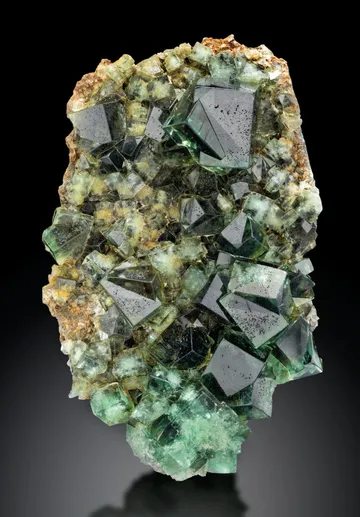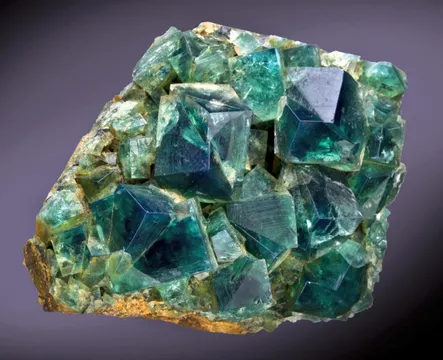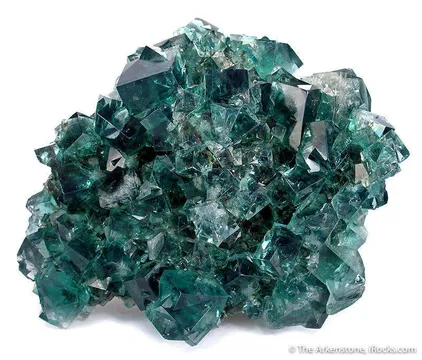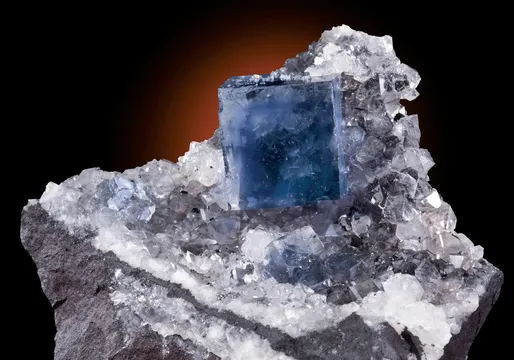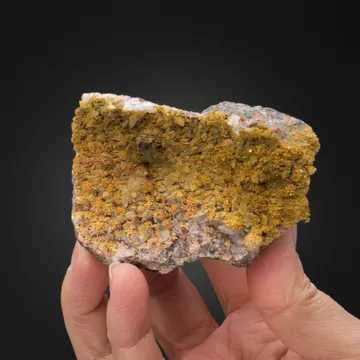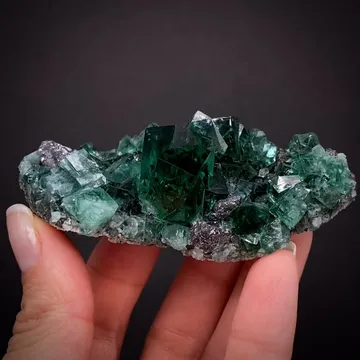
Rogerley Quarry, UK: emerald-green fluorite crystals with glassy cubes and blue daylight fluorescence; a historic, collector-favored Pennine locality.
Key facts
Rogerley Quarry is one of the defining modern localities for British collector minerals: a disused limestone quarry in Weardale, County Durham, that became a purpose-worked mineral-specimen mine rather than an industrial ore mine. Its reputation rests on emerald-green fluorite from the Northern Pennine Orefield, especially lustrous cubic and penetration-twinned crystals from vein-adjacent replacement flats in the Great Limestone. The finest pieces have the unmistakable Rogerley look: saturated green cubes, often glassy at the corners and edges, perched on ironstone, limestone, quartz, calcite, or subordinate galena, and capable of a blue to violet-blue daylight fluorescence strong enough to alter the specimen’s appearance in a window or under open sky.
The locality matters historically because it bridged the old Weardale tradition of lead and fluorspar mining with a new model of specimen recovery. Lindsay and Patricia Greenbank and Michael and Brenda Sutcliffe began serious specimen work in the early 1970s through the Cumbria Mining and Mineral Company, at a time when a commercial mine operated mainly for crystals was still a radical idea in Britain. Later, UK Mining Ventures turned Rogerley into an internationally watched summer specimen operation, with named pocket zones, detailed mine records, careful extraction techniques, and a steady presence at the major mineral shows. Since 2017 the broader Rogerley Quarry project has included the Diana Maria mine on the Sutcliffe vein, adding new pockets, colour styles, and gemmy fluorite to the locality’s already formidable record.
Regional View
Country View
Geologically, Rogerley is a small, collector-scale window into the same hydrothermal system that made the Northern Pennines famous. Mineralising brines rose through steep faults, deposited fluorite and galena in open cavities, and spread laterally into permeable horizons as metasomatic “flats” along the bedding of the Great Limestone. That distinction matters to collectors: vein material can include larger, single fluorite crystals, including purple and yellow-green examples, while flat-style pockets are the classic source of Rogerley’s smaller but sharper green twins.

Photo: Wikimedia Commons
Search for specimens: View all specimens from Rogerley Quarry, UK
Rogerley Quarry lies in Weardale, County Durham, on the north side of the A689 between Frosterley and Stanhope. The quarry itself was opened for limestone, chiefly as flux for the iron industry around Tow Law and Consett, rather than for lead or fluorspar. The mineral veins were originally an inconvenience in the limestone operation, and fluorite-bearing material appears to have been discarded around the quarry before collectors realised what it contained.
The host rock is the Carboniferous Great Limestone, part of the Namurian succession on the Alston Block. Rogerley Quarry is also geologically important beyond its mineral specimens: the wider quarry exposure is a Geological Conservation Review site and SSSI noted for Great Limestone cyclothem sedimentology, including clastic intervals and an ancient channel profile. For the mineral collector, however, the key feature is the interaction between competent limestone beds, shale partings, open fractures, and replacement zones. Where mineralising fluids could move through broken rock and reactive limestone, they left cavities lined by fluorite, galena, quartz, and subordinate carbonates.
The classic Rogerley mine exploited the Greenbank vein, a near-vertical structure in the eastern part of the quarry. At the quarry face the vein is split into two stringers roughly a metre apart, and Sir Kingsley Dunham named it for Lindsay and Patricia Greenbank. Mineralisation occurs both in the vertical vein and in adjacent flats that extend laterally from the vein parallel to bedding. The most collectable fluorite has generally come from the flats, where open solution cavities and replacement textures allowed green cubic crystals and interpenetrant twins to grow on limestone, ironstone, quartz, and iron-carbonate-replaced wall rock. West Cross Cut material is especially associated with iron-carbonate replacement by ankerite and siderite, later oxidised to a gossan-like ironstone matrix.
A second structure, the Sutcliffe vein, is exposed in the western extension of Rogerley Quarry. Lindsay Greenbank and Mick Sutcliffe collected some good green and purple fluorite from the vein in the 1970s, but the exposure was difficult to work and the operation returned to the Greenbank vein. The Sutcliffe vein became central again in 2017, when Ian and Diana Bruce’s UK Mining Ventures Ltd began developing what became the Diana Maria mine. Geological mapping also identified the River Catcher vein, close to and roughly parallel with the Sutcliffe vein, adding a third fluorite-bearing structure to the quarry system.
The sequence of operators is unusually well documented. From 1972 to 1996, the Cumbria Mining and Mineral Company — Lindsay and Patricia Greenbank with Michael and Brenda Sutcliffe — worked the quarry and mine mainly as a weekend specimen operation. Their early work began on the quarry face and high flats, about 20 m above the quarry floor, before an adit was driven along the Greenbank vein. After a pause following Lindsay Greenbank’s illness and the 1998 decision to sell the project, a United States-based UK Mining Ventures partnership including Cal and Kerith Graeber and Jesse Fisher took over. Full-time seasonal specimen mining began in May 1999 and produced many of the best-known Rogerley pocket names. In 2017 Ian and Diana Bruce acquired the operation under UK Mining Ventures Ltd, refurbished the Rogerley workings, and began major development of the Sutcliffe vein at Diana Maria.
The named-pocket record is one of the great strengths of the locality. Early quarry and CMMC material can be attractive but is often less precisely placed than post-1999 specimens. The Black Sheep Pocket, opened in 1999, was an interconnected series of fluorite-lined cavities in the flats east of the vein and produced hundreds of specimens, including green crystals with blue or yellow cores and phantoms. The Weasel Pocket, in the Greenbank vein, yielded larger untwinned purple fluorites with drusy quartz coatings. Birthday, Solstice, Dipper, and West Cross Cut pockets followed in the early 2000s; Solstice was small but high quality, while West Cross Cut became one of the most productive and aesthetically important flat-style zones.
From the mid-2000s onward, pocket names became a shorthand for subtle but real specimen differences. Corner Pocket pieces may show light green fluorite with a fine sugary quartz coating. The Tube produced unusual pale green fluorite with internal purple layers and notable galena. Rat Hole yielded hundreds of good specimens from a long, narrow cavity, with larger untwinned fluorites and little galena. Rat Tail, an extension of Rat Hole, was smaller but produced deeper-coloured, gemmier, more lustrous pieces before instability forced backfilling. Jewel Box and Blue Bell became collector favourites for flawless, deep green twinned crystals, and Penny’s Pocket Zone is famous for very strong daylight fluorescence and the 2012 Weardale Giant.
The Weardale Giant was Rogerley’s most dramatic single specimen: a roughly one-metre-wide, approximately 300 kg block from Penny’s Pocket Zone, coated with many hundreds of deep green fluorite cubes, including interpenetrant twins to about 7 cm, all showing intense deep blue daylight fluorescence. It was displayed at Tucson in 2013, then later reduced to produce smaller specimens. The decision to cut it was controversial in collector circles, but it also placed fragments of a legendary discovery into more collections than one monumental, nearly immovable block ever could.
Diana Maria added a new chapter within the same quarry. In summer 2017, stripping 3 to 6 m of overburden near the Sutcliffe vein exposed a richly mineralised cavity roughly 6 by 10 m, with emerald-green and blackberry-purple fluorite crystals to 6 cm on edge, commonly colour-zoned and growing on drusy clear to milky quartz. Early opencast pockets included Graeber Jones, Snowstorm, Pavel’s, Emerald Peaks, and Green Hill; underground work then produced Queen of Green, Purple Haze, Galena, November Gem, Frosterley, Green Sugar, Papa, Why-Aye, Gushing Water, 4th July, Northern Flats, Autumn, Heavy Metal, Bypass, Truffle Pig, Milky Way, Hidden Forest, and later named pockets. For collectors, “Rogerley Quarry” now commonly embraces both the classic Rogerley mine on the Greenbank vein and Diana Maria on the Sutcliffe vein, though good labels should preserve the exact mine, vein, pocket, and year whenever known.
The quarry and mines are private, professionally operated workings and are not open for casual collecting. Public-access assumptions are especially dangerous here: the quarry walls, old adits, unstable flats, wet ground, roof-support issues, blasting history, and monitored radon conditions all place Rogerley firmly outside ordinary field-collecting territory. Modern specimens enter collections through the mine operators, dealers, shows, auctions, and deaccessioned private collections rather than through independent collecting.
Fluorite is the signature mineral of Rogerley Quarry: mostly CaF2 as cubic crystals, commonly emerald to leaf green in the flat-style pockets, with smaller crystals typically twinned by octahedral penetration twinning and larger vein crystals more often single, opaque, and occasionally purple or yellow-zoned. In the classic Rogerley mine, flat material commonly ranges from tiny crystals to about 3 or 4 cm, with exceptional twins and larger cubes reported to around 7 or 8 cm; Diana Maria has produced colour-zoned green, purple, and blackberry-cornered crystals to several centimetres on quartz, calcite, aragonite, ironstone, and minor galena. The best Rogerley fluorites combine saturated colour, glassy lustre, transparency at corners and edges, undamaged cubic form, strong blue to violet daylight fluorescence, and an attractive matrix rather than loose, cloudy, etched, or bruised crystals.
Galena at Rogerley is usually a supporting but important species, occurring as grey metallic cuboctahedral, octahedral, modified cubic, and sometimes corroded crystals associated with fluorite, quartz, and ironstone. In the classic Rogerley mine, small crude cuboctahedral galenas are common companions to green fluorite in many zones, while the Tube produced massive galena and several large, crudely formed cuboctahedral galena crystals; at Diana Maria, a specifically named Galena Pocket yielded substantial galena with fluorite and quartz, and Green Sugar material includes small black modified cubes and octahedra to a few millimetres. Better Rogerley galena specimens are not judged by mirror-bright perfection alone, but by sharp contrast with gemmy green fluorite, recognisable form, freedom from excessive corrosion, and precise pocket provenance.
Other documented minerals from Rogerley Quarry and its mines include quartz, calcite, aragonite, ankerite, siderite, dolomite, smithsonite, hydrocerussite, sphalerite, chalcopyrite, greenockite or possible hawleyite, and cerussite-group alteration products in the broader quarry record. The assemblage is deliberately modest compared with complex polymetallic localities: carbonates, sulphides, fluorite, and quartz dominate. No accepted type-locality mineral species is associated with Rogerley Quarry in the major locality records; its “rarities” are instead locality-rarities and aesthetic variants — blackberry-purple fluorite, yellow and multicolour-zoned fluorite, bubble-bearing gem crystals, fluorite over fossil coral, fluorite with pervasive snow-white calcite or aragonite, and unusual galena-rich Diana Maria pocket material.
The principal authenticity issue with Rogerley is not a known industry of fabricated specimens, but provenance precision. Green daylight-fluorescent fluorite occurs at several Weardale localities, including Heights, Eastgate, Lady Annabella, Diana Maria, and others, so “Rogerley-style” is not the same as Rogerley. True Rogerley labels should ideally name Rogerley Mine or Diana Maria Mine, the vein where known, a pocket or zone, and a collecting year. This is especially important for older material: some CMMC-period specimens have been reported as incorrectly attributed to Eastgate or Blue Circle Cement Quarry, and old labels may preserve names or attributions that have since been clarified.
Daylight fluorescence is a powerful clue but not a standalone proof of origin. Rogerley and Diana Maria fluorite can shift from emerald green in artificial light to violet-blue or indigo-blue in natural daylight, and it fluoresces strongly under longwave ultraviolet, but other Weardale fluorites can also show daylight response. The strength, colour, matrix, crystal habit, and label history must all agree. Be cautious with specimens sold only as “English green fluorite” or “Weardale daylight fluorite” when priced as named-pocket Rogerley.
Condition is the other major buying point. Fluorite has perfect octahedral cleavage and a Mohs hardness of 4, so corner bruises, edge rubs, cleaved crystal tops, and healed-looking breaks are common on matrix plates that came from clay- or rubble-filled cavities. Some pockets were brecciated or partially collapsed before discovery, and not all damage is recent; nonetheless, damage across prominent front crystals sharply affects value. Fine Rogerley pieces should be examined under strong side light for small chips along cube edges, detached and reattached crystals, glue repairs, and matrix trimming scars near exposed crystals.
Cleaning history matters. Many specimens came out coated with clay, calcite, aragonite, or quartz druse; some pockets are known specifically for snowy carbonate coatings or sugary quartz. Removing a coating can reveal gem fluorite, but aggressive acid work, abrasion, or over-cleaning can dull surfaces, undercut crystals, or erase a pocket’s characteristic look. Conversely, intact natural coatings can be desirable when they frame rather than obscure the fluorite, as in Snowstorm, Queen of Green, November Gem, Green Sugar, Corner, and similar pocket styles.
For display, Rogerley fluorite rewards experimentation with light. Diffuse daylight often shows the blue-violet fluorescence better than harsh direct sun, while 365 nm longwave UV typically produces a bright blue to bluish-white response. Avoid unnecessary knocks, vibration, and heavy ultrasonic cleaning; large ironstone matrix pieces can be surprisingly heavy and should be supported well. Faceted Rogerley fluorite exists and beautifully demonstrates the optical effect, but fluorite is too soft and cleavable for hard-wearing jewellery.
Market availability is better than for many classic British localities because the mine has had modern specimen production and because material has been widely distributed through dealers and shows. Still, top pieces are scarce. Ordinary small green clusters, included twins, and minor edge-damaged plates are obtainable; named-pocket miniatures with gem transparency and strong daylight fluorescence are more competitive; large, undamaged, aesthetic plates from celebrated pockets such as Jewel Box, Blue Bell, Rat Tail, Penny’s, Bluebirds, Queen of Green, November Gem, Hidden Forest, 50 Year, and comparable Diana Maria finds command serious collector attention.
The modern Rogerley story begins with a collector looking upward. Around 1970, Raymond Blackburn found green fluorite specimens around the quarry floor and spoil, recognised that their source lay high on the north face, and decided the exposure was too awkward for him to tackle. Lindsay and Patricia Greenbank acquired some of the material, and soon Lindsay Greenbank and Mick Sutcliffe were literally roping down from the top of the quarry to examine the mineralised zone. What later became a famous specimen mine began not with a shaft, mill, or ore contract, but with loose discarded limestone blocks, a difficult quarry wall, and the conviction that the green crystals were worth pursuing.
In 1972 the Greenbanks and Sutcliffes formed the Cumbria Mining and Mineral Company to mine specimens commercially. In Britain at the time, that was a startling premise. The quarry’s veins had not been valuable enough for conventional lead or fluorspar mining, yet the same “impurities” that had spoiled building or flux limestone became the quarry’s treasure once the value shifted from tonnage to crystals. The early work focused on a 10 m bench cut about 20 m above the quarry floor at the High Flats Horizon, where the Greenbank vein and associated flats offered enough cavity mineralisation to justify decades of weekend labour.
When UK Mining Ventures took over in 1999, Rogerley was not waiting like a polished jewel case. The workings had deteriorated, the mine was wet, old timbers and track needed rehabilitation, and the crew had to rebuild practical access before serious specimen recovery could begin. During cleanup, pressurised water became more than a housekeeping tool. Washing mud from the walls revealed mineralisation that mining eyes could read. At one alcove, a mud seam on the eastern face looked promising; when the mud washed away and a few slabs came loose, the miners were looking into a cavity completely lined with green fluorite. That pocket became Black Sheep.
Black Sheep was not a neat little vug. It opened into an interconnected series of solution cavities, roughly 1 m high, 1.3 m wide, and eventually about 5 m deep. The floor was broken, and specimens up to small-boulder size could be removed by hand, but the ceiling preserved large plates. To save them, the crew used a diamond chain saw, cutting slabs with fluorite-coated, stalactite-like projections of matrix. By the end of August 1999, the first UKMV season had yielded hundreds of specimens. The pocket’s name, less solemn than the find deserved, came from a local ale popular with the mining crew.
Another early cavity acquired a resident before it became a pocket name. The Weasel Pocket was named for a “weasel” that had lived there, later recognised more correctly as a stoat. Its eviction was abrupt, and the pocket’s contents were different from the classic green flat material: large clusters of purple cubic fluorite, mostly opaque except near the edges, coated with white finely crystalline quartz. Even when not gemmy, those specimens helped show that Rogerley was not just a one-note green-fluorite locality; vein, flat, and pocket position all mattered.
The pocket names preserve the miners’ private geography. Solstice Pocket was found on 21 June 2001, midsummer’s day, and although it was not especially prolific, it produced high-quality fluorite with little corrosion. Dipper Pocket took its name from flats that appeared to dip into the adit floor. Corner Pocket sat at the northern edge of the West Cross Cut zone and produced small, light green crystals frosted with a sugary quartz crust. High Pocket required a ladder. Rat Hole was a long, narrow tube where only one person could collect at a time. Rat Tail, its extension, was smaller but produced deeper, gemmier crystals before the near-surface ground began to collapse and the area had to be backfilled for safety.
The Dodgy Bugger Pocket earned its name honestly. The best specimens were attached to large loose rocks in the roof, making extraction both difficult and dangerous. One remarkable piece was a limestone block overgrown with white quartz and green fluorite crystals, weighing more than 100 kg. Rather than break it, head miner Byron wrapped it first in bubble wrap and then sealed it in silver duct tape, an image that nicely captures Rogerley’s mix of hard-rock mining and specimen anxiety: a mineralogical prize swaddled like fragile furniture before being wrestled out of the earth.
In mid-July 2007, after mucking out blast debris at the main face, the miners encountered a clay-filled pocket zone trending east from the vein. The pocket was partly collapsed and brecciated, not the sort of clean hollow that promises easy plates, yet it yielded flawless deep green twinned fluorite crystals. It was named Jewel Box for a reason. Nearby, the Blue Bell Pocket, worked in 2008 and 2009, honoured the Blue Bell Inn at St. John’s Chapel, a favourite pub of the crew. Some of the best Blue Bell specimens pair classic Rogerley twinning with the saturated green colour and daylight fluorescence that made the mine famous on the international market.
The Weardale Giant belongs to another scale altogether. In July 2012, in Penny’s Pocket Zone, the miners uncovered a roughly metre-wide block weighing about 300 kg, coated with hundreds of green fluorite crystals on limestone. Occasional interpenetrant cubes reached about 7 cm among the smaller crystals, and the whole specimen showed intense deep ink-blue daylight fluorescence. It was photographed outside the mine on 19 July 2012 with Jurgen Margraf and Robert Brandstetter, then shown at the 2013 Tucson Gem and Mineral Show. Later, it was reduced in size to produce many smaller specimens — a pragmatic decision, but one that makes collectors still pause. Was the Giant more important as one monumental survivor or as many superb pieces in many cabinets? Rogerley has always forced that question: the specimen is the ore.
When ownership passed to Ian and Diana Bruce in 2017, the story shifted westward in the quarry to the Sutcliffe vein. While the old Rogerley mine required refurbishment to satisfy modern mine-safety requirements, the team stripped overburden near the old Sutcliffe exposure and found the first Diana Maria fluorites. A 6 by 10 m mineralised cavity in collapsed flats produced emerald-green and blackberry-purple crystals, often on drusy quartz, and confirmed that the quarry still had a second life. The new mine was named for Diana Maria Bruce, whose family background in Saxon mineral collecting made the name more than a polite dedication.
Diana Maria quickly developed its own cast of pocket names. Graeber Jones honoured Cal Graeber and Ian Jones. Snowstorm referred to snowy white carbonate over fluorite. Pavel’s Pocket took its name from Pavel Škácha, who discovered it. Queen of Green, found in January 2018, was named for the colour, gemminess, and perfection of the fluorite lining the pocket. Purple Haze, Galena, November Gem, Frosterley, Green Sugar, Heavy Metal, Truffle Pig, Milky Way, and Hidden Forest followed, each name capturing either the pocket’s appearance, discovery circumstances, or the miners’ humour. In a locality famous for green fluorite, the stories matter because the pocket name is often the key to the specimen’s exact character.