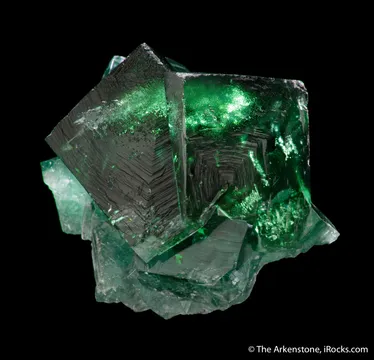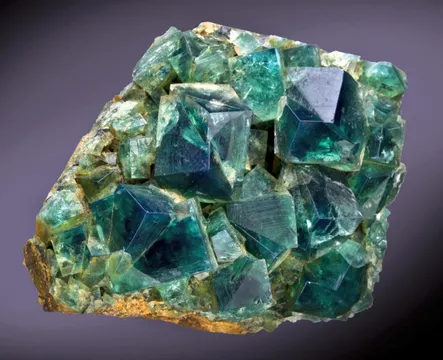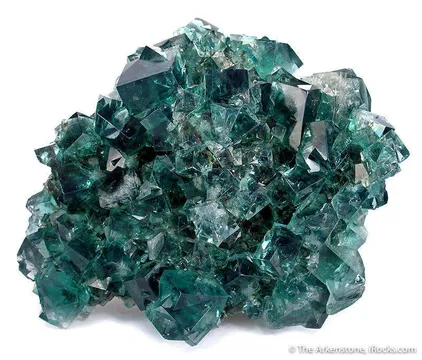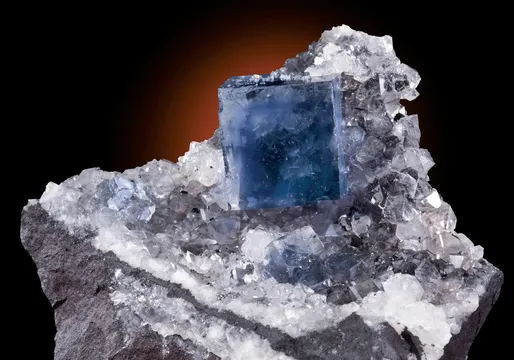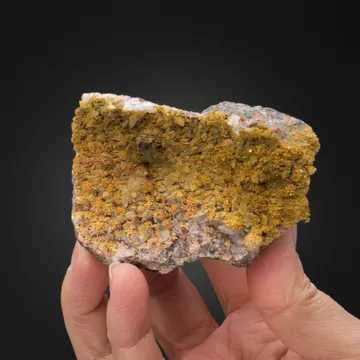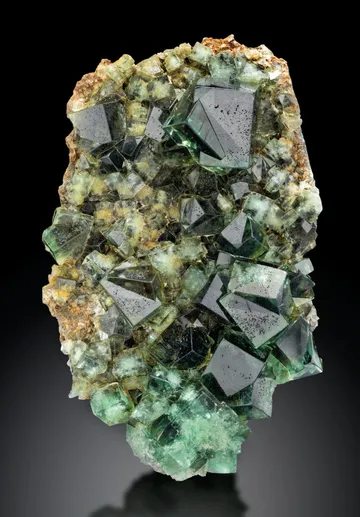
Queen of Green Pocket, UK - a Diana Maria fluorite pocket in Rogerley Quarry, yielding gemmy green fluorite with daylight fluorescence and sharp twins.
Key facts
Queen of Green Pocket is one of the defining modern pockets of the Diana Maria Mine, the newer specimen-mining development in the Rogerley Quarry complex near Frosterley and Stanhope in Weardale, County Durham. It belongs to the Northern Pennine Orefield, where fluorite-bearing hydrothermal veins and replacement “flats” cut and spread through Carboniferous Great Limestone. In collector terms, Queen of Green matters because it distilled the best virtues of the Diana Maria operation into a sharply recognizable look: gemmy lime- to emerald-green fluorite, commonly in interpenetrant twins and small clusters, set against a snowy white carbonate coating on ironstone and limestone matrix, with the famous Weardale daylight fluorescence adding blue, indigo, or purplish overtones in sun or long-wave ultraviolet.
Regional View
Country View
The pocket was discovered during the first flush of the Diana Maria project, after UK Mining Ventures Ltd. shifted attention to the Sutcliffe Vein in the western part of Rogerley Quarry. Earlier Rogerley fame rested on the Greenbank Vein, but the Sutcliffe system soon proved capable of producing its own classics. Queen of Green was found in January 2018, before the main underground phase was fully under way, and it quickly became one of the most coveted named Diana Maria pockets because its best crystals combined saturated green colour, high transparency, bright luster, sharp cubic and modified cubic faces, and an unusually photogenic contrast with white carbonate.

Photo: UK Mining Ventures
Good Queen of Green specimens are not simply “green Diana Maria fluorite.” The finer examples show isolated, glassy twins emerging from a pale carbonate crust rather than being buried in it; the crystals may carry blue to indigo fluorescent rims, mossy green internal texture, or rare modified faces. The pocket’s reputation was strengthened by the fact that its output was tightly controlled in the marketplace: the entire contents were reportedly bought by Marshall Sussman of Crystal Cellar, so specimens have tended to appear in discrete releases and through resale rather than as a steady mine-run supply.
Search for specimens: View all specimens from Queen of Green Pocket, UK
Queen of Green Pocket is a named pocket within the Diana Maria Mine, Rogerley Quarry, near Frosterley and Stanhope, County Durham, England. The pocket is recorded on Mindat as “Queen of Green Pocket, Diana Maria Mine, Rogerley Quarry, Stanhope, County Durham, England, UK,” at approximately 54° 44' 25'' N, 1° 59' 14'' W. It is not a stand-alone mine; it is one productive cavity or pocket in the Diana Maria workings, which exploit the Sutcliffe Vein and associated flats in the Rogerley Quarry complex.
Geologically, the pocket belongs to the Weardale portion of the Northern Pennine Orefield, developed in Carboniferous limestones, sandstones, and shales over the Weardale Granite. At Rogerley and Diana Maria, the important host is the Great Limestone, a competent Carboniferous limestone unit that provided both open fractures and favourable replacement horizons. The deposit style is the classic Weardale combination of steep hydrothermal vein structures feeding laterally developed metasomatic flats. Mineralizing fluids moved along open faults and brecciated, porous vein zones; where they met favourable limestone beds and less permeable shale barriers, they spread laterally, producing vuggy cavities lined by euhedral fluorite.
The Diana Maria Mine is centred on the Sutcliffe Vein, named for Michael “Mick” Sutcliffe, one of the original Rogerley collecting partners. The Sutcliffe Vein trends roughly southwest-northeast and stands approximately normal to the older Greenbank Vein system exploited by the main Rogerley Mine. UK Mining Ventures’ geological work in 2017 also identified the River Catcher Vein, roughly parallel to the Sutcliffe Vein and about 35 m to the north. Within the Diana Maria workings, the Sutcliffe structure divides the mineralized ground into Southern Flats and Northern Flats. The Southern Flats are especially associated with green fluorite, and Queen of Green is one of the pockets cited as a prime example of that green-fluorite-producing side of the system.
The immediate matrix of Queen of Green specimens is typically ironstone and limestone replacement material, with green fluorite-lined cavities and white carbonate overgrowths. The fluorite occurs as sharp cubes and interpenetrant twins, usually in lime, spring-green, leaf-green, or emerald tones. Some crystals show modified faces; at least one documented specimen carried a bubble fluid inclusion and a tetrahexahedral upper face. White carbonate may form drusy, botryoidal, platy, or encrusting material around and between the fluorite crystals, sometimes framing the larger fluorites while covering smaller ones.
The broader Rogerley story began when collector Raymond Blackburn found specimen-grade green fluorite on the quarry floor around 1970. Lindsay and Patricia Greenbank visited in 1971, then, with Michael and Brenda Sutcliffe, investigated the high north quarry face using ladders and ropes. Specimen mining began in 1972 under the Cumbria Mining and Mineral Company, making Rogerley the first commercial mineral-specimen mining project in the British Isles. Work was mainly part-time and weekend-based until the mid-1990s. In 1999, UK Mining Ventures LLC, a U.S.-based group including Cal Graeber and Jesse Fisher, began full-time summer specimen mining and produced many of the classic Rogerley named pockets.
In 2017, the Rogerley operation passed to Ian and Diana Bruce under UK Mining Ventures Ltd. While the old Rogerley workings were being refurbished to meet modern mine-safety standards, the team began work on the Sutcliffe Vein in the western quarry face. Removal of overburden exposed richly mineralized collapsed flats with excellent daylight-fluorescent fluorite, encouraging development of the new Diana Maria Mine, named for Diana Maria Bruce. The Queen of Green Pocket followed in January 2018, before the formal underground phase advanced fully into the hill. In May 2018, the operation installed a heavy-duty RSJ portal, laid rail, and began tunnelling along the Sutcliffe Vein.
Collecting access today is not public field collecting. Rogerley and Diana Maria are privately operated specimen mines, not open quarries or casual pay-to-dig sites. Specimens reach collectors through UK Mining Ventures, Crystal Classics, associated dealers, and the secondary market. The nature of extraction also explains the condition profile: specimens are cut, split, and trimmed from strong limestone and ironstone using specialized tools, including hydraulic splitters and diamond chainsaws, because blasting would shatter the fluorite. Even so, perimeter trimming contacts, edge bruises, and minor crystal nicks are common on cabinet pieces from the pocket.
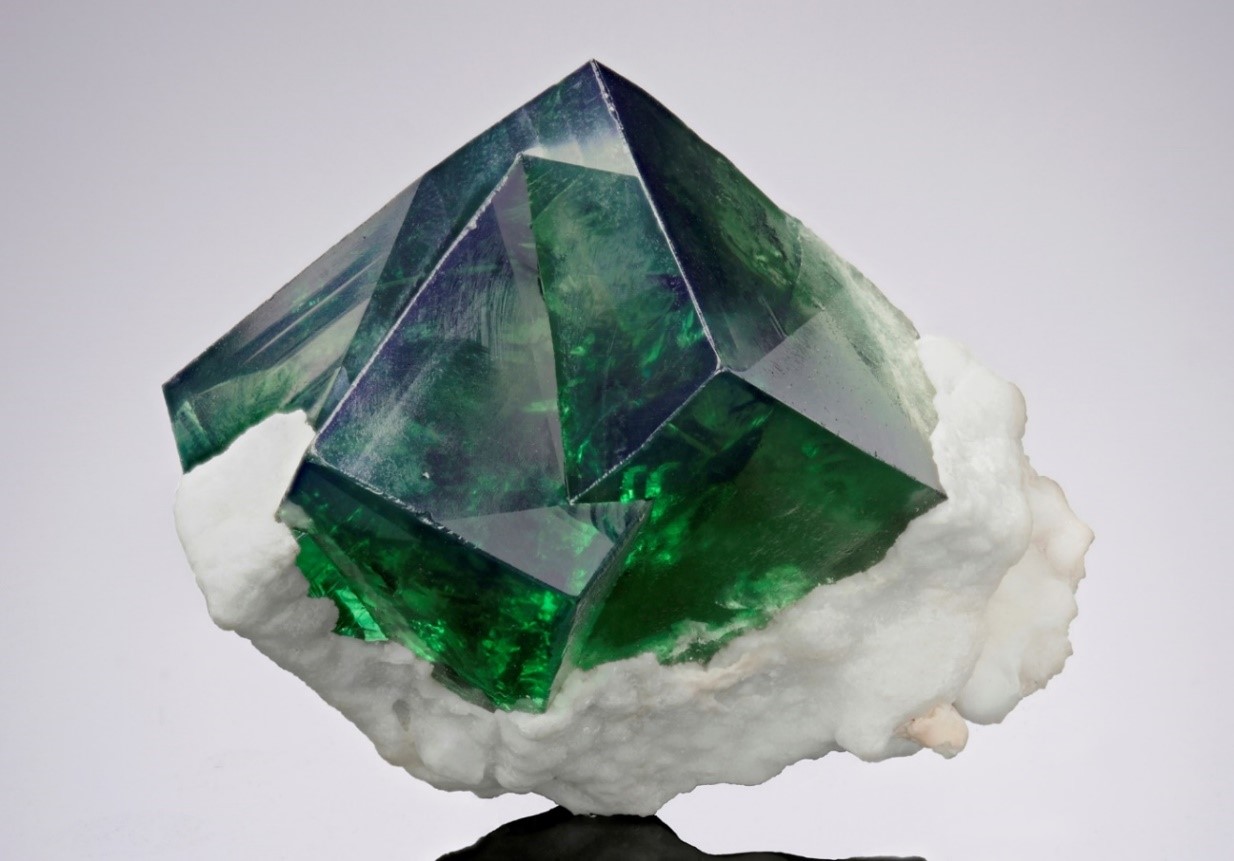
Photo: UK Mining Ventures
Fluorite is the reason Queen of Green exists in the collector vocabulary: the pocket yielded lime- to leaf-green and emerald-green cubic crystals, many of them glassy interpenetrant twins, lining cavities in ironstone-rich replacement material and commonly framed or partly overgrown by snowy white carbonate. Documented examples range from thumbnails and miniatures with 1–2 cm twins to showy cabinet pieces around 10–12 cm across, including specimens with crystals to about 2.5–3.5 cm across and archive pieces up to roughly 12 x 9 x 6 cm. The best pieces are judged by crystal isolation, transparency, saturated green body colour, minimal extraction bruising, and the blue-indigo to purple daylight fluorescence that can make the edges appear to glow under sunlight; ordinary examples tend to be more crowded, more heavily coated, less gemmy, or chipped along exposed cube corners.
Aragonite is the name under which many Queen of Green combination specimens entered the collector market, especially pieces described as gemmy green fluorite emerging from a chalky, snowy white, sometimes “organic-looking” carbonate coating. Several dealer records list the association as fluorite with aragonite and describe bright matte-white to crystalline coatings that isolate the green twins and give the pocket its dramatic colour contrast; however, later locality documentation and some auction descriptions record that at least some of the white material originally called aragonite was subsequently determined to be calcite. For collectors, the practical point is label discipline: a Queen of Green “aragonite” specimen should be valued chiefly as a fluorite specimen unless the carbonate identity is supported by analysis or a reliable mine/dealer record, with the best examples showing the white carbonate as a clean, aesthetic frame rather than a smothering crust.
At the pocket scale, the most conservatively documented mineral assemblage is fluorite with calcite, with some market records also citing aragonite and occasional galena remnants on matrix. At the Diana Maria and Rogerley mine scale, the broader assemblage includes fluorite, calcite, aragonite, quartz, galena, hydrocerussite, and smithsonite, but not all of those should be assumed for Queen of Green without specimen-level evidence. No type-locality mineral is associated with Queen of Green Pocket; its importance is aesthetic, geological, and market-historical rather than nomenclatural.
The chief authenticity issue for Queen of Green is not widespread fakery but labelling precision. The most important label question is whether the white carbonate is aragonite or calcite. Many specimens were sold as fluorite with aragonite, and that wording persists on older dealer labels and in some collection records. Mine documentation and at least one later auction description, however, state that white material originally thought to be aragonite was analyzed as calcite. When a piece carries the “aragonite” association, keep the original label for provenance but note the uncertainty unless the carbonate has been tested.
True Queen of Green pieces should have the Diana Maria look: sharply formed green fluorite, commonly twinned, with strong daylight or long-wave ultraviolet fluorescence and a white carbonate association. The colour should not be a flat bottle-green alone; many crystals show internal mossiness, zoning, transparent green edges, or blue-indigo fluorescent overtones. Because Diana Maria and Rogerley fluorites are famous and expensive, locality confusion is possible. Green daylight-fluorescent fluorite from Rogerley, Heights, Lady Annabella, other Diana Maria pockets, or even other Weardale mines may be visually similar to the casual eye. A credible Queen of Green specimen should carry a label or provenance trail tying it specifically to the pocket, not merely to “Rogerley,” “Diana Maria,” or “Weardale.”
Condition standards need to be realistic. The fluorite is brittle and cleaves perfectly; the pockets were extracted from hard limestone and ironstone; and specimens were trimmed for display. Small nicks on exposed cube corners, bruising along the edges of plates, and contacts on the back or underside are normal. Serious collectors should distinguish acceptable extraction and trimming contacts from distracting front-face damage. On Queen of Green, a single prominent bruised twin can reduce desirability sharply because the pocket’s premium rests on gemminess and perfection.
The carbonate coating adds both beauty and vulnerability. White calcite or aragonite-style coatings can be powdery, drusy, platy, or botryoidal, and they may trap dirt in recesses. Avoid acids, aggressive ultrasonic cleaning, and hard brushing. A gentle air bulb, soft artist’s brush, or careful rinse is usually safer than trying to make the white matrix unnaturally bright. Keep specimens away from repeated thermal shock and from heavy handling: fluorite scratches easily and cube edges abrade quickly.
Fluorescence is a major part of the appeal. Under strong daylight or long-wave UV, Queen of Green fluorite can shift toward blue, indigo, or purple. That response is best appreciated by comparing the same specimen in incandescent or warm artificial light, neutral LED light, sunlight, and 365 nm UV. Short-wave UV is unnecessary for display and increases handling risk to eyes and skin; long-wave UV with proper eyewear is the collector-friendly choice. Prolonged direct sun is not recommended as a storage method, even if the fluorescence is spectacular—use sunlight briefly for viewing and photography, then return the specimen to stable display conditions.
Market availability is limited and uneven. The pocket was a named 2018 find, not an ongoing production zone, and the contents were reportedly acquired as a lot by Marshall Sussman of Crystal Cellar. Pieces later appeared through major dealers and auctions, often at strong prices for their size because the pocket combines modern UK significance, daylight fluorescence, and unusually attractive white-on-green contrast. Cabinet specimens with clean isolated twins, strong colour, and minimal damage command a premium; heavily coated or chipped pieces are more affordable but still carry a pocket-name premium when the provenance is sound.
Queen of Green belongs to the moment when the Diana Maria Mine changed from a promising surface prospect into a new chapter of Weardale specimen mining. The old Rogerley operation had been built on the Greenbank Vein, but in 2017, while that mine was being brought up to modern standards, the team turned to the Sutcliffe Vein in the western quarry face. The ground was not an inviting showpiece at first: before the new work, the approach road did not exist, and the area around the Sutcliffe Vein was a grassy slope left untouched since the original limestone quarrying. Once overburden came off, collapsed mineralized flats appeared, and the new mine suddenly had a personality of its own—green, purple, yellow, strongly fluorescent, and pocketed.
The Queen of Green Pocket was the first great named proof that the Diana Maria ground could stand beside classic Rogerley. A UK Mining Ventures archive photograph records Ian Bruce in the pocket with Jakub Sauermann and Miroslav Volejnik as the first fluorite specimens were being collected. In front of them sat a large ironstone block cut through by green fluorite-lined cavities and surrounded by snowy white calcite. It is a telling image: not a romantic cavern glittering by headlamp, but a working specimen mine, with the prize still embedded in tough, dark matrix and every worthwhile piece demanding controlled extraction.
Another archive image places Jakub Sauermann outside the Diana Maria entrance, holding a superb emerald-green Queen of Green fluorite. Sauermann was not simply a visitor posing with a trophy; he worked at Diana Maria as an intern while studying for a master’s degree in geology at Adam Mickiewicz University in Poznań, Poland. Behind him, the old quarry face exposes a clean section through the Great Limestone—the same Carboniferous unit that gave the pocket its mineralized cavities. In one frame, the photograph compresses the whole locality: academic geology, commercial specimen recovery, the industrial quarry, and a specimen good enough to announce a new mine to the collector world.
The physical work behind those pieces was exacting. Diana Maria development used compressed-air drills and blasting for headings, but pockets could not be treated like ore. Specimens were recovered by specialist mineral-recovery miners using hammers, chisels, prybars, nylon tools, hydraulic splitters, and diamond chainsaws. The hydraulic splitter used in the mine could apply more than 400 tons of force, yet its purpose was delicacy: open a fracture, relieve the limestone, and free a specimen without transmitting the shock that would ruin fluorite. That is why a Queen of Green piece may show sawed matrix or trimming contacts on the edges but preserve razor-sharp twins on the front.
The mine itself was also being engineered as the pocket story unfolded. In late April 2018, the quarry face around the Sutcliffe Vein was scraped and hand-cleared of unstable rock; a pre-engineered RSJ portal was brought into position, timber-clad, and protected with graded rock. Rail went in, ventilation was installed, and the underground drive began following the Sutcliffe Vein. Shortly inside the portal, the rail line split: straight ahead along the east-west Sutcliffe Vein, and left toward the branch leading to Queen of Green. For collectors, that layout matters because it ties pocket labels to actual underground geography rather than to marketing romance.