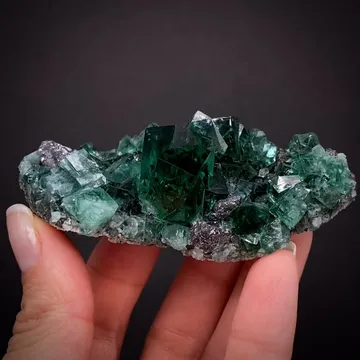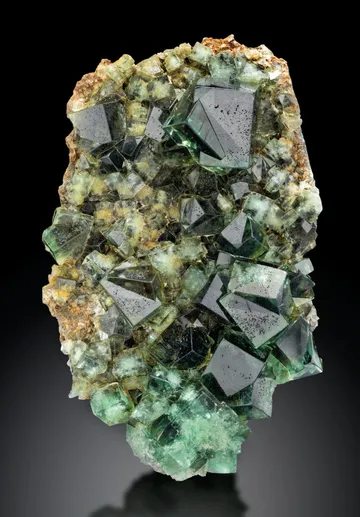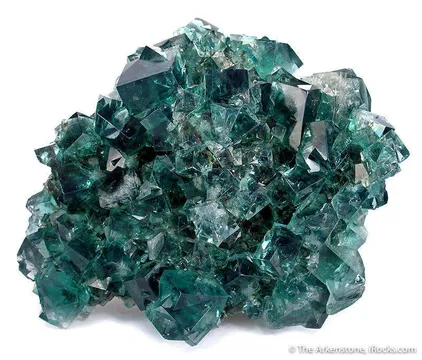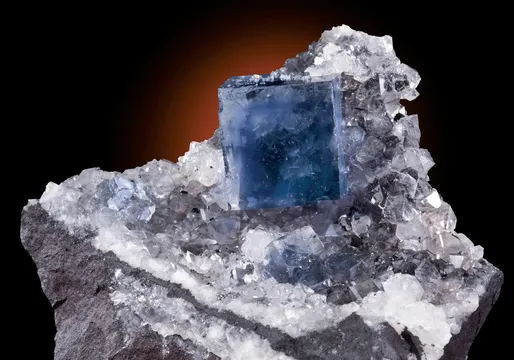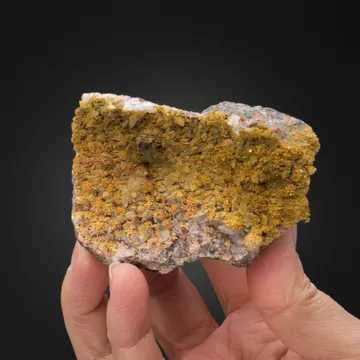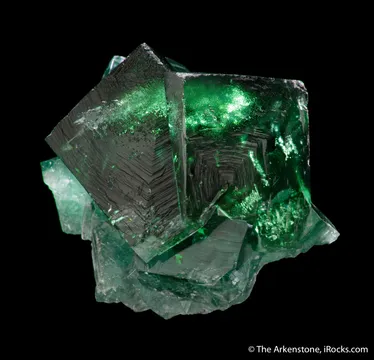
Rogerley Mine, UK — a defining modern fluorite locality in Weardale, yielding emerald-green daylight-fluorescent cubes, often twinned on quartz.
Key facts
Rogerley Mine is one of the defining modern fluorite localities of the British Isles: a small, purpose-driven specimen mine developed in an abandoned limestone quarry near Frosterley, Weardale, County Durham. Its importance is not measured in tons of ore but in cabinet specimens—sharp, glassy, emerald-green fluorite cubes and penetration twins from the upper Great Limestone, commonly set on white quartz, brown ironstone, limestone, or accompanied by bright metallic galena. In the North Pennine Orefield, where centuries of mining were directed mainly at lead, iron, zinc, fluorite, barite, and witherite, Rogerley stands apart because it was worked commercially for specimens rather than industrial fluorspar.
The deposit is a compact expression of the Weardale vein-and-flat system. Mineralising fluids moved through steep fissure veins, especially the Greenbank and Sutcliffe veins, and spread laterally along bedding-parallel replacement zones known locally as flats. At Rogerley, those flats produced the classic emerald-green fluorites—often twinned, lustrous, and famously daylight fluorescent—while vein pockets could yield larger untwinned crystals, including purple, yellow, and colour-zoned material. The best pieces have a look that collectors recognise across a room: saturated green cubes that take on an inky blue to violet cast in sunlight, floating over sparkling quartz or rusty iron carbonate matrix.
Regional View
Country View
Historically, Rogerley matters because it bridged two collecting eras. The older Weardale tradition was built on miners saving crystals from lead and fluorspar workings; Rogerley, beginning with Lindsay and Patricia Greenbank and Mick and Brenda Sutcliffe in the 1970s, made specimen recovery the purpose of the mine. Later, under UK Mining Ventures, the locality became unusually well documented pocket by pocket: Weasel, Black Sheep, Solstice, West Cross Cut, Corner, Rat Hole, Jewel Box, Blue Bell, Penny’s Pocket, Bluebirds, Wolfie, and others all acquired distinct collector identities. That level of pocket documentation is one reason serious collectors prize original labels from Rogerley almost as much as the locality itself.

Photo: Géry Parent, Wikimedia Commons

Search for specimens: View all specimens from Rogerley Mine, UK
Rogerley Mine lies in Rogerley Quarry, just west of Frosterley in Weardale, County Durham, on the north side of the A689 road toward Stanhope. The quarry itself was opened in the nineteenth century for limestone, used as a flux in ironmaking at nearby industrial centres such as Tow Law and Consett. The later specimen mine was developed within the old quarry walls, in the upper part of the Great Limestone, one of the key Carboniferous carbonate units hosting mineralisation in the North Pennine Orefield.
The ore system is the classic North Pennine Pb-Zn-Ba-F style, but at Rogerley the collector’s interest is concentrated in fluorite-rich veins and flats rather than large-scale industrial ore. The Greenbank vein is the principal north-northwest-trending structure followed by the original mine workings, while the Sutcliffe vein, farther west in the quarry, became the focus of the later Diana Maria development. Mineralising fluids used fault and fracture zones as conduits, depositing fluorite and galena in open spaces and also replacing limestone along bedding-parallel flats. In those flats, iron carbonate alteration—described historically as ankeritisation and sideritisation—left a rusty, gossan-like matrix after oxidation. That ironstone matrix is part of the typical Rogerley visual signature.
Two specimen styles matter most. Vein specimens tend to be harder to extract and may show larger single fluorite crystals, sometimes up to about 8 cm on edge, with purple, green, or yellow colour and corroded octahedral to cuboctahedral galena. Flat specimens are more abundant and are the locality’s fame: smaller emerald-green cubes, very often interpenetrant twins on the octahedral plane, lining solution cavities and replacement pockets. Many have white or pale centres, colour zoning, and exceptionally strong daylight fluorescence. Quartz may occur as sparkling druse or sucrosic coatings, either as a contrast matrix beneath the fluorite or as a late coating over crystals in pockets such as Corner.
Specimen-grade fluorite was first recognised in the old quarry around 1970 by Raymond Blackburn, who traced loose material to a zone high on the north quarry face. Lindsay and Patricia Greenbank visited in 1971, and together with Mick and Brenda Sutcliffe began evaluating the deposit. In 1972 they formed the Cumbria Mining and Mineral Company, operating Rogerley mainly as a weekend specimen mine through 1996. The early work included a bench roughly 20 m above the quarry floor on the Greenbank vein, an area later named in honour of the Greenbanks by Sir Kingsley Dunham. Early specimens show sharp mid-sea-green to peppermint-green fluorite crystals, commonly to about 20 mm, with cloudy white centres and etched galena.
After the Greenbank-Sutcliffe era, the mine was purchased by UK Mining Ventures LLC, a North American group including Cal and Kerith Graeber and Jesse and Joan Fisher. Full summer-season specimen mining began in 1999 and continued through 2016, creating the pocket sequence that dominates modern Rogerley labels. The 1999 season alone produced a major find reported at roughly 1,800 specimens, including important Black Sheep material. The West Cross Cut, opened opposite the Black Sheep Pocket, became the most productive flat zone yet found in the mine, with fluorite on oxidised iron carbonate replacement matrix. Later pockets such as Jewel Box, Blue Bell, Rat Hole, Rat Tail, Penny’s Pocket, and Bluebirds produced the specimens that established Rogerley’s modern international reputation.
In 2017 the project passed to Ian and Diana Bruce under UK Mining Ventures Ltd. While the old Rogerley workings were refurbished, attention shifted to the Sutcliffe vein in the quarry, about 400 m west of the main Rogerley portal. This work became the Diana Maria mine, named for Diana Bruce, and produced world-class fluorite in its own right. Rogerley and Diana Maria are best understood as related parts of the Rogerley Quarry fluorite system, but labels should be kept precise: Rogerley Mine, Diana Maria Mine, Sutcliffe vein, Greenbank vein, and individual pocket names are not interchangeable.
Collecting access today is closed to ordinary field collectors. The original Rogerley underground workings were reported as deliberately collapsed in mid-2026 for safety and to prevent unauthorised entry after mining had ended there. Specimens now enter the market from historic Rogerley production, old collections, dealer inventory, and the adjacent Diana Maria operation rather than from public collecting. For collectors, that makes accurate old labels and pocket documentation increasingly important, especially for material mined before the post-1999 naming system became standard.
Notable named finds include Weasel Pocket, which produced large clusters of mostly untwinned purple fluorite with fine white drusy quartz; Black Sheep Pocket, a set of silicified flats with colour-zoned fluorite showing green edges and blue or yellow cores; Solstice Pocket, discovered on 21 June 2001 and known for scarce but high-quality lustrous pieces; Corner Pocket, with light green fluorite and fine sucrosic quartz coatings; Rat Hole and Rat Tail, with gemmy green crystals and relatively little galena in the Rat Hole material; Jewel Box and Blue Bell, both associated with particularly fine deep green twinned crystals; Penny’s Pocket, with intensely daylight-fluorescent gemmy cubes; and the Weardale Giant, the celebrated July 2012 monster specimen from Penny’s Pocket Zone.
Rogerley fluorite is the locality’s signature species and one of the most recognisable modern British mineral specimens: emerald to leaf-green cubic crystals, frequently twinned as penetration twins, with strong daylight fluorescence that shifts the apparent colour toward blue, indigo, or violet in sunlight. Flat-zone material generally shows smaller twinned cubes, commonly from a few millimetres to about 4 cm on edge, while vein pockets can yield larger, more solitary untwinned crystals, including purple and yellow examples and crystals reported to about 8 cm on edge. Good specimens combine sharp form, glassy lustre, saturated green colour, strong daylight response, minimal etching or bruising, and attractive contrast on quartz, limestone, or ironstone; ordinary pieces may have cloudy white centres, incomplete crystals, clay staining, etched faces, or pocket-collapse damage. The highest-regarded finds include West Cross Cut, Jewel Box, Blue Bell, Rat Tail, Penny’s Pocket, Bluebirds, Wolfie, and the single Weardale Giant specimen, the latter a roughly metre-wide, 300 kg fluorite-covered block from July 2012.
Galena at Rogerley is the main metallic associate of the fluorite and occurs as grey to bright lead-sulphide crystals, typically octahedral or cuboctahedral and commonly corroded or etched rather than perfectly sharp. It appears with green fluorite in many of the vein and flat assemblages, including early Greenbank material, Black Sheep specimens, Bluebirds pieces, and quartz-backed fluorite plates, and it is especially useful aesthetically when the metallic grey crystals sit cleanly among transparent green cubes. The best Rogerley galenas are not usually sought as isolated galena specimens but as balanced fluorite-galena combinations: bright enough to contrast, not so heavily corroded that they become visually dull, and placed so they add rhythm and scale to the fluorite. Massive or crude galena lined parts of some cavities, and a narrow 2006 pocket known as The Tube produced several large, roughly formed cuboctahedral galena crystals with pale green fluorite and quartz.
Quartz from Rogerley is most important as a textural and aesthetic partner to fluorite rather than as a stand-alone species, occurring as sparkling white druse, sucrosic coatings, and iron-stained colourless quartz substrates in vein and flat assemblages. Weasel Pocket produced purple fluorite with white finely crystalline drusy quartz, Black Sheep material is known for fluorite with galena on quartz, the Rat Hole Pocket yielded larger untwinned green fluorites often on a layer of white quartz, and Corner Pocket is distinctive for small light-green fluorite crystals carrying a late coating of fine-grained sucrosic quartz. Top quartz-associated Rogerley pieces have strong contrast: saturated green or purple fluorite rising cleanly from a bright white granular quartz carpet, without so much later quartz that the fluorite faces lose transparency or sharpness.
Other documented minerals from Rogerley are comparatively few, reflecting the simple carbonate-hosted chemistry of the deposit. Verified species include ankerite, aragonite, calcite, dolomite, hydrocerussite, siderite, and smithsonite, in addition to fluorite, galena, and quartz. The iron carbonate minerals are especially important geologically because they record the replacement processes that produced the flats, even though they are usually matrix minerals rather than display species. Hydrocerussite and smithsonite are locality rarities tied to alteration of lead and zinc mineralisation. Rogerley is not known as a type locality; its scientific significance lies instead in its exceptionally well documented specimen pockets and its role as a living example—until the closure of the original workings—of North Pennine flat-style Pb-Zn-Ba-F mineralisation.
Rogerley specimens are common enough on the market that most serious fluorite collectors can acquire an example, but the quality range is enormous. Small green twins and modest matrix pieces are available with some regularity; sharply crystallised cabinet specimens with excellent lustre, strong transparency, dramatic daylight fluorescence, attractive quartz or galena association, and clean condition are much scarcer. Pocket provenance adds value. A label naming Jewel Box, Blue Bell, Rat Tail, Penny’s Pocket, Black Sheep, Solstice, West Cross Cut, Wolfie, or another documented pocket is more desirable than a simple “Rogerley Mine” label, provided the attribution is credible.
The most important locality-authenticity issue is mislabelling rather than outright faking. Some older Greenbank-era specimens were reportedly attributed to Eastgate Quarry, also known as the Blue Circle Cement Quarry, even though they were Rogerley material. Conversely, modern specimens from Diana Maria, Lady Annabella, Heights, Eastgate, or other Weardale localities may superficially resemble Rogerley because they can share green fluorite, twinning, and daylight fluorescence. A precise label should distinguish Rogerley Mine from Diana Maria Mine, even though both are within Rogerley Quarry and both are associated with the UK Mining Ventures story.
No widely documented campaign of dyed, irradiated, or manufactured Rogerley fluorite fakes is associated with the locality, but collectors should still examine suspiciously perfect pieces carefully. Repairs, glued crystals, filled gaps in brecciated plates, and trimmed or sawn matrix are more realistic concerns in high-value material. The mine’s own recovery methods involved careful extraction, rock splitters, and diamond saw trimming, so a sawn limestone or ironstone base is not inherently a problem; undisclosed restoration on the display face is. A UV response alone is not proof of Rogerley origin, since other Weardale fluorites can fluoresce strongly.
Condition is critical. Rogerley fluorite can look rugged in hand photographs but is still fluorite: cleavage, bruised cube corners, rubbed high points, and edge nicks are common. Many crystals have natural cloudy “white centres,” internal veils, clay films, etched patches, or slight corrosion, especially in older vein material and brecciated pockets. These features are acceptable when natural and balanced by lustre and colour, but they reduce value when they obscure the glassy green faces that define the locality. The best pieces look alive under normal indoor light and then transform in sunlight without needing a blacklight demonstration.
For display, avoid prolonged direct sun. The daylight fluorescence is part of the pleasure of owning Rogerley fluorite, but the safest practice is to show the effect briefly and store or display the specimen under UV-filtered glass or ordinary low-UV lighting. Handle specimens by the matrix rather than the crystals, keep galena-bearing pieces dry, and be cautious with chemical cleaning: Rogerley pockets often carry clay, iron staining, galena, hydrocerussite, carbonate matrix, and delicate quartz coatings, so aggressive acids or repeated soaking can damage associations or destabilise softer alteration minerals.
The Rogerley story begins not with a mining company but with a collector looking up at a quarry face. Around 1970, Raymond Blackburn found attractive green fluorites in the old Rogerley Quarry rubble and recognised that their source was a small zone high on the north face. The catch was height. Blackburn apparently was not eager to climb or descend to the pocket, so he sold some of the material to Lindsay and Patricia Greenbank of Kendal. In 1971 the Greenbanks followed his description to the quarry, where the first finds showed sharp green cubes to about 20 mm with cloudy centres and small etched galena crystals. Then the operation became more theatrical: the Greenbanks and their collecting partners, Mick and Brenda Sutcliffe, investigated the face by lowering electron ladders from the quarry rim to reach cavities near the top of the Great Limestone.
That awkward perch became Britain’s first true commercial specimen-mining project. In 1972 the Greenbanks and Sutcliffes formed the Cumbria Mining and Mineral Company and began work that would continue, mostly on weekends, for nearly a quarter-century. The early bench was only about 10 m long but sat roughly 20 m above the quarry floor, and it opened the Greenbank vein—the structure later named by Sir Kingsley Dunham. For collectors used to miners saving crystals as a by-product, Rogerley was something different: the crystals were the product. That idea, obvious today, was novel enough in Britain that the project carried an almost experimental air.
The pocket names preserve the human texture of the mine. Black Sheep Pocket was named not for geology but for a local ale popular with the crew. Weasel Pocket commemorated a resident animal that turned out to be a stoat. Solstice Pocket was found on Midsummer’s Day, 21 June 2001. Rat Hole was a long, narrow cavity where only one person could collect at a time. Rat Tail was the extension at one end of it. Dodgy Bugger Pocket earned its name honestly: many of the best specimens were on large, loose rocks in the roof. Blue Bell remembered the Blue Bell Inn at St. John’s Chapel. Wolfie Pocket honoured Ian and Diana Bruce’s lurcher cross, described by UK Mining Ventures as the mine’s “chief Rock-hound!”
The mine also had its heavy machinery moments, despite being a specimen operation. Development blasting was deliberately kept to short rounds to minimise shock to nearby pockets. Broken rock was cleared with an EIMCO Model 12B rocker shovel, the rail-mounted pneumatic “mucker” that scooped debris and flipped its bucket backward into a waiting wagon. But once a pocket was exposed, the rhythm changed completely. Specimen miners used hammers, chisels, prybars, nylon tools for sticky clay, hydraulic rock splitters, and diamond chain saws. The rock splitter could apply more than 400 tons of force without the vibration of blasting—exactly the sort of improbable tool needed when the goal was not to break rock but to persuade it to release a crystal plate intact.
The most famous release came in July 2012 in Penny’s Pocket Zone. The miners uncovered a fluorite-covered block about 1 m wide and weighing close to 300 kg, later called the Weardale Giant. Its limestone matrix was coated with hundreds of deep green fluorite cubes, with scattered interpenetrant crystals to about 7 cm and intense ink-blue daylight fluorescence. It was named for one of the legendary Giants of Weardale, blacksmith brothers said to have worked on surrounding hilltops. The specimen was photographed outside the mine on 19 July 2012 beside Jurgen Margraf and Robert Brandstetter, a surreal object halfway between a mineral specimen and a piece of architecture. It was later shown at Tucson in 2013, but its size, weight, value, and logistics meant it was eventually reduced to create a number of smaller specimens.
Penny’s Pocket itself was no simple gift. It was heavily brecciated, and the fluorites were coated with soft and hard clay. Many crystals were only a few millimetres to about 4 cm on edge, but they were gemmy, lustrous, and among the strongest daylight-fluorescent pieces then known from the mine. One specimen even preserved a replaced colonial coral overgrown by fluorite, a striking reminder that the flats were not abstract geological zones but altered limestone full of ancient biological structure. In thin section, such material reveals the delicate fabric of the coral and the piecemeal nature of the replacement that made room for fluorite.
The end of the original mine was as deliberate as its beginning. In June 2026, word spread through the collector community that the old Rogerley workings had closed for the last time and that tunnels had been collapsed for safety and to prevent unauthorised access. By then Diana Maria, next door in Rogerley Quarry, had taken over the active role in producing Weardale fluorite. Rogerley did not fade away because collectors lost interest; it ended because the ground had become unstable and the mine had already given the collecting world a half-century of specimens with names, dates, pockets, and stories attached.