






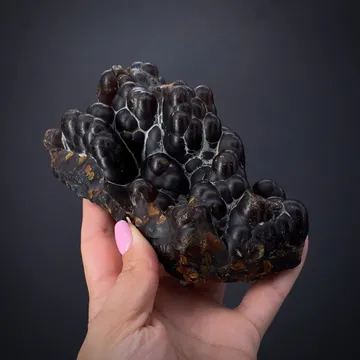
Rio Grande do Sul, Brazil - famed for amethyst in basalt geodes and classic agate geodes, with dark rinds, pale chalcedony bands, and strong lapidary appeal.
Key facts
Rio Grande do Sul is one of the great volcanic-gem provinces of the mineral-collecting world: the southern Brazilian state where basalt flows of the Serra Geral Formation and the broader Paraná volcanic province produced immense numbers of silica-lined geodes. To collectors, the name usually calls up two related but distinct specimen traditions. In the north, around Ametista do Sul, Iraí, Planalto, Frederico Westphalen, Rodeio Bonito, and the Alto Uruguai region, the prize is amethyst in basalt geodes—purple quartz lining elongate cavities, commonly over a pale agate and colorless quartz shell, with late calcite, gypsum, goethite, barite, and clay minerals adding specimen character. In the central part of the state, especially around Salto do Jacuí and the Soledade trading and cutting center, the classic material is agate: geodes and nodules with fortification banding, eye structures, hollow crystal centers, and enormous commercial importance for the lapidary trade.
The best Rio Grande do Sul specimens have a look that is immediately recognizable: dark basalt rinds, a greenish celadonite or chloritic selvage, pale chalcedony or agate bands, then sparkling quartz or amethyst growing inward. Cabinet and museum-size amethyst “cathedrals” from the state can stand like violet-lined windows cut through black lava; smaller collector pieces may be far more refined, with crisp calcite scalenohedra perched on amethyst, green inclusions forming phantoms in calcite, or delicate late iron oxides tracing “skunk” bands along crystal faces. For agate collectors, Rio Grande do Sul is equally foundational: it supplied the rough that helped feed the Idar-Oberstein cutting industry, filled countless nineteenth- and twentieth-century collections, and remains a benchmark for Brazilian agate in both natural and dyed forms.
Regional View
Country View
Geologically, these are cavity-filling deposits in volcanic rocks rather than vein deposits in the classic Alpine or hydrothermal sense. The essential collector’s sequence is repeated again and again across the district: a cavity opened or preserved in the lava, a green alteration rind at the wall, cryptocrystalline silica as chalcedony and agate, coarser colorless quartz, and—where iron-bearing conditions and later irradiation history allowed—amethystine quartz. Calcite is not a mere accessory here; in Ametista do Sul and Iraí it is one of the great late-stage species, forming euhedral crystals in open geode centers and occasionally producing specimens as sought-after as the amethyst itself.


Search for specimens: View all specimens from Rio Grande do Sul, Brazil
Rio Grande do Sul is the southernmost state of Brazil, bordered by Uruguay and Argentina, and its gem deposits are mostly tied to the volcanic pile of the Serra Geral Formation in the Paraná Basin. The important collector deposits are geode and amygdule systems in basaltic to locally more evolved volcanic rocks. In the Alto Uruguai amethyst belt, the host is commonly described as massive, relatively fresh basalt, mined by horizontal adits driven into a favorable geode-bearing level. In the Salto do Jacuí agate district, the host rocks are more deeply weathered volcanic units, and agate geodes are commonly worked by open pits and shallow workings rather than the long hard-rock adits typical of Ametista do Sul.
The Ametista do Sul mining district has been studied as a flow-by-flow volcanic sequence. Geological work there has described multiple basalt flows and several geode-bearing levels, with the most productive amethyst level supplying the world-class elongated geodes for which the district is famous. The geodes may be spherical, cap-shaped, tubular, cylindrical, or vertically elongated; in the Ametista do Sul literature, metric geodes up to about 4 meters long are specifically noted. Their internal fill is not random. The outermost wall is typically green to blue-green celadonitic alteration material, followed by agate and chalcedony, then colorless quartz, and finally amethyst toward the open center. Late calcite and, in some workings, gypsum var. selenite developed after the main silica stages.
Mining has been both small-scale and highly organized. In the 1980s descriptions of Rio Grande do Sul amethyst mining, some families worked their own land with hand tools, rented bulldozers or jackhammers when necessary, or partnered with gem merchants who financed exploration and extraction. Open-pit methods were used in some areas, while underground work became important where intact amethyst-lined cavities were preserved in unweathered basalt. At Iraí, Alberto Lemos de Moraes is credited in the gemological literature with trying underground recovery in 1969; his tunnel reportedly reached about 60 meters. In Ametista do Sul and neighboring municipalities, the modern mining landscape is a patchwork of privately controlled garimpos, cooperatives, legal permits, safety training, and downstream cutting, retail, and tourism.
COOGAMAI, the Cooperativa de Garimpeiros do Médio Alto Uruguai, is a central modern institution in the district and describes itself as Brazil’s first cooperative of garimpeiros. Its public materials list licensed garimpos under its orbit and emphasize legal regularization, safety training, environmental licensing, and technical support. The highest concentration is in Ametista do Sul and Planalto, but production and commerce involve a wider network of northern Rio Grande do Sul towns. Soledade, in central Rio Grande do Sul, is crucial in a different way: it is a major cutting, treatment, wholesaling, and export center for agate, amethyst, and related silica materials, so specimens purchased there may have originated elsewhere in the state or even outside it unless labeled with a named mine or municipality.
Historically, the Rio Grande do Sul agate and amethyst story is tied to German-speaking immigrant and cutting traditions. Gemological accounts note that immigrants from the Hunsrück region near Idar-Oberstein settled between the Taquari and Jacuí rivers around 1820 and recognized the economic potential of local agate and amethyst shortly afterward. By the mid-nineteenth century, Brazilian agate rough was already part of the transatlantic supply chain feeding Idar-Oberstein’s lapidary industry. Ametista do Sul itself has a more local twentieth-century origin story, with mining in the Médio and Alto Uruguai region said to have begun in the 1940s after farmers and hunters found stones in roots, streams, and worked fields. The municipality took its present identity from the gem: originally associated with the name São Gabriel, it became Ametista do Sul as the mining economy and public identity grew around amethyst.
Access today is not the same as a casual collecting locality. Active mines are working industrial or cooperative operations, and permission is essential. The practical collector route is through reputable dealers, mine shops, Soledade wholesalers, and the public-facing attractions in Ametista do Sul, where former or controlled mine spaces have been turned into museums, restaurants, wine cellars, and underground tourism sites. Some tourist visits show geodes in the basalt and demonstrate how the miners read the rock, but that should not be confused with open collecting access. Serious specimen buyers should ask for the most precise available locality: Rio Grande do Sul is a correct regional label, but “Iraí,” “Ametista do Sul,” “Planalto,” “Salto do Jacuí,” “Soledade,” “Barros Cassal,” or a named mine is far better when it is honestly known.
Notable finds are not restricted to giant cathedrals. A single amethyst pocket may yield sculptural geode sections, loose crystal groups, calcite-on-amethyst plates, quartz epimorphs after anhydrite, gypsum blades, or small but elegant calcite crystals with green inclusions. Salto do Jacuí agate is different: the commercial finds are often large volumes of geodes rather than one display pocket, and the rough may be selected for banding, translucency, natural color, ability to take dye, or suitability for slicing into slabs and bookends. Rio Grande do Sul is therefore both a specimen locality and an industrial gem-material province, and the collector must always read a piece in that dual context.
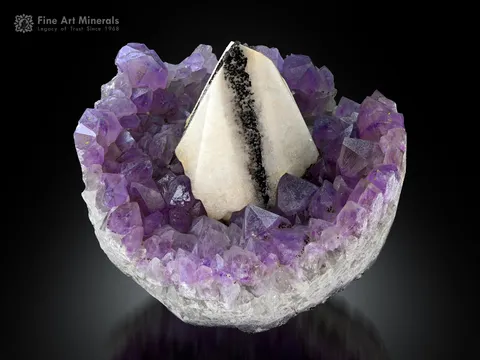
Calcite from Rio Grande do Sul is best known from the amethyst geodes of Ametista do Sul and Iraí, where it commonly represents a late stage of crystallization in the open center of the cavity, growing after the main agate, quartz, and amethyst sequence. Good specimens show sharp white, colorless, pale honey, or green-included scalenohedra and modified rhombohedral forms perched on amethyst or quartz; in Iraí, calcite crystals to around 10 cm have been recorded from amethyst geodes, and the district is especially admired for scalenohedra with chlorite or celadonite inclusions. The finest pieces have contrast—bright calcite against purple amethyst, green phantoms or dusting in the calcite, or the rare “skunk” effect in which iron oxides form dark bands on calcite faces—while ordinary examples are merely broken carbonate patches or dull late crusts on commercial geode fragments.
Quartz from Rio Grande do Sul is the structural heart of the geodes: colorless macrocrystalline quartz commonly lines the cavity after chalcedony and agate and before amethyst, and in many agate geodes it forms the sparkling central druse or larger rock-crystal interior. In the Alto Uruguai amethyst belt, quartz may occur as clear to milky crystals beneath or beside amethyst, as crusts lining basalt cavities, as epimorphs after earlier minerals, and as the colorless transition zone between banded agate and purple quartz; in Salto do Jacuí and Soledade material, quartz centers are a familiar feature of sliced agate nodules. Collectible quartz pieces from the state are those with clean terminations, attractive association with amethyst, calcite, celadonite, or agate banding, and an intact geode architecture that shows the sequence of growth, rather than isolated broken points cobbed from cutting rough.
Amethyst is the signature mineral of Rio Grande do Sul, especially from Ametista do Sul, Iraí, Planalto, and the Alto Uruguai district, where purple quartz crystals line basalt-hosted geodes in one of the world’s most productive amethyst provinces. Crystals range from millimetric druse to centimeter-scale points, with published descriptions noting crystals up to roughly 15 cm in the Ametista do Sul district and gemological accounts noting common geode crystals up to about 10 cm; the best color is a saturated violet to bluish violet, typically without much brown, though some pieces are grayish or unevenly zoned. Good collector specimens preserve the full visual story—black basalt rind, green celadonitic selvage, pale agate or chalcedony, colorless quartz, then bright amethyst—with added value for sharp calcite, gypsum, goethite, or unusual inclusions; ordinary pieces are abundant broken cathedral sections with pale, bruised, heated, glued, or heavily repaired surfaces.
Agate from Rio Grande do Sul is centered on Salto do Jacuí and the broader central-state cutting trade, with additional production and commerce through Soledade and related districts; it occurs as banded chalcedony filling geodes and nodules in Serra Geral volcanic rocks, commonly as oval to irregular cavities with quartz, amethyst, or opal in the center. The Salto do Jacuí district is famous for large-scale production, including gray to bluish-gray “Umbu” agate with weak or subdued banding that is widely used for dyeing, but the collector-grade material is the natural-pattern material: fortification bands, eyes, tubes, scenic patterns, translucent layers, and hollow centers lined with quartz. Fine pieces are judged by natural color, sharpness and continuity of banding, translucency, freedom from saw cracks, and whether any dyeing or polishing is appropriate and disclosed; mediocre examples are flatly dyed, muddy-banded commercial slices with little mineralogical or aesthetic individuality.
Chalcedony in Rio Grande do Sul is not merely a separate collectible species but the essential early silica lining of the state’s geodes, forming the microcrystalline layers that grade into agate, onyx, and later macrocrystalline quartz. In the Ametista do Sul sequence it follows the green celadonitic wall alteration and precedes colorless quartz and amethyst; in the agate districts it makes the pale gray, white, bluish, caramel, or brownish bands and massive interiors that lapidaries slice, polish, and sometimes dye. Collectors should look for pieces that show the transition from chalcedony to quartz in one intact section, natural orbicular or eye structures, clean botryoidal or waxy surfaces, and association with basalt rind or amethyst, while avoiding overpolished commercial pieces where the original cavity relationships have been lost.
Chlorite from Rio Grande do Sul is a collector’s label that requires care, because green material in the amethyst geode assemblage may be true chlorite-group mineral, clinochlore, celadonite, or mixed clay alteration depending on the specimen and how it was identified. The most desirable pieces are from Iraí and related Alto Uruguai localities, where green inclusions, dustings, or phantoms occur in or on calcite and quartz, creating pale-green to deep-green contrast against white calcite, colorless quartz, or purple amethyst; Mindat photo data and Mineralogical Record index entries specifically document chlorite-included calcite from Iraí. The best examples show the green mineral as a crystallographically meaningful inclusion or phantom rather than a vague coating, and labels that distinguish “chlorite group,” “clinochlore,” and “celadonite” are preferable to broad trade descriptions.
Beyond the principal silica and carbonate suite, Rio Grande do Sul has a much richer mineral record than many collectors realize. Ametista do Sul and Iraí geodes have produced celadonite, goethite, lepidocrocite, pyrite, gypsum var. selenite, barite, fluorite, mordenite, and quartz epimorphs after anhydrite, while the wider Serra Geral basalt quarries of the state carry zeolites such as heulandite-series minerals, mordenite, scolecite, and stellerite. The state also has notable non-geode mineralization: the Vista Alegre district on the Rio Grande do Sul–Santa Catarina border is documented for native copper, chrysocolla, copper oxides, and minor malachite and azurite in Paraná basalt; Lavras do Sul and other shield-related areas add metallic and hydrothermal species that belong to a different geological chapter. No major IMA type mineral is broadly celebrated from the Rio Grande do Sul geode fields themselves, but the state is exceptional for varieties and assemblages: iris agate, eye agate, “skunk” calcite, selenite in amethyst geodes, and the commercial and scientific importance of its agate-amethyst systems.
Rio Grande do Sul material is abundant, but abundance does not remove the need for careful buying. The most common authenticity issue is not fake amethyst; it is incomplete or misleading disclosure. Much of the agate from the state is dyed, especially gray Salto do Jacuí material selected because it accepts color well. Dyed agate is a legitimate lapidary product when sold as such, but collectors seeking natural mineral specimens should examine color concentration along cracks, unnaturally even neon hues, and dye bleeding into porous rind or fractures. Natural agate and chalcedony from Rio Grande do Sul do exist in attractive colors, but the strongest blue, pink, green, and hot-purple agate slices in the mass market should be presumed treated unless provenance and disclosure are strong.
Heat treatment is equally important. Rio Grande do Sul amethyst has long been heated to produce citrine, and older gemological literature notes that the resulting material has been marketed in Brazil under misleading names such as “Rio Grande do Sul topaz.” Heated citrine from amethyst may be attractive, but it should never be confused with natural citrine from geodes, which local miners regarded as rare. “Green amethyst” is another problematic trade phrase: green quartz sold under that name is generally treated quartz or prasiolite-style material, not amethyst in the mineralogical sense. For Rio Grande do Sul specimens, ask whether the piece is natural amethyst, heated citrine, dyed agate, or a polished decorative object.
Large amethyst cathedrals and geode sections require condition scrutiny. Because the basalt rind is heavy and irregular, bases are commonly cut flat, backed with cement, stabilized, or mounted; that may be normal for décor pieces but should be disclosed for specimen-grade material. Look for repaired cracks through the agate shell, glued crystal fields, repainted black edges, and artificially darkened basalt rinds. Some giant agate or quartz geode slices are stabilized before sawing, which can be entirely reasonable when the object is a lapidary sculpture, but it changes how a collector should value it as a natural specimen.
Mislabelling between Brazil and Uruguay is frequent. The volcanic geode provinces continue across the border, and polished amethyst cathedrals may be sold simply as “Brazil,” “Uruguay,” “Soledade,” or “Rio Grande do Sul” depending on where they were mined, bought, cut, or exported. Uruguay pieces often have different color and geode style, but visual separation is not always reliable. Soledade is a commercial hub, not necessarily the mine locality. A strong label should name the state and, where possible, the district or municipality: Iraí for many calcite-amethyst specimens, Ametista do Sul for classic mine geodes, Salto do Jacuí for agate, and Barros Cassal or Fontoura Xavier where applicable.
Condition problems vary by species. Amethyst tips chip easily in transport, and pale bruising on terminations is common in geode sections. Calcite on amethyst is much softer than quartz and reacts to acid, so avoid acidic cleaning and do not assume that iron staining can be safely removed. Gypsum var. selenite from the district is soft, water-sensitive over time, and easily cleaved. Celadonite, chlorite-group minerals, and clay-rich green rinds can shed or smear if aggressively scrubbed. Fluorescence can add interest: calcite from Iraí-type specimens has been reported to show strong pink response under longwave ultraviolet light, sometimes with phosphorescence, but fluorescence should be tested gently and not used as a sole locality proof.
The market remains broad. Small amethyst geode fragments and dyed agate slices are inexpensive and ubiquitous; refined calcite-on-amethyst, chlorite-included calcite, good natural agate, complete miniature geode sections, unusual epimorphs, and old-label Iraí or Ametista do Sul specimens are much scarcer. The top end is no longer just “largest and darkest.” Serious collectors now value intact paragenesis, precise locality, natural color, association minerals, and whether a piece escapes the heavily processed decorative pipeline.
One of the most memorable modern agate stories from Rio Grande do Sul began not in a mine gallery but in a soybean field. In 2014, farmers tilling land struck a large boulder with a backhoe and crushed one end, exposing crystals inside. The object proved to be an approximately 2-meter, or 6-foot, geode-boulder. Before the saw could touch it, the damaged stone had to be stabilized with wire and cement. Then came the slow part: each slice took 12 days to saw, and polishing the full set of 16 slices took more than a year. The finished group became GIA’s “Eyes of Brazil” exhibit, a dramatic sequence of agate plates that shows the cavity wall, the layered chalcedony, and the later rock crystal that grew into the remaining open space. It is a specimen story that feels entirely Rio Grande do Sul: farm country, basalt, hidden geodes, lapidary labor, and a final object that is half mineral specimen and half monumental sculpture.
The older mining literature gives a vivid picture of how Rio Grande do Sul amethyst was read underground. Miners learned to follow green clues. Small celadonite nodules only a few millimeters across might lead to tiny quartz geodes, and those in turn could guide work toward larger amethyst-filled cavities. A rounded green knob protruding from gray-black basalt was worth attention. The thickest green selvages were considered promising, because the same iron-rich alteration environment was linked in miners’ experience to better amethyst. Once a geode was located, a small hole could be punctured through the rind and a light lowered inside so a buyer could judge the crystals before the geode had even been removed. The price could be negotiated in the rock, before the piece became either a mineral specimen or cobbing rough.
At Iraí, the work could be brutally patient. Alberto Lemos de Moraes began testing underground recovery in 1969, choosing massive, unweathered basalt because intact amethyst-lined cavities were more likely there than in fractured rock. Explosives and power tools opened the tunnel, which eventually extended to about 60 meters, but the final removal of a good geode still came down to hand tools. A large intact geode could take as long as a week to chisel free from hard basalt. That fact explains much about the condition of old Rio Grande do Sul specimens: the clean, intact, unrepaired ones were never easy, and they were never merely scooped from soft ground.
Near Santa Maria, a different episode shows the unpredictable abundance of the province. In the early 1930s, German gem dealers visiting the region reportedly found amethyst crystals scattered on the ground. Decades later, at the Siegfried Klein mine about 20 kilometers outside Santa Maria, a newly opened pit worked by four miners with simple picks yielded thousands of loose sections of amethyst geodes. During the first week, about 1,000 kg of amethyst came out; roughly 200 kg was specimen or cobbing quality, and after cobbing that might yield only 5 to 10 kg of usable material. It is a perfect example of the Rio Grande do Sul paradox: enormous tonnage, but a much smaller fraction suitable for fine gems or refined specimens.
The Bortoluzzi-Fischer mines near Iraí show the other end of the operational scale. There, 20 miners used open-pit methods to reach an amethyst-bearing basalt layer about 30 meters below the surface. A bulldozer spent an entire year removing hundreds of tons of overburden before miners reached the productive basalt. At that level, jackhammers, explosives, and hand tools took over. Some recovered geodes weighed up to 100 kg, though many crystals were very dark. Around Iraí, other mines followed the horizontal adit model, with tunnels about 2 meters high and up to 5 meters wide driven into hillsides to meet the productive layer.
Ametista do Sul has transformed part of that underground world into public spectacle. Former mine spaces now hold mineral museums, restaurants, shops, wine cellars, and other attractions, while active mining continues around the district. This is not a theme pasted onto a town; it is a town built around a real deposit. The walls, churches, shops, and museums are filled with the same mineral that miners have chased through basalt for generations.
H. A. Gilg, G. Morteani, Y. Kostitsyn, C. Preinfalk, I. Gatter, and A. J. Strieder, “Genesis of amethyst geodes in basaltic rocks of the Serra Geral Formation (Ametista do Sul, Rio Grande do Sul, Brazil): a fluid inclusion, REE, oxygen, carbon, and Sr isotope study on basalt, quartz, and calcite,” Mineralium Deposita, 38(8), 1009–1025, 2003 — Core scientific paper on Ametista do Sul geode formation, paragenesis, fluid inclusions, isotopes, and low-temperature cavity infill.
David Stanley Epstein, “Amethyst Mining in Brazil,” Gems & Gemology, Winter 1988 — Classic field-based gemological account of Brazilian amethyst mining, with detailed Rio Grande do Sul sections on geology, mining methods, production, heat treatment, Santa Maria, and Iraí.
Pedro Luiz Juchem, “Gem Materials in Rio Grande do Sul State, Brazil — A Field Trip Guide,” UFRGS/LABOGEM, 2014 — Field guide to the state’s agate and amethyst districts, including Salto do Jacuí, Ametista do Sul, Soledade, geode mining, processing, and regional geology.
Pedro Luiz Juchem, Tania Mara Martini Brum, G. M. Pulz, and Lauren da Cunha Duarte, “Geologia e mineralogia das gemas do Rio Grande do Sul,” in 50 Anos de Geologia, Instituto de Geociências, UFRGS, 2007 — Portuguese-language overview of Rio Grande do Sul gem geology and mineralogy, with important details on Salto do Jacuí agate, Ametista do Sul amethyst, calcite, selenite, and geode stratigraphy.
D. J. Mossman, L. A. Groat, J. M. Ehrman, Ralf Brüning, and Lynne Semple, “‘Skunk’ Calcite — Mineral Paragenesis in an Amethyst Geode from Ametista, Rio Grande Do Sul, Brazil,” The Mineralogical Record, 40(2), 121–125, 2009 — Specialist study of rare banded calcite, goethite, lepidocrocite, and amethyst relationships in an Ametista do Sul geode.
Léo A. Hartmann and coauthors, “Geochemical stratigraphy of lavas and fault-block structures in the Ametista do Sul geode mining district, Paraná volcanic province, southern Brazil,” Ore Geology Reviews, 2012 — Important paper on lava-flow stratigraphy and structural controls in the Ametista do Sul mining district.
Viter Magalhães Pinto, Léo Afraneo Hartmann, and Wilson Wildner, “Epigenetic hydrothermal origin of native copper and supergene enrichment in the Vista Alegre district, Paraná basaltic province, southernmost Brazil,” International Geology Review, 2011 — Scientific treatment of native copper, copper oxides, chrysocolla, malachite, and azurite in Paraná basalts along the Rio Grande do Sul–Santa Catarina region.
Serviço Geológico do Brasil / CPRM, “Mapa Gemológico do Estado do Rio Grande do Sul” — Official gemological map and resource summary for Rio Grande do Sul, documenting amethyst, agate, carnelian, jasper, citrine, fossil wood, serpentinite, and other gem materials.
Mindat, “Rio Grande do Sul, Brazil” — Regional mineral database page with documented species, sublocalities, and links to Ametista do Sul, Iraí, Salto do Jacuí, Barros Cassal, and other locality pages.
Mindat, “Ametista do Sul, Rio Grande do Sul, Brazil” — Locality page for the most famous amethyst district, including mineral list, references, mine names, and Rock Currier locality notes.
Mindat, “Calcite from Iraí, Rio Grande do Sul, Brazil” — Useful occurrence page for the important Iraí calcite association, including photo-based associations with amethyst, quartz, celadonite, chlorite-group minerals, fluorite, barite, and zeolites.
“DOCUMENTARY: Ametista do Sul — Brazil’s Underground City of Amethysts,” Elzinga, YouTube — Long-form travel documentary showing Ametista do Sul mines, museum spaces, underground attractions, amethyst commerce, and local identity.
“A trip to the underground agate mine in Salto do Jacui, RS, Brazil,” The Rock Space, YouTube — Short field video from an underground agate mine in the Salto do Jacuí district.
GIA Museum, “Eyes of Brazil” exhibit — Museum media and exhibit description for the 16-slice agate geode from Rio Grande do Sul discovered in a soybean field in 2014.
Museu de Mineralogia — Ametista do Sul e Geoparque Subterrâneo — Public-facing museum site for the Ametista do Sul underground mineralogy attraction, useful for understanding how the district presents mining and mineral specimens to visitors.
Mindat — Rio Grande do Sul, Brazil — Best starting point for the full state-level mineral list and sublocality hierarchy.
Mindat — Ametista do Sul, Rio Grande do Sul, Brazil — Focused database page for the state’s most famous amethyst-geode district.
Mindat — Iraí, Rio Grande do Sul, Brazil — Important locality page for amethyst, calcite, chlorite/celadonite associations, and late-stage geode minerals.
GIA — Amethyst Mining in Brazil — Essential gemological field article with detailed Rio Grande do Sul mining observations.
GIA Museum — Eyes of Brazil — A vivid museum account of a single large Rio Grande do Sul agate geode cut into 16 polished slices.
Gilg et al. 2003 — Genesis of amethyst geodes in basaltic rocks of the Serra Geral Formation — Scientific foundation for understanding Ametista do Sul geode paragenesis.
Juchem — Gem Materials in Rio Grande do Sul State, Brazil — Field-trip guide with practical geological context for agate, amethyst, mining districts, and processing centers.
COOGAMAI — Cooperativa de Garimpeiros do Médio Alto Uruguai — Current institutional source for the cooperative structure behind much of the modern Ametista do Sul mining sector.
COOGAMAI — Atividades da Coogamai — Useful current page on licensed garimpos, training, legal regularization, and cooperative mining support.
Serviço Geológico do Brasil / CPRM — Mapa Gemológico do Estado do Rio Grande do Sul — Official geological survey reference for the state’s gemstone resources.
Museu de Mineralogia — Ametista do Sul — Visitor-oriented view of the underground museum and geotourism side of the amethyst district.
Secretaria do Turismo de Ametista do Sul — História — Local historical background on the municipality and the development of amethyst mining.

.jpg)