






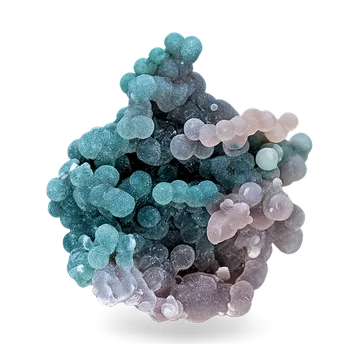
Chalcedony — Rio Grande do Sul: banded agate and amethyst geodes from Salto do Jacuí and Ametista do Sul; prized for color, scale, and volcanic context.
Key facts
Chalcedony from Rio Grande do Sul is best understood as part of one of the great volcanic-silica provinces of the mineral world. In collectors’ trays it appears as agate, onyx, eye agate, translucent gray and white chalcedony, hollow geode shells, quartz-lined nodules, and the pale chalcedony bases on which Brazilian amethyst grew. The state is famous for commercial agate and amethyst, but the quiet mineralogical foundation of that fame is chalcedony: the fibrous, microcrystalline SiO2 that built the first silica linings inside basalt cavities before later quartz and amethyst occupied the open centers.
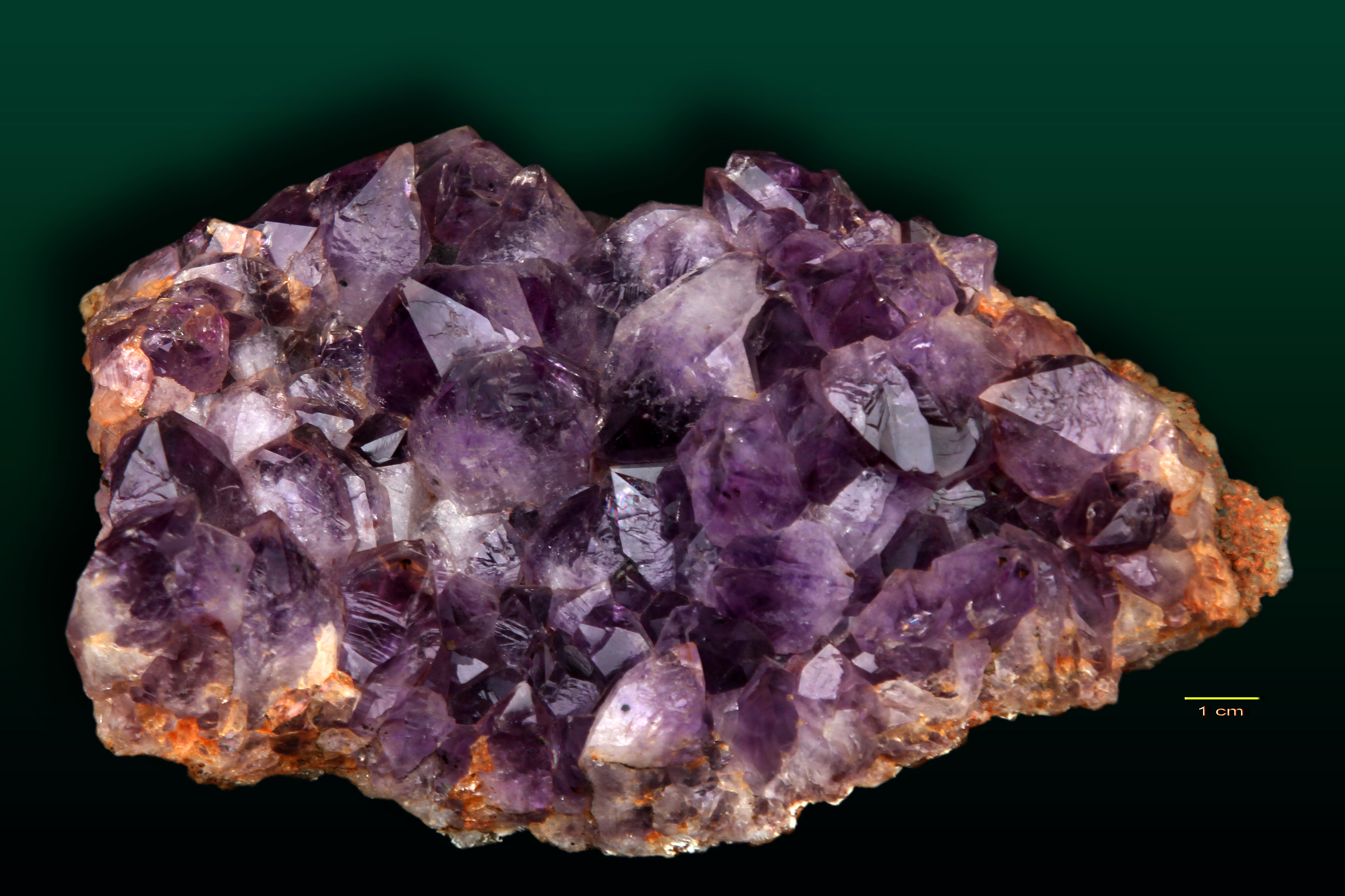
Photo: Lech Darski, Wikimedia Commons
The locality is not a single pit but a state-scale collecting name covering several related districts in the Serra Geral Formation of the Paraná Basin. In the central part of the state, Salto do Jacuí is the classic agate and chalcedony mining district, with geodes hosted by altered vesicular basalt. In the north, especially around Ametista do Sul and the Alto Uruguai region, the same broad volcanic story produces the immense amethyst geodes for which Brazil is famous; their outer mineral sequence commonly begins with celadonite and chalcedony or agate, passes inward to colorless quartz, and ends with purple amethyst.

Photo: Dennis Tryon, Wikimedia Commons
What makes Rio Grande do Sul chalcedony distinctive is the combination of abundance, scale, and variety. Small cabinet pieces may show tight fortification banding, translucent gray windows, white plume-like swirls, quartz-lined cavities, or delicate blue-gray tones. Larger pieces can be sliced from geodes tens of centimeters across, and exceptional geode-boulders reach display scale. Collectors prize natural color, sharp band contrast, undyed gray-blue or white chalcedony, intact geode margins, amethyst-on-chalcedony paragenesis, unusual casts, and specimens that preserve enough rind or basalt context to make the volcanic origin legible.
Historically, Rio Grande do Sul chalcedony has also mattered far beyond specimen cabinets. The state became a major source of Brazilian agate for cutting, dyeing, polishing, bookends, cameos, slabs, spheres, and decorative objects, while Ametista do Sul became synonymous with the amethyst geode trade. For serious mineral collectors, the most desirable material is not the heavily dyed lapidary stock but the specimens that show the natural architecture of the geode: chalcedony shell, agate banding, quartz transition, and, where present, the amethyst core.
Search for specimens: View all chalcedony specimens from Rio Grande do Sul, Brazil
The chalcedony deposits of Rio Grande do Sul are volcanic geode deposits in the Lower Cretaceous Serra Geral Formation, part of the Paraná volcanic province. The host rocks are mainly basaltic lava flows, especially altered vesicular or amygdaloidal basalt. Gas cavities, fractures, and larger open spaces in the lava later became sites for silica deposition. In the simplest collector’s view, the cavity wall was coated first by green celadonite or altered basalt minerals, then by chalcedony and agate, then by more coarsely crystalline quartz, and, in the amethyst districts, finally by amethystine quartz.
Salto do Jacuí, in central Rio Grande do Sul, is the principal agate district. Mining there is mainly open-pit work in altered vesicular basalt, and the extracted material has fed both the natural specimen trade and the enormous Brazilian agate lapidary industry. The district is especially associated with banded agate, chalcedony, onyx, eye agate, opal, quartz, calcite, gypsum, and altered clay minerals. The prized Umbu agate is noted for an uncommon dark blue color and high microporosity, a feature that also made some Salto do Jacuí agate especially responsive to dyeing in commercial processing.
Ametista do Sul, in the northern Alto Uruguai region, is the great amethyst-geode counterpart. There, large geodes are extracted from fresh basalt, commonly in horizontal underground workings driven into geode-bearing flows. The mines exploit a productive horizon in thick basaltic lava, and miners evaluate geodes by drilling or opening a small window and introducing light to judge the color and size of the interior crystals. Chalcedony is not the showiest phase in those geodes, but it is the essential early lining: a gray to white agate-chalcedony layer between the green outer alteration shell and the later quartz-amethyst interior.
Collecting access is not comparable to casual public rockhounding in an abandoned dump. These are active mining and commercial districts. Salto do Jacuí material generally enters the market through miners, lapidary processors, exporters, and dealers. Ametista do Sul has mine tours and museum-style underground displays, but working mines are industrial spaces; specimen access depends on local permission, mine ownership, and safety conditions. The safest route for collectors is through reputable dealers who can distinguish natural chalcedony and agate from dyed decorative stock and who can describe whether the piece comes from Salto do Jacuí, Ametista do Sul, Iraí, Barros Cassal, Soledade-area trade stock, or another Rio Grande do Sul locality.
Production has been substantial for decades. Older references already treated Rio Grande do Sul agate and amethyst as major world commodities, and modern geological work continues to focus on the state because its geodes are large, abundant, and unusually informative. Notable finds range from small agate nodules to multi-meter amethyst geodes and large agate geode-boulders cut into dramatic slices. For chalcedony collectors, the best finds are often less theatrical than the largest amethyst cathedrals: a natural, undyed agate nodule with crisp bands, a hollow chalcedony cast, a geode showing the complete sequence from chalcedony rind to quartz center, or an amethyst plate where the chalcedony base is still visible.
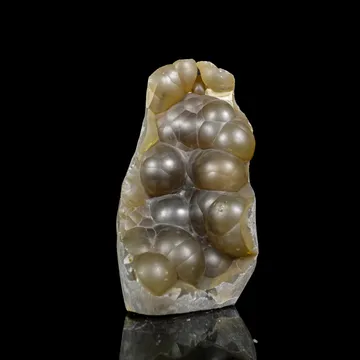
Rio Grande do Sul chalcedony occurs primarily as geode linings, agate bands, nodules, hollow casts, and transitional layers beneath quartz or amethyst. In hand specimen it may be massive, botryoidal, finely banded, fortification-patterned, swirled, translucent, waxy, or drusy where later quartz has overgrown the chalcedony surface. The most familiar form is agate: banded chalcedony in concentric or subparallel layers inside former cavities. In the amethyst districts, chalcedony commonly forms the outer gray or whitish shell beneath the quartz-amethyst interior.
Colors range from white, cream, pale gray, bluish gray, brown, honey, reddish brown, and orange-brown to darker blue-gray tones. Many natural pieces are understated compared with dyed commercial agate. That restraint is part of their appeal: fine natural Rio Grande do Sul chalcedony often has soft internal glow, smoky translucency, and bands that appear to float rather than shout. Iron oxides and hydroxides can contribute brown, red, yellow, or orange tones; white layers may be opaque and porcelain-like; translucent zones may appear gray-blue at the edges.
Typical specimen sizes vary widely. Small nodules and broken geode sections may be only a few centimeters across. Good cabinet specimens commonly fall in the 5–20 cm range. Commercial agate pieces and geode sections may be much larger, and amethyst geodes from the northern district can reach meter scale. For the serious collector, size matters only when the mineralogical story remains clear. A small geode with crisp natural banding, intact rind, and clean chalcedony-to-quartz transition is often more desirable than a large, over-polished, dyed slab.
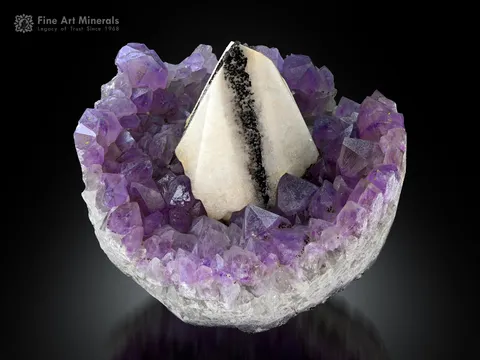
Associated minerals are locality-dependent. In Salto do Jacuí, quartz, agate, chalcedony, onyx, eye agate, opal, calcite, gypsum, and zeolite-group minerals are recorded with altered basalt and clay minerals. In Ametista do Sul, chalcedony is associated with amethyst, colorless quartz, agate, celadonite, calcite, goethite, gypsum, pyrite, and locally iron oxyhydroxide coatings such as goethite and lepidocrocite-related patinas. The famous “skunk” calcite specimens from Ametista do Sul are a reminder that these geodes are not just simple quartz pockets; they can preserve a complicated sequence of silica, carbonate, and iron minerals.
Quality is judged differently depending on the form. For natural agate and chalcedony, collectors look for undyed color, sharp but not artificial-looking banding, good translucency, complete geode margins, balanced polish if the piece is cut, and minimal fractures. For amethyst-on-chalcedony specimens, the quality of the chalcedony base matters: clean white or gray chalcedony, visible banding, pleasing contrast with purple quartz, and an unrepaired contact between the microcrystalline base and later crystals. For unusual chalcedony casts, hollow forms, or polyhedral agate, completeness and lack of crushing are paramount.
The most diagnostic visual feature is the layered volcanic-geode architecture. A Rio Grande do Sul specimen may show a rough basaltic or green celadonitic exterior, a chalcedony-agate rind, a zone of colorless quartz, and an inward-facing druse of amethyst. Even when only part of that sequence survives, it gives the material a distinctive identity and separates good geological specimens from generic polished agate décor.
Authenticity issues for Rio Grande do Sul chalcedony are mostly about treatment, presentation, and locality precision rather than outright synthetic manufacture. Agate from Brazil is abundant enough that fully fake agate is uncommon; the real concern is dye. Much Brazilian agate is intentionally dyed for the decorative and lapidary trade, and the porous structure of some chalcedony bands accepts dye very readily. Bright blue, hot pink, neon green, strong purple, saturated black-and-white contrast, or color concentrated in cracks and porous bands should be treated as enhanced unless convincingly documented otherwise.
Natural blue-gray chalcedony and naturally dark Umbu-type agate do exist, so the presence of blue alone is not proof of dye. The distinction lies in subtlety, distribution, and surface behavior. Natural color usually follows mineralogical banding with restrained saturation; dye often pools in fractures, rind margins, saw marks, or porous white layers and may look too even or too vivid. A loupe can reveal color bleeding into cracks or granular zones. On polished slabs, inspect the outer edge and any chips: artificial color often reveals itself where it has penetrated irregularly.
Heat treatment is also part of the broader Rio Grande do Sul quartz story. Some amethyst from Brazil is heated to produce citrine-like yellow to orange material. For chalcedony and agate, heating and chemical treatment may be used in dyeing processes or to modify colors. This does not make the stone “fake,” but it does change its collecting category. A mineral specimen sold as natural chalcedony or natural agate should not be dyed; a decorative lapidary object may be attractive even when treated, provided the treatment is disclosed.
Large amethyst geodes and cathedral pieces from Rio Grande do Sul commonly have cut bases, cement, resin, plaster, paint, or reinforcement on the back or exterior. Stabilization can be legitimate when heavy geodes are prepared for display, but it becomes a problem when cement is used to imitate natural rind, hide repairs, add weight, or disguise assembled fragments. For chalcedony collectors, examine whether the chalcedony shell is continuous, whether broken geode sections have been glued, and whether the matrix contact is natural or reconstructed.
Common condition issues include saw marks, over-polishing, bruised quartz druse, edge chips on agate bands, internal fractures from extraction, repaired geode walls, and weathered or friable basalt rind. In hollow geodes, thin chalcedony shells may be cracked or stabilized. Amethyst-on-chalcedony plates often have broken crystal tips even when the chalcedony base is intact. For natural, unpolished chalcedony, avoid chalky, weathered surfaces unless the specimen has unusual form or clear locality significance.
Rarity depends strongly on type. Ordinary dyed Brazilian agate slices are common. Natural undyed Rio Grande do Sul chalcedony with excellent banding is scarcer but still obtainable. Fine amethyst-on-chalcedony specimens are available because of sustained production, though top pieces with strong amethyst color, visible chalcedony base, and minimal damage are increasingly selected quickly. Unusual hollow casts, polyhedral agate forms, natural blue-gray material, complete small geodes, and specimens with well-documented mine provenance are the more interesting targets for advanced collectors.
In one of the most memorable modern agate stories from Rio Grande do Sul, the discovery began not in a mine gallery but in a farm field. In 2014, soy farmers were tilling land when a backhoe crushed the end of a large boulder and exposed crystals inside. The boulder proved to be an agate geode about 2 meters, or 6 feet, long. Before it could be cut, the damaged geode-boulder had to be stabilized with wire and cement. Each slice then took 12 days to saw, and polishing the full set of 16 slices took more than a year. The finished series, now known through GIA’s “Eyes of Brazil” exhibit, is a superb demonstration of the way chalcedony first lined the cavity walls and left room for rock crystal to grow toward the center.
A very different view comes from underground at Ametista do Sul. In the Belvedere mine, visitors see the mining logic of the district in three dimensions: dark basalt walls, geodes left in place, and the pale sequence of silica visible where cavities are opened. The useful clue for miners is the green outer celadonite; beneath it lies agate-chalcedony, then colorless quartz, and finally amethyst. The geodes can be immense. One underground gallery displays an amethyst geode approximately 2 meters long by 1 meter high, and geodes in the district may reach about 3 meters in length.
The technique of evaluating those geodes is wonderfully direct. When miners locate a cavity, they make a small hole, introduce a lamp, and judge the interior by the color and size of the amethyst crystals. A dark, saturated purple lining with larger crystals raises the value; pale or less attractive material may be cut for decorative use or heated to produce citrine colors. Extraction is deliberately cautious. Rather than shattering the basalt with high-energy blasting, miners may use low-impact black powder and then hand tools, chisels, and careful excavation around the geode.
Ametista do Sul has also turned exhausted mine space into spectacle. Former workings have been used as underground restaurants, wine bars, and tourist galleries. At the Belvedere complex, glass-topped tables can hold large amethyst geodes beneath the diners’ hands, and geodes remain visible in the walls. It is commercial theater, certainly, but it also captures the lived reality of the district: chalcedony, quartz, and amethyst are not just specimens boxed for export; they are built into the town’s architecture, tourism, and identity.
Adriane Commin-Fischer, Gilles Berger, Mireille Polvé, Michel Dubois, Paul Sardini, Daniel Beaufort, and Milton Formoso, “Petrography and chemistry of SiO2 filling phases in the amethyst geodes from the Serra Geral Formation deposit, Rio Grande do Sul, Brazil,” Journal of South American Earth Sciences, 2010 — Key study of the silica filling sequence, including chalcedony, quartz, and amethyst, with fluid-inclusion, trace-element, and Sr-isotope data.
H. Albert Gilg, Giulio Morteani, Yuri Kostitsyn, Christine Preinfalk, Istvan Gatter, and Adelir J. Strieder, “Genesis of amethyst geodes in basaltic rocks of the Serra Geral Formation (Ametista do Sul, Rio Grande do Sul, Brazil),” Mineralium Deposita, 38, 1009–1025, 2003 — Foundational geochemical and isotope paper on Ametista do Sul geodes and their basalt, quartz, and calcite associations.
Cassiana R. L. Michelin, Ana Maria P. Mizusaki, Valderez P. Ferreira, Tânia M. M. de Brum, and Leo A. Hartmann, “Ágata associada ao magmatismo do Cretáceo da Bacia do Paraná, sul do Brasil,” Pesquisas em Geociências, 40(2), 129–139, 2013 — Important paper on Salto do Jacuí agate, including its association with Serra Geral volcanism, Umbu agate, and estimated formation temperatures.
Pedro Luiz Juchem, Adelir José Strieder, Léo Afraneo Hartmann, Tânia Mara Martini de Brum, Gênova Maria Pulz, and Lauren da Cunha Duarte, “Geologia e mineralogia das gemas do Rio Grande do Sul,” 2007 — Broad overview of Rio Grande do Sul gem deposits, including the contrast between Salto do Jacuí open-pit agate mining and Ametista do Sul underground amethyst mining.
Adelir J. Strieder and Roberto Heemann, “Structural constraints on Paraná basalt volcanism and their implications on agate geode mineralization (Salto do Jacuí, RS, Brazil),” Pesquisas em Geociências, 33(1), 37–50, 2006 — Cited locality reference for Salto do Jacuí’s basalt-hosted agate mineralization and associated minerals.
D. J. Mossman, J. M. Ehrman, Ralf Brüning, Lynne Semple, and Lee A. Groat, “‘Skunk’ Calcite: Mineral Paragenesis in an Amethyst Geode from Ametista, Rio Grande Do Sul, Brazil,” The Mineralogical Record, 40(2), 121–125, 2009 — Specialist paper on unusual calcite, goethite, lepidocrocite, and amethyst relationships in an Ametista do Sul geode, with notes on chalcedony-shell inclusions.
Léo A. Hartmann and coauthors, “Sequential opening and filling of cavities forming vesicles, amygdales and giant amethyst geodes in lavas from the southern Paraná volcanic province, Brazil and Uruguay,” International Geology Review, 54(1), 1–14, 2012 — Regional model for cavity opening and mineral filling in the Paraná volcanic province.
Léo A. Hartmann and coauthors, “Geochemical stratigraphy of lavas and fault-block structures in the Ametista do Sul geode mining district, Paraná volcanic province, southern Brazil,” Ore Geology Reviews, 2012 — Establishes the flow stratigraphy and structural controls of the Ametista do Sul district, including the key geode-bearing flows.
Daniel Proust and Claude Fontaine, “Amethyst-bearing lava flows in the Paraná Basin (Rio Grande do Sul, Brazil): cooling, vesiculation and formation of the geodic cavities,” Geological Magazine, 2007 — Field and modeling study of cavity formation in Ametista do Sul basalt flows.
David Stanley Epstein, “Amethyst Mining in Brazil,” Gems & Gemology, Winter 1988 — Classic gemological article describing Brazilian amethyst mining districts, including Rio Grande do Sul and the heating of some amethyst to citrine.
GIA Museum, “Eyes of Brazil” exhibit — Notable museum display of 16 agate slices cut from a single Rio Grande do Sul geode-boulder discovered in 2014.
“Eyes of Brazil,” GIA Museum — Exhibit media and description for a spectacular 16-slice agate geode from Rio Grande do Sul, including the discovery and cutting story.
“Visit to Ametista do Sul, Brazil,” GeoscienceINFO — Field-photo essay by Dr. Bill Pearson showing Ametista do Sul mine galleries, large amethyst geodes, chalcedony-agate layering, and local mine tourism.
“The Museum Mine, Ametista do Sul, Rio Grande do Sul, Brazil,” Mindat — Photo-rich Mindat article documenting the museum mine, geodes in basalt, chalcedony layers, and the practice of inspecting geode interiors with a lamp.
“Cutting Open a Stunning Agate with Amethyst Geode! You WON’T Believe the Lines and Colors!,” YouTube — Video of an Ametista do Sul agate-amethyst geode being opened, useful for visualizing the layered chalcedony-to-quartz interior.
Mindat: Ametista do Sul, Rio Grande do Sul, Brazil — Locality page with mineral list, references, and photographs for the main amethyst-geode district where chalcedony occurs as part of the geode sequence.
Mindat: Salto do Jacuí, Rio Grande do Sul, Brazil — Essential locality page for the principal agate and chalcedony district in Rio Grande do Sul.
Wikimedia Commons: Minerals of Ametista do Sul — Open image archive with amethyst, chalcedony, calcite, and geode photographs from Ametista do Sul.
Wikimedia Commons: Minerals of Rio Grande do Sul — Broad image category with agate, amethyst, chalcedony, calcite, and quartz specimens from the state.
GIA: “How to Travel Brazil: Gemstones Edition” — Concise gemological overview noting Rio Grande do Sul’s amethyst, citrine, rock crystal, agate, and chalcedony production.
GIA: “Amethyst Mining in Brazil” — Older but still valuable field-based article on Brazilian amethyst mining, including Rio Grande do Sul.
ScienceDirect: “Petrography and chemistry of SiO2 filling phases…” — Technical source for the chalcedony-quartz-amethyst sequence and low-temperature silica deposition in Serra Geral geodes.
ResearchGate: “Geologia e mineralogia das gemas do Rio Grande do Sul” — Useful regional paper on the state’s gem geology, production, and mining styles.
ResearchGate: “Agate deposits in Cretaceous magmatism in the Paraná Basin, southern Brazil” — Focused study of Salto do Jacuí agate and chalcedony in the Serra Geral Formation.
GIA Museum: “Eyes of Brazil” — Excellent museum reference for a large Rio Grande do Sul agate geode and the labor involved in cutting and polishing it.

,_Quartz-374229.jpg)