Rhineland-Palatinate, Germany — a collector’s province famed for Landsberg cinnabar and native mercury, Bad Ems lead-zinc-silver veins, and the Eifel’s blue ha…
Key facts
Rhineland-Palatinate is not a single-mineral locality in the usual narrow sense; it is a collector’s province, a compact part of western Germany where several of Europe’s most distinctive mineral environments lie within one political boundary. Its importance rests on three very different geological worlds: the mercury-silver mineralization of the North Palatine Uplands around Landsberg, the lead-zinc-silver vein systems of the lower Lahn around Bad Ems and Friedrichssegen, and the alkaline volcanic ejecta of the Eifel, especially the Laacher See volcanic complex. Together they give the state an unusually broad collecting personality: old scarlet cinnabar and mercury halides, heavy metallic galena and classic lead secondary minerals, and the vivid electric-blue haüyne that made the Eifel famous among both mineral collectors and gemologists.
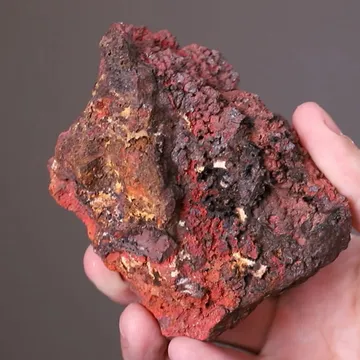
The Palatinate mercury occurrences are the historical anchor. Landsberg, better known to generations of collectors as Moschellandsberg, is one of Germany’s great mercury localities, with cinnabar, native mercury, metacinnabar, calomel, eglestonite, moschellandsbergite, schachnerite, paraschachnerite and moschelite tied to a small hill above Obermoschel. The best pieces are seldom large by modern show standards, but they have an unmistakable old-European density: red cinnabar in dark or pale vein matrix, silvery-white mercury amalgam minerals, occasional droplets of native mercury, white to gray mercury chlorides and iodine-bearing rarities, often accompanied by old handwritten labels.
Regional View
Country View
The lower Lahn adds a different, heavier register. Bad Ems, Friedrichssegen, Rosenberg and neighboring workings belong to the Ems vein district, where siderite-quartz veins carried galena, sphalerite, chalcopyrite and silver-bearing ore. Collectors know the district especially for pyromorphite, cerussite and related secondary lead minerals, but galena is the root of that fame: it was the lead ore, the parent mineral for the oxidized lead suite, and in some prized old specimens it forms sharp metallic crystals or pseudomorphs after pyromorphite.
The Eifel completes the triad with fire rather than ore. Around Laacher See, a young explosive volcanic system scattered phonolitic pumice, lapilli and sanidine-rich ejecta containing haüyne, nosean, nepheline, leucite, augite, titanite, phlogopite, apatite and other minerals of silica-undersaturated alkaline rocks. In hand specimens the best haüyne appears as sharp to rounded glassy blue crystals in pale pumice or feldspathic matrix, usually millimetric but sometimes large enough to become legendary. Fine crystals are not merely “blue specks”; they are tiny saturated points of cobalt to sky blue, often glowing visually against cream, gray or vesicular volcanic rock.

Photo: Wikimedia Commons
Search for specimens: View all specimens from Rhineland-Palatinate, Germany
Rhineland-Palatinate’s mineral localities lie across several major geological settings. The Palatinate portion includes the Saar-Nahe Basin and the North Palatine Uplands, where Permian sedimentary and volcanic rocks host mercury, silver, copper and related mineralization. The Donnersberg area near Imsbach is built around a Permian rhyolite massif; there, hydrothermal veins in and around the rhyolite carried copper, lead, zinc, cobalt, silver and manganese minerals, with rich secondary assemblages formed in the weathered portions of the veins. The Lahn district belongs to the Rhenish Massif, where hydrothermal vein systems in Devonian country rocks produced lead, zinc, copper and silver ores. The Eifel, by contrast, is a volcanic field, and its collector minerals occur largely in ejecta, pumice, tuff and quarry exposures rather than in traditional metal mines.
The Landsberg mercury district is the most important locality in the state for cinnabar and mercury minerals. The mercury deposits at Obermoschel are concentrated on the Landsberg/Moschellandsberg hill, not spread evenly across the surrounding town. Historically named workings include Backofen, Carolina, Vertrauen zu Gott, Segen Gottes, Hilfe Gottes, Gottesgab, Erzengel and Baron Friedrich. Mining for silver-mercury ore is documented in the 15th century, and the old term Hartsilber, or “hard silver,” referred to the brittle silver-mercury amalgam ore later recognized mineralogically as moschellandsbergite. Workings came and went over many centuries: older small-scale production preceded the 15th-century records, activity declined by the late 16th century, attempts at revival began in the early 18th century, and the last operating period ended during the Second World War.
Mineralogically, Landsberg is a low-temperature mercury-silver system famous out of all proportion to its physical size. Cinnabar occurs with metacinnabar, native mercury, calomel, eglestonite, terlinguaite, tetrahedrite-group minerals, chalcopyrite, sphalerite, pyrite, galena, quartz, calcite or ankerite, iron oxides and copper secondaries such as azurite and malachite. The finest collecting pieces are not normally large show plates; they are rich small-cabinet, miniature and thumbnail pieces that combine multiple mercury species. A strong Landsberg specimen may show wine-red to scarlet cinnabar microcrystals, silvery amalgam, native mercury globules, pale calomel or rare iodide minerals in cavities or on old ore matrix.
The Bad Ems–Friedrichssegen–Rosenberg district occupies the lower Lahn and is best understood as a vein district rather than a single mine locality. The Emser Gangzug, the principal vein system, extends for roughly 14.5 km from the Braubach area through Bad Ems toward Arzbach. Its ore was dominated by galena and sphalerite with chalcopyrite, pyrite and siderite-quartz gangue. In the oxidation zone, galena supplied lead for the district’s famous pyromorphite, cerussite, anglesite and a wide suite of secondary Pb-Cu-Zn minerals, including rarities later described from dump and vein material.
Mining around Bad Ems is old, with traditions of Roman activity and documented medieval work, followed by a much larger industrial phase. In 1871 the operations were organized under Emser Blei- und Silberwerk AG, and in 1909 the enterprise passed into the corporate line that became Stolberger Zink AG. Mercur and Pfingstwiese, close to Bad Ems, are classic names for lead minerals and especially pyromorphite. Friedrichssegen, near Lahnstein, was one of the great lower-Lahn mining settlements and closed in 1913. Rosenberg at Braubach carried the district’s later history; the Rosenberg/Königsstiel operations are recorded as the last mine on the Emser Gangzug, closing in 1963.
For collectors, the most important Bad Ems-region finds are old oxidation-zone pockets and vugs that yielded pyromorphite, cerussite, galena, linarite, plumbogummite, ramsbeckite, schulenbergite, lahnsteinite and many other secondary species. Galena specimens from the district range from primary metallic crystals to highly desirable galena pseudomorphs after pyromorphite. Friedrichssegen and Rosenberg labels deserve especially careful reading, because old “Bad Ems” labels may refer broadly to the Ems-Lahn vein district rather than to Bad Ems proper.
The Eifel volcanic localities are a separate collecting universe. Haüyne occurs in silica-undersaturated alkaline volcanic rocks and ejecta associated with the Laacher See volcanic complex, especially in pumice, ash and lapilli deposits near Mendig and Nickenich. The In den Dellen quarries near Mendig are particularly well known in specimen literature and photo records for haüyne in pale matrix with sanidine and augite. Gem-quality haüyne is concentrated in this Eifel material: crystals are typically tiny, often 1–2 mm, while complete crystals over 5 mm are already exceptional. The blue color is the draw, but the best collector specimens also need placement, contrast, crystal definition and intact matrix.
Collecting access today must be approached cautiously and legally. Many of the old metal mines are abandoned, unstable or closed, and underground entry is unsafe and commonly prohibited. Moschellandsberg is also part of a protected Natura 2000/FFH area important for bat habitat, so collecting there is not a casual recreational activity. Bad Ems and Friedrichssegen material is mostly a specimen-market and old-collection proposition, though museum and heritage sites preserve the mining history. Eifel haüyne has historically been found in active or former pumice and quarry settings, but quarry access depends on current ownership, working conditions and explicit permission; vertical pumice faces and loose quarry walls are dangerous. For most collectors, the realistic route to a fine Rhineland-Palatinate specimen is through reputable dealers, estate collections and old European labels rather than field collecting.
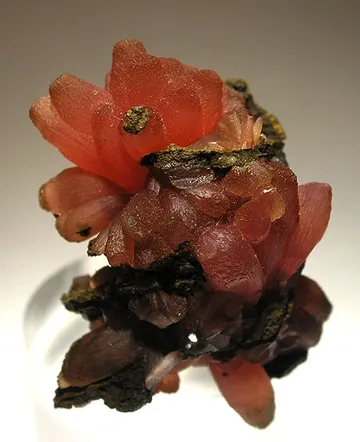
Cinnabar from Rhineland-Palatinate is above all a Landsberg/Moschellandsberg classic, where it occurs in the old mercury-silver mines around Obermoschel as massive red ore, sparkling wine-red to scarlet microcrystals, dark red botryoidal or granular crusts, and cavity linings in quartz, calcite or iron-stained matrix. It is closely associated there with native mercury, metacinnabar, calomel, eglestonite, terlinguaite, tetrahedrite-group minerals, moschellandsbergite, schachnerite, paraschachnerite, galena, pyrite, sphalerite, chalcopyrite, azurite and malachite. Most attractive pieces are small, and large flashy cinnabar crystals are not the expectation; the best specimens are judged by richness, bright fresh red color, visible crystal sparkle under magnification, undisturbed cavities, mercury-mineral associations and old provenance from named Landsberg workings such as Backofen, Carolina or Vertrauen zu Gott.
Galena from Rhineland-Palatinate is most collectible from the lower Lahn district around Bad Ems, Friedrichssegen and Rosenberg, where it was the principal lead ore in siderite-quartz veins with sphalerite, chalcopyrite, pyrite and silver-bearing phases in Devonian host rocks. Specimens may show bright metallic gray cubes, cuboctahedra or more complex multifaced crystals, sometimes on quartz-siderite matrix or with sphalerite and pyromorphite; in the Bad Ems tradition, the most coveted galena-related pieces include old galena pseudomorphs after pyromorphite, a form that directly records the chemical life of the oxidized lead veins. Ordinary pieces are heavy chunks of ore, but good locality specimens have sharp form, high metallic luster, limited bruising, an identifiable mine or district label, and ideally an association with the lead secondary minerals that made Bad Ems famous.
Haüyne from Rhineland-Palatinate means the Eifel, especially the Laacher See volcanic complex near Mendig and Nickenich, where blue crystals occur in phonolitic pumice, ash, lapilli and sanidine-rich ejecta with sanidine, nosean, nepheline, leucite, augite, titanite, phlogopite, apatite, magnetite and related alkaline-volcanic minerals. Most crystals are only 1–2 mm, and well-formed crystals above 5 mm are rare; fine matrix specimens show saturated sky-blue to deep cobalt-blue glassy crystals placed cleanly in pale pumice or feldspathic matrix, while gem rough and faceted stones are prized for transparency, even blue color and freedom from open fractures. Eifel haüyne can fluoresce orange under long-wave ultraviolet, but the response is inconsistent, and top specimens are separated from ordinary blue flecks by crystal size, sharpness, transparency, color saturation, contrast and credible Eifel provenance.
Beyond these three species, Rhineland-Palatinate is unusually rich in type-locality and historically important minerals. Landsberg/Moschellandsberg is tied to belendorffite, calomel, moschellandsbergite, moschelite, schachnerite and paraschachnerite. The Eifel gave its name and type material to ettringite at Ettringen, and the Mayen/Ettringer Bellerberg area is central to the history of several high-temperature calcium-aluminate and volcanic xenolith minerals, including brownmillerite, chlormayenite and strätlingite in the broader Mayener Feld record. The lower Lahn has its own rarities, including lahnsteinite from the Friedrichssegen Mine. The Siegerland portion of northern Rhineland-Palatinate includes the celebrated goethite type-locality tradition at the Hollertszug/Hollerter Zug mine near Herdorf. For a systematic collector, the state is therefore more than a source of attractive specimens; it is a dense map of mineral nomenclature.
Rhineland-Palatinate specimens demand locality literacy. Labels reading “Eifel,” “Laacher See,” “Mendig,” “Niedermendig,” “In den Dellen,” “Bad Ems,” “Ems,” “Lahn,” “Friedrichssegen,” “Rosenberg,” “Landsberg,” “Moschellandsberg,” or “Obermoschel” are not interchangeable. Old dealers often used regional shorthand, and a specimen labelled simply “Bad Ems” may come from Mercur, Pfingstwiese, Friedrichssegen, Rosenberg or another part of the Ems-Lahn district. Likewise “Eifel haüyne” can refer to loose gem rough, pumice-hosted crystals, basaltic lapilli material or sanidine-rich ejecta, and the collecting significance changes with the sublocality.
Cinnabar and mercury specimens from Landsberg should be handled with respect. Cinnabar is mercury sulfide, and associated native mercury, mercury chlorides and mercury iodides are not casual handling minerals. Do not heat them, grind them, clean them ultrasonically, expose them to acids, store them in damp reactive environments or allow children to handle them. Native mercury globules can migrate or detach; calomel and other halides may be soft, light-sensitive or environmentally sensitive. The safest approach is stable boxed storage, minimal handling and no aggressive cleaning. Bright cinnabar color is desirable, but unnaturally vivid red coatings on anonymous “old German” matrix should be viewed skeptically unless supported by habit, association and provenance.
Haüyne has its own authenticity issues. The intense Eifel blue invites confusion with cobalt glass, blue spinel, blue apatite, lazurite-group material and even dyed or artificially introduced blue grains in matrix. For faceted stones, gemological confirmation is straightforward by refractive index, specific gravity, isotropic character and Raman spectrum. Treatments are also documented: paraffin wax has been identified in open fissures in some Eifel haüyne gems, used because wax or oil can visually reduce the prominence of fractures. Matrix specimens are less often treated in that sense, but they are sometimes over-trimmed, glued into matrix, or sold with exaggerated crystal sizes. A true fine specimen should show natural integration of the blue crystals in pumice or ejecta, not isolated blue grains suspiciously placed on a surface.
Galena from the Ems district is dense, soft and cleaves easily, so bruised corners and shiny broken faces are common. Fine specimens need scrutiny under low magnification: many old pieces have edge wear from a century or more of cabinet life, but fresh crushing, excessive trimming or sprayed coatings reduce value. Galena pseudomorphs after pyromorphite are especially desirable and should be assessed for complete form, crystal architecture and whether the morphology genuinely reflects pyromorphite rather than ordinary galena crystal growth. Lead minerals should be kept away from food preparation areas, washed hands are sensible after handling, and powdery alteration products should not be inhaled.
Market availability varies sharply by sublocality. Eifel haüyne remains available, especially as small crystals in matrix and small faceted stones, but fine natural matrix pieces with larger, sharp, saturated crystals are selectively competed for. Bad Ems and Friedrichssegen pieces are mostly old-collection specimens; attractive pyromorphite, cerussite and galena-related examples with old labels bring a premium. Landsberg mercury minerals are far scarcer on the open market, particularly combinations with cinnabar, native mercury, calomel, moschellandsbergite or rare iodides. In this state, the label can be almost as important as the specimen: a modest miniature with a credible 19th-century or early-20th-century provenance may be more collectible than a larger but locality-ambiguous piece.
The story of Moschellandsberg begins like a footnote in an account book and becomes one of European mineralogy’s stranger chapters. In 1442, the Meisenheim rent records noted income from “Hartsilber” at the hill above Obermoschel, valued “auf 500 Gulden me oder mynder.” The phrase is wonderfully medieval in its uncertainty—roughly 500 guilders, more or less—but the mineral behind it was not vague at all. It was the brittle silver-mercury amalgam ore that later generations would name moschellandsbergite. The hill carried a castle on top and mercury workings below, and its mine names read like invocations from another age: Vertrauen zu Gott, Segen Gottes, Hilfe Gottes, Gottesgab, Backofen and Carolina.
The revival pattern at Landsberg is equally telling. The mines were already old when the Lazarus adit received hereditary-adit rights in 1489, yet production later collapsed and lay dormant for long stretches. In 1712 there was another attempt to reopen the mines, but meaningful renewed work began only in 1728. A mining ordinance followed in 1743. By 1861 all the mines were idle, then a late 19th-century attempt flickered without leaving much record, and a final working period ran from 1934 to 1942. What remains to collectors is not a modern production stream but an old hill with a compressed, almost cabinet-sized mineral mythology: cinnabar, calomel, mercury, silver amalgams and the rare species that keep Landsberg labels alive.
One of the best discovery stories from the state belongs to moschelite. In 1984, Ulrich Heidtke, a private researcher and employee of the Pollichia Museum, examined material from the Backofen mine, a medieval and possibly older mercury-silver working at Moschellandsberg. In a small cavity inside a pear-shaped nodule of hornstone, he found native mercury, a little cinnabar, orange grains and lemon-yellow plates. Then came the unforgettable field clue: an intense iodine smell. Analysis showed the orange grains to be coccinite and the yellow plates to be a previously unknown mercury iodide. The new species was later described as moschelite, named for the locality, and type material entered the Natural History Museum Vienna under catalogue number M549.
Bad Ems tells its stories in a different language: industry, elegance and little barrels. The town was a spa resort, but its surrounding hills were pierced by lead and silver mines. The phrase “Emser Tönnchen,” the little Ems barrels, belongs to pyromorphite rather than galena, yet galena is the reason those lead phosphates exist. At Friedrichssegen the mining settlement became large enough to leave museums, models, industrial remains and social memory; the local mining museum preserves more than 40 Friedrichssegen mineral exhibits and displays “Emser Tönnchen” from a family collection tied to the last director of the mine. In 1880, 30 students from the Berlin Mining Academy visited Friedrichssegen, and in 1886 the Association of German Engineers came with 50 engineers—clear evidence that the mine was known not only for mineral specimens but for its processing technology and industrial ambition.
The Eifel’s haüyne story is more recent and more gemological. In the summer of 1999, Lore Kiefert and H. A. Hänni received 100 faceted Eifel haüynes for study. The stones were tiny by jewelry standards, just 0.095 to 0.173 ct each, but they were extraordinary as a group because haüyne is such a rare gemstone. Most were destined for a butterfly brooch set with diamonds and a pink sapphire, which sold at Sotheby’s in Geneva in November 1999 for 45,000 Swiss francs, approximately US$30,000 at the time. The laboratory work found the stones to be light to dark blue, with some showing orange long-wave ultraviolet fluorescence and some containing fissures filled with paraffin wax. For collectors, the episode is a reminder that the same tiny blue crystals picked from Eifel pumice can move from quarry dust to mineral drawers to high jewelry.
Then there is the oversized exception that every haüyne collector remembers: a crystal about 3.2 cm in diameter, found in the Eifel by an amateur collector in early October 2012. That size is astonishing against the normal Eifel scale, where many crystals are around 1–2 mm and well-formed examples over 5 mm are already rare. Since early 2013 the crystal has belonged to the TU Bergakademie Freiberg, and it has been displayed in the Krüger-Haus in the “Deutsche Minerale” exhibition. A locality that usually rewards patience with specks of blue once produced a crystal large enough to recalibrate what collectors thought possible.