Wolf Mine, Germany — European rhodochrosite locality famed for raspberry-red crystals in dark limonite pockets, with malachite-coated copper and minerals.
Key facts
Wolf Mine at Herdorf is one of the classic European rhodochrosite localities, and for many collectors it is the German rhodochrosite locality. The mine worked the northern end of the Florz-Füsseberger lode tract in the Siegerland siderite district, a hydrothermal vein system hosted by Devonian shales, sandstones and siltstones of the Rheinisches Schiefergebirge. Economically it was an iron-ore mine, exploiting siderite and brown iron ore, yet its collecting fame rests on the extraordinary secondary mineral pockets of the deep oxidation zone: raspberry-red rhodochrosite, malachite-coated native copper, cuprite, goethite, pyrolusite and a small but important suite of rare arsenates, sulfates and oxides.
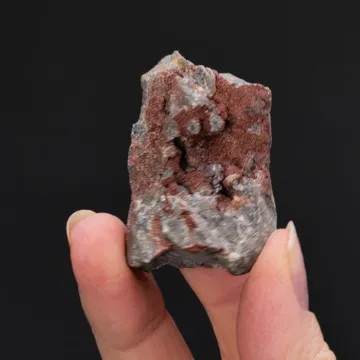
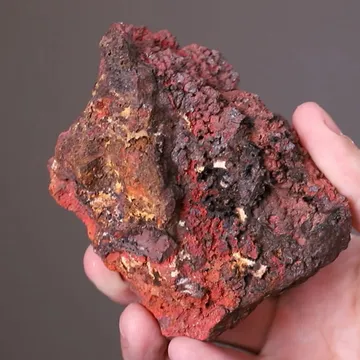
The best Wolf pieces have a very specific look. They are not the giant, glassy, freestanding rhombohedra of Colorado or South Africa; they are intimate, richly textured European classics. Bright rose to raspberry-red scalenohedral rhodochrosite crystals, commonly only millimeters across and rarely approaching 2 cm, line cavities in dark brown to black limonite and goethite. On superior specimens the contrast is theatrical: red sprays and rosettes set into glossy “kidney ore,” sometimes with tiny green halos of malachite on native copper, or with cuprite adding a deep red metallic accent. The result is a locality style that is instantly recognizable and difficult to imitate convincingly.
Regional View
Country View
Wolf is also historically important because its mineral fame came late. Older Siegerland mineral literature discussed rhodochrosite from other mines before Wolf became widely described, but by the twentieth century Wolf specimens had entered major private and museum collections. Today the former mine site is built over and commercially used; the great collecting era is over, leaving the old mine production and historical collections as the source of virtually all significant specimens.

Photo: Rob Lavinsky / iRocks.com via Wikimedia Commons

Photo: Leon Hupperichs via Wikimedia Commons
Search for specimens: View all specimens from Wolf Mine, Germany
Wolf Mine lies at Herdorf in the Altenkirchen district of Rhineland-Palatinate, near the boundary with the North Rhine-Westphalian Siegerland. Geologically it belongs to the Siegerland siderite district, where steep hydrothermal veins cut Devonian sedimentary rocks. The Wolf workings occupied the northern end of the Florz-Füsseberger Gangzug, a lode tract several kilometers long that also included such important mines as San Fernando, Friedrich-Wilhelm, Füsseberg and Glaskopf. The vein filling was dominantly siderite with quartz; lead, zinc, copper, silver, cobalt and nickel minerals were present locally, especially in the upper parts of the system.
The collecting importance of Wolf depends on the mine’s unusually deep oxidation zone. In many Siegerland siderite deposits, the “iron hat” of brown iron ore was comparatively shallow. At Wolf, limonitic ore and goethite-rich cavities extended down to roughly the 400 m level. The oxidation of siderite created limonite and goethite masses riddled with vugs, stalactitic surfaces and botryoidal “Glaskopf” textures. These cavities were the nursery for the mine’s rhodochrosite and many of its copper and manganese secondary minerals. The best rhodochrosite is associated with the transition between the brown iron ore zone and the underlying siderite, especially around the 300 to 350 m levels, where carbonate conditions and manganese-bearing solutions favored the growth of MnCO3.
Primary ore-specimen production from Wolf was modest compared with its secondary-mineral fame. The siderite itself could form bladed crystals in scarce druses, with quartz, galena, sphalerite, pyrite, chalcopyrite and occasional tetrahedrite-group minerals. Galena crystals are known up to about 1.5 cm, pyrite commonly as small cubes, and tetrahedrite-type crystals to a few millimeters. Ullmannite occurred on the 500 m level as idiomorphic crystals and aggregates enclosed in siderite. The notable primary collector find was millerite from the 520 m level, discovered in 1955 as brass-yellow needles in sheaves, nests and wiry aggregates, typically around 1 cm and on exceptional pieces reported to 2 cm.
Mining activity in the area of Wolf is mentioned in an eighteenth-century description from 1741, referring to iron ore on the mountain called Wolf, and old maps record numerous shallow workings and pingen. The actual Wolf mine is generally associated with the nineteenth-century development of the lode. A first adit was driven after the concession period beginning around 1834, but the mine remained a late developer compared with older Siegerland operations. In 1890 the Reifenrath brothers of Neunkirchen acquired the property and began machine-shaft mining, bringing the workings down to around 300 m by the First World War.
Krupp acquired Wolf in 1916 or 1917 and modernized the operation with new steam hoisting, roasting facilities, improved compressors and electric pumping. Monthly output rose into the several-thousand-ton range, and the mine employed hundreds of men during its strongest early twentieth-century phase. Economic conditions after the First World War forced closure in 1925; surface installations were dismantled and the workings flooded. Reopening preparations began in the 1930s. A 38 m headframe was erected, a new hoisting plant installed, the shaft was strengthened, and a cableway more than 3 km long was built to move ore to the central Füsseberg processing and roasting plant. Wolf resumed production in 1937 and reached its highest recorded annual output in 1944, with about 84,000 tonnes of ore.
The mine closed again in 1945. Water movement through fractures affected the neighboring San Fernando workings, and the later history of Wolf became tied to that mine. In the early 1950s the Wolf and San Fernando fields were connected underground and operated within the Erzbergbau Siegerland AG system. Ore from Wolf was ultimately hauled through San Fernando, and the combined operation continued until April 1962. The broader Siegerland ore industry then faded rapidly under pressure from cheaper imported ores. Wolf’s headframe, once a prominent landmark over the Heller valley, was demolished in 1975. Today the site is commercially developed, and only a commemorative sheave recalls the mine on the surface.
For collectors, the key specimen-producing environment was the limonitic cavity system of the oxidation zone. Former miners described red rhodochrosite crystals glittering in lamp light in large druses, some reported at more than a meter across. The richest and most aesthetically important rhodochrosite came from the 300 to 350 m zone. The other famous finds were the copper suite: native copper as flakes, six-sided plates, dendrites, mossy growths and wires, commonly coated or replaced by malachite; cuprite from especially good finds in 1906 and 1909, yielding lustrous octahedra; and malachite sprays in limonite cavities. A later layer of collector interest came from reexamining old Wolf specimens, where tiny rare minerals such as chalcoalumite, delafossite, philipsbornite and corkite were recognized on classic limonite-goethite matrices.
Wolf Mine rhodochrosite is best known as raspberry to rose-red scalenohedral crystals and aggregates on limonite, goethite and quartz, with most crystallized examples in the few-millimeter to 1 cm range and the largest crystals rare at about 2 cm. The finest pieces came from the brown-iron-ore to siderite transition around the 300 to 350 m levels, where cavities in limonitic ore were lined by small “rice grain” crystals, intergrown scalenohedra, rosettes, hedgehog-like sprays, botryoidal to reniform coatings and stalactitic aggregates. Color is a major discriminator: deep orange-pink to raspberry-red translucent crystals on black goethite are far more desirable than paler, chalkier or yellow-brown iron-rich examples. The most prized associations add locality character without obscuring the rhodochrosite, especially malachite-patinated native copper or small cuprite on dark “Glaskopf” matrix.
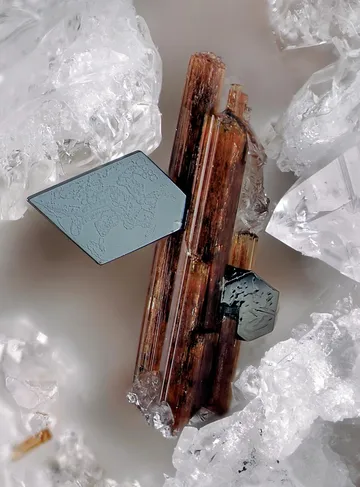
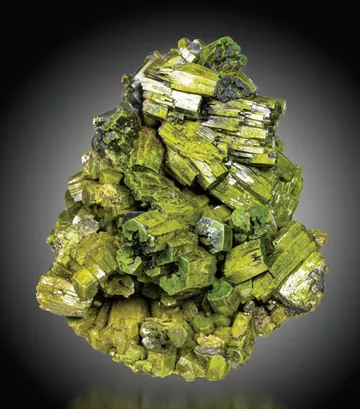
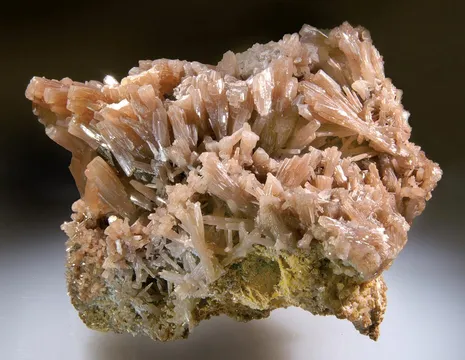
Wolf is not principally a type-locality story; it is a paragenesis and preservation story. Its supporting cast is unusually good for a siderite iron mine. Native copper is a classic associate, commonly as small flakes and plates with a green malachite skin, but also as dendritic, fern-like, mossy or wire aggregates. Cuprite from the 1906 and 1909 finds is among the best-known Siegerland cuprite, with sharp lustrous octahedra from a few millimeters to about 1 cm and rare chalcotrichite needles. Goethite forms glossy botryoidal and stalactitic “Glaskopf,” with documented stalactites reaching impressive cabinet scale; pyrolusite and cryptomelane-type manganese oxides occur as black coatings, blades and stalactitic aggregates. Rarer species include chalcoalumite, delafossite, cerussite, mimetite, scorodite, pharmacosiderite, philipsbornite and corkite, generally as tiny crystals in limonite cavities. The primary vein assemblage adds siderite, quartz, galena, sphalerite, pyrite, chalcopyrite, ullmannite and the 1955 millerite find from the 520 m level.
A genuine Wolf specimen should look like a product of limonitic iron ore, not a generic pink carbonate on quartz. The most convincing rhodochrosites show small, steep scalenohedral crystals or composite sprays in cavities of dark brown to black goethite/limonite, often with earthy ochre zones, glossy botryoidal surfaces or old fracture edges. Matrix matters greatly here. A Wolf label attached to loose pink carbonate, massive banded rhodochrosite, large isolated gem crystals, or rhodochrosite on an association foreign to the Siegerland should be treated with caution.
Mislabelling is a real concern because Wolf rhodochrosite is famous and valuable. Other German rhodochrosite localities, including Louise, Ohliger Zug and Frauenberger Einigkeit, can produce attractive material, but their style and abundance differ. International material from Romania, Peru, South Africa, China, Colorado or Mexico is even more often visually incompatible once the matrix, habit and crystal size are considered. Old labels add significant confidence, especially from established European collections or dealers, but the best authentication is still the complete object: limonite-goethite matrix, small red scalenohedral growth, and the right copper/malachite/cuprous associations.
Documented artificial material is especially relevant for chalcanthite from Wolf. Historical descriptions record natural blue crystalline coatings, reniform aggregates and small stalactites on decomposed pyritic ore, but sharp, well-formed chalcanthite crystals attributed to Wolf are widely suspect and many examples in collections are likely synthetic or grown after mining. Chalcanthite is also water-soluble and should be kept dry; even natural material can deteriorate under humid handling or storage.
Condition is a serious issue on Wolf rhodochrosite. The crystals are small, exposed and commonly perched inside rugged limonite cavities, so bruising, rubbing, missing tips and iron-oxide dust are common. Good pieces are judged by undamaged sparkle across the vug, strong red color, depth of cavity, attractive limonite architecture, and whether the specimen has been trimmed to show the pocket cleanly. Avoid aggressive cleaning: acids can attack carbonates, loosen limonite, alter malachite, and damage delicate secondary minerals. Water and humidity can also be risky for pieces containing chalcanthite, pyrite-rich decomposed ore, or earthy iron oxides.
Market availability is steady but finite. Wolf was not a modern specimen-mining locality, and the mine is closed and built over; worthwhile pieces circulate through old collections, estate material, specialist dealers and auctions. Small but representative rhodochrosite vugs are obtainable, while rich, vividly colored miniatures and cabinet specimens with old provenance, copper or cuprite associations, and undamaged red crystal coverage command strong prices. Large museum-grade Wolf rhodochrosites are genuinely scarce and tend to remain in long-held collections.
The Wolf story begins before the mine had the collector fame it now carries. In 1741, J. H. Lamprecht described an ironstone mountain near Herdorf called “Wolf,” a place where ore was already being won from the ground. The image is not yet of a deep industrial shaft, but of an old Siegerland iron landscape marked by shallow workings and pingen. The great veins were there, but Wolf’s modern importance had not yet announced itself.
Even in the nineteenth century, Wolf lagged behind its neighbors. Alfred Ribbentrop’s 1885 account of the Daaden-Kirchen mining district did not celebrate it as a major producer; the mine appeared essentially as a register entry. Then, in 1890, the Reifenrath brothers of Neunkirchen began the machine-shaft phase, and the quiet northern end of the Florz-Füsseberger lode changed character. By the First World War the workings had reached about 300 m depth, and the mine had become valuable enough for Krupp to step in.
Krupp’s purchase was a turning point. The Essen firm bought the mine for roughly 2 million Reichsmark and rebuilt it as a modern industrial operation. A new steam hoist, a six-oven roasting plant, expanded compressors and electric water handling followed. Ore that had once moved by horse cart was linked more efficiently to the railway, and the monthly production rose to as much as 5,000 tonnes. In 1921 Wolf recorded about 46,000 tonnes of ore, but the postwar economy soon caught up with it. On January 31, 1925, the mine was shut down, much of the plant was dismantled, and water reclaimed the underground workings.
The 1930s reopening gave Wolf one of its most memorable pieces of engineering: a cableway of more than 3 km from Wolf to the central Füsseberg preparation plant. Each bucket carried about a tonne, the route took roughly 25 minutes one way, and the system was designed for about 40 tonnes per hour. In 1937 the modernized mine reopened, complete with a new 38 m headframe. During the Second World War output rose sharply, and 1944 became Wolf’s record year with about 84,000 tonnes of ore. Then the war ended the run. In 1945 the mine shut again.
The water did not simply stay where the operators expected it. After Wolf’s pumps stopped, water moved through fractures and vein openings toward neighboring San Fernando, where mining had resumed after its own wartime interruption. The inflow became troublesome enough that Friedrichshütte and Krupp arranged to maintain Wolf’s water handling so San Fernando could continue. That hydrologic connection foreshadowed the mines’ later underground union: in the 1950s, Wolf and San Fernando were connected, and Wolf ore was hauled through the San Fernando shaft.
For mineral collectors, the most unforgettable testimony comes from the miners’ descriptions of the oxidation-zone cavities. They spoke of countless red rhodochrosite crystals sparkling under lamp light, sometimes in druses more than a meter across. It is difficult to overstate what that must have looked like: dark wet iron ore, black goethite kidney surfaces, and sudden fields of red points shining back from the walls. The old miners’ name “Himbeerspat” — raspberry spar — was not poetic exaggeration. On the best pieces, the crystals really do gather into berry-like clusters and red floral rosettes.
The mine’s last monument stood above ground. For about a decade after closure, the Wolf headframe remained high over the Heller valley, one of the last visible symbols of the Siegerland ore industry. Local mining friends tried to preserve it, but maintenance costs and structural decay won. In 1975 the headframe was demolished. The site is now commercial ground, and the visible memorial is modest: a sheave set on a parking area, a small industrial relic marking a mine whose finest remembrance is now in mineral drawers and museum cases.