Landsberg, Germany — a historic mercury locality yielding cinnabar, native mercury, calomel, and rare amalgams; Moschellandsbergite is its signature for collec…
Key facts
Landsberg—better known in older mineralogical literature as Moschellandsberg—is one of the great European names in mercury mineral collecting. The locality is the northern slope of the Landsberg hill near Obermoschel in Rhineland-Palatinate, where a small volcanic hill and its old silver–mercury workings produced an assemblage out of all proportion to the size of the district: cinnabar, native mercury, calomel, mercury-bearing fahlores, silver halides, copper secondary minerals, and a suite of exceedingly rare natural amalgams and mercury halides. To collectors, its signature species is Moschellandsbergite, Ag2Hg3, the silver–mercury amalgam named for the hill and best known from the Carolina Mine, where the world’s finest crystals were recovered from old workings.
The geological setting is unusually instructive. The Moschellandsberg mercury deposit is hosted in a Permo-Carboniferous volcanic complex of the Saar-Nahe Basin, with hydrothermal mineralization emplaced at shallow levels. In the upper part of the system, cinnabar dominates as red impregnations, coatings, and microcrystalline crusts; downward, the paragenesis becomes more complex, bringing in siderite, chalcopyrite, bornite, stibnite, native mercury, tetrahedrite–tennantite, silver minerals, and rare amalgams. That vertical transition is exactly what gives Landsberg specimens their distinctive look: red cinnabar flashes, dark sulfide patches, brown carbonate, pale calomel crusts, and tiny bright metallic blebs or crystals in the same small hand specimen.
Regional View
Country View
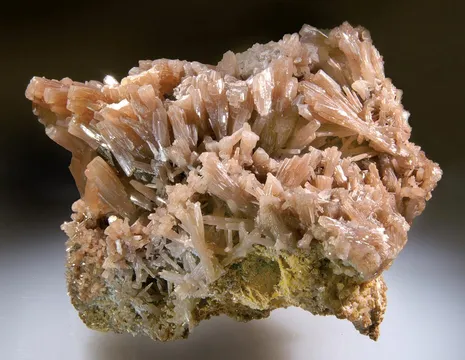
The best Landsberg specimens are seldom large in the modern show-case sense; their power is in rarity, age, association, and locality precision. A top Moschellandsbergite may be only a few millimeters across, but if it is a sharp, metallic crystal on matrix from Carolina, it belongs to a very small population of known specimens. Fine calomel is likewise a cabinet mineral of delicacy rather than size, with old pieces showing pale, rounded to radiating aggregates or rare crystals, often in proximity to native mercury. Cinnabar specimens range from earthy red coatings to bright microcrystals, and the strongest examples combine saturated color with visible crystallization and a convincing old German provenance.

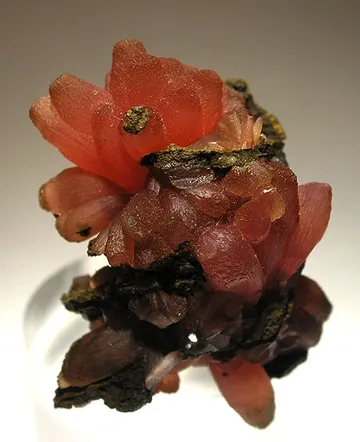
Photo: Rob Lavinsky, iRocks.com via Wikimedia Commons
Search for specimens: View all specimens from Landsberg, Germany
Landsberg is the collecting and historical name used for the Moschellandsberg mercury-mining area at Obermoschel, in the Nordpfälzer Land of Rhineland-Palatinate. The mineral localities lie on and beneath the northern flank of the Landsberg hill, also called Moschellandsberg or Schlossberg, close to the ruins of Landsberg Castle. The principal mines recorded from the hill include Carolina, Backofen, Vertrauen zu Gott, Gottesgabe, Erzengel, Baron Friedrich, Segen Gottes, Hilfe Gottes, and Gabe Gottes. In collector usage, “Landsberg,” “Moschellandsberg,” “Obermoschel,” and occasionally older regional labels such as “Zweibrücken” may all appear on historical material, but the best labels preserve the mine name—especially Carolina, Backofen, Vertrauen zu Gott, or Gottesgabe.
The deposit is a shallow hydrothermal mercury system developed in a Permo-Carboniferous volcanic caldera complex within the Saar-Nahe Basin. Published work on the ore system describes formation at roughly 100–300 m depth over a broad thermal interval, from about 200 °C down to below 65 °C. The mineralization is vertically zoned. The upper part, extending through approximately the upper 100 m, is dominated by cinnabar with kaolinite, dickite, quartz, and lesser siderite, hematite, and barite. Deeper and more complex levels, followed to about 175 m below the top of the deposit, add more siderite and a richer metallic assemblage including chalcopyrite, bornite, stibnite, native mercury, tetrahedrite, tennantite, silver sulfosalts, arsenides, and natural amalgams.
For mining, cinnabar was the chief ore through most of the productive life of the district. Native mercury occurred subordinately but could be locally conspicuous, and silver was historically important both as native silver and as silver-bearing mercury compounds. The old name “Hartsilber,” or hard silver, reflects the unusual silver–mercury amalgam material known long before it was formally recognized in modern mineralogical terms as Moschellandsbergite. The famous Carolina Mine is especially important because of its Moschellandsbergite crystals, preserved underground openings, and rare mercury-halide mineralization; Backofen is important for later rare iodide discoveries, including Moschelite; Vertrauen zu Gott is central to the silver-amalgam species Schachnerite and Paraschachnerite.
Mining at Landsberg is documented from the mid-15th century, with particularly important phases in the 16th, 18th, and 19th centuries. A final attempt to work the Obermoschel mercury ores began in 1934, during the raw-material autarky policies of the German Reich, but the remaining ore proved too poor for profitable mining. Work ended in 1942, closing roughly five centuries of documented activity at the hill. The mining landscape is still legible in the woods: old dumps, collapsed adits and shafts, mouth openings, subsidence features, and large underground stopes survive as traces of an intensely worked but now quiet mercury field.
Collecting access today must be treated as restricted and historically sensitive. The Carolina Mine area is protected as the Denkmalzone “Quecksilbergrube Carolina,” established to preserve the adit portal, underground workings, and associated geoscientific and mining-historical evidence. The legal protection explicitly addresses the danger of uncontrolled removal of samples and prohibits entry into the underground system except for authorized scientific, heritage, and bat-protection personnel, with penalties for unauthorized interference. In practical collecting terms, the locality is not a modern dig site for the serious collector; important specimens on the market overwhelmingly come from old collections, historical labels, older dealer stock, or documented scientific and private holdings.
The most notable specimen-producing settings were the old underground ore zones and cavities in the main mercury workings. Carolina yielded the celebrated Moschellandsbergite crystals, calomel, native mercury, cinnabar, metacinnabar, and rare halides. Calomel from the Carolina workings is recorded from the Vorderer Lazarus-Trum, where old specimens include pale to amber or smoky crystals and radiating aggregates. Backofen produced classic mercury-halide microminerals, including Moschelite as lemon-yellow plates associated with cinnabar and native mercury. The whole district is best understood as a rare-mineral locality where small, well-documented pieces carry more weight than size: a 4 mm Moschellandsbergite, a clean calomel crystal group, or a cinnabar specimen with visible mercury globules can be more consequential than a larger but generic red-coated rock.
Cinnabar is the fundamental ore mineral of Landsberg and the red thread that runs through the entire assemblage: it occurs as bright to dark blood-red microcrystals, fine granular coatings, earthy impregnations in altered rock, and crystallized masses in cavities and seams. The strongest cabinet examples show abundant, lustrous red microcrystals rather than merely powdery stain, commonly with quartz, calcite, siderite, native mercury, pyrite, marcasite, tetrahedrite, calomel, or rare amalgams. Most individual crystals are sub-millimetric to under about 2 mm, so quality here is judged under magnification by saturation, sparkle, crystallization, and association; a specimen with cherry-red cinnabar in cavities plus visible mercury droplets, calomel, or sharp fahlore is a much better Landsberg piece than a dull red smear on matrix.
Moschellandsbergite is the locality’s defining species: a natural silver–mercury amalgam, Ag2Hg3, named for Moschellandsberg and best known from the Carolina Mine. On Landsberg specimens it appears as silver-white to slightly brassy metallic crystals, rounded grains, blebs, or aggregates in cavities and ore matrix, with documented associations including cinnabar, metacinnabar, siderite, chalcopyrite, pyrite, sphalerite, tetrahedrite–tennantite, and mercurian silver. Ordinary material may be only tiny metallic blebs in dark ore or barite-rich matrix; top pieces show well-formed cubo-octahedral, dodecahedral, or elongated crystals in the millimeter range, with exceptional historical matrix crystals reaching around 1 cm or slightly more. Because good matrix specimens are rare and many known examples are old, provenance, intact metallic luster, minimal cracking, and a crystal that is clearly displayed rather than buried in ore are decisive.
Native mercury from Landsberg occurs as bright liquid globules in crevices, cavities, and porous ore, most often with cinnabar and sometimes with siderite, calomel, metacinnabar, or amalgam minerals. Specimens commonly show the mercury only under magnification, where it appears as tiny silvery droplets lodged among red cinnabar grains or within dark sulfide-rich cavities; larger and obvious droplets are much scarcer. Good examples are those where the mercury is visible, safely retained in natural recesses, and clearly associated with the classic Landsberg assemblage rather than added loose to a box or vial; pieces with cinnabar plus native mercury, old labels, and no evidence of artificial enhancement have the strongest collector appeal.
Calomel, Hg2Cl2, is one of the great rarities of Landsberg and has long been tied to the Moschellandsberg mines as a type-locality species. At this locality it is a secondary mercury chloride of the oxidized margin of the ore, commonly in limonitized rock and in direct association with native mercury, cinnabar, eglestonite, terlinguaite, malachite, and azurite; historical records name Carolina and Gottesgabe among the productive mines, and the Vorderer Lazarus-Trum of Carolina is attached to notable old pieces. Most calomel appears as crusts, shells, nodules, or confused radiating aggregates of fine needles, with individual crystals usually about 0.5–2 mm and rare crystals approaching 10 mm. Color ranges from water-clear, white, pale gray, yellowish, and faintly greenish to smoky brown or nearly black after light exposure, so the best Landsberg calomels combine recognizable crystal form, pale fresh color or attractive amber tone, association, and careful storage history.
Siderite at Landsberg belongs to the carbonate-rich stages of the hydrothermal system and becomes more prominent in the deeper, more complex parts of the ore zone. Collector specimens are far less common than the locality’s cinnabar labels might suggest; the better pieces show chocolate-brown to slightly iridescent rosettes, rhombohedral aggregates, or compact veins, sometimes sitting over or beside red cinnabar and native mercury. Its value here is not as a general siderite species specimen but as a rare Landsberg association mineral: a crystallized siderite with cinnabar underneath, or a siderite vein carrying red cinnabar and microscopic mercury globules, tells the story of the deposit’s transition from the upper cinnabar zone into the mixed carbonate–sulfide–amalgam assemblage. Sharpness, brown luster, absence of crumbling limonite, and visible association with cinnabar or mercury make a piece stand out.
Tetrahedrite-group minerals at Landsberg are part of the Sb–As–Cu–Ag-rich fahlore suite that appears in the more complex levels of the mercury system, and mercury-bearing tetrahedrite has been documented from the locality. In specimens, tetrahedrite is usually a metallic companion rather than the main show species: small silvery to steel-gray crystals or grains occur with deep red cinnabar, pyrite, calcite, and, in the broader paragenesis, native mercury and Moschellandsbergite. The best pieces are old-time combinations where the tetrahedrite is sharp enough to be seen as distinct metallic crystals, not just dark ore, and where the red cinnabar provides strong contrast. Labels can be tricky, because some old pieces catalogued as native mercury or quicksilver may actually display tetrahedrite and cinnabar more clearly than visible liquid mercury.
Beyond these headline species, Landsberg is one of the richest rare-mercury localities in Germany. Type-locality minerals tied to the hill or its mines include Moschellandsbergite from Carolina, Calomel from Landsberg, Moschelite from Backofen, and the amalgams Schachnerite and Paraschachnerite from Vertrauen zu Gott; Belendorffite, Cu7Hg6, is another rare amalgam species associated with the district. The broader list includes metacinnabar, eglestonite, terlinguaite, coccinite, kuzminite, shakhovite, chlorargyrite including bromian material, iodargyrite, acanthite, native silver, native gold, chalcopyrite, bornite, chalcocite, galena, sphalerite, stibnite, arsenopyrite, nickeline, rammelsbergite, pyrite, marcasite, barite, calcite, quartz, azurite, malachite, brochantite, langite, and several other secondary copper, silver, antimony, and mercury phases. Most of these are micromount or analytical species here, but for rare-species collectors the small names on a Landsberg label can be just as important as the red cinnabar visible to the naked eye.
The central authenticity issue with Landsberg specimens is provenance. The locality has been mined, traded, written about, and relabelled for centuries, so old labels may read Landsberg, Moschellandsberg, Obermoschel, Zweibrücken, Palatinate, Pfalz, Rheinbayern, or the name of a specific mine. “Zweibrücken” on an old label is not necessarily wrong, but it is a historical administrative clue rather than a precise mine locality. Conversely, a modern label that says only “Germany” or “Palatinate” is too vague for a premium rare-species specimen unless accompanied by old documentation or analytical confirmation. Cinnabar from other Palatinate mercury districts—Stahlberg, Lemberg, Königsberg, Mörsfeld, and others—can resemble Landsberg material, and at least some dealer descriptions record old labels that were corrected from another Pfalz locality to Obermoschel. For high-value Moschellandsbergite, calomel, Schachnerite, Paraschachnerite, Belendorffite, or Moschelite, locality confidence and, where appropriate, analytical support matter greatly.
There is no widely recognized modern “fake industry” for Landsberg in the way seen for some showier gem minerals, but there are real hazards: misidentified metallic blebs, mercury added or redistributed onto specimens, calomel darkened by storage, and historical labels separated from their original pieces. Native mercury should sit naturally in cavities or cracks, not appear as free rolling droplets conveniently placed on a matrix. Moschellandsbergite can be confused visually with other silver–mercury amalgams, native silver, mercury-rich fahlore, or bright sulfides; the safest premium pieces are either historically famous, analyzed, or from highly reliable old collections.
Condition is unusually important. Calomel is weakly light-sensitive and can darken from pale or colorless through brown to nearly black after prolonged exposure; display it away from strong daylight and minimize ultraviolet exposure even though fresh calomel can show a striking red fluorescence under long-wave UV. Moschellandsbergite may show cracking or shrinkage features, sometimes attributed to mercury loss or thermal expansion and contraction in the natural amalgam. Native mercury is mobile, toxic, and capable of producing vapor, especially if heated; do not warm, saw, grind, or ultrasonically clean Landsberg mercury specimens. Cinnabar and other mercury compounds should be treated as toxic heavy-metal minerals: wash hands after handling, avoid dust, keep away from children and food areas, and store specimens in well-labelled boxes.
Market availability is thin. Cinnabar specimens from Landsberg appear periodically, especially as small cabinet or miniature examples with old labels, but fine crystallized cinnabar with visible native mercury or calomel is much less common. Moschellandsbergite on matrix is genuinely rare; sharp crystals with good display and old provenance are premium European classics, and many of the better examples are already in museums or advanced private collections. Calomel from Landsberg is also a serious rarity when well crystallized, while siderite and tetrahedrite are best valued as unusual association pieces rather than as species representatives. The strongest purchases are old, specific, and honest: a modest but well-documented miniature from Carolina or Backofen will outlast a larger but vague “Landsberg” specimen every time.
One of the oldest stories at Landsberg begins not with mercury, but with “hard silver.” In 1442, the Moschellandsberg workings were already valuable enough to appear in a Meisenheim account entry referring to profit from Hartsilber—hard silver, the brittle silver–mercury material later understood as the locality’s famous amalgam. A recorded sum of “500 Gulden me or mynder” gives the episode the feel of a medieval ledger suddenly opening onto mineralogical history. To a modern collector, that line is extraordinary: it suggests that the material later named Moschellandsbergite was not merely an analytical curiosity but part of the economic identity of the hill centuries before its formal mineral description.
By 1489 the workings were sufficiently organized that Duke Alexander granted hereditary adit rights for the Lazarusstollen. That name still echoes through the mineral record: the Vorderer Lazarus-Trum of the Carolina Mine is attached to notable calomel pieces, including amber to smoky crystals and radiating white aggregates. The continuity is unusually satisfying—late medieval mine rights, 18th- and 19th-century cabinet minerals, and modern micromount records all tied to the same underground geography beneath Landsberg Castle.
The hill also caught Goethe’s attention. At the St. Rochus festival in Bingen on 16 August 1814, conversation turned from Oberstein agates to the mercury mines of Moschellandsberg, and Goethe recorded the hope of obtaining “schönes kristallisiertes Amalgam” from the locality. That phrase still lands with force. He was not asking for a generic ore sample; he understood that the attraction was crystallized amalgam, the same improbable silver–mercury material that later collectors would pursue under the name Moschellandsbergite.
Calomel supplied its own 18th-century drama. Johann Jakob Ferber and Friedrich von Beroldingen wrote about the mercury chloride under old names such as Quecksilberhornerz and Hornquecksilber. In 1781, G. A. Suckow travelled from the Electoral Palatinate court in Mannheim to Obermoschel specifically to obtain material for chemical analysis. He called the mercury chloride “das natürliche Turpeth” and considered it “so selten und merkwürdig”—so rare and remarkable—that no other mercury mineral then known seemed to match its fascination. Later, Heinrich von Dechen observed that calomel occurred almost always beside native mercury and suggested that some rounded groups seemed to have formed from it. In those early accounts, the mineral is not a cabinet label but an object of chemical surprise.
A darker calomel anecdote reaches far beyond Obermoschel. During Napoleon’s exile on Saint Helena, physicians reportedly administered large quantities of calomel, then a fashionable medicine for digestive and other complaints. The Palatinate was under French control during part of this period, and calomel from the occupied Pfalz was a plausible source of the drug. Later tests on hairs associated with Napoleon’s last clothing raised suspicions of mercury poisoning. Whether or not Landsberg itself supplied the exact material, the story captures how these small pale mercury-chloride crystals belonged not only to mineral cabinets but also to the medical and political history of Europe.
The modern surface of Landsberg can look deceptively quiet. A visitor sees wooded slopes, castle ruins, a road to the hilltop, the old Bet- und Zechenhaus of the combined Landsberg mercury works—built in 1758 and enlarged in 1839—and only scattered openings or depressions to hint at what lies below. Local guide Ralf Kauth has described a hidden underground world with about 280 m of mining height and more than 40 km of adits and shafts. At Backofen, the old mine ground survives as a deep funnel-shaped hollow in the forest; today a playground zipline spans the depression, a strangely cheerful object hanging above a void made by centuries of mercury mining.