Ray Mine, USA — Arizona copper locality famed for bladed native copper twins, chrysocolla, cuprite, and desert-copper specimens prized by collectors.
Key facts
Ray Mine is one of the great Arizona copper localities: a giant porphyry copper system in the Mineral Creek, or Ray, District of eastern Pinal County, near Kearny, Scott Mountain, Teapot Mountain, and the Dripping Spring Mountains. For ore geologists it is a large, structurally disrupted Laramide porphyry copper deposit whose production history spans underground workings, a huge open pit, concentrator operations, leaching, and SX-EW copper recovery. For collectors, Ray means something more tactile: bladed native copper twins with green malachite patina, copper coated by sparkling cuprite, silky chalcotrichite, bright blue chrysocolla, chrysocolla stalactites dusted with drusy quartz, and the distinctive Ray combinations of quartz, chalcedony, gypsum, malachite, azurite, tenorite, and rarer copper silicates and phosphates.
The best Ray specimens have a recognizable desert-copper look. The copper is rarely just a shapeless mass; it may be branching, arborescent, flattened, spinel-law twinned, or sculptural, often with reddish-brown cuprite or green secondary copper minerals on the surface. The chrysocolla can be massive and lapidary-grade, but the most collectible pieces are textural: blue-green stalactites, pale blue pseudomorphic forms, botryoidal seams, and sparkling quartz-druse coatings over saturated turquoise-blue interiors. Ray’s mineral specimens came not from a small collector dig but from the episodic mercy of a major industrial mine: seams, cavities, caliche-zone pockets, and oxidized copper-rich zones opened briefly by blasting and earthmoving, then gone.
Regional View
Country View
The collector literature gives Ray a place beside Bisbee, Ajo, Morenci, and New Cornelia in the Arizona copper canon, but Ray’s personality is its own. Bisbee is celebrated for cavernous carbonate replacement ores and electric azurite; Ajo for superb New Cornelia chrysocolla and cuprite; Ray for native copper twins and quartz-covered chrysocolla from an active, low-grade porphyry system. Its finest old coppers, especially the green-patinated spinel twins, are among the most distinctive native copper specimens from Arizona.

Photo: Wikimedia Commons
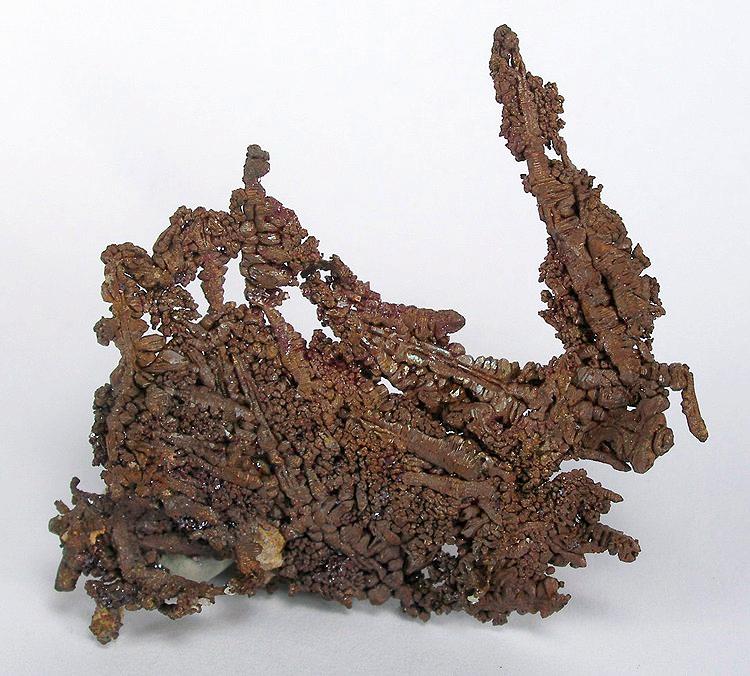
Photo: Wikimedia Commons
Search for specimens: View all specimens from Ray Mine, USA
Ray Mine is an open-pit porphyry copper mine in eastern Pinal County, Arizona, on State Route 177 between Superior and the Kearny-Hayden-Winkelman copper corridor. The mine lies in the Mineral Creek Mining District, also called the Ray District, in ground geologically tied to the Dripping Spring Mountains, Scott Mountain, Granite Mountain, Teapot Mountain, and the broader belt of east-central Arizona Laramide copper systems.
Geologically, Ray is a classic but structurally complicated porphyry copper deposit. The sulfide system is developed in Precambrian basement and Laramide intrusive rocks, including Pinal Schist, Ruin Granite, quartzite, diabase, Apache Group sedimentary rocks, and porphyry intrusions associated with the Granite Mountain porphyry system. Diabase has been especially important as a receptive host for copper mineralization, and the mine’s ore types have been dominated by diabase and Pinal Schist. Primary hypogene mineralization includes chalcopyrite, pyrite, and molybdenite; supergene enrichment produced important chalcocite ore; and near-surface oxidation generated the collector suite of copper oxides, carbonates, silicates, phosphates, native copper, quartz, and gypsum.
The structural picture is anything but simple. Ray’s alteration and mineralization have been displaced and redistributed by major faults, including the Emperor Fault and Diabase Fault, and by later Basin-and-Range-style tilting and extension. From the highway overlook, the mine exposes a cross-section through oxidized, enriched, and hypogene parts of the system: weathered copper silicate zones, secondary copper minerals, altered schist, diabase-hosted sulfides, and porphyry-related wall rocks. This structural disruption helped bring different levels of the system into mining reach and is one reason Ray has yielded such a varied suite of copper specimens.
The district’s nineteenth-century story began with prospecting along Mineral Creek. The Ray or Mineral Creek Mining District was organized in 1873, and early attention centered on silver before the scale of the copper resource became clear. Mineral Creek Mining Company built a five-stamp mill in 1880. Ray Copper Company followed in the 1880s, and later ownerships included Globe Mines Exploration Company, Ray Copper Mines Ltd., Gila and Ray Copper companies, and Ray Consolidated Copper Company. A railroad connection in the early twentieth century made large-scale shipment of ore practical, and the Hayden smelter was built to treat Ray ore. Underground mining began on an industrial scale in 1911.
The mine became part of the Kennecott world in the 1930s. Stripping for open-pit mining began in 1948, open-pit production began in 1952, and underground mining ceased in 1955. The conversion from underground workings to the Pearl Handle open pit changed the specimen story dramatically: instead of narrow underground pockets alone, collectors and miners began encountering near-surface oxidized seams, caliche-zone copper pockets, large exposed veins, and cavity-rich chrysocolla zones during bulk mining. ASARCO purchased the Ray Unit from Kennecott in 1986, later integrating it with the Hayden operations. Modern Ray Operations include the open pit, a concentrator, solvent extraction-electrowinning facilities, leach operations, maintenance and warehouse facilities, and rail transport linking Ray and Hayden.
Collecting access today is not casual field collecting. Ray is an active industrial mine, and specimens enter the market through historic mine collections, old dealer inventories, former miner finds, and occasional organized or contracted salvage when specimen zones are encountered. The public may view the mine from established overlooks along State Route 177 when open, but the pit, dumps, benches, roads, and operating areas are not open rockhounding ground. Serious collectors should assume that fresh Ray material has passed through miners, contractors, or dealers rather than through legal public collecting.
Several find types define Ray’s specimen history. The early open-pit years produced copper wires and branching clusters coated with red cuprite in a caliche-associated near-surface zone. Later finds included seams of spinel-law twinned native copper, sheet copper, pockets of copper with cuprite and chalcotrichite, chrysocolla pseudomorphs after earlier crystals, and major vuggy seams of chrysocolla stalactites coated by sparkling drusy quartz. Labels may mention the Pearl Handle Pit, the Ray shaft, the Ballpark Pit, the 1900 level, the Poorman area, or the Emperor Fault; such sublocality information is worth preserving, because Ray specimens without find context can be difficult to separate from superficially similar Arizona copper-mineral material.
Native copper is Ray’s signature collector mineral, especially as elongated spinel-law twins, branching arborescent groups, sheet-like pieces, wires, and sculptural clusters associated with cuprite, chalcotrichite, tenorite, malachite, chrysocolla, and quartz-rich matrix. Good Ray copper is distinguished by recognizable crystallization rather than mere massiveness: sharp flattened twins, complete floaters, branching forms with straight bladed edges, lustrous copper surfaces partly protected by cuprite or malachite, and old specimens with sublocality or collection history. Sizes range from thumbnails and miniatures to cabinet pieces, with documented copper specimens in the 10–20 cm class and older reports of much larger clusters; ordinary pieces are dull, massive, bent, or heavily corroded, while the best examples retain crisp form, balanced architecture, and natural green or reddish patina from the mine’s oxidized copper zones.
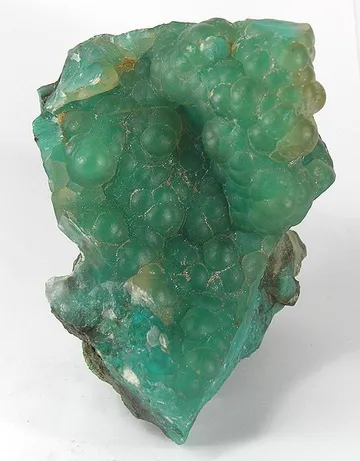
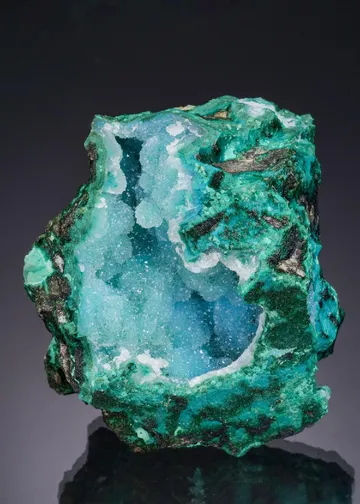
Ray chrysocolla is one of the mine’s most visually distinctive products, occurring as saturated turquoise-blue to blue-green massive material, botryoidal seams, drusy pocket linings, stalactitic clusters, chalcedony-rich “gem silica” material, and pseudomorphic forms after earlier copper or sulfate minerals. The prized specimens are not merely colorful lumps: they show bright blue interiors beneath quartz druse, rounded stalactites in tight clusters, chrysocolla-quartz vugs, or blue-green replacements that preserve earlier crystal shapes, commonly with malachite, azurite relics, cuprite, tenorite, gypsum, dioptase, quartz, or chalcedony. Miniatures and small cabinet pieces are commonest on the market, but well-preserved stalactitic groups with intact tips, rich color, and sparkling quartz coatings are the Ray chrysocollas that move from decorator material into serious locality-suite territory.
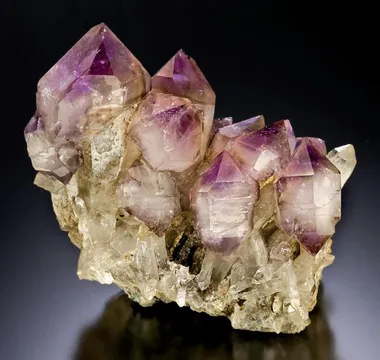
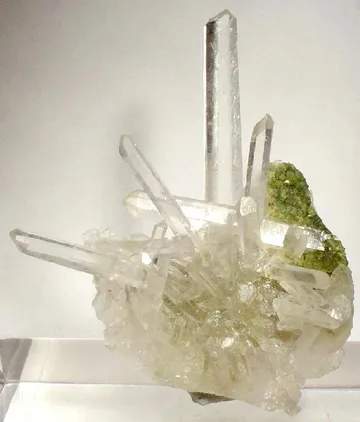
Quartz at Ray is most collectible when it is inseparable from the copper-silicate story: pale to sparkling drusy quartz coating chrysocolla stalactites, sugary quartz crusts over blue-green seams, clear microcrystals lining vugs in chrysocolla-rich matrix, and quartz-rich host rock carrying copper oxides and secondary copper minerals. The famous late-1990s-style chrysocolla-quartz pocket material includes stalactites and cavity linings coated by fine quartz points that let the blue chrysocolla glow through; this optical contrast is the difference between a standard Ray copper-ore specimen and a display-quality piece. Larger quartz-only specimens are not the mine’s claim to fame, but quartz as a sparkling overgrowth, vein filling, or vug lining gives Ray chrysocolla its best texture and is a key association for dioptase, malachite, and chalcotrichite specimens.
Cuprite from Ray ranges from red to dark reddish-brown crystal coatings on native copper to sharper octahedral, modified octahedral, and cubic crystals, with the fibrous variety chalcotrichite forming some of the most attractive micro- to miniature-scale pieces. Many classic Ray coppers are at least partly cuprite-coated, and some of the early open-pit copper-wire finds were valued precisely because red crystallized cuprite coated branching copper forms. The best cuprite specimens show visible crystal faces, bright red internal color or sparkling red surfaces, strong contrast against native copper or dark tenorite, and minimal abrasion; lesser examples are blackened, massive, or merely stained copper with no distinct cuprite form.
Azurite at Ray is a subordinate but important oxidation-zone mineral, occurring as blue crystals, coatings, and associations with chrysocolla, malachite, gypsum, quartz, and copper-rich matrix. The locality is especially interesting for blue-green pseudomorphic material historically discussed as chrysocolla after azurite or after selenite gypsum; some pieces preserve bladed or prismatic architecture even when the chemistry and identity of the original mineral have been debated. Good Ray azurite specimens have sharp blue relief, recognizable crystal form, or attractive contrast with malachite and chrysocolla, but Ray is not a Bisbee-style azurite locality; its azurite is best collected as part of the broader chrysocolla-quartz-gypsum secondary assemblage rather than as large, standalone azurite crystal groups.
Malachite from Ray occurs as coatings, fibrous crusts, acicular tufts, botryoidal patches, and most memorably as the green patina on native copper spinel twins from the Pearl Handle Pit. On many Ray coppers, malachite is not an accessory to be removed but part of the specimen’s identity: a velvety or lustrous green film that records oxidation in place and gives Ray twins a look unlike freshly cleaned metallic copper. Collectible malachite-rich pieces are strongest where the green is textural and deliberate-looking—needles in small vugs, rich crusts over copper or chrysocolla, or balanced blue-green combinations—while ordinary material is flat green staining on copper ore.
Gypsum at Ray belongs to the oxidized, sulfate-rich part of the copper system and is best known to collectors through associations with azurite and chrysocolla, including bladed or selenite-like forms that may have served as templates for chrysocolla pseudomorphs. Clear to white gypsum crystals, gypsum with azurite, and gypsum with copper-silicate staining appear in documented Ray material, but the most desirable examples are those where gypsum adds structure: blades, sprays, or ghosted forms in blue-green chrysocolla rather than chalky, friable crusts. Because gypsum is soft and easily bruised, surviving Ray pieces with intact blades, clean contrast, and reliable old labels deserve more respect than their species rarity alone might suggest.
Chalcedony at Ray is part of the silica-rich copper-oxidation assemblage, forming blue to blue-green chrysocolla-bearing chalcedony, “gem silica” style material, translucent seams, botryoidal coatings, and cryptocrystalline quartz that grades into drusy quartz-lined pockets. The best chalcedony specimens show saturated copper color with translucency, smooth botryoidal or stalactitic form, and a lively contrast between waxy chalcedony and sparkling quartz druse. Much Ray chrysocolla offered as massive blue material is really a mixture of chrysocolla and silica; collectors should value pieces with good color, polishable depth if lapidary, or natural vug texture if specimen-grade, and should be wary of dull, porous, or artificially brightened fragments.
In Ray Mine collecting, “spinel” most often appears not as the mineral spinel, MgAl2O4, but as shorthand for spinel-law twinned native copper, one of the locality’s most famous habits. These copper twins form flattened, blade-like crystals joined along a twin plane, commonly building elongated V-shaped or branching groups; the best examples are sharp, complete, naturally patinated, and visually architectural rather than bent scraps of copper. A Ray label that says “spinel twin” should be read as a crystallographic habit of copper unless the specimen is analytically documented as the oxide mineral spinel; this distinction matters because Ray’s collector reputation rests on twinned copper, not on gem spinel.
Dioptase from Ray is a minor but desirable copper silicate, occurring as emerald-green microcrystals and drusy bands in oxidized copper-silica assemblages, especially with quartz and malachite. Ray dioptase is not famous for large crystals; its appeal is color and association, as thin bright green layers or sparkling microcrystalline surfaces set against pale quartz, blue chrysocolla, or green malachite. The strongest examples are combination pieces where the dioptase is visibly crystalline, richly colored, and undamaged under magnification; massive green coatings without sparkle are far less compelling and can be confused with malachite or other copper silicates without careful inspection.
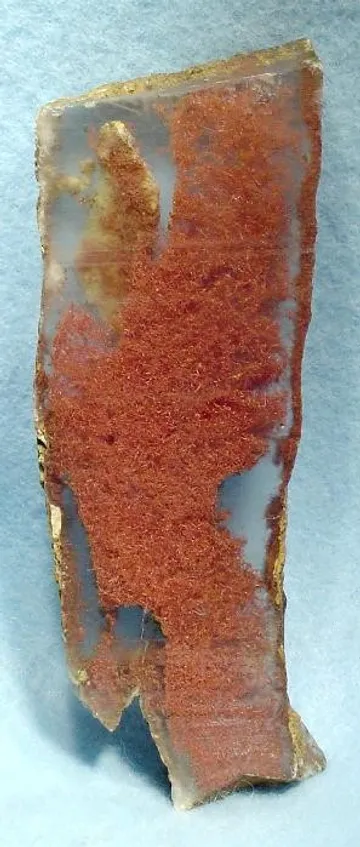
Chalcotrichite, the hairlike variety of cuprite, is one of Ray’s best micro and small-cabinet attractions, recorded as sparkling red fibrous aggregates on or near native copper, tenorite, quartzite, and delafossite-bearing material. A documented modern occurrence in the Poorman area produced felted masses to several centimeters in quartzite with native copper, giving Ray chalcotrichite more locality-specific interest than a generic “red fuzz” label would imply. Fine pieces need open, undamaged sprays or mats with bright red color and visible luster; because the fibers are fragile, flattened or dusty examples lose much of the charm that makes Ray chalcotrichite desirable.
Calcite occurs at Ray in the oxidized and vein assemblages as white to colorless crystals, crusts, and matrix associations with copper minerals, and older collector accounts note that fine calcites are not unusual from the mine. Its importance here is usually as a supporting mineral: hosting or contrasting native copper, cuprite, chrysocolla, malachite, and iron oxides, or adding bright crystal faces to otherwise earthy copper-ore specimens. Good Ray calcite is clean, sharp, and compositionally tied to copper mineralization; ordinary calcite without strong association or locality history is much less sought after than the mine’s coppers and chrysocolla.
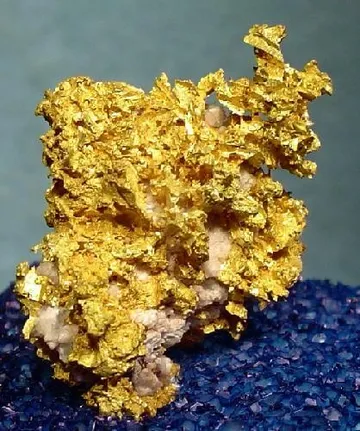
Beyond the headline species, Ray has a deep documented mineral list typical of a large copper porphyry and its oxidized cap: chalcocite, chalcopyrite, bornite, pyrite, molybdenite, tenorite, goethite, jarosite, brochantite, libethenite, delafossite, descloizite, shattuckite, gem silica, opal, halloysite, kaolinite, montmorillonite, alunite, baryte, apatite, magnetite, ilmenite, rutile, titanite, zircon, tourmaline, epidote, garnet-group minerals, biotite, muscovite, chlorite-group minerals, orthoclase, native silver, native gold, and several alteration or gangue phases. Delafossite with chalcotrichite, grass-green libethenite, and copper-silicate rarities are especially worth watching for, but analytical caution is appropriate: many blue and green Ray coatings are visually similar, and the best labels are those that preserve both the species and the sublocality or find context.
Ray Mine specimens are common enough that the locality is familiar, but genuinely fine examples are not common. Ordinary chrysocolla masses, small copper fragments, and mixed copper-ore pieces appear regularly; sharp spinel-law copper twins, old cuprite-coated wires, intact chrysocolla-quartz stalactites, convincing pseudomorphs, and well-documented chalcotrichite or dioptase pieces are scarcer and more competitive.
The main authenticity issue is not a famous wave of manufactured fakes but misdescription. “Spinel” on a Ray label usually means spinel-law twinned copper, not the mineral spinel. “Chrysocolla after azurite” and “chrysocolla after gypsum” labels should be treated with care, because some Ray pseudomorphs have long been debated on morphology alone. “Gem silica” should show chalcedonic translucency and not merely blue chrysocolla staining. Dioptase, shattuckite, libethenite, delafossite, and other rarities deserve analytical or expert confirmation when the specimen value depends on the name.
Treatments are a practical concern with Ray chrysocolla and copper. Porous chrysocolla and chrysocolla-chalcedony may be oiled, waxed, stabilized, sealed, or photographed wet to intensify color. Native copper may be cleaned, acid-brightened, lacquered, or stripped of natural patina; for Ray, overcleaning can actively reduce value, because the green malachite patina and reddish cuprite coatings are part of the classic look. Bright metallic copper with no natural oxidation should be viewed skeptically unless the dealer explains the cleaning history.
Condition issues vary by species. Copper twins bend easily and may have repaired tips, broken branches, or old attachment scars; judge them by completeness, crystallographic sharpness, and whether damage interrupts the silhouette. Chalcotrichite is extremely fragile and should be protected from vibration, dusting, and repeated handling. Gypsum is soft and easily scratched. Chrysocolla stalactites may have broken terminations or contacted edges hidden by the saturated color, so inspect tips and bases closely. Quartz druse can disguise bruises but also reveals them under strong light.
Ray specimens should be stored dry and handled gently. Copper and cuprite are stable under normal cabinet conditions, but avoid harsh chemical cleaning. Gypsum should not be soaked. Chrysocolla and chalcedony-rich specimens can vary in porosity, so prolonged wetting, oils, ultrasonic cleaners, and aggressive solvents are poor choices. Fluorescence is not a major selling point for the classic Ray suite; visual appeal under daylight or neutral LED light is far more important than ultraviolet response.
Provenance adds real value. Labels mentioning the Pearl Handle Pit, Poorman area, Ballpark Pit, 1900 level, Ray shaft, Emperor Fault, a 1950s or 1970s find, or a known Arizona collection should be preserved. Because Ray is active and access is controlled, the market depends heavily on old collections and episodic salvage, so well-labeled older pieces often deserve a premium over similar-looking “Arizona copper mine” material with vague locality.
Ray’s story begins before the mine was Ray. The copper showing along Mineral Creek was noted in the nineteenth century, in a landscape where soldiers, prospectors, and road builders repeatedly stumbled into Arizona’s metal wealth. The district was organized in 1873, but the first fever was silver. Only after years of difficult access and uneven early ventures did the copper body reveal the scale that would eventually swallow a town.
The first industrial heartbeat was small: a five-stamp mill built by Mineral Creek Mining Company in 1880. By the early 1880s a furnace was treating ore from the Ray, Scorpion, and Bilk mines. Later British capital entered through Ray Copper Mines Ltd., which built a mill at Kelvin, where Mineral Creek meets the Gila River. The arithmetic went wrong. The ore was expected to run 4 percent copper but averaged closer to 2 percent, and the company failed after processing about 200,000 tons. That failed calculation is a perfect Ray detail: the deposit was enormous, but the mining industry had not yet fully learned how to profit from enormous low-grade copper systems.
Ray became a company town in 1909, and the Hayden smelter followed soon after. Underground mining began in 1911, and during World War I the town boomed to about 5,000 people, with two banks and a newspaper called the Copper Camp. Then the twentieth century did what large copper mines often do: it turned a place of houses, streets, and families into ore. Kennecott built Kearny in 1958 as a planned community for residents of Ray, Sonora, and Barcelona, because the expanding open pit was going to consume their towns. Today, the vanished communities survive in markers, photographs, and labels; the pit is the landscape.
The Pearl Handle Pit gave collectors one of the great Arizona copper episodes. As miners broke through hard caliche near the surface, they exposed clusters of long, branching crystallized copper wires coated with bright red crystallized cuprite. Some wires were six to eight inches long. Most specimens were hand-sized clusters, and hundreds were saved by miners. One collector later boasted of owning 150 examples. In the Phoenix and Tucson collecting circles of the time, the barter economy was charmingly direct: citrus and garden produce traded for copper-wire specimens from Ray.
Bob Jones’ account of collecting at Ray captures the heat and scale of the place better than any tidy locality label can. Invited by John Mediz, who held the collecting contract at the time, Jones drove 60 miles early in the morning and entered the pit to work a huge zone of native copper filling cracks and seams. Mediz collected sheet copper while Jones looked for crystallized pieces. They were on the south-facing wall, and by noon the temperature was above 100 degrees. That is the proper mental picture for many Ray specimens: not a cool cave pocket, but a blasted industrial desert wall, heavy copper sheets, hard light, and collectors racing the mine schedule.
The famous spinel-twinned copper find may be Ray’s most beloved specimen story. It happened before formal specimen contracts were common. A large mass of crystallized native copper opened in the pit, and miners, shovel operators, and truck drivers salvaged what they could. The crystals were flat-bladed spinel twins, joined end-to-end into long V-shaped groups with straight, sharp edges. Some clusters reached about ten inches long, and miners could pull the loosely attached specimens apart into small examples or pieces large enough to fill both hands. Their color made them exceptional: instead of dark weathered copper, many were coated by a lustrous to velvety malachite-green patina. Those green twins remain among the most recognizable native copper specimens from Arizona.
Ray’s blue specimens have their own legend. Some pale blue crystal groups were first sold as chrysocolla after azurite, but their striated, flat, lath-like forms made collectors question that interpretation. Because azurite rarely presents that exact habit, gypsum or selenite became the favored explanation for some examples. The argument matters less than the visual result: brittle, hand-sized clusters of blue-green pseudomorphic forms, a Ray specialty born in the oxidation zone.
The great chrysocolla stalactite seam reads almost like a cave discovery inside a copper mine. Mining tore into cavities lined and filled with chrysocolla stalactites “hanging like so many icicles,” to borrow the memorable image from Bob Jones’ account. Some stalactites were six to eight inches long; others had grown into columns. Many stood in tight, subparallel clusters only fractions of an inch apart, some curved as if shaped by moving copper-bearing solutions. Then came the final aesthetic gift: most were coated with bright, sparkling drusy quartz, sometimes transparent enough to let the intense blue chrysocolla glow through. The find was so large that Andy Clark, a local miner and expert collector, was hired to mine and prepare the specimens for sale. Individual pricing was impractical, so the material was grouped into lots of six or more pieces and offered by bid to collectors and dealers.