Fat Jack Mine, USA — a classic American source of amethyst-tipped quartz scepters and smoky quartz, with rare lead-tungstate specimens and diverse sulfides.
Key facts
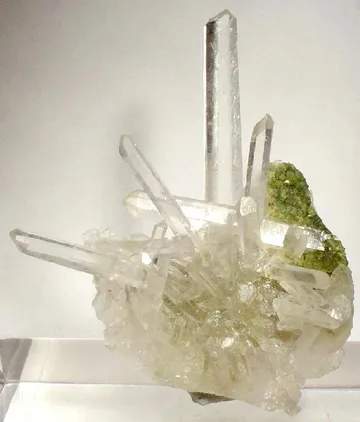
Fat Jack is the little Bradshaw Mountains mine that refuses to behave like a minor locality. On paper it is a former gold-silver-amethyst mine south of Crown King, in the Pine Grove Mining District of Yavapai County, Arizona; to collectors it is one of the classic American sources of amethyst-tipped quartz scepters, smoky quartz, and uncommon lead-tungstate specimens. Its best pieces have the unmistakable Fat Jack look: pale to medium violet amethyst caps perched on milky or smoky quartz stems, sometimes with color zoning, phantoms, sidecar crystals, iron-oxide dusting, or a whole spray of smaller quartz crystals around the base. The mine’s mineralogy is broader than the scepters suggest. Oxidized lead-copper-sulfide mineralization has yielded stolzite, wulfenite, pyromorphite, osarizawaite, cerussite, anglesite, mottramite, malachite, chrysocolla, galena, sphalerite, pyrite, and native gold, making Fat Jack a rewarding locality for both display-quartz collectors and Arizona rarity specialists.
Regional View
Country View
The geological setting explains the mix. Fat Jack lies in the Pine Grove district, an old Ag-Au area around Crown King where northeast-trending schist, granodiorite, granite, diorite, and rhyolite-porphyry dikes host quartz-carbonate vein systems. In that environment, early sulfide and precious-metal mineralization was overprinted by oxidation and late open-space crystallization. For specimen collectors, the prize is not ore but pocket texture: sceptered quartz crystals, amethyst caps, smoky zones, and secondary lead minerals occupying cavities and fractures where late fluids had room to grow crystals rather than simply cement rock.

Photo: Wikimedia Commons
The mine’s reputation rests especially on specimens that balance delicacy with geometry. Ordinary Fat Jack quartz may be pale, broken, or only vaguely sceptered; the best pieces show a clear structural story, with a distinct first-generation stalk and a later cap whose amethyst or smoky color reveals a changed growth episode. Some pieces are thumbnails with a single clean scepter, while the most desirable miniatures and small-cabinet examples carry multiple crystals on matrix, sharp terminations, or rare associations with stolzite and pyromorphite. Large stolzite from Fat Jack has drawn renewed attention: recent literature records exceptional crystals to about 6 cm, a scale that puts the locality into the world conversation for the species rather than merely the Arizona one.
Search for specimens: View all specimens from Fat Jack Mine, USA
Fat Jack Mine is on Lane Mountain near Crown King, in the Pine Grove Mining District of the Bradshaw Mountains, Yavapai County, Arizona. Mindat places the locality at approximately 34° 9' 34" N, 112° 19' 23" W, and records it as a former surface and underground Au-Ag-amethyst mine. Western Mining History, drawing from MRDS data, gives the elevation as about 6,880 feet and lists silver and gold as the primary commodities. The broader Pine Grove district occupies high country north of Crown King and east of Towers Mountain, roughly in the 6,000- to 7,500-foot elevation belt.
The district geology is a compact version of the Bradshaw story: old metamorphic rocks, intrusive bodies, dikes, shears, and mineralized quartz veins. Pine Grove country rock is described as a northeast-trending belt of schist intruded by granite to the east, granite and diorite to the west, and granodiorite to the southwest. These rocks are cut by northeast-trending granite and rhyolite-porphyry dikes. The vein gangue in the district is chiefly quartz with ankerite and calcite, and many mines occupy granodiorite that intruded Bradshaw granite and older Yavapai schist. Fat Jack specimens fit that model well: quartz is the principal collector mineral, carbonate gangue is present, and the oxidized suite points back to galena, sphalerite, pyrite, chalcocite, covellite, and other sulfide-stage minerals.
The ore and specimen mineralization are best understood as two overlapping collector targets. The mining target was a small precious-metal system carrying gold and silver values in quartz-sulfide veins. The specimen target is the oxidized and vuggy part of that system, where quartz scepters, amethyst, smoky quartz, stolzite, pyromorphite, wulfenite, and osarizawaite developed in cavities. The documented Fat Jack mineral list includes native gold; galena, sphalerite, pyrite, chalcocite, and covellite; hematite and limonite; ankerite, cerussite, malachite, and chrysocolla; anglesite and baryte; jarosite and osarizawaite; mottramite and pyromorphite; quartz, amethyst, smoky quartz, opal, stolzite, and wulfenite. That is a remarkably expressive assemblage for such a small locality.
Fat Jack was never a major published producer on the scale of the Crown King Mine, and public records give little in the way of tonnage or sustained ore output. Its modern history is more visible through specimen collecting. The locality was brought to the attention of the wider mineral community by Jeff Scovil and Les Wagner, Jr. in their 1991 Mineralogical Record article, following important 1980s finds of amethyst and smoky quartz scepters. A 1990 Mineralogical Record symposium abstract dealt with stolzite from the mine, and later Arizona quartz summaries continued to cite Fat Jack among the state’s notable quartz localities.
Ownership and access have shifted repeatedly. Collecting literature from the 2000s and 2010s refers to different claim holders and operators; one Arizona quartz abstract noted that over roughly 20 to 25 years the claim had been owned by about half a dozen people. A Mineralogical Society of Arizona program biography records that Les Presmyk operated the Fat Jack claim as a small open-pit specimen project from November 2000 to May 2002, including work on the Plan of Operations for continued activity in the Prescott National Forest. A 2013 collecting page stated that the mine was under claim by Rodney Moore and that collecting without permission was forbidden. Later MSA newsletters and field-trip lists show Fat Jack as a controlled club-access locality, not an open public digging site. For today’s collector, the practical rule is simple: treat Fat Jack as an active claim or permission-only locality unless the current claim holder or an organized club trip explicitly authorizes access.
Specimen finds have come in waves rather than as a steady commercial stream. The classic 1980s pieces include amethyst and smoky quartz scepters with flattened, lustrous caps, some from old Arizona collections such as the Dave and Emily Stoudt collection and material passing through the Tucson market in the early 1990s. A documented 2000 find produced delicate matrix scepters with only a faint purple tint, a form described by dealers as atypical because many Fat Jack scepters are more robust and loose rather than matrix pieces. Mindat and dealer records document pieces with amethyst caps on milky stalks, smoky-amethyst compound crystals, pale amethyst-tipped smoky scepters, and quartz associated with stolzite, pyromorphite, and wulfenite. Another small but intriguing branch of the locality’s history is quartz pseudomorph material, with a 1994 note in The Pseudo News referring to new quartz pseudomorphs from the mine.
Fat Jack amethyst is most valued when it forms a distinct cap on an earlier quartz stalk, creating a true scepter rather than simply a purple quartz crystal. The color is typically light to medium purple rather than deep Four Peaks purple, but the best specimens compensate with strong luster, transparency, crisp hexagonal terminations, and an obvious two-stage growth relationship between milky, colorless, or smoky stems and later amethystine overgrowths. Documented specimens range from tiny thumbnails only a few centimeters tall to major scepters and groups approaching small-cabinet size, with the Mineralogical Record index noting amethyst-tipped scepters to 15 cm and some Japan-law twins. Associations include colorless quartz, smoky quartz, hematite or iron-oxide dusting, and, more rarely, secondary lead minerals; superior pieces show complete terminations, minimal edge wear, sharply perched caps, and either pleasing matrix placement or a sculptural freestanding habit.
Quartz from Fat Jack is the backbone of the locality: colorless, milky, smoky, amethystine, sceptered, and occasionally twinned. The classic habit is a scepter in which an earlier, narrower stalk supports a later broader cap; some examples are pale smoky with amethyst phantoms or tips, while others are milky stems capped by gemmy amethyst. Mindat records quartz here specifically as sceptered, and photo records show associations with amethyst, smoky quartz, pyromorphite, stolzite, wulfenite, ankerite, and iron oxides. The best quartz specimens are not merely clean points but specimens with character: distinct growth generations, balanced side crystals, phantoms, sharp caps, or rare matrix examples from small finds. Ordinary pieces can be pale, nicked, or only loosely sceptered; fine pieces are instantly recognizable as Fat Jack because the pale Bradshaw quartz and later purple or smoky growth are both visible in the same crystal.
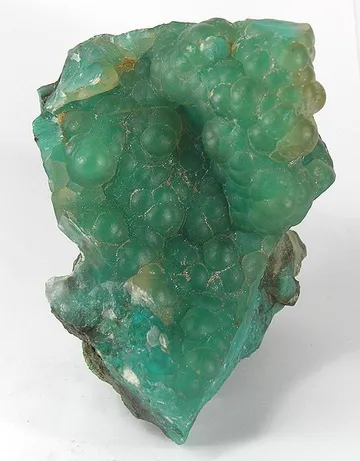
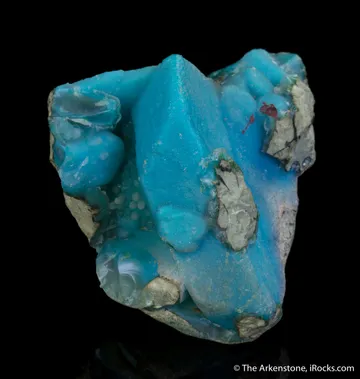
Beyond quartz, Fat Jack’s serious mineralogical importance lies in its oxidized lead-copper-tungstate suite. Stolzite, Pb(WO4), is the standout rarity, documented as rough cubic to platy crystals and, in recent work, as exceptional large crystals to about 6 cm with smaller tabular stolzite crystals on their surfaces. Wulfenite, Pb(MoO4), is reported as small crystals on quartz with stolzite. Pyromorphite occurs as green crusts and also as pale, minute acicular to prismatic crystals on quartz in photo-documented specimens. Osarizawaite, Pb(Al2Cu)(SO4)2(OH)6, is a notable micro-rarity here, indexed in the Mineralogical Record as minute pseudocubic material. Collector records also mention limonite or goethite pseudomorphs after pyrite, including unusually large examples for the locality, along with cerussite, anglesite, mottramite, malachite, chrysocolla, baryte, ankerite, hematite, galena, sphalerite, chalcocite, covellite, pyrite, opal, and native gold.
Fat Jack specimens should be judged first by morphology, not color alone. Many pieces are pale; that is normal for the locality. A light violet cap on a sharply formed scepter can be far more desirable than a darker but poorly formed or damaged crystal. Look for a visibly narrower stem, a later cap with crisp faces, clean termination geometry, and a natural relationship between smoky, amethystine, and milky zones. Matrix pieces are especially appealing when the quartz is not merely glued-looking or isolated but naturally embedded in a pocket plate with smaller companion crystals.
Condition is a major issue. Scepters concentrate stress at their caps and at the neck between stem and head, so edge nicks, bruised terminations, and repaired stems are common. Old specimens may have iron-oxide coatings that are natural and locality-typical; aggressive acid cleaning can make them look too bright, flatten the character of the pocket surfaces, or expose older damage. Stolzite, pyromorphite, wulfenite, and osarizawaite associations are delicate and should not be cleaned casually. Even quartz specimens should be examined under magnification for reattached caps, filled breaks, and rubbed termination edges.
Mislabelling is possible because “amethyst scepter” is a broad market category and Fat Jack pieces can superficially resemble material from other Arizona or western U.S. localities. The most convincing Fat Jack labels usually connect to Crown King, Lane Mountain, the Pine Grove District, known Arizona collectors, older Stoudt or Urish provenance, the 1980s finds, Jeff Scovil or Les Wagner-era material, or more recent MSA-related field collecting. Be cautious with vague “Arizona amethyst scepter” labels and with pieces whose habit or color looks more like Madagascar, Nevada, or Brazilian scepter quartz than Bradshaw Mountain material.
No widely documented irradiation or dyeing problem is tied specifically to Fat Jack quartz in the sources consulted, but smoky quartz and amethyst in general are species categories where enhancement questions sometimes arise. For this locality, the bigger authenticity questions are locality provenance, repair, and overcleaning rather than color treatment. Stolzite presents a different problem: very large crystals invite scrutiny because Fat Jack material overlaps visually with some stolzite or pseudomorph material from other localities. The 2024 Mindat discussion that led into the 2026 Rocks & Minerals article is a useful reminder that large Fat Jack stolzite should be analytically supported when the specimen is important.
Market availability is intermittent. Small loose scepters and modest smoky or amethystine crystals appear from time to time, often as thumbnails in the low to middle collector price range. Good matrix scepters, sharp old-collection miniatures, and clean amethyst-smoky combinations are much less common. Specimens with credible stolzite, pyromorphite, wulfenite, or osarizawaite associations are specialized and generally scarcer than the quartz. The locality is active enough in Arizona collecting circles that new material occasionally surfaces, but it is controlled-access material, not a commodity locality feeding the market in volume.
One of the charms of Fat Jack is that it keeps reappearing in collectors’ lives as a permission gate rather than a roadside free-for-all. A 2006 Mindat field-collecting discussion named Gary Spraggens as having the mine under claim and remarked that clubs could sometimes get in for about “$20 a head,” with the pointed advice not to go unless recent blasting had exposed something worth digging. That short comment captures the working rhythm of the locality: pockets are not everywhere, and a trip may be memorable or barren depending on whether fresh ground has been opened.
By September 2013 the mine had another public face. Rodney Moore’s collecting page described Fat Jack as under claim and closed to collecting without permission, then showed the sort of small reward that keeps people asking. He wrote that on his first visit he dug nice quartz scepters, some with smoky or amethyst tints, and credited Jeff Bee, a Crown King local helping at the mine, with finding the first two crystals shown on the page. The photos are presented as a field collector would present them: not as museum trophies, but as the proof that a stubborn little claim outside Crown King could still produce scepters with color.
The Mineralogical Society of Arizona connection adds another chapter. In February 2016, the MSA Rockhound Record let “the cat out of the bag”: Joseph Philpott Jr. wrote that “The Dons and I” were the proud owners of the Fat Jack Mine near Crown King and the Prism mine near Tonopah, and that they would lead MSA trips later that year. Fat Jack was no longer simply a locality in old Mineralogical Record pages; it had become a club destination again, the kind of place where newer collectors could stand in the same Bradshaw dirt that produced the classic scepters.
A more surprising modern story centers on stolzite, not quartz. In September 2024, Dana Slaughter posted on Mindat that he had been handed an enormous single crystal he first suspected might be stolzite after scheelite from Darwin, California. Then came the shock: it was reported to be from Fat Jack. He described it as probably 6 cm tall, reasonably sharp, with micro-stolzite crystals on the surface, and confirmed at the University of Arizona. The specific gravity seemed low, testing continued, and the discussion ranged over whether the specimen might be among the largest stolzite crystals known. A later comment noted microprobe variation of roughly 50 to 80 mol% stolzite with the remainder wulfenite, a chemically fascinating detail for a specimen that had already upended expectations on size.
That story did not remain a forum curiosity. In 2026, Ron Gibbs, Raymond Grant, and Dana Slaughter published “Large Stolzite Crystals From the Fat Jack Mine, Yavapai County, Arizona” in Rocks & Minerals. The article recorded that only a small number of these exceptional crystals were collected, that some reached about 6 cm, and that many bore smaller tabular stolzite crystals only a few millimeters across. For a mine famous to most collectors for pale purple quartz scepters, the revelation that it had also produced world-class-scale stolzite is exactly the sort of twist that keeps old Arizona claims alive in the collecting imagination.