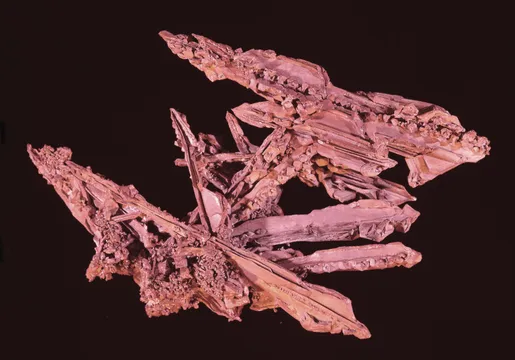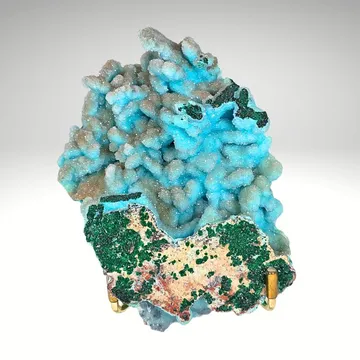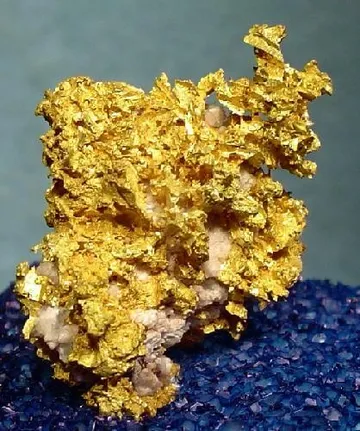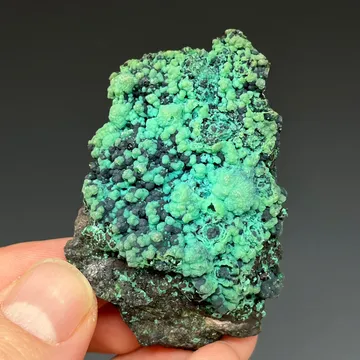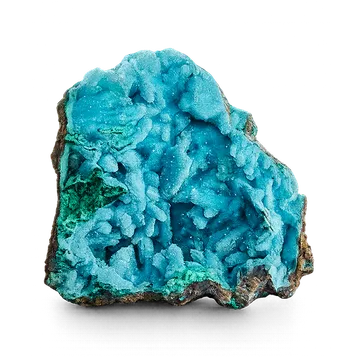
Chrysocolla from Ray Mine, Arizona — saturated blue-green color, textures like drusy quartz and botryoidal seams, with Ray District appeal for collectors.
Key facts
Ray Mine chrysocolla has the color that made Arizona copper minerals famous: saturated turquoise, robin’s-egg blue, blue-green, and darker teal, often with enough silica to take on the glassy depth collectors associate with “gem silica” or chrysocolla chalcedony. The best specimens are not merely blue masses. They are textural pieces: botryoidal seams, sparkling quartz-dusted pockets, stalactitic fingers, chrysocolla replacing earlier copper minerals, and intensely colored material set against brown gossan, quartzite, black tenorite-rich matrix, malachite, or relic azurite forms.

Photo: Wikimedia Commons
The mine sits in the Ray District of Pinal County, in the old Mineral Creek mining country near Scott Mountain and Kearny. It is a major porphyry copper system, and its chrysocolla belongs to the oxidized and supergene portions of that system rather than to the primary hypogene sulfide ore. Copper-bearing fluids and weathering processes worked through fractured rock, faults, breccias, diabase, schist, quartzite, and porphyry-related host rocks, producing oxide and silicate copper minerals above and around the deeper sulfide system. In that environment, chrysocolla formed as coatings, vein fillings, masses, stalactitic growths, and silica-rich intergrowths with quartz and chalcedony.
Ray is especially important to collectors because it produced several recognizable chrysocolla “looks.” One is the rich, compact blue-green mass, prized for color and size. Another is chrysocolla under a drusy quartz coating, where clear to white microcrystals give the surface a sugar-sparkle. A third is the stalactitic material from pockets opened during mining, some pieces showing rounded or curving blue fingers with later quartz overgrowth. A fourth is chrysocolla pseudomorphing azurite, malachite, or gypsum, retaining the earlier mineral’s shape while replacing it with blue-green copper silicate.

Photo: Wikimedia Commons
Collectors look first for color saturation, then for form. A clean, vivid, undamaged Ray specimen with quartz druse, stalactites, or a convincing pseudomorph is far more desirable than a large but dull lump. The most charismatic pieces show the color glowing through transparent quartz, or preserve delicate shapes that would normally have been destroyed in an open-pit copper operation. That survival story is part of the appeal: many Ray specimens were rescued from ore zones that otherwise existed for copper production, not mineral collecting.

Photo: Wikimedia Commons
Search for specimens: View all chrysocolla specimens from Ray Mine, Arizona, USA
Ray Mine is in eastern Pinal County, Arizona, in the Mineral Creek or Ray District, near Scott Mountain and Kearny. Modern mining is conducted as a large open-pit copper operation with a concentrator and solvent extraction-electrowinning facilities. It is part of ASARCO’s Ray Operations, with copper moving through the local mining and smelting infrastructure around Ray and Hayden.
Geologically, Ray is a classic porphyry copper deposit. The deposit is structurally and lithologically complicated: mineralization is governed by host-rock type, faulting, original position within the porphyry system, and a long history of supergene enrichment and oxidation. The older rocks include Pinal Schist and Precambrian diabase or dolerite intrusions; later porphyry-related intrusions include the Granite Mountain Porphyry, generally treated as the important Laramide-age mineralizing intrusion. In the mine, primary sulfide copper occurs chiefly as chalcopyrite in favorable mafic host rocks, while enriched chalcocite formed an important supergene blanket. The chrysocolla of collector interest belongs mainly to oxidized and silicate copper ore zones, where chrysocolla occurs with minerals such as malachite, cuprite, native copper, tenorite, quartz, chalcedony, gypsum, libethenite, and dioptase.
The operating history begins in the late nineteenth century. The sequence of company names reads like a capsule history of Arizona copper: Mineral Creek Mining Company in 1880, Ray Copper Company in 1883, Globe Mines Exploration Company in 1898, Ray Copper Mines in 1899, Gila & Ray Copper companies in 1906, Ray Consolidated Copper Company in 1910, underground mining in 1911, Nevada Consolidated Copper Company in 1927, and Kennecott’s Ray Mines Division in 1933. Stripping for open-pit mining began in 1948, open-pit mining began in 1952, and underground mining ceased in 1955. ASARCO purchased the Ray Unit from Kennecott in 1986, and the modern Ray Complex took shape through later concentrator, crusher, leaching, and tankhouse developments.
For collectors, access is the crucial point: Ray is an active industrial copper mine, not a public collecting locality. Specimens on the market are from old collections, mine employees, historic dealer lots, authorized recoveries, or material saved during mining episodes. The best provenance includes old labels, level information, collection history, or a chain of ownership from recognized Arizona or national dealers. “Ray Mine” is common on labels, but higher-value specimens benefit from more specific information such as Ray Mine, Scott Mountain, Ray District, Mineral Creek District, Pinal County, Arizona, and, in rare cases, a mine level or documented find.
Notable finds include the quartz-coated chrysocolla stalactites associated with pockets in the active open pit, especially material described from the Pearl Handle Pit during mining in 1997. Those specimens helped define Ray’s modern collector reputation: blue to blue-green chrysocolla fingers, sometimes in clusters, sometimes curved, and in the finest examples overgrown with sparkling clear quartz. Older specimens from the 1960s through early 1980s are also valued, especially complete stalactitic miniatures and fine chrysocolla pseudomorphs after azurite.
Ray chrysocolla is most often massive, botryoidal, mammillary, stalactitic, drusy, or pseudomorphous rather than crystallized in the hand-specimen sense. The species itself is commonly extremely fine-grained to amorphous-looking in specimens, and at Ray the collector forms are products of open space, replacement, fracture filling, and silica overgrowth rather than large individual crystals.
Color ranges from intense turquoise and sky blue to blue-green, teal, green, and locally darker green-black to blackish material. The most desirable color is the saturated, luminous blue to blue-green associated with silica-rich chrysocolla and chrysocolla chalcedony. Less valuable material may be dull, porous, chalky, brown-stained, or weakly colored, though even these pieces can be interesting if they show mine geology or good associations.
Quartz is the most important associated mineral in display specimens. It may occur as drusy microcrystals over chrysocolla, as clear sparkling points in vugs, as chalcedony in gem-silica-like material, or as quartzite matrix. A continuous, undamaged quartz druse can transform a merely colorful specimen into a premium Ray piece, because the clear quartz catches light while the blue chrysocolla glows beneath it.
Malachite is a common companion, adding bright to dark green contrast. Azurite is especially important where chrysocolla has replaced azurite crystals, preserving blades, bow-tie clusters, or sharper crystal habits in blue-green pseudomorphs. Gypsum may also be involved in pseudomorphs, and some specimens show chrysocolla after malachite and gypsum in the same pocket. Tenorite and other dark copper oxides can provide black matrix contrast; cuprite, native copper, dioptase, libethenite, gypsum, heulandite-group zeolites, clinoptilolite-group zeolites, goethite, hematite, and calcite are also recorded in Ray associations.
Typical specimen sizes vary widely. Small thumbnails and miniatures with pockets of blue chrysocolla and quartz are relatively attainable. Fine small-cabinet pieces are much scarcer, particularly if the quartz druse is intact and the color is strong. Stalactitic specimens may occur as individual fingers or clusters; documented examples range from small miniatures to dramatic elongated growths. The celebrated 1997 stalactitic material included growths described as pencil-thin to thicker than a thumb, a couple of inches to about 10 inches long, with single stalactites and clusters of a dozen or more joined fingers. In the collector market, however, complete, aesthetic pieces are far less common than broken or trimmed fragments.
The locality’s most distinctive quality factors are:
Ray chrysocolla is common enough as a locality name, but fine Ray chrysocolla is not common. Ordinary massive pieces, small blue seams, and quartz-coated fragments appear regularly. Excellent stalactitic clusters, sharp chrysocolla-after-azurite pseudomorphs, large vug sections, and vivid chrysocolla chalcedony are much harder to obtain, and documented old-label examples sell well when the aesthetics are strong.
Condition is the main issue. Chrysocolla can be soft, porous, and friable unless protected or reinforced by quartz or chalcedony. Stalactites break at the base or tip; pseudomorphs lose their sharp edges; drusy quartz can be bruised or abraded; chalky chrysocolla can powder on high points. On quartz-coated pieces, inspect for crushed druse, rubbed edges, glued breaks, and places where the sparkling surface has been mechanically cleaned too aggressively. On stalactitic specimens, broken tips are common and should be expected unless the piece is described as complete. A cleanly sawn base is not automatically a defect if the display face is natural and undamaged, but undisclosed repairs on fingers or pseudomorphs materially affect value.
Authentication concerns fall into two categories: locality and material. Locality confusion is possible because Arizona has many chrysocolla-producing copper mines, including famous sources around Bisbee, Morenci, Inspiration, Miami, Planet, Christmas, and others. Ray material often has a distinctive combination of vivid blue chrysocolla, dark oxide matrix, quartz druse, and stalactitic or pseudomorphous forms, but appearance alone is not proof. For better specimens, provenance matters.
Material misrepresentation is also possible. In the lapidary trade, chrysocolla chalcedony or “gem silica” may be confused with dyed chalcedony, stabilized porous chrysocolla, or other blue-green copper-stained silica. Fine natural gem silica should show believable internal color distribution rather than a uniform artificial dye look concentrated in fractures. For specimen collectors, the greater concern is undisclosed stabilization or resin impregnation of soft chrysocolla. Stabilization is not always unacceptable, especially in lapidary pieces, but it should be disclosed. On mineral specimens, an overly plastic surface, unnatural gloss in pits, darkened seams, residue in cavities, or a chemical odor can be warning signs.
No widely documented, Ray-specific mass-fake problem appears in the mineral literature, but the value of top Ray material makes caution worthwhile. Be particularly careful with highly uniform electric-blue polished pieces sold with vague “Arizona chrysocolla” labels, with repaired stalactites offered as pristine, and with pseudomorphs lacking close photographs of terminations and contact points. For significant purchases, favor established dealers, old collection labels, Mindat photo matches, museum or publication references, or specimens with a documented collector history.
Current market availability is uneven. Modest Ray chrysocolla remains available, but the best pieces generally surface one at a time from older collections or dealer inventories. Recent public auction records show small-cabinet pseudomorphous material still trading in the hundreds of dollars, while exceptional historic pseudomorphs, large quartz-coated display specimens, and trophy stalactitic pieces can move into the low to high thousands depending on size, completeness, and provenance.
The most vivid Ray chrysocolla story belongs to the stalactite pockets exposed during mining in 1997. In the huge active open pit east of Phoenix, mining cut into the Pearl Handle Pit and opened a large seam that was not simply filled solid with chrysocolla. It had open space. Inside were blue to blue-green chrysocolla stalactites: long, thick, sometimes curving fingers formed by copper-rich descending solutions. Some were single growths; others were tight clusters of a dozen or more sub-parallel fingers. They ranged from pencil-thin to thicker than a thumb at the base, and from a couple of inches to about 10 inches long.
Their form was part of their mystery. Stalactites normally obey gravity, yet many Ray chrysocolla fingers curved. Some tapered from bases more than an inch across to tips only about a quarter-inch wide. Broken examples did not necessarily show a hollow central tube, suggesting that instead of growing from a dripping straw-like center, they may have thickened from fluids running down the outside. The undulating surfaces hinted at changes in solution chemistry or wet-dry cycles as the copper-bearing fluids pulsed through the pocket.
Then the second act came: silica-rich fluids entered some of the pockets after the chrysocolla had already formed. Tiny transparent quartz points grew over the earlier blue stalactites, so the finished specimen looked like blue copper silicate seen through a coat of sugar-bright quartz. That is the classic Ray look: not just blue, but blue glowing through sparkle.
The company’s response to the find is one of those fortunate moments in specimen history. Instead of sending all of it to the crusher, the operation recognized that the pocket had collector value. An experienced miner and specimen digger, Andy Clark, was brought in to recover the material and arrange it into lots. Local collectors and dealers then bid on those lots at auction. The mine made money; collectors gained specimens; and a pocket that would have been ordinary ore in the mining schedule became a reference point for Ray chrysocolla.
Another Ray story is quieter but no less telling. A documented small batch of dioptase and chrysocolla specimens was collected in May 1992 by Pat, a shift boss at the Ray Mine. One recorded specimen from that lot is a 44 x 37 x 26 mm piece: rich-blue chrysocolla in a pocket, covered by clear little quartz crystals on tan quartzite matrix. The entire lot was acquired only a few days after collecting. That kind of chain of custody is exactly why old mine-employee material is prized: the specimen is not merely “from Ray”; it is anchored to a person, a month, and a moment inside the working mine.
The Ray pseudomorphs after azurite have their own drama. A well-known miniature from the 2280 Level shows an upright, bow-tie-like cluster of chrysocolla after azurite on gossan matrix, with pseudomorph crystals reaching 3.2 cm. It came with a 1970s-era Roberts Minerals label that preserved the mine level. The form is delicate enough that most comparable pieces lost crystals, tips, or matrix attachment long ago. In that specimen, the appeal is not only the blue-green replacement, but the survival of azurite’s architecture inside a mineral that usually appears massive.
At the other end of the scale is a museum-sized chrysocolla with druzy quartz coating in the Zuhl Collection at New Mexico State University. The piece is listed as weighing 200–250 pounds, with notes describing blue-green chrysocolla covered by hundreds of tiny glass-clear quartz crystals. The same record gives its dimensions as 23 x 24 x 14 and places it on display in the Zuhl Museum’s Wow Gallery. Whether one accepts every superlative attached to the specimen or not, the facts are striking enough: Ray chrysocolla can be a miniature pocket treasure, a mine-level pseudomorph, or a quartz-sparkled blue mass weighing hundreds of pounds.