A collector's guide to Qinglong Mine, China: its geology, mining history and notable minerals, illustrated with the 43 specimens documented from this locality on EarthWonders.
Key facts
Qinglong Mine—better known in the literature and among specimen people as the Dachang Mine of the Dachang antimony ore field—is one of the defining modern Chinese localities for collectors who care equally about aesthetics, paragenesis, and geological context. It lies in Qinglong County, Qianxinan Buyi and Miao Autonomous Prefecture, Guizhou Province, in the northwestern Youjiang Basin, where antimony-gold mineralization is concentrated in a peculiar ore-bearing horizon called the “Dachang layer” between the Middle Permian Maokou Formation limestone and the Upper Permian Emeishan basalt succession. Industrially, Qinglong is an antimony-gold deposit; aesthetically, it is a fluorite-calcite-creedite locality of striking personality.
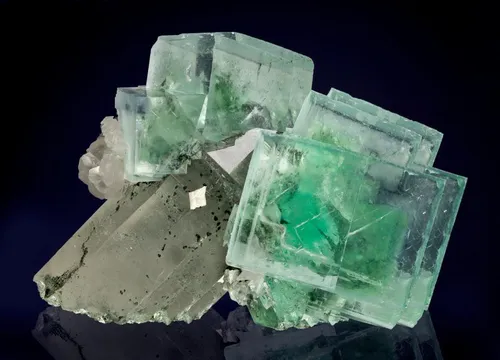
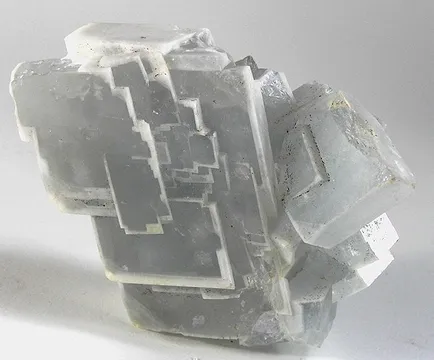
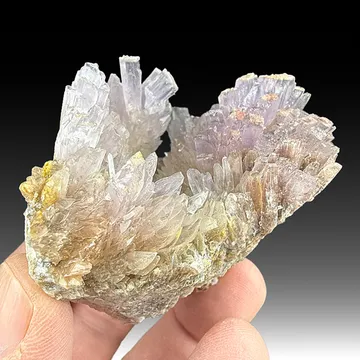
The best-known collector specimens are not ore pieces in the old stibnite sense, but late open-space and secondary-pocket pieces: sharp fluorite cubes with pale lilac, greenish, or colorless interiors and deep violet edge zoning; white to orange calcite, commonly scalenohedral or stacked into stalactitic aggregates; delicate gypsum veils; and bright sprays or spheroidal aggregates of creedite, ranging from colorless and white to pale violet. The most memorable fluorites have become market-recognizable as “purple edge,” “purple pattern,” or “QR-code” fluorite—names collectors use for the dark violet mosaic, stepped-growth, and edge-phantom patterns that make Qinglong pieces recognizable across a room.
Historically, Qinglong matters on two levels. First, it is one of southwestern China’s important antimony deposits and has been repeatedly studied in connection with Youjiang Basin antimony-gold metallogeny. Second, it is the type locality for ottensite, a rare sodium-potassium antimony oxysulfide-hydrate named for Berthold Ottens, whose writing and field work did much to introduce Chinese localities to the international mineral-collecting world. That type-locality status gives Qinglong an unusual bridge between economic geology, modern Chinese specimen production, and systematic mineralogy.
Regional View
Country View
For the collector, Qinglong is best understood as a locality of contrasts: a serious Sb-Au ore system that has yielded some of the most playful-looking fluorites of the Chinese market; a mine famous for purple fluorite that also produces scientifically important antimony oxidation minerals; and a place where specimen labels must be read carefully because “Qinglong,” “Dachang,” “Guizhou,” “yttrofluorite,” and “QR-code fluorite” have all been used with varying precision in the trade.
Search for specimens: View all specimens from Qinglong Mine, China
Qinglong Mine is situated at Dachang, in Qinglong County, southwestern Guizhou. The locality is recorded in mineralogical databases as Qinglong Mine, or Dachang Mine, within the Dachang Sb ore field. Published coordinates place the mine near 25°40′24″ N, 105°10′24″ E. The deposit belongs to the large group of low-temperature hydrothermal antimony-gold systems along the northwestern margin of the Youjiang Basin, a region better known to economic geologists for Carlin-like gold deposits, vein-type antimony deposits, and related As-Sb-Hg-Tl geochemical signatures.
The ore setting is unusually important for understanding the specimens. The main host is the “Dachang layer,” an altered, siliceous and argillic horizon developed at the contact interval above Maokou Formation limestone and below Emeishan basaltic rocks. Earlier Chinese work subdivided this ore-bearing layer into intensely silicified rocks, basaltic conglomerate or silicified conglomeratic clay rocks, and clay rocks. More recent papers describe widespread silicic, fluorite, argillic, and decarbonate alteration, with mineralization controlled by fractures, breccias, and permeable horizons.
The ore field is not a single tiny pocket locality but a larger antimony-gold district. Published studies divide the large Qinglong Sb-(Au) deposit into eight ore blocks: Dachang, Shuijingwan, Dishuiyan, Gulu, Houpo, Xishe, Sanwangping, and Heishanjing. Early antimony ore is characterized by jasperoid, stibnite, and fluorite, especially in open-space wallrock breccias; later Sb-Au mineralization is represented by quartz, arsenian pyrite, and finer stibnite in veins and stockworks. For specimen collectors, that relationship explains why fluorite, quartz, calcite, gypsum, baryte, and later secondary minerals occur together rather than as isolated species stories.
Resource figures vary by reporting date and source. Mineralogical locality records cite reserves of about 0.27 Mt Sb at 2.6% Sb, while a more recent court-reorganization notice concerning Guizhou Qinglong Xinde Antimony Industry Co., Ltd. described mining-license assets over 41.1576 square kilometers, a licensed production scale of 300,000 tonnes per year, and reported resources including antimony ore, pyrite ore, fluorite ore, selenium resources, and coal. Provincial listings also show Guizhou Qinglong Antimony Mine as a heavy-metal key-industry enterprise engaged in antimony mining and beneficiation at Dachang Town, Dachang Community.
Specimen production has come in waves rather than as one classic, well-documented discovery. Creedite was already established in the international market by the early 2000s, including pale to violet spheroidal aggregates and glassy prismatic crystals in vugs. Purple-edged fluorite began appearing in small quantities well before 2019, then received broader collector attention when larger and sharper fluorite-on-quartz plates reached dealers. A strong 2021 period brought analyzed fluorite-calcite-gypsum combinations, many of which showed exceptionally lustrous fluorite over scalenohedral calcite with thin gypsum coatings. More recent material has included rare secondary minerals such as carbonatecyanotrichite, cyanotrichite, tyuyamunite, hewettite, and confirmed mikehowardite.
Access today should be treated as restricted industrial-mine access, not casual field collecting. The mine is an active or recently active antimony mining area under formal Chinese mineral-rights control, with environmental regulation, tailings concerns, and corporate operating structures. Serious collectors generally acquire Qinglong material through Chinese mineral dealers, international show lots, auction houses, or established dealer inventories, rather than by visiting the mine.
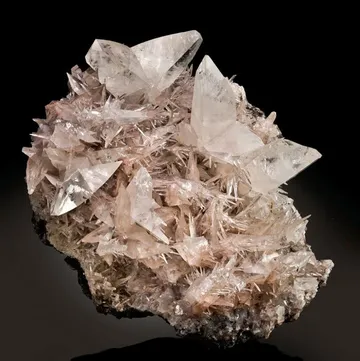
Qinglong calcite is most familiar as the white, creamy, or orange counterpoint to purple fluorite: lustrous scalenohedra, stacked stalactitic growths, and drusy aggregates that serve as both matrix and visual foil. The better examples show sharp, undamaged calcite rising through or beneath fluorite cubes, commonly with thin gypsum films or late coatings, and some specimens are fluorescent under longwave and shortwave UV. Cabinet pieces exist, but much of the attractive market material is miniature to small-cabinet size; ordinary pieces have bruised calcite points or visually busy gypsum skins, while the best pieces preserve crisp calcite geometry, strong contrast with fluorite, and enough openness to show the growth sequence.
Fluorite is Qinglong’s signature collector mineral: sharp cubes, often 0.5 to 3 cm on edge, with pale lilac, greenish, colorless, or translucent interiors framed by dramatic dark purple edge phantoms, stepped-growth borders, and mosaic surface zoning. It occurs on quartz druse, chalcedony, calcite, baryte, dolomite, gypsum, and occasionally with creedite or secondary copper and vanadium minerals. Good specimens are judged by sharpness, luster, intact cube corners, contrast between pale faces and purple margins, and the rhythmic distribution of cubes across the matrix; the finest “purple edge” plates look architectural rather than merely colorful, with the zoning readable from across the case.
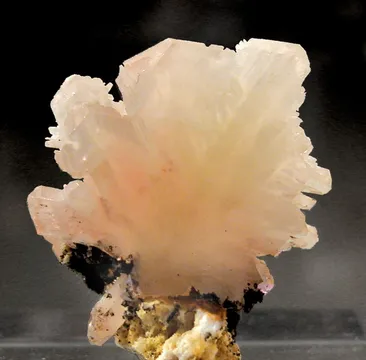
Creedite from Qinglong occurs as radiating sprays, spheroidal aggregates, and bright prismatic crystals in vugs or on quartz, fluorite, gypsum, hewettite, allophane, and other late minerals. Color ranges from colorless and white through pale lavender to richer violet zones, and the better specimens show separated sprays or balls with visible terminations rather than matted crusts. Documented examples include gemmy colorless crystals to more than 2 cm in vugs and violet spherical aggregates on larger matrix pieces; many specimens are strongly fluorescent, with blue to blue-white responses and phosphorescence under UV. The best Qinglong creedites combine transparency, radial form, and an undamaged perch on contrasting white quartz or purple fluorite.
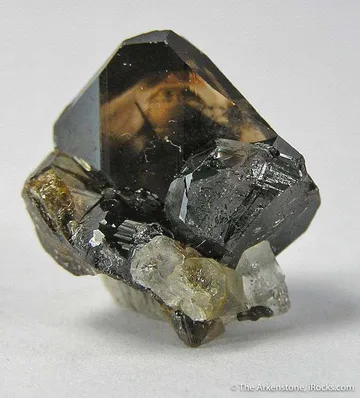
Beyond calcite, fluorite, and creedite, Qinglong is unusually rich in late and secondary species for an antimony-gold mine. Stibnite is the primary ore mineral of historical importance, and ottensite—the locality’s type mineral—forms reddish to pinkish-red, minutely crystalline to botryoidal crusts on etched stibnite, with mopungite finely intermixed in the type material. Baryte, quartz, gypsum, allophane, carbonatecyanotrichite, cyanotrichite, malachite, azurite, carlhintzeite, gearksutite, fluellite, hewettite, tyuyamunite, metazeunerite, torbernite, schubnelite, and mikehowardite have also been documented from the locality or its photo-confirmed specimen suite. For systematic collectors, Qinglong’s appeal is that a single mine can provide attractive display fluorite and calcite, UV-interest creedite, a type-locality antimony mineral, and a suite of rare secondary copper, vanadium, uranium, and aluminum-fluoride species.
The most important buying caution is nomenclature. Purple Qinglong fluorite has been sold as “yttrofluorite,” but analyzed dealer material and Mindat notes state that some violet material sold under that name contained no measurable yttrium. Unless a specimen is accompanied by reliable analytical data, it should be labeled fluorite, not yttrofluorite. The “QR-code” label is also a trade description rather than a mineralogical variety; it has been applied both to Qinglong purple-edge fluorite and to superficially similar Chinese fluorites from other regions, including Fujian material. Locality precision matters: a sound label should read Qinglong Mine or Dachang Mine, Dachang Sb ore field, Qinglong County, Qianxinan, Guizhou, China. Labels placing this material in Shandong, Hebei, or simply “Qinglong, China” deserve scrutiny.
Condition is a real issue. Fluorite cubes may have small cleaves at corners and edges, and the satiny faces can hide contact marks until the specimen is rotated under strong light. Calcite points are easily bruised, especially on the white scalenohedral groups that project beyond the fluorite. Gypsum coatings and late selenite films are fragile and can flake or abrade with handling. Creedite sprays and balls are more delicate still; broken radial tips are common, and cleaning should be minimal. Avoid soaking complex Qinglong specimens, especially those with gypsum, creedite, secondary copper minerals, or unidentified yellow vanadates/uranium minerals.
UV response can be a plus. Qinglong creedite is documented as fluorescent under shortwave and longwave UV, with phosphorescence, and some calcite and fluorite specimens also show fluorescence. For display, test gently and record the wavelength, because “fluorescent” in dealer descriptions may refer to calcite, fluorite, creedite, or more than one phase. Specimens containing tyuyamunite, metazeunerite, torbernite, or other uranium-bearing species should be treated as radioactive-mineral specimens: store them sensibly, avoid inhaling dust, wash hands after handling, and keep them out of damp, sealed micro-environments that may encourage alteration.
Market availability has changed over time. Purple-edge fluorite and calcite-fluorite-gypsum combinations are still available, though the finest large, sharp, undamaged plates are not common. Creedite is scarcer and more variable: small sprays and spheres appear occasionally, while bright, open, aesthetic vug specimens are substantially harder to replace. Type-locality ottensite is rare and should be expected as microcrystalline crusts rather than showy crystals. The recent appearance of rare secondary species has increased systematic interest in Qinglong, but it has also raised the premium on verified identifications; for rare species from this locality, analytical confirmation is worth paying for.
The most collector-worthy story from Qinglong begins not with purple fluorite but with red crusts on stibnite. On several specimens from the mine, well-formed stibnite crystals—up to about 5 cm long and 6 mm wide in the type description—were coated by thin, reddish ottensite crusts only about a millimeter thick. That is exactly the kind of mineral that can be overlooked in a display case: not a big transparent crystal, not a glittering pocket plate, but a chemically unusual skin on an ore mineral. The new species was named for Berthold Ottens, the German collector, dealer, and author whose work on Chinese mineral localities helped give Western collectors a more accurate vocabulary for China’s rapidly emerging specimen market. Qinglong’s type-locality mineral therefore carries a quiet historical irony: the mine that later became famous for eye-catching “QR-code” fluorite first entered systematic mineralogy through a subtle antimony crust.
A second, more recent Qinglong story belongs to the fluorites. For years, purple-edge cubes leaked out in small lots, recognizable to specialists but not yet abundant enough to become a full market phenomenon. Then larger plates began appearing: pale cubes with dark violet rims sitting on white quartz druse, some with glossy overgrowths, some with stepped edges, some looking almost pixelated. Dealers and collectors reached for digital language—“QR-code,” “barcode,” “purple pattern”—because ordinary fluorite terms did not quite capture the geometry. The best examples are not simply purple cubes; they are pale crystals outlined, interrupted, and re-written by violet growth zones, as if the final pulse of fluorite selectively emphasized edges, corners, and surface relief.
The third story is a cautionary one. Some violet Qinglong fluorite was marketed as “yttrofluorite,” a name that suggests rare-earth enrichment and can lift a specimen’s perceived importance. But analyzed specimens from the 2021 fluorite-calcite-gypsum production were reported with no detectable yttrium, and Mindat now warns that more or less violet “yttrofluorite” from the locality was sold despite analyses showing no measurable yttrium. That correction is useful, not disappointing. It reminds collectors that Qinglong fluorite does not need an exotic variety name to be important: its real value is the locality-specific zoning, the association with calcite, gypsum, quartz, baryte, and creedite, and its place in a well-studied Sb-Au hydrothermal system.