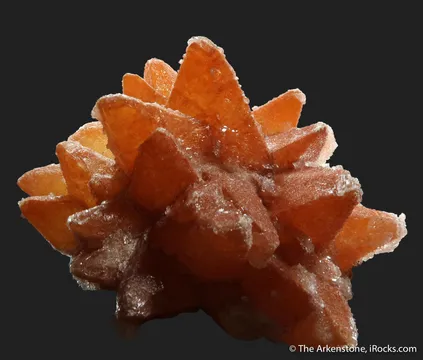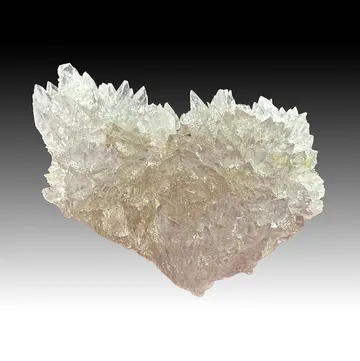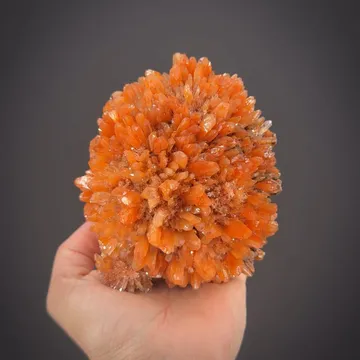
Creedite from Qinglong Mine, China: lavender prismatic sprays, high luster, rarity, and striking three-dimensional display that attracts collectors.
Key facts
Creedite from the Qinglong Mine occupies a particular niche among modern Chinese minerals: it is not the famous product of the mine, yet it is often the specimen that makes collectors stop and look twice. Qinglong is better known as a stibnite-bearing antimony-gold district, and more recently for fluorite, carbonatecyanotrichite, odd vanadium and uranium species, and rare aluminofluorides. Against that background, creedite appears as a late, delicate mineral of cavities and fractures—transparent to translucent sprays, colorless rosettes, lavender balls, and, on the best pieces, intensely glassy prismatic crystals with real sculptural presence.
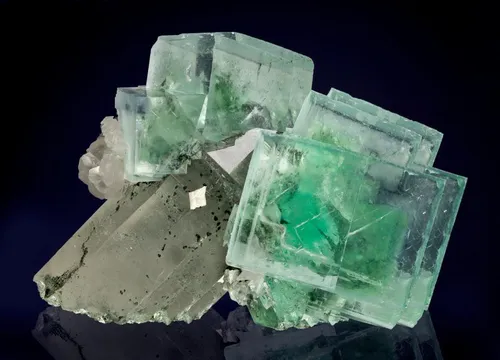
The classic Qinglong look is a cluster of radiating prismatic crystals rather than the orange hedgehog balls associated with many Mexican creedites. Colorless material is the baseline: clear, white, faintly smoky, or pale yellowish sprays on matrix, sometimes on quartz druse or with fluorite. Lavender to purple Qinglong creedite is the collector prize. It is scarcer, more immediately visual, and especially desirable when the color is internal and even rather than concentrated along cracks or broken surfaces. The best examples combine sharp terminations, high luster, good transparency, undamaged tips, and a three-dimensional growth that can be displayed from more than one side.
The geological setting explains the unusual associations. The Qinglong Mine, also called the Dachang Mine, lies in the Dachang antimony ore field of Qinglong County, Qianxinan Prefecture, Guizhou Province. The deposit is an epithermal antimony-gold system developed in the broader Youjiang–Nanpanjiang basin region of southwestern China. Antimony mineralization is tied to the so-called Dachang layer, a silicified and brecciated Permian horizon between Maokou Formation limestone and Emeishan basalt. Fluids moving through faults, fractures, silicified rocks, and cavities left behind stibnite, fluorite, quartz, calcite, gypsum, and a surprisingly diverse suite of later secondary minerals. Creedite belongs to that later, volatile-rich story: a calcium-aluminum sulfate fluoride-hydroxide mineral, Ca3Al2(SO4)(OH)2F8·2H2O, that needs both fluorine and sulfate availability, and at Qinglong it often appears in precisely the fluorite-rich, cavity-bearing environment one would expect.
Historically, Qinglong creedite seems to have entered the specimen market in waves rather than as one single, well-documented pocket. Older dealer records and gallery records show colorless to pale material circulating by the early 2000s. A notable market presence followed around the mid-2010s to 2018–2019, when more radiating aggregates and fluorescent examples appeared. Since 2023–2026, the locality has again drawn attention because creedite has accompanied rare species from new Dachang finds, including gearksutite and the remarkable lemon-yellow carlhintzeite assemblages. That has made Qinglong creedite more than just an attractive cabinet mineral: it has become a clue-bearing member of one of the more interesting recent secondary-mineral stories in China.
Search for specimens: View all creedite specimens from Qinglong Mine, China
The Qinglong Mine is the Dachang Mine of the Dachang Sb ore field, in Qinglong County, Qianxinan Buyi and Miao Autonomous Prefecture, Guizhou Province, China. Mindat gives the locality coordinates as approximately 25°40′24″ N, 105°10′24″ E. The locality is part of a large Qinglong Sb-Au system with multiple ore blocks in the district, including Dachang, Shuijingwan, Dishuiyan, Gulu, Houpo, Xishe, Sanwangping, and Heishanjing.
Geologically, the deposit is an epithermal antimony-gold system in which ore bodies are structurally controlled and concentrated in the Dachang layer. The important stratigraphic package includes Middle Permian Maokou Formation limestone, the Dachang layer of silicified and brecciated rocks, Upper Permian Emeishan basalt, and overlying Longtan Formation strata. The antimony ore is chiefly associated with stibnite-bearing quartz veins and silicified rocks, while later fluids and oxidation produced fluorite, gypsum, sulfate and fluoride minerals, and colorful secondary species.
The mine’s specimen mineralogy is much broader than its industrial identity suggests. Besides stibnite and fluorite, Qinglong is recorded for baryte, calcite, quartz, gypsum, allophane, carbonatecyanotrichite, cyanotrichite, hewettite, tyuyamunite, fluellite, gearksutite, carlhintzeite, metazeunerite, ottensite, and other secondary species. Creedite is one of the most visually appealing of these late minerals because it forms transparent prismatic sprays and rounded crystal aggregates rather than merely crusts or earthy coatings.
The industrial mine history is antimony-centered, with gold also important in modern geological interpretations. Environmental studies of the Dachang antimony mine tailings show that the district has a substantial history of mining and waste accumulation, and published work has examined Sb, As, Pb, Zn, Cd, Hg, and other elements in tailings and surrounding soils. For collectors, this matters practically: this is not a casual public collecting locality. Specimens have reached the market through miners, local dealers, Chinese mineral specialists, and international dealers, not through an established public fee-dig or recreational collecting program. Any field collecting or access should be assumed to require permission, local knowledge, and serious safety awareness around old mine workings and contaminated waste.
Production of creedite specimens has been episodic. Older Chinese creedites from Qinglong include colorless, glassy crystals on matrix, some recorded from early-2000s material. Dealer records describe pockets since about 2015 that produced more ball-like aggregates of densely packed smaller crystals, and other pieces from 2018–2019 that differ strongly in habit from earlier material. Recent pieces collected or marketed in 2023–2026 show continued specimen output from the broader Dachang/Qinglong area, especially in association with fluorite, gypsum, hewettite, gearksutite, and carlhintzeite-bearing assemblages.
Notable finds include clear sprays on quartz druse that fluoresce blue to blue-white with phosphorescence under UV, lavender-to-purple radiating aggregates from recent market lots, and yellow-to-colorless creedite accompanying rare gearksutite and carlhintzeite in the 2025 Dachang finds. These newer associated-species pieces are especially interesting mineralogically because they show creedite as part of a late fluorine- and sulfate-rich assemblage, not merely as an isolated aesthetic mineral.
Qinglong creedite is usually prismatic to bladed and radiating, commonly forming sprays, spherical to hemispherical aggregates, and intergrown balls of sparkling crystals. Individual crystals may be water-clear, white, pale yellow, lavender, violet, or zoned from purple into colorless or yellowish areas. The most desirable crystals are sharp, glassy, transparent, and visibly terminated; doubly terminated crystals are recorded on better specimens.
Color is one of the key locality distinctions. Much Qinglong material is colorless or nearly so, and fine colorless pieces can be very attractive when the crystals are bright and freestanding. Lavender and purple examples are less common and command more attention, particularly when the color is natural-looking, internal, and paired with high transparency. Some purple Qinglong pieces form dense sparkling balls, while others show flatter, more elongated lavender crystals or larger prismatic sprays rising from matrix.
Documented specimen sizes range widely. Thumbnail examples around 2.5 cm occur, as do miniatures and small cabinets in the 4–9 cm range. Larger cabinet specimens are known, including examples over 12 cm and a recorded 15.5 cm matrix specimen. Individual crystal lengths in published dealer and photo records include 8 mm, 1 cm, 2.25 cm, 3 cm, and, on an exceptional purple miniature, crystals reportedly to 3.5 cm. For the locality, a matrix specimen with clean, freestanding crystals over 2 cm is already better than average; a colorful, highly transparent, undamaged, three-dimensional group is decidedly fine.
Common associates include fluorite, quartz, gypsum, allophane, hewettite, carbonatecyanotrichite, baryte, hematite or limonite staining, tyuyamunite, fluellite, calcite, and pyrite. Newer and more specialized assemblages may include gearksutite and carlhintzeite; these are especially important to advanced collectors because they tie the creedite to rare aluminofluoride mineralization in the Dachang district. Fluorite association is particularly fitting: Qinglong is also known for distinctive patterned fluorite, and fluorine-rich fluids were central to the late cavity mineralogy.
Fluorescence is worth checking. Qinglong creedite has been documented as fluorescent under shortwave and longwave ultraviolet light, with blue to blue-white response and phosphorescence in at least some specimens. Not every specimen should be assumed to perform equally under UV, but fluorescence can add significant interest when it is strong and well documented.
Quality is judged by a combination of crystal sharpness, luster, transparency, color, composition, and condition. The finest Qinglong creedites are not simply the largest. A compact miniature with undamaged sprays, clean lavender color, and all-around display can be more desirable than a large cabinet piece with crushed high points. On colorless pieces, glassy luster and architectural separation of sprays are critical; otherwise the specimen can appear visually busy or chalky. On purple pieces, collectors should look carefully for signs of dye, because treated Qinglong creedite is a documented market issue.
Qinglong creedite is a locality where authenticity questions are real but manageable. The most important documented treatment concern is purple dyeing: some Qinglong creedite specimens have reportedly been dyed with purple ink to improve saleability. The warning signs are color concentrated in cracks, along damaged areas, at the attachment points, or in porous matrix rather than within intact crystal volume. A suspicious purple that looks painted into crevices is not the same as natural lavender zoning in transparent crystals. Acetone solubility of the dye has been reported as a diagnostic clue, but solvent testing can damage labels, adhesives, coatings, or associated minerals, so it should be done only with care and preferably on an inconspicuous area or by someone experienced.
Condition is the everyday problem. Creedite sprays snag easily, and Qinglong aggregates often have exposed tips on all sides. Broken terminations, rubbed high points, pocket-wall separation marks, and small contacts are common. Matrix pieces may also contain soft, friable, or earthy material that sheds grit. When evaluating online listings, insist on multiple angles and close views of the tallest sprays; a single frontal glamour shot can hide a flat, contacted back or a broken apex.
The distinction between natural lavender material and dyed material is economically important. Natural purple Qinglong creedite is scarcer than colorless creedite and brings stronger collector interest. However, a clean, water-clear cluster with fine crystal architecture is still a worthy specimen from this locality. Conversely, a deeply colored but suspiciously stained purple piece should be treated cautiously unless it has strong provenance and convincing visual evidence.
Association pieces are becoming more important. Creedite with fluorite is a classic Qinglong pairing. Creedite with gearksutite, carlhintzeite, hewettite, tyuyamunite, or fluellite belongs to a more specialized suite of late-stage secondary minerals and appeals to collectors who build paragenetic or rare-species sets. For these pieces, analytical confirmation matters more than usual, especially where yellow species are present; carlhintzeite, tyuyamunite, carnotite, and other yellow minerals can be visually confusing in small crystals.
Market availability is moderate but uneven. Small creedite specimens from Qinglong appear regularly enough that a patient collector can choose rather than settle, but the best examples—purple, transparent, sharp, undamaged, and three-dimensional—are much less common. Recent auction and dealer records show miniatures and small cabinets available at accessible to mid-range prices, while exceptional purple or unusually large pieces command a premium. The locality remains active in the specimen trade as of recent years, particularly through Chinese-sourced dealer material and international resale, but top-grade pieces are still selective purchases rather than bulk commodity specimens.
The most interesting Qinglong story is not a single heroic pocket but a slow change in attention. For years, the district was treated primarily as an antimony-gold producer, with stibnite and fluorite carrying most of the mineral-collector identity. Colorless secondary crystals did not always look profitable enough to attract systematic study. Creedite, in particular, could pass as a pretty but modest late mineral unless someone put it under magnification, under UV, or into the context of the strange fluoride-rich assemblages coming from the district.
That changed as collectors and Chinese mineralogists began looking more closely at the secondary suite. Qinglong turned out not to be one simple mine in the collector sense, but a complex district with multiple independently mined deposits and varied mineralization. Berthold Ottens, who has written extensively on Chinese minerals and personally visited Qinglong in 2006, later emphasized that the later secondary minerals were not well covered by the main geological literature. His perspective helps explain why creedite could be present, photographed, traded, and still not fully appreciated for what it represented in the district’s late-stage mineralogy.
By 2009, Qinglong creedite had reached serious collections. Ottens photographed Qinglong creedite in the Bill Pinch collection, and Jeff Scovil photographed Qinglong metazeunerite from the same broader locality context. These were not the flashy, mass-market fluorites that later collectors would recognize by nickname; they were signals that the district’s small secondary minerals deserved closer attention.
A second wave of interest came with the highly fluorescent creedites that appeared by 2017–2018. One documented specimen measured 65 x 57 x 22 mm and weighed 50 grams, with transparent, gemmy prismatic creedite sprays on white quartz druse. Under ultraviolet light it gave a bright blue to blue-white response, with phosphorescence. Another 2018 record called the material a “new find” and noted strong fluorescence and phosphorescence in a 7 cm field of view. For a species many collectors think of mainly as an orange Mexican daylight mineral, the Qinglong pieces offered a different experience: pale, glassy sprays that came alive under UV.
Then came the 2025 Dachang aluminofluoride story. In March 2025, new specimens from the Qinglong/Dachang district appeared with lemon-yellow carlhintzeite, a rare calcium aluminum fluoride hydrate that had previously been known mainly in tiny or poorly developed forms from localities such as Hagendorf in Bavaria. The new Chinese material was larger and better crystallized. Reports described yellow spheroids and tufts of acicular crystals, in some cases to about 1 cm, on brown matrix and accompanied by fluorite and sharp colorless creedite. The association was striking because creedite had already been known from Qinglong, but not as a showy companion to what were being described as the best carlhintzeite specimens yet seen.
The work did not stop at looking. Small groups of carlhintzeite crystals from Dachang were analyzed by Raman spectroscopy and compared against material from Hagendorf. The studied Chinese groups were tiny in absolute terms—one reported at 11 x 5 mm and another at 4 x 4 mm—but large in significance for the species. The yellow color was considered unusual for an aluminofluoride and possibly related to trace uranium. The analytical work also mattered because these late Qinglong assemblages contain several pale or yellow species that can confuse even experienced collectors if judged only by color.
Creedite played the supporting role in that 2025 drama, but a very useful one. On some pieces, nearly colorless creedite crystals sat on fluorite with yellow carlhintzeite; on others, creedite appeared with gearksutite and quartz. A documented gearksutite-creedite-quartz specimen from the March 2025 find measured 81 x 50 x 34 mm and was sold with an analysis copy. There, the white gearksutite was associated with yellow creedite crystals, turning an obscure species into a more legible specimen by pairing it with a familiar, well-crystallized mineral. In the hands of a collector, that is exactly what Qinglong creedite now does best: it makes the district’s late, fluorine-rich mineral chemistry visible.