Prospect Park Quarry, USA — renowned for green prehnite with hollow epimorphs, rich basalt cavities, and a key collector locality in Paterson–Passaic County.
Key facts
Prospect Park Quarry is one of the classic northern New Jersey trap-rock localities: a long-lived crushed-stone quarry in the Orange Mountain Basalt of the Newark Basin, about two miles north of Paterson, whose commercial benches opened the vesicles, pillow interiors, junction pockets, veins, breccias, and amygdaloidal cavities that made the locality famous among zeolite and prehnite collectors. Its collector reputation rests above all on green prehnite—especially hollow epimorphs after anhydrite—together with an unusually rich basalt-cavity suite of calcite, stilbite, heulandite, laumontite, quartz, datolite, babingtonite, apophyllite-group minerals, pectolite, analcime, chabazite, natrolite, mesolite, sulfides, native copper, native silver, and rarer accessory species.
The best Prospect Park specimens have a look that is immediately different from the more familiar Indian zeolites or Nova Scotia zeolite plates. They tend to be dense, sculptural, and architectural: pale apple-green to water-green prehnite fingers rising from dark basalt; sparkling prehnite spheres over nearly black pumpellyite-rich layers; quartz-lined cavities with calcite rhombs; tan, brown, or rarely green stilbite sheaves; cream laumontite with prehnite; and black to altered blue-gray babingtonite tucked among calcite, heulandite, and quartz. For collectors of American trap-rock minerals, the quarry is one of the anchor localities of the Paterson–Passaic County tradition.
Regional View
Country View
Geologically, Prospect Park worked basalt belonging to the old “Watchung trap rock” mining vocabulary but now placed in the Orange Mountain Basalt of the Newark Supergroup. The collector’s quarry was not a metallic mine; its economic product was trap rock aggregate. Its mineralogical importance came as a by-product of blasting and crushing, when pockets in the basalt were exposed before being destroyed. The productive zones were not continuous ore bodies but discrete cavities: pillow centers, junction openings between pillows, vertical seams, breccia cavities, and gas cavities in vesicular basalt.

Photo: Wikimedia Commons
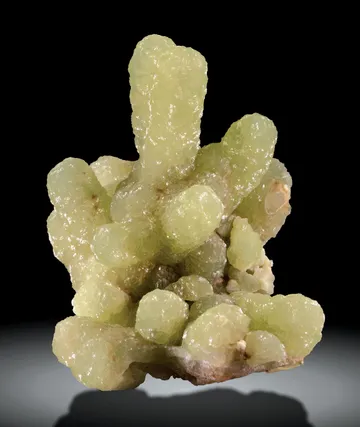
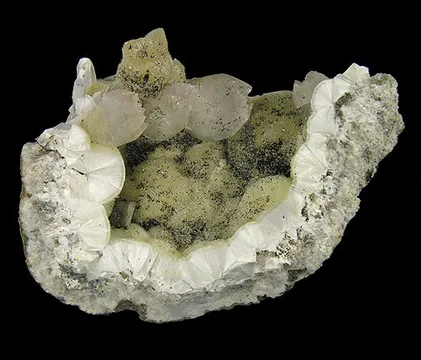
This cabinet specimen shows the form that made Prospect Park a textbook locality for collectors: lustrous pale-green prehnite preserving the shape of earlier anhydrite. In the finest examples the prehnite is not merely a smooth coating but shows visible crystalline texture over finger-like or blade-like casts, sometimes with hollow interiors where the original anhydrite was later removed.

Photo: Wikimedia Commons
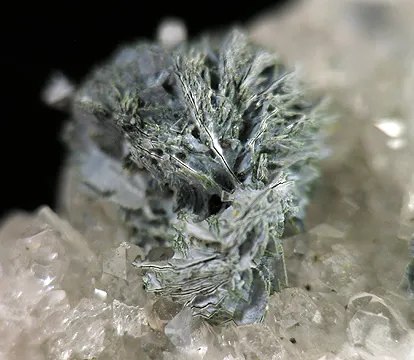
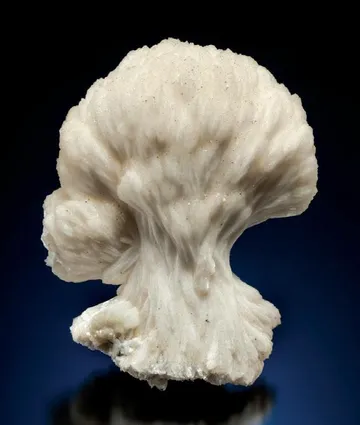
Prospect Park babingtonite is a quieter but important part of the locality’s personality. Fine pieces are valued less for crystal size than for association and contrast: altered blue-gray to dark crystals with pale heulandite, colorless calcite, and quartz, typically in compact basalt-cavity miniatures and small cabinet specimens.
Search for specimens: View all specimens from Prospect Park Quarry, USA
Prospect Park Quarry lies in the borough of Prospect Park, Passaic County, New Jersey, north of Paterson, in the classic trap-rock belt of the Watchung Mountains. Older specimen labels commonly say “Paterson,” and sometimes “Patterson,” because the Paterson quarries were the broader collecting district by which these minerals were known. The precise locality, however, is Prospect Park Quarry, also historically associated with the names Sowerbutt Quarry, Vandermade Quarry, Warren Brothers Quarry, Warren Brothers Quarry and Mill, and Warren Brothers Company, Division of Ashland Oil.
The quarry worked Orange Mountain Basalt, the First Watchung basalt of older literature. This basalt is dark greenish gray to greenish black and is composed chiefly of calcic plagioclase and clinopyroxene, including augite and pigeonite. The Orange Mountain Basalt consists of multiple flows, and in the Prospect Park–Paterson trap-rock district the most important specimen-producing environments were the vesicular, pillowed, and fractured portions of the flows. Collectors should think of Prospect Park not as a vein mine but as a three-dimensional field of cavities: mineralized pillow interiors, junction pockets between pillows, breccia openings, vertical fault-zone cavities, amygdules, and seams.
The mineralization is the classic low-temperature basalt-cavity assemblage of northern New Jersey. Quartz is an early lining in many openings, followed by prehnite, pectolite, heulandite, stilbite, and laumontite in the documented crystallization sequence, while calcite appears through much of the sequence. The best pockets could produce multiple generations on a single specimen: quartz lining on basalt; green prehnite overgrowths or casts; later calcite rhombs or scalenohedra; zeolite sheaves and plates; and occasional datolite, babingtonite, apophyllite-group minerals, sulfides, or copper minerals.
Commercially, the operation began in 1901 under James A. Sowerbutt. After Sowerbutt’s death in 1916, the quarry was operated by Abraham Vandermade and James Vandermade, then sold to Warren Brothers in 1969. Tilcon New Jersey acquired the quarry in the early 1980s. By the early twenty-first century, the locality had shifted from active aggregate production to closure, backfilling, and redevelopment. Modern references describe the pit as being filled for a future housing development, and contemporary collecting guidance treats the site as private and research-only unless explicit permission has been obtained.
Prospect Park’s collecting history continued long after many other Paterson-area trap-rock localities became inaccessible or exhausted. Legal access in the late 1990s and early 2000s produced important new material, including heulandite, red stilbite, datolite, amethyst, greenockite, calcite, and prehnite. The 2005 Rocks & Minerals article by James S. Zigras and Matthew L. Gorring documented recent finds from the quarry and helped cement the view that Prospect Park was not merely one more New Jersey basalt pit but one of the great trap-rock specimen localities.
The last great episode came in 2010, when a series of pockets in a large dome-shaped diapir-like structure in the middle of the quarry yielded exceptional prehnite epimorphs after anhydrite. Dealers and collectors described the structure as roughly 40 x 40 x 40 feet, and the find produced some of the most desirable late Prospect Park prehnites: lustrous pale to medium apple-green “fingers,” with hollow or cast interiors, visible crystalline prehnite faces, and occasional milky white calcite scalenohedra. Because the quarry was being filled, those specimens are widely regarded as the locality’s final major production.
Prehnite is the signature Prospect Park mineral and occurs here as pale apple-green, water-green, bluish green, and darker green spherical aggregates, sparkling crusts, stalactitic masses, and especially epimorphs after anhydrite. The finest specimens preserve slender to blocky anhydrite forms as hollow “fingers,” sprays, or casts, commonly on basalt and often associated with calcite, quartz, laumontite, datolite, stilbite, heulandite, babingtonite, pumpellyite, and minor sulfides. Cabinet pieces are known, but many of the best collector specimens are thumbnails to small cabinets where the form is complete, undamaged, lustrous, and translucent; ordinary pieces are massive, contacted, clay-coated, or lacking distinct crystal texture. The 2010 diapir-pocket discovery produced particularly desirable finger casts with visible individual prehnite crystallization, a feature that separates the best late Prospect Park pieces from smoother, less defined New Jersey prehnite coatings.
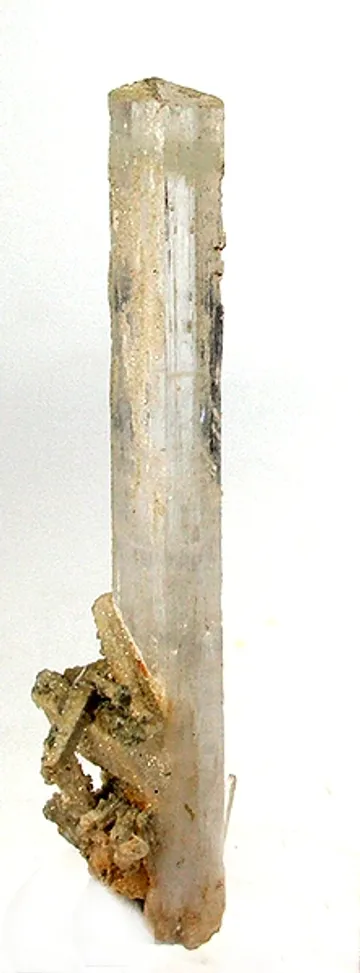
Anhydrite at Prospect Park is most important as the vanished or partly preserved precursor that shaped the quarry’s celebrated prehnite and quartz casts. Original anhydrite crystals formed bladed, flattened, or prismatic shapes in basalt cavities; later silica or prehnite coated them, and subsequent removal of the anhydrite left hollow boxy cavities, blades, sprays, and finger-like forms. Actual preserved anhydrite is far less common than casts after it, and the best anhydrite-related specimens are those where the geometry is unmistakable: square or flattened cross sections, striated interiors, open “cast box” structures, or a fan of quartz casts capped by calcite. Collectors should value sharp form and clear evidence of the replaced anhydrite over vague green prehnite knobs described too loosely as “after anhydrite.”
Calcite is a major supporting mineral at Prospect Park and appears through much of the cavity-filling sequence, which explains its frequent association with quartz, prehnite, heulandite, stilbite, laumontite, babingtonite, and datolite. Documented specimens include colorless to milky modified scalenohedra on prehnite, rhombohedra with quartz, doubly terminated crystals, orange translucent crystals, and small sparkling calcite crystals dusting prehnite casts. Fine Prospect Park calcite specimens are judged by sharpness, translucency, undamaged terminations, and placement on contrasting matrix; the most collectible pieces are not merely loose cleaved calcite but crystallized combinations where calcite completes the architecture of a trap-rock pocket, especially when perched cleanly on green prehnite or quartz-lined basalt.
Stilbite-Ca is one of the important Prospect Park zeolites and occurs in the two principal pocket environments: larger pillow pockets and smaller junction pockets between pillows. The largest sheaves were reported from large pillow pockets, while the best bow-ties came largely from junction pockets; colors range from tan to gemmy brown, with rare pale green examples colored by chlorite-group inclusions. Sheaves may reach roughly 10 cm across, while many bow-ties are around 5 cm long, and Smithsonian-displayed material includes a showy bow-tie of about 10 cm. Fine pieces have intact paired sheaves, glassy to pearly luster, good color, and strong contrast with quartz, calcite, heulandite, laumontite, prehnite, or babingtonite; average pieces are partial fans, isolated sprays, or contacted cavity fragments.
Heulandite-Ca from Prospect Park is a characteristic mid- to late-stage zeolite in the basalt cavities, commonly associated with quartz, calcite, laumontite, stilbite, prehnite, babingtonite, and datolite. Specimens range from pale golden plates with babingtonite and calcite to red heulandite crystals recorded to about 1.8 cm in association with stilbite. The best pieces show distinct, lustrous tabular crystals rather than dull zeolitic crusts, and they are especially desirable when the heulandite provides warm color contrast against black basalt, white or colorless calcite, cream laumontite, tan stilbite, or dark babingtonite. Good labels matter because older “heulandite” from New Jersey trap-rock quarries is sometimes broadly named, while well-documented Prospect Park pieces are usually identified as heulandite-Ca or heulandite subgroup.
Quartz at Prospect Park is both a pocket-lining mineral and a collectible species in its own right, occurring as rock crystal, smoky quartz, amethyst, chalcedony, and agate, as well as casts after anhydrite. It is an early mineral in the documented paragenesis and commonly forms the substrate for later calcite, stilbite, heulandite, laumontite, babingtonite, datolite, and prehnite. Amethyst vugs and veins were noted from the quarry, while unusual specimens include quartz “sandwich” or box-like casts containing flattened anhydrite and fans of slender quartz casts with calcite at the apex. The best Prospect Park quartz pieces are those that show the trap-rock context clearly—amethyst or smoky color, sharp lining crystals, casts after anhydrite, or later zeolite and calcite associations—rather than anonymous drusy quartz without a diagnostic locality character.
Babingtonite is a notable Prospect Park rarity and is most valued here in association pieces with quartz, calcite, heulandite, stilbite, prehnite, laumontite, and datolite. Rather than forming large isolated display crystals, the quarry’s babingtonite typically appears as small dark to altered blue-gray crystals or aggregates in compact basalt-cavity specimens, sometimes with pale golden heulandite and nearly colorless calcite on quartz. The finest pieces are those where the babingtonite is visible, lustrous, well placed, and not swallowed visually by the surrounding zeolites; they appeal to collectors because the color and association are distinctive for the species, even when the individual crystals are modest in size.
Laumontite is common enough in the Prospect Park assemblage to be a regular association with prehnite, quartz, calcite, heulandite, stilbite, apophyllite-group minerals, babingtonite, datolite, and pectolite, but it is also one of the condition-sensitive species from the quarry. It forms cream to white prismatic or bladed zeolitic growths and late-stage cavity fillings, often paired with green prehnite or tan stilbite. Good specimens retain crisp laumontite crystals with minimal chalking, flaking, or dehydration damage; lesser pieces show the familiar powdery, dull, or “once-was-laumontite” surfaces that are common in older trap-rock collections. Stable, well-preserved laumontite on a strong Prospect Park association is therefore more desirable than an equally large but friable mass.
Datolite at Prospect Park occurs in basalt-cavity associations with prehnite, quartz, heulandite, stilbite, babingtonite, chalcopyrite, laumontite, apophyllite-group minerals, and other zeolites. It may appear as green datolite, sparkling druzy microcrystals, or a crystalline layer beneath or among prehnite, and it is recorded in attractive combinations such as transparent thick prehnite on datolite crystals and stalactitic prehnite over a datolite microcrystal base. Good Prospect Park datolite specimens are typically association pieces rather than single-species showpieces: the datolite should be visible, crystalline, and integral to the pocket surface, with bonus value when paired with prehnite, babingtonite, or quartz in a well-documented quarry specimen.
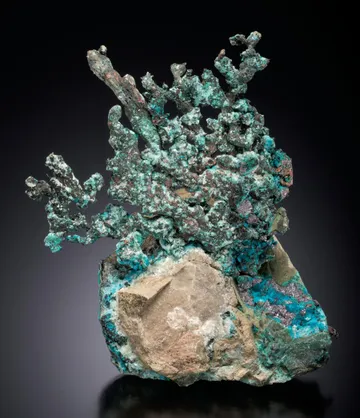
Other documented minerals from Prospect Park include actinolite, aegirine, albite, analcime, apophyllite-group minerals, baryte, bornite, chabazite-Ca, chalcocite, chalcopyrite, chlorite-group minerals, chrysocolla, covellite, cuprite, diopside, epidote, ferro-hornblende, fluorapophyllite-(K), galena, gmelinite-Na, goethite, greenockite, gypsum including selenite, hematite, hydroxyapophyllite-(K), malachite, mesolite, native copper, native silver, natrolite, pectolite, pumpellyite-group minerals, pyrite, pyrolusite, sphalerite, stevensite, thaumasite, and thomsonite-Ca. Among these, collector attention is especially drawn to native silver, perfect hemimorphic greenockite crystals on prehnite, mesolite spheres on prehnite with calcite, peach-colored gmelinite with fibrous pectolite on prehnite, and sulfide-rich zones carrying chalcopyrite in small crystals or crude chunks.
Prospect Park material is abundant in old collections but finite in fresh supply. The quarry is closed to routine collecting, has been backfilled for redevelopment, and should be treated as private property requiring explicit permission. Any “newly collected” material should be viewed cautiously unless it comes with a credible chain of custody, because the important modern production dates mainly from documented access periods before and during the quarry’s final years.
The most common locality problem is mislabelling. Older labels often read simply “Paterson, New Jersey,” “near Paterson,” or even “Patterson,” and many such specimens may indeed be Prospect Park, but the Paterson district also includes Upper New Street, Lower New Street, Great Notch, McBride Avenue, and other trap-rock localities with overlapping mineral suites. A strong Prospect Park attribution is helped by old labels naming Sowerbutt, Vandermade, Warren Brothers, or Prospect Park; collection history tied to known New Jersey collectors; or morphology typical of the quarry, such as prehnite fingers after anhydrite from the 2010 pockets.
Condition is critical. Prehnite fingers are commonly hollow, so broken tips, bruised ridges, and contacted backs are expected but should be priced accordingly. Some late prehnites carry clay coatings that mute luster and transparency. Calcite is easily cleaved or bruised. Anhydrite-related pieces may be fragile where the original sulfate dissolved away, leaving thin cast walls. Laumontite is the most handling-sensitive of the common species because dehydration can turn sharp crystals dull, white, and powdery; keep laumontite-bearing specimens in a stable, moderate-humidity cabinet and avoid heat, direct sun, and repeated wet cleaning.
Documented treatments and outright fakes specific to Prospect Park are not a major theme in the literature, but over-cleaning and locality inflation are real concerns. Avoid acid cleaning unless you know exactly what is present: calcite will be attacked, laumontite may suffer, and delicate cast interiors can be damaged mechanically. The strongest market pieces are well-formed prehnite-after-anhydrite casts, especially the 2010 diapir-pocket material; high-quality stilbite bow-ties and sheaves; distinct babingtonite combinations; sharp calcite-on-prehnite plates; and rarer association specimens with datolite, greenockite, mesolite, gmelinite, pectolite, or native silver. Ordinary prehnite crusts remain obtainable, but top examples with sharp form, translucency, complete fingers, and old or documented provenance are increasingly hard to replace.
The quarry’s history begins in an almost civic way: 1901, the year Prospect Park became an independent borough, was also the year the quarry opened. James A. Sowerbutt began the operation, and after his death in 1916 the quarry passed into the hands of his son-in-law Abraham Vandermade and then James Vandermade. The family names stayed attached to specimen labels long after ownership changed, which is why an old “Vandermade Quarry” calcite or prehnite can be the same locality as a later “Warren Brothers” or “Prospect Park” piece.
By the late twentieth century, the quarry was a survivor. Many of the old Paterson-area trap-rock quarries had closed, flooded, or become inaccessible, but Prospect Park continued to yield collectible cavities. At the 2000 New Jersey show, James Zigras appeared with material from legal access to the old quarry: heulandite, red stilbite, datolite, amethyst, greenockite, calcite, and some prehnite. It was not a romantic wilderness locality; it was an industrial pit in suburban Passaic County. Yet the benches were still giving up the same mineral language—green prehnite, quartz, zeolites, calcite—that had made northern New Jersey famous for generations.
One of the most evocative old pieces is a large Prospect Park prehnite from the Richard A. Kosnar collection, reportedly collected in 1964. The specimen itself was a pale-green group of prehnite stalactites over darker material, with datolite microcrystals on the underside. But what makes it memorable is the writing on the bottom: “collected by RAK,” “Superb,” “rare,” the number “81,” the date “6/6/64,” the word “night,” and “Prospect Park.” Those scribbles turn a specimen into a field note. They place the rock back in the quarry after dark, in the hands of a young New Jersey collector who would become part of American mineral-dealing history.
The closing act came in 2010. During the latter half of that year, collectors recovered a major prehnite discovery from a series of large pockets in the middle of the quarry, in a dome-shaped diapir-like structure described as about 40 x 40 x 40 feet. The find was bittersweet from the beginning because the quarry was being filled. The best specimens were pale to medium apple-green prehnite fingers after anhydrite, with lustrous surfaces and individual prehnite crystals visible to the naked eye. That detail matters: many prehnite casts are attractive from a distance but nearly amorphous on the surface; these showed distinct crystallization.
At the 2011 Tucson Show, around twenty superb cabinet-size prehnites from that late-2010 find surfaced through Rob Lavinsky and then through Brian and Brett Kosnar’s Mineral Classics. The family connection gave the episode a neat circularity: Richard Kosnar had collected New Jersey trap-rock minerals decades earlier, and his sons were now handling what many collectors considered the quarry’s “last hurrah.” As the backfill advanced and the locality disappeared as an active source, the 2010 prehnite fingers became more than attractive specimens. They became the closing punctuation mark on more than a century of Prospect Park collecting.