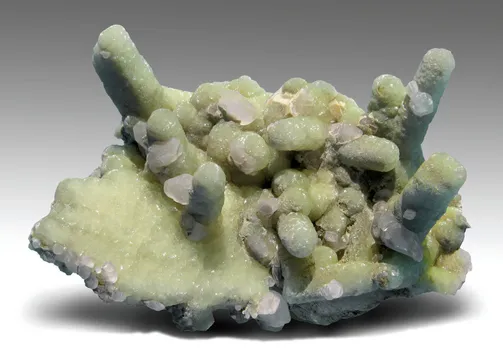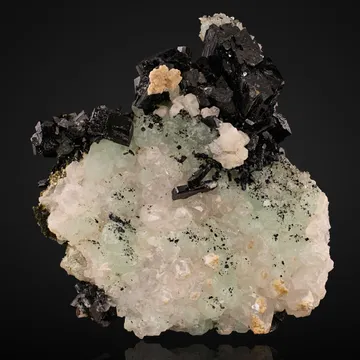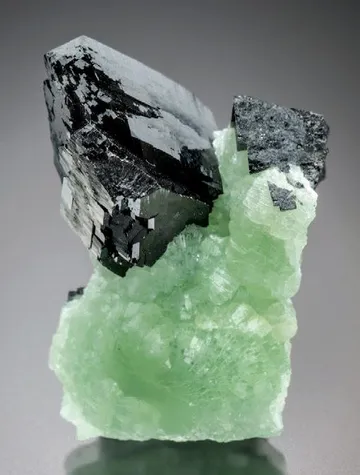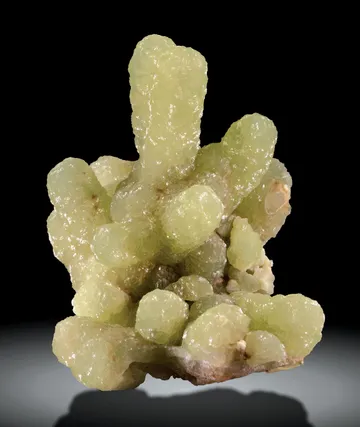
Prospect Park Quarry babingtonite is one of the most recognizable departures from the usual appearance of the species. Instead of the familiar jet-black, sharply lustrous babingtonite on pale prehnite or zeolite matrix, the best Prospect Park pieces show blue-gray to greenish-gray, fibrous-looking altered crystal groups set against quartz, calcite, and heulandite. That color is the locality’s signature: understated, cool-toned, and unmistakably different from the black babingtonites of many New England traprock quarries.
Key facts
Prospect Park Quarry babingtonite is one of the most recognizable departures from the usual appearance of the species. Instead of the familiar jet-black, sharply lustrous babingtonite on pale prehnite or zeolite matrix, the best Prospect Park pieces show blue-gray to greenish-gray, fibrous-looking altered crystal groups set against quartz, calcite, and heulandite. That color is the locality’s signature: understated, cool-toned, and unmistakably different from the black babingtonites of many New England traprock quarries.

Photo: Wikimedia Commons
The quarry was a First Watchung basalt traprock operation in the Orange Mountain Basalt, part of the Newark Basin’s great Early Jurassic volcanic sequence. The collector’s setting was not an ore vein in the usual sense, but a basalt cavity environment: pillow interiors, junction pockets between pillows, veins, amygdaloidal cavities, and related vesicular structures where late fluids deposited quartz, calcite, prehnite, zeolites, and associated silicates. For babingtonite, the prized pieces are small, aesthetic matrix specimens where the gray-blue altered aggregates contrast against glassy quartz or pale calcite rather than disappearing into dark basalt.
Prospect Park Quarry also matters because it belongs to the classic Paterson-area traprock tradition. The quarry’s mineralogy overlaps the celebrated New Street quarries, Great Notch, Upper Montclair, and other northern New Jersey basalt localities, but Prospect Park developed its own personality: particularly rich prehnite and zeolite assemblages, fine datolite, quartz, calcite, apophyllite-group minerals, heulandite, chabazite, laumontite, and uncommon babingtonite. Its specimens carry the aura of a locality that was productive for roughly a century, then effectively left the collecting world as quarrying ended and the pit was reclaimed.

Photo: Wikimedia Commons
For serious collectors, the appeal is not size. Prospect Park babingtonite is about locality character: blue-gray altered groups, correct traprock matrix, credible old provenance, and associations with the quarry’s classic pale calcite, heulandite, quartz, and prehnite suite. A small, undamaged, well-composed miniature can be far more desirable than a larger but poorly documented or visually confused piece.
Search for specimens: View all babingtonite specimens from Prospect Park Quarry, New Jersey, USA
Prospect Park Quarry was a traprock aggregate quarry in Prospect Park, Passaic County, New Jersey, historically also known in labels and literature as the Sowerbutt Quarry, Vandermade Quarry, Warren Brothers Quarry, and Warren Brothers Quarry and Mill. The working lay about two miles north of Paterson and exposed First Watchung basalt, now generally treated as Orange Mountain Basalt or Watchung Basalt.
The quarry was opened in 1901 by James A. Sowerbutt. After his death in 1916, operation passed to his son-in-law Abraham Vandermade and then to James Vandermade. Warren Brothers acquired it in 1969, and Tilcon New Jersey later purchased it in the early 1980s. Mineral collecting followed the working life of the quarry, with important material entering collections through local collectors, organized access, dealer dispersals, and older estate holdings. The quarry was still photographed in its final active phase in 2011, with “final days of blasting,” “diapirs,” and “advancing backfill” documented in locality photographs. By the 2020s the site was classed as built over or under reclamation, and municipal planning documents described redevelopment of the former Tilcon Quarry property as a major borough project.
Geologically, Prospect Park sits in a volcanic system more complex than a simple massive basalt face. The Orange Mountain Basalt consists of three major flows. At Prospect Park and related Paterson-area exposures, the basalt records subaerial and subaqueous volcanic structures, including vesicular flow tops, amygdaloidal zones, pillow structures, pahoehoe textures, lava-tube-like cavities, breccia zones, and diapiric features. These cavities and structural openings became the mineral collector’s pockets. Mineralization occurred in pillow interiors, junction pockets between pillows, veins, amygdaloid cavities, and related open spaces.
The broader Paterson-area secondary mineral sequence involved hot saline fluids, basalt alteration, and later low-grade hydrothermal to burial-metamorphic mineral growth. Calcium-rich zones favored prehnite and calcite; sodium-enriched pillowed basalt favored zeolites. Prospect Park’s mineral suite reflects that chemistry beautifully: prehnite, quartz, calcite, heulandite, laumontite, chabazite, analcime, apophyllite-group minerals, datolite, pectolite, stilbite, natrolite, and many subordinate copper, iron, carbonate, sulfate, and silicate species. Babingtonite is part of this late secondary assemblage, but it is uncommon at the quarry and much scarcer than the major display species.
Collecting access today should be considered closed. The quarry has been reclaimed and redeveloped or held for redevelopment, and old-style quarry collecting is no longer a realistic option. Modern specimens on the market come from earlier recoveries, old dealer stocks, and dispersed private collections.
The diagnostic look of Prospect Park babingtonite is blue-gray to greenish-gray altered crystal groups rather than the black, glassy crystals many collectors expect from the species. Published and photographed specimens describe the babingtonite as rare blue-gray altered crystals, sometimes partially altered to a pyroxene-like material. Mineral-reference literature also notes altered babingtonite from the Paterson and Prospect Park area, including replacement or pseudomorphic tendencies toward amphibole-like minerals. In practical collecting terms, this means many Prospect Park specimens have a silky, fibrous, splintery, or matte-to-subvitreous look rather than a sharp black mirror luster.
The habit is typically small clustered groups on matrix, not large isolated crystals. Fine examples may show several discrete gray-blue sprays or compact aggregates across a quartz-rich surface, with individual groups visually separated by clear to milky quartz, pale golden calcite, or heulandite. Known photographed specimens include cabinet-to-miniature sized matrix pieces such as 4.7 x 3.6 x 1.6 cm and 3.7 x 3.4 x 2.8 cm, which is a useful guide to the scale at which the material is most often encountered: small but highly distinctive.
Common and desirable associations include quartz, calcite, heulandite-Ca or heulandite-subgroup minerals, and prehnite. Some pieces show glassy quartz as the principal display matrix, with pale golden calcite rhombs and heulandite adding color and texture. The best specimens have clean contrast: gray-blue babingtonite groups placed on a pale, sparkling matrix, with enough relief that the babingtonite reads immediately rather than blending into dark basalt.
Quality is judged by several locality-specific factors:
A collector should not reject a Prospect Park specimen simply because the babingtonite is not black. In fact, for this locality, a rarely black, gray-blue altered appearance can be a positive identification clue when the matrix and associations are correct.
The chief authenticity issue is locality precision rather than artificial treatment. Prospect Park Quarry has several historical names, and specimens may appear under Sowerbutt Quarry, Vandermade Quarry, Warren Brothers Quarry, Warren Brothers Quarry and Mill, or simply Prospect Park. Those names can be legitimate, but vague “Paterson, New Jersey” or “New Jersey traprock” labels should be treated cautiously unless the matrix, associated minerals, and provenance support Prospect Park.
No well-documented treatment tradition is associated with Prospect Park babingtonite. The more common confusion is natural alteration: the babingtonite may be partly replaced or altered, and its blue-gray fibrous appearance can look unlike textbook babingtonite. That alteration is part of the locality’s character, not necessarily damage or fakery. Still, specimens should be examined carefully so that dark amphibole, pyroxene-like alteration, chlorite, or manganese/iron oxides are not being sold as babingtonite without evidence.
Condition problems are typical for traprock cavity specimens. Quartz and calcite points may be bruised; calcite rhombs can show cleaves; heulandite and zeolite-group minerals may be delicate; babingtonite aggregates can be rubbed, broken, or visually softened by alteration. Edge contacts are common because many pieces were removed from pocket walls or trimmed from basalt. On a premium specimen, the babingtonite groups should be intact and prominent, and any peripheral contact should not cut through the main display area.
Rarity is high in a practical market sense. Babingtonite itself is a minor species at Prospect Park compared with prehnite, datolite, quartz, calcite, and zeolites, and the quarry is no longer a producing collecting site. Specimens appear mainly through old collections, occasional dealer offerings, and small dispersals. A fine miniature with clear blue-gray babingtonite on quartz, calcite, and heulandite is a locality specimen first and a babingtonite specimen second: its value lies in the combination of species, place, association, and closure.