Prospect Park Quarry, New Jersey, USA - prehnite famed for apple- to mint-green, translucent botryoidal forms, hollow casts, and standout collector appeal.
Key facts
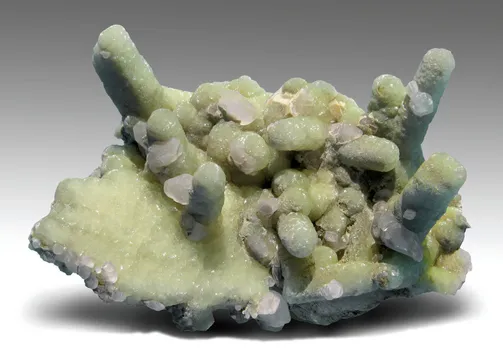
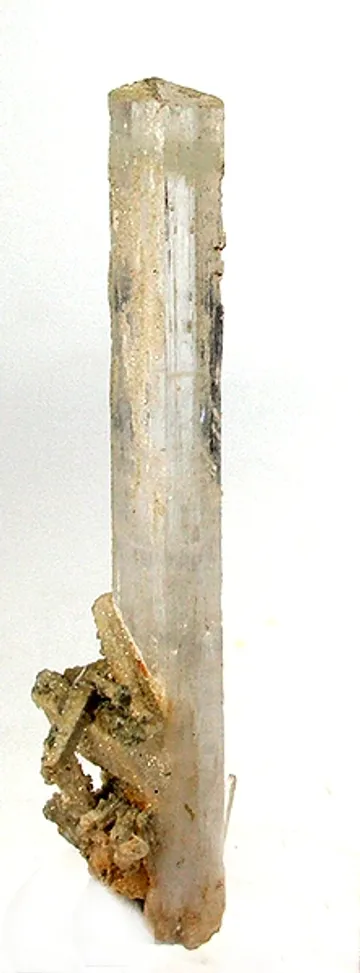
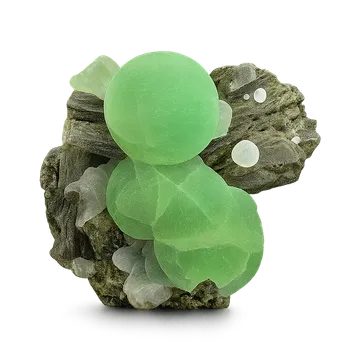
Prospect Park Quarry prehnite is one of the unmistakable classics of American trap-rock mineralogy: soft apple- to mint-green prehnite, often translucent, grown as rounded balls, botryoidal crusts, knobby hemispheres, and—most memorably—hollow casts and “fingers” after earlier evaporite crystals. The locality’s finest pieces have a sculptural quality that separates them from ordinary basalt-amygdale prehnite. They look less like coatings and more like mineral architecture: tubes, stalactitic rods, barrel-like forms, and sharp-edged epimorphs whose vanished cores tell as much of the story as the green prehnite itself.

Photo: Wikimedia Commons
The quarry worked the Orange Mountain Basalt of the First Watchung Mountain, part of the Newark Basin’s Early Jurassic basalt sequence. Prospect Park’s mineral pockets were not random little vesicles; they occupied a variety of structures—pillow interiors, junction pockets between pillows, veins, amygdaloidal zones, and especially unusual diapiric cavities in the basalt. In those voids, prehnite was deposited during late hydrothermal and burial-related mineralization, along with calcite, quartz, datolite, laumontite, stilbite, heulandite, pectolite, natrolite, babingtonite, and other New Jersey trap-rock associates.
The locality’s great collector appeal lies in the combination of form, color, association, and history. A loose green prehnite ball from Prospect Park can be attractive; a matrix piece with several isolated gemmy spheres on calcite is better; a complete hollow prehnite cast after anhydrite, standing up in three dimensions, belongs to the short list of American prehnite types that seasoned collectors recognize across a room. The best examples preserve the geometry of the earlier mineral while showing the soft radiating texture, pearly to waxy luster, and pale green translucency of prehnite.

Photo: Wikimedia Commons
Prospect Park is also historically important because it was one of the great working quarries of the Paterson–Passaic County trap-rock district, an area long prized for zeolites, prehnite, datolite, quartz, calcite, and babingtonite. Collectors value old Prospect Park labels—Sowerbutt, Vandermade, Warren Brothers, Tilcon, and simply “Prospect Park” all appear in the literature and in old collections—because the quarry is now defunct and was being reclaimed and redeveloped after the end of aggregate production. What remains in the market is collection material: old finds, traded pieces, dealer stock, estate specimens, and the occasional superior example emerging from a long-held New Jersey suite.
Search for specimens: View all prehnite specimens from Prospect Park Quarry, New Jersey, USA
Prospect Park Quarry was a former trap-rock aggregate quarry in Prospect Park, Passaic County, New Jersey, roughly two miles north of Paterson. The quarry is in the Orange Mountain Basalt, historically called the First Watchung basalt, a dark greenish-gray to greenish-black basalt made chiefly of calcic plagioclase and clinopyroxene. The basalt sequence here includes massive and columnar parts, vesicular flow tops and bottoms, pillow structures, and pahoehoe structures—exactly the physical architecture that allowed late fluids to move, react, and deposit collectible minerals in cavities.
The prehnite is tied closely to the basalt’s void systems. At Prospect Park it occurs in three especially important settings: diapirs, amygdaloidal horizons, and pillow basalt cavities. The diapirs are dome-shaped structures beginning in the lower colonnade of the first flow and extending upward into the entablature. Openings near their upper interiors were lined by carpets of prehnite epimorphs after anhydrite. At the top of the lower flow, an amygdaloidal horizon carried thinner botryoidal prehnite linings. Pillow interiors and junction pockets supplied additional mineralized cavities, often producing assemblages richer in calcite, zeolites, quartz, datolite, and related species.
The quarry opened in 1901 under James A. Sowerbutt. After his death in 1916, operations passed to his son-in-law Abraham Vandermade and to James Vandermade. The property was sold to Warren Brothers in 1969, and in the early 1980s Tilcon New Jersey acquired it. Aggregate production ultimately ended in the early twenty-first century; redevelopment documents and later quarry summaries describe an approximately 80-acre Tilcon quarry property mined for construction aggregate from 1901 until 2010 and subsequently targeted for reclamation and mixed-use redevelopment.
For collectors, that history matters. Prospect Park was not a casual roadside exposure but an active industrial quarry, and the finest mineral specimens appeared when blasting and quarry expansion opened the right pockets at the right time. Access depended on ownership, safety, permission, and the realities of a working aggregate operation. Today, the locality should be treated as closed and unavailable for collecting. The market supply is therefore finite: old self-collected material, museum and collection pieces, dealer stock, and specimens recycled from estates.
The locality is best known to prehnite collectors for three overlapping styles. First are the spherical and hemispherical green prehnites on basalt or calcite. Second are botryoidal sheets and knobby masses, sometimes with white laumontite or calcite. Third are the casts after anhydrite—the “fingers,” hollow tubes, and occasional widened “snakehead”-like forms that place Prospect Park in the same conversation as the classic Paterson quarries. The same quarry also produced notable zeolite and trap-rock associations, including calcite, laumontite, quartz, datolite, heulandite-Ca, stilbite-Ca, natrolite, pectolite, babingtonite, gmelinite, analcime, pumpellyite-group minerals, thomsonite-Ca, hematite, chalcopyrite, pyrite, and native copper and silver among the broader mineral list.
Prospect Park prehnite is predominantly pale green, apple-green, mint-green, water-green, or yellow-green. Color can be delicate rather than loud, and lighting changes its personality: under some lamps a piece looks pale and silky; under cooler or fluorescent lighting the green may become stronger. The most desirable color is clean, fresh, and translucent, especially when the prehnite forms isolated balls or complete casts rather than dull continuous crusts.
The classic habits are the chief attraction. Collectors look for rounded balls, hemispheres, botryoidal crusts, knobby aggregates, stalactitic forms, barrel-like forms, and hollow epimorphs after anhydrite. In an epimorph, the prehnite coated an earlier crystal and preserved its exterior shape after that earlier mineral dissolved away. Prospect Park pieces may show open basal hollows or tubes where the anhydrite once sat, and the best casts retain crisp overall form while still displaying prehnite’s soft radial surface texture. Some examples approach the “snakehead” style familiar from New Jersey prehnites: an elongated cast with a widened head.
Size ranges are broad. Small cabinet pieces with prehnite spheres around 1 cm across are common enough to define the locality’s look. Better single spheres can reach several centimeters; one documented Prospect Park prehnite ball measured 3.8 cm. Important cast specimens can be cabinet-sized, and one documented prehnite-after-anhydrite specimen measured 10.5 x 10.2 x 5.7 cm, with a large cast reaching 8 cm in length. A separate well-known finger group measured 11.5 x 11 x 8.5 cm, with individual fingers to 4.25 cm. Large, complete, three-dimensional casts with little damage are considerably scarcer than ordinary botryoidal plates.
Associations strongly influence desirability. Calcite is the most familiar and can provide clear, white, or colorless contrast beneath green prehnite balls. Laumontite appears as pale to white sprays or prisms on some prehnite, giving a snow-on-green effect, but it is also condition-sensitive. Datolite, quartz, heulandite, stilbite, pectolite, natrolite, babingtonite, and apophyllite-group minerals all occur in the broader association suite. Babingtonite on prehnite from the New Jersey trap-rock district has its own collector following, and Prospect Park matrix pieces with sharp black babingtonite, clean green prehnite, and balanced composition are especially desirable.
Quality is judged by form first, then color, luster, translucency, association, and condition. A vivid apple-green sphere with glassy or sparkling surface, perched cleanly on calcite, outranks a broad dull coating. A complete hollow cast after anhydrite outranks a broken finger. A sculptural three-dimensional group outranks a flat sawed-looking plate. Collectors should also inspect the terminations and exposed edges carefully, because prehnite fingers and casts are easily bruised, and broken tips are common.
No well-documented class of Prospect Park-specific fake prehnite is widely recognized in the mainstream mineral literature, but authenticity still matters. The first concern is locality accuracy. Similar green prehnite casts and fingers occur in the Paterson trap-rock quarries, especially Upper and Lower New Street, and labels sometimes drift from “Paterson” to “Prospect Park” or from one Passaic County quarry to another. A credible old label, a known collection history, or a specimen style consistent with documented Prospect Park material carries real weight.
The second concern is surface enhancement. Prehnite in general has sometimes been oiled to improve luster, and this should be considered when a specimen looks unnaturally glossy, greasy in recesses, or inconsistent across broken and unbroken areas. Oiling is not a locality signature, but it can affect any older prehnite specimen that has passed through the market. Chemical cleaning is also possible where iron staining or brown coatings were removed; good cleaning can be acceptable, but overcleaned pieces may look etched, chalky, or uneven.
Condition is a major issue. Hollow casts after anhydrite have vulnerable edges, open bases, and projecting forms. Even when a specimen displays beautifully from the front, check the sides and underside for missing fingers, crushed tips, glued repairs, and fresh-looking breakage. Botryoidal prehnite may show bruised high points, especially on sphere clusters. Laumontite associations require extra care because laumontite can dehydrate and become chalky or friable; stable storage away from heat and severe dryness is prudent for prehnite-laumontite pieces.
Rarity is tiered. Ordinary Prospect Park prehnite coatings and small botryoidal pieces are obtainable. Attractive miniatures and small cabinets with distinct green balls on calcite or basalt appear from time to time. Complete sculptural casts after anhydrite, vivid lustrous spheres, large three-dimensional finger groups, and pieces with excellent provenance are much harder to replace. The quarry’s closure and redevelopment have changed the collecting equation permanently: new quarry production is no longer a realistic source, so market availability depends on older collections.
Recent market records show the spread clearly. Modest miniatures and small cabinets have sold at auction in the low tens to low hundreds of dollars, including a 4.6 cm prehnite cast after anhydrite that sold for $47 in 2023 and a 7.7 cm prehnite-after-anhydrite piece with laumontite that sold for $113 in 2024. Better color and luster command more: a 7.4 cm bright apple-green Prospect Park prehnite sold for $361 in 2025. Dealer listings for larger casts and better old-stock examples commonly run several hundred dollars, with some asking prices from about $450 to $1,200 depending on size, completeness, aesthetics, and source.
A final provenance note is worth making. Two notable New Jersey prehnites were reported missing from the Paterson Museum collection: a 3.8 cm green prehnite sphere collected by Jim Kaufman in 1979 at Prospect Park Quarry, and a larger specimen approximately 4 1/2 x 3 1/2 inches with multiple gemmy striated green prehnite spheroids on calcite-coated basalt matrix. That does not imply that ordinary Prospect Park prehnites are suspect, but it is a reminder that exceptional old New Jersey trap-rock specimens deserve careful provenance review.
Prospect Park’s best stories are not tales of a wilderness claim or a remote pegmatite camp; they are urban quarry stories, with blasting benches, basalt walls, old labels, and collectors watching for the brief moment when an industrial operation exposed a mineral pocket before the crusher got it.
One of the most telling collector vignettes comes through the Charlie Key material photographed by Rob Lavinsky. The specimen is small—3.0 x 2.8 x 1.9 cm—but it carries a 2 cm prehnite ball of unusually saturated green color and unusually fine surface luster. The note attached to it says that prehnite was a passion for Charlie, and that he grew up in New Jersey; Prospect Park was not just another locality to him. He kept “a whole suite” of the material, much of it obtained through self-collecting and trading during the 1960s and 1970s. That is precisely how many of the strongest New Jersey trap-rock collections were built: not by one spectacular purchase, but by years of patient local attention, trading, and knowing which quarry names mattered.
The missing Paterson Museum prehnites form a more unsettling chapter. In August 2007, Frank A. Imbriacco III reported that a 3.8 cm green prehnite sphere, collected by Jim Kaufman in 1979 at Prospect Park Quarry, was missing from the Paterson Museum. The piece was important enough to have been illustrated in the July/August 1984 issue of Rocks & Minerals. Years later, Imbriacco added that another extremely fine New Jersey trap-rock specimen from the museum’s permanent collection was also missing. He had seen it on display on the top shelf, far left, in the newest doubly locked cases at the end of 2012, and another local collector remembered seeing it in late 2014 or early 2015. The specimen was about 4 1/2 x 3 1/2 inches, likely also collected by Kaufman, with at least half a dozen undamaged, isolated and clustered, gemmy, striated, translucent green prehnite spheroids on a sloping basalt matrix covered with calcite crystals. For New Jersey collectors, that description is not abstract—it is the kind of piece that represents an entire quarry in one specimen.
Even dealer descriptions preserve some of the quarry’s last echoes. Prospect Park prehnite-after-anhydrite casts are repeatedly described as a historic discovery from a defunct locality, with hollow interiors visible where the anhydrite once was and where prehnite-depositing fluids moved. One small cabinet cast was called almost a “snakehead,” not quite the widened form that earns that local nickname, but close enough to show why New Jersey collectors developed their own vocabulary for these shapes. Another piece with laumontite exposed the basal hollows beneath mint-green knobby prehnite and carried scattered white laumontite prisms across the surface—an object that reads like a miniature cross-section of Prospect Park’s mineralizing sequence.