Pedra Azul, Brazil — premier aquamarine pegmatite district in Minas Gerais, with saturated blue crystals and fluorapatite and rare herderite; collector favorit…
Key facts
The Pedra Azul pegmatite district is one of the signature aquamarine regions of northeastern Minas Gerais: a small-body, beryl-topaz pegmatite district in the Eastern Brazilian Pegmatite Province where the best crystals have the saturated blue to blue-green color that old dealers once called “Fortaleza” aquamarine. The district is centered around Pedra Azul and Medina in the Jequitinhonha valley region, and its collector reputation rests on a deceptively simple pegmatite style: small to medium, biotite-rich, tourmaline-poor or tourmaline-free bodies genetically tied to late G5 granites of the Araçuaí orogen. They are not the lithium-rich, multicolored LCT pegmatites that made other parts of eastern Minas Gerais famous. Pedra Azul is instead a fluorine- and beryllium-flavored beryl-topaz district, where aquamarine, topaz, quartz, albite, cleavelandite, microcline, muscovite, fluorapatite and herderite give serious collectors a very different pegmatite palette.
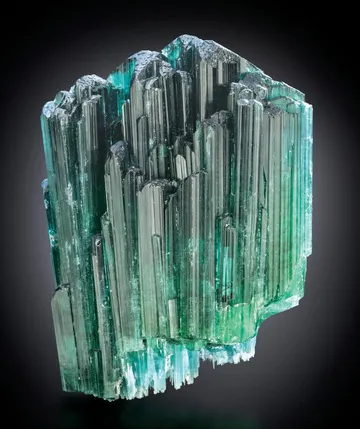
Its best specimens are immediately recognizable. The aquamarines can be stout, lustrous, prismatic crystals in clear blue to greenish blue tones; some are naturally etched into sculptural, ice-like forms, and a few have reached museum stature. The Medina field, within the Pedra Azul district, also produced classic fluorapatites: glassy, gemmy, sherry to golden-brown or yellow-green crystal groups, often matrixless or on albite and muscovite, with a compressed, intergrown habit that is quite unlike the more familiar purple or green apatites from other world localities. At Funil, the scientific interest deepens: chemically confirmed fluorine-rich herderite from a weathered zoned pegmatite is one of the district’s most important rare-phosphate records.
Regional View
Country View
Pedra Azul’s place in gem history is also secured by the Dom Pedro aquamarine, cut from an enormous crystal mined in the district in the late 1980s. The surviving large piece was transformed by Bernd Munsteiner into the 10,363-carat obelisk now in the Smithsonian’s National Museum of Natural History. For mineral collectors, the story is bittersweet: a once-natural giant became one of the world’s great gem sculptures, while the smaller and more mineralogical Pedra Azul specimens—etched aquamarines, sherry fluorapatite floaters, topaz on cleavelandite, greenish-gray herderite and bladed albite plates—carry the district’s pocket character into cabinets.
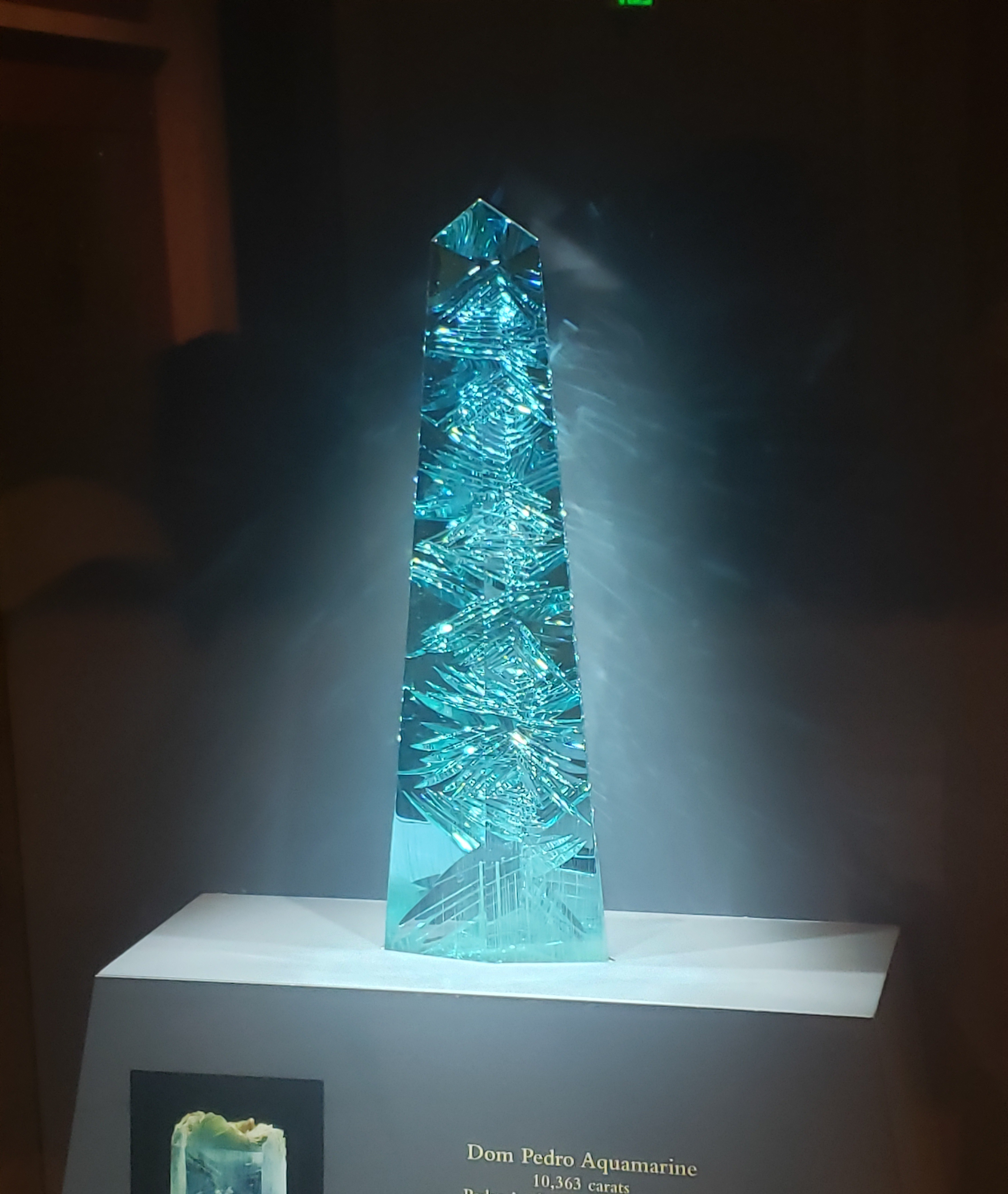

Photo: Wikimedia Commons
Search for specimens: View all specimens from Pedra Azul pegmatite district, Brazil
The Pedra Azul pegmatite district lies in northeastern Minas Gerais, within the Eastern Brazilian Pegmatite Province of the Araçuaí orogen. The district includes the Medina pegmatite field and localities such as the Funil mine, Serrinha pegmatite and Galdino claim, and broader district references also include the municipalities of Pedra Azul, Medina, Almenara, Jequitinhonha and Itaobim. In regional syntheses, Pedra Azul is classed as a residual rare-element pegmatite district related to G5 granites, with aquamarine, topaz and quartz as its principal historical mineral resources. The name Pedra Azul—literally “blue stone”—could hardly be more appropriate for a district whose defining gem is blue beryl.
The pegmatites are typically small. Scientific descriptions of Pedra Azul and Medina bodies repeatedly emphasize lenticular to tabular forms, commonly less than 5 m thick, with simple but distinct zoning. They are generally biotite-rich and poor in tourmaline, and the absence of lithium minerals such as spodumene and lepidolite is a useful field and collection-level distinction from the more evolved lithium pegmatites of Araçuaí and other eastern Minas Gerais districts. Their main rock-forming minerals are feldspar, quartz, muscovite and biotite, with beryl and topaz as the principal gem minerals and fluorapatite, herderite, fluorite, phenakite and other accessory species recorded locally.
At the Funil mine in Medina, the pegmatite was described as a weathered, zoned body about 3 m thick, striking roughly east-west. Near surface it is subvertical, while at depth it dips south at about 40 degrees. Its wall zone is finer grained; the intermediate zone contains weathered microcline with quartz grains and biotite sheets; a discontinuous quartz core is normally only a few decimeters thick. Particularly important for collectors is the description of albite-rich, kaolinized zones several centimeters wide, which were regarded locally as guides in the search for aquamarine. This is exactly the geological setting one expects behind many Pedra Azul specimens: beryl and topaz recovered from weathered pockets and replacement zones rather than from large, highly evolved lithium pegmatite chambers.
The aquamarine-bearing pegmatites studied near Pedra Azul include Poço Redondo, Barreiro and Palmaço, located south of the town of Pedra Azul. These small lenticular bodies show pronounced mineralogical and textural zoning. Barreiro yielded the better gemological color among the studied samples, commonly medium blue; Poço Redondo produced light to very light blue stones; Palmaço yielded very light blue to greenish-blue aquamarine. Chemical work on the Pedra Azul aquamarines showed that sodium is the dominant alkali in the beryl structure, and that the beryl chemistry fits relatively primitive, rare-alkali-poor pegmatites rather than highly fractionated Li-Rb-Cs bodies. For collectors, that helps explain why Pedra Azul is not a great lepidolite-elbaite-spodumene district, but rather a specialized source of aquamarine, topaz, fluorapatite and associated feldspar-quartz specimens.
Mining has historically been small-scale and specimen-selective, with garimpo-style workings and individual pegmatite mines rather than a single large, continuously operated industrial mine. The Funil mine is important both for topaz finds in the 1990s near the hanging wall and for the later analytical confirmation of herderite. The Medina field is the best-known collector subarea, especially for aquamarine and fluorapatite. Serrinha is documented for albite, beryl including aquamarine, microcline, muscovite, quartz, schorl and topaz. The Galdino claim is tied to apatite material reported from Medina. The district also produced notable aquamarine finds in the mid-1990s and the famous 2005 etched aquamarine “ice sculpture” material from clay-filled pockets.
Collecting access today should be treated as private-mine and private-land access. These are not public collecting dumps in the North American sense. Much of the historically productive material entered the market through Brazilian miners, local buyers, Teófilo Otoni and Governador Valadares dealers, and international specimen dealers. Serious field visits require permission from landowners and mineral-rights holders, and old workings in deeply weathered pegmatite and kaolinized feldspar can be unstable. For most collectors, the realistic access route is the specimen market: older Medina apatites, etched aquamarines from named finds, topaz-cleavelandite pieces, and occasional labels preserving Funil, Serrinha, Medina or Pedra Azul district detail.
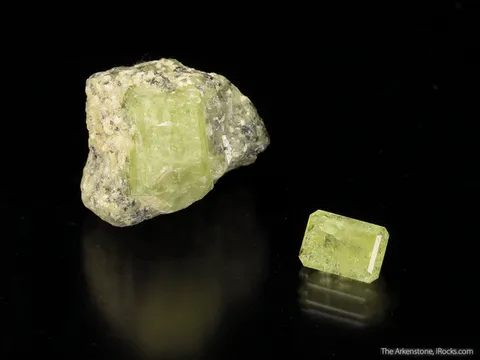
Fluorapatite is one of Pedra Azul’s most distinctive collector minerals, especially from the Medina pegmatite field, where it occurs as a common accessory in replacement bodies and as highly collectible gemmy crystal groups. The classic specimens are not the usual single apatite prisms on matrix, but glassy, intergrown, often matrix-free clusters in sherry, smoky peach, golden-brown, yellow to yellow-green tones, with sharp hexagonal faces, compressed or stacked growth and a luster that can make small miniatures look improbably rich. Documented Medina examples range from millimetric crystals on muscovite and albite to floater clusters around 4–5 cm across, with individual crystals reported to several centimeters; older dealer records place some of the classic material in the 1970s and 1980s. Good Pedra Azul fluorapatite is judged by transparency, unbruised terminations, sculptural all-around crystallization, the locality’s characteristic sherry-golden color, and, in some pieces, attractive yellow to creamy-pink fluorescence under ultraviolet light; ordinary pieces are smaller, more included, matrix-bound or visibly bruised on the exposed prism and pinacoid edges.
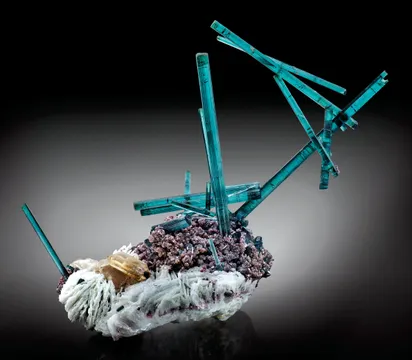
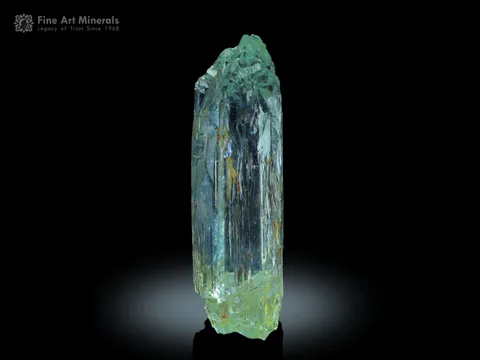
Aquamarine is the mineral that made Pedra Azul famous, occurring in small, zoned, rare-alkali-poor pegmatites where albite-rich kaolinized zones and replacement bodies served as practical guides for miners. Crystals from the district and the Medina field range from under 5 cm study crystals in the scientific literature to cabinet-scale specimens exceeding 10 cm, with a 19.3 cm flawless, strongly colored etched crystal noted from Medina material of the mid-1990s and the sculptural 2005 etched “ice sculpture” aquamarines representing a very different clay-pocket style. Colors span very light blue, medium blue and greenish blue, with Barreiro noted for better medium-blue gem material and Poço Redondo and Palmaço generally paler in studied samples. The finest collector pieces have saturated color without being inky, high transparency, bright luster, crisp termination or complete floater form, and natural etching that enhances rather than destroys the crystal shape; average pieces are pale, abraded, sawn, incomplete, or gem rough masquerading as specimen material.
Beryl at Pedra Azul is economically and mineralogically central, not only as aquamarine but also as non-blue beryl and heliodor recorded from the Medina pegmatite field. In these G5-related pegmatites the beryl occurs in a comparatively simple assemblage with quartz, microcline, albite, muscovite, topaz and accessory phosphates, rather than with the lithium minerals typical of more evolved LCT systems. Specimen beryl appears as prismatic crystals, sometimes etched, sometimes partly embedded in feldspar-quartz pegmatite, and the best examples show good hexagonal form, transparency, a clean termination and enough color—blue, yellow or pale greenish—to separate them from ordinary industrial beryl. For labels, “beryl” from Pedra Azul may describe pale or non-gem crystals from the same beryl-topaz pegmatites that produce aquamarine; collector value rises sharply when the piece preserves pocket character, good luster, associated albite or muscovite, and a precise Medina, Serrinha, Funil or Pedra Azul district provenance.
Albite is one of the key pocket and replacement-zone minerals in the Pedra Azul district, especially at Funil and Serrinha, where it appears in the same mineral system as aquamarine, beryl, quartz, microcline, muscovite and topaz. At Funil, several-centimeter-wide albite-rich zones, now wholly kaolinized in places, were specifically noted as guides for aquamarine search, while small replacement bodies in the district commonly concentrate the accessory phosphate minerals. Collector albite from Pedra Azul is usually valued less as an isolated feldspar species than as the architecture of a specimen: white to off-white granular, platy or bladed feldspar providing contrast for aquamarine, topaz, fluorapatite, muscovite or herderite. Good pieces have clean, bright albite surfaces, undamaged associated crystals and an undisturbed pocket texture; ordinary examples are chalky, friable, iron-stained or so kaolinized that the feldspar has lost both form and support.
Quartz is a major structural mineral in the Pedra Azul pegmatites, forming discontinuous cores and pocket walls rather than serving only as a background gangue. At Funil the quartz core is described as discontinuous and generally only a few decimeters thick, while district-level summaries list quartz alongside aquamarine and topaz as one of Pedra Azul’s main mineral resources. Collector quartz from the district is most important when it records the pegmatite pocket environment: milky to clear crystals with albite, microcline, muscovite, fluorapatite, topaz or beryl, and occasional smoky quartz noted from Medina. The best quartz-associated specimens are balanced matrix pieces in which quartz supports gem aquamarine or sherry fluorapatite without overwhelming it; loose or massive quartz has little locality premium unless it carries sharp secondary crystals or a historically meaningful label.
Cleavelandite, the platy to bladed variety of albite, is an important visual component of Pedra Azul pegmatite specimens even where it is recorded under albite in locality lists. Field-trip descriptions of Medina–Pedra Azul pegmatites identify late sodic plagioclase near quartz cores, together with microcline and minor muscovite, with the albite showing the bladed habit called cleavelandite. In the specimen market, Pedra Azul cleavelandite is familiar as a white, bladed matrix for colorless topaz, beryl and aquamarine, giving sharp gem crystals the contrast that makes them cabinet-worthy. Fine cleavelandite specimens show crisp, lustrous blades arranged in airy aggregates with little clay alteration; lesser pieces are flattened, stained, broken along cleavage, or represented only by chalky kaolinized remnants of the original albite plates.
Other documented Pedra Azul district minerals include topaz, herderite, microcline, muscovite, biotite, schorl, fluorite, phenakite and heliodor, with topaz and herderite particularly important. Topaz was a mining target along with gem beryl and is reported from Funil and Serrinha; collector pieces include colorless prismatic topaz on bladed albite-cleavelandite. Herderite from Funil is the district’s standout rarity: euhedral greenish-gray crystals were analyzed chemically and shown to be fluorine-rich, with recorded fluorine contents in the range expected for true herderite rather than hydroxylherderite-dominant material. Phenakite and fluorite add beryllium-fluorine interest, while schorl is relatively subordinate compared with tourmaline-rich Minas Gerais pegmatites elsewhere.
Pedra Azul labels deserve close attention. The names Pedra Azul, Fortaleza, Medina and “Minas Gerais aquamarine” have all appeared in the trade, and they do not carry the same precision. “Fortaleza” is historically associated with fine blue aquamarine from the Pedra Azul area, but it is also a color-trade term that can be used loosely. “Medina” may mean the municipality, the Medina pegmatite field, or an individual mine or pegmatite such as Funil or Serrinha. For higher-value specimens, especially aquamarine and fluorapatite, a label that preserves “Medina pegmatite field, Pedra Azul district, Minas Gerais, Brazil” is preferable to a generic “Brazil” or “Minas Gerais.”
Aquamarine from Pedra Azul is commonly cut as gem rough, so specimen buyers should distinguish natural crystals from repaired, trimmed, sawn or polished fragments. Watch for flat sawed bases hidden in stands, polished faces on etched crystals, oiling or resin used to mask fractures, and crystals mounted to feldspar or quartz matrix without credible pocket contact. The 2005 etched aquamarines are naturally sculptural and can look almost carved; the test is whether etching continues naturally around edges and into cavities, rather than stopping abruptly at polished or ground surfaces. Pockets in kaolinized albite can leave clay in cavities, which is normal, but glue-filled cracks and suspiciously clean reattachments should be inspected under magnification.
Fluorapatite from Medina is fragile by virtue of its glassiness, exposed crystal edges and common floater habit. The best pieces are complete all around, but many attractive specimens have bruises on terminations or contact points between clustered crystals. Damage is especially easy to miss on sherry-colored apatite because the internal reflections can hide tiny chips. Ultraviolet response can be a useful added feature—yellow under longwave and creamy-pink under shortwave has been reported for classic Medina material—but fluorescence should not be used as the sole locality test. Handle apatite gently: it is much softer than quartz, and cleaning should avoid acids, ultrasonic treatment and hard brushing.
Topaz and beryl are harder, but their cleavage and internal strain still matter. Colorless topaz on cleavelandite can detach cleanly from the bladed albite matrix, and repaired topaz crystals are not unusual in the broader gem-pegmatite trade. Aquamarine crystals should be checked for reheated color claims: heating pale greenish beryl to improve blue color is common in the gem trade generally, though it is much harder to prove on a specimen unless documentation exists. Strong, natural-looking blue color with weathered pocket surfaces, clay inclusions or untouched terminations is more desirable than over-clean, suspiciously uniform gem rough with no matrix context.
Pedra Azul specimens are available, but the market is selective. Good aquamarine is rarely cheap, and the finest etched crystals, saturated Medina crystals and older “Fortaleza” material are strongly competed for by gem and mineral buyers alike. Classic Medina fluorapatites appear periodically from older collections and dealer inventories, often as miniatures to small-cabinet pieces. Herderite from Funil is much scarcer and should be bought only with strong provenance or analytical confidence. Cleavelandite, albite, microcline and quartz matrix pieces are more affordable unless carrying sharp topaz, aquamarine or high-quality apatite.
The great Pedra Azul story begins with a mistake: an enormous aquamarine crystal, mined in the late 1980s, was dropped. Before the accident, the crystal was roughly three feet long and close to 100 pounds. After it shattered into three pieces, two were sold away to become anonymous jewelry stones. The largest surviving piece, still about 60 pounds, escaped that fate and began a far stranger life. It traveled from Brazil to Germany, where the gem artist Bernd Munsteiner studied it for four months, sketching hundreds of possible designs before committing to the one he called Ondas Maritimas, “Waves of the Sea.” He then spent about six months cutting the crystal into an obelisk, carving negative facets into the back so that light would ricochet through the blue-green interior.
The result was the Dom Pedro aquamarine: 10,363 carats, about 14 inches tall, and unlike almost any gem object in a mineral museum. It is not a faceted stone in the ring-and-pendant sense. It is a sculpture made from a pegmatite crystal, with the artist’s cuts turning internal light into stacked starbursts. Smithsonian curator Jeffrey Post has described the stone as “unprecedented,” and the museum’s own record now lists the specimen as beryl variety aquamarine from Pedra Azul, cut by Munsteiner in a fancy obelisk form. For collectors who prefer natural crystals, the Dom Pedro is a complicated object: a lost giant specimen, a saved giant gem, and a monument to the fact that Pedra Azul’s pegmatites were capable of growing aquamarine on a scale most districts never approach.
Another Pedra Azul episode belongs not to a museum case but to the 2005 etched aquamarine find. Specimens from this pocket group were described in the market as “ice sculptures,” and the phrase fits. The crystals were free-form, naturally etched aquamarines recovered from large clay-filled pegmatite pockets, their surfaces dissolved and sculpted into cavities, ridges and translucent blue planes. One auctioned example measured about 10.5 x 7.62 x 5.08 cm and was described as a complete all-around floater with strong internal brilliance. These are the sort of pieces that make locality attribution more than a label: they do not look like ordinary terminated prismatic beryl, and they do not look like faceted gem rough. They look like a pocket fluid kept working after the crystal grew, cutting back the beryl into a frozen, water-worn form.
The Funil mine story is quieter but mineralogically sharper. Herderite had long been a difficult species, often confused with hydroxylherderite and historically clouded by uncertain chemistry. At Funil, researchers found euhedral, centimeter-scale, greenish-gray crystals near the hanging wall of a weathered zoned pegmatite—the same upper, fluorine-rich environment associated with important topaz finds in the 1990s. Chemical analyses confirmed fluorine-rich herderite compositions, with measured fluorine values high enough to matter in the herderite-hydroxylherderite series. For a collector, that means Funil is not merely another aquamarine dig; it is one of the localities where the phosphate chemistry of the Pedra Azul system becomes visible in hand specimens.