






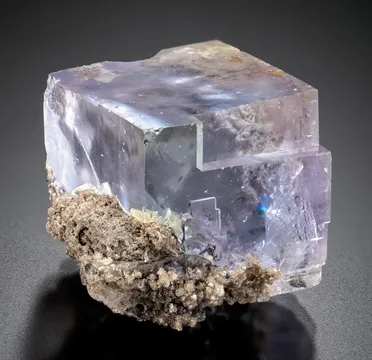
New York, USA - diverse mineral provinces from Herkimer quartz to Balmat sphalerite; prized for regional varieties, historic specimens, and zinc-rich lodes.
Key facts
New York is not one mineral locality so much as a compact mineralogical continent. For collectors it matters because several entirely different specimen provinces meet inside one state: the vuggy Upper Cambrian Little Falls Dolostone of the Mohawk Valley with its brilliant doubly terminated “Herkimer diamond” quartz; the Precambrian Franklin Marble belt of Orange County with black spinel, clintonite, edenite, warwickite, chondrodite, phlogopite, fluorite, and rare amphiboles; the old Ellenville lead-copper workings of Ulster County with quartz, pyrite, galena, sphalerite, and chalcopyrite; the iron districts of the Adirondacks, Hudson Highlands, and Brewster area with magnetite; and the Balmat-Edwards district of St. Lawrence County, one of the great North American zinc districts, with sphalerite, galena, pyrite, calcite, tremolite, and an unusual suite of rarities.
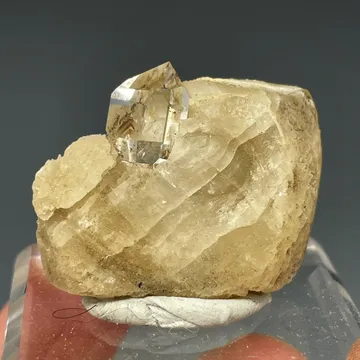
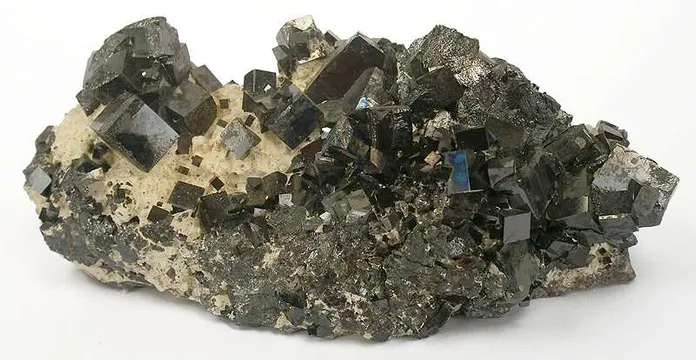
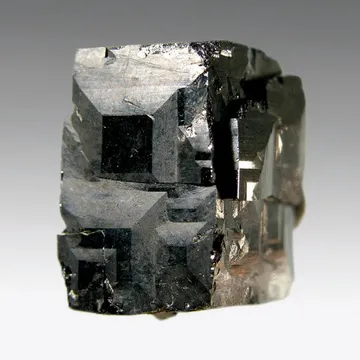
The best New York specimens have a look that is instantly regional. Herkimer quartz is glassy, high-relief, and naturally faceted, often loose from its dolostone pocket or perched on pale dolomite with anthraxolite and small sulfides. Amity spinel is heavy, black to brown-black, and octahedral in white Franklin Marble, commonly accompanied by golden-brown phlogopite, orange-brown chondrodite, graphite, and calcite. Ellenville pieces are old-time cabinet specimens: drusy or prismatic quartz carrying brassy pyrite and chalcopyrite, sometimes with galena or sphalerite, a nineteenth-century mining aesthetic rather than a modern quarry aesthetic. Tilly Foster magnetite has the dense, metallic presence of classic iron ore, but the finest pieces are not merely ore; they are sharp dodecahedral and striated octahedral crystals from a famous and dangerous mine.
Regional View
Country View
New York’s collecting history is unusually deep. Lewis Caleb Beck’s 1842 work on the mineralogy of the state grew out of the early Geological Survey era, and the New York State Museum’s mineral holdings were built around those foundational collections. Oren Root began assembling one of the early American mineral collections in 1834. By the later nineteenth century, New York localities were already supplying specimens to museums and private cabinets: Herkimer quartz from the Mohawk Valley, spinel and type minerals from Amity-Edenville, Ellenville quartz and chalcopyrite, giant Gore Mountain garnet, and magnetite-related minerals from Tilly Foster.
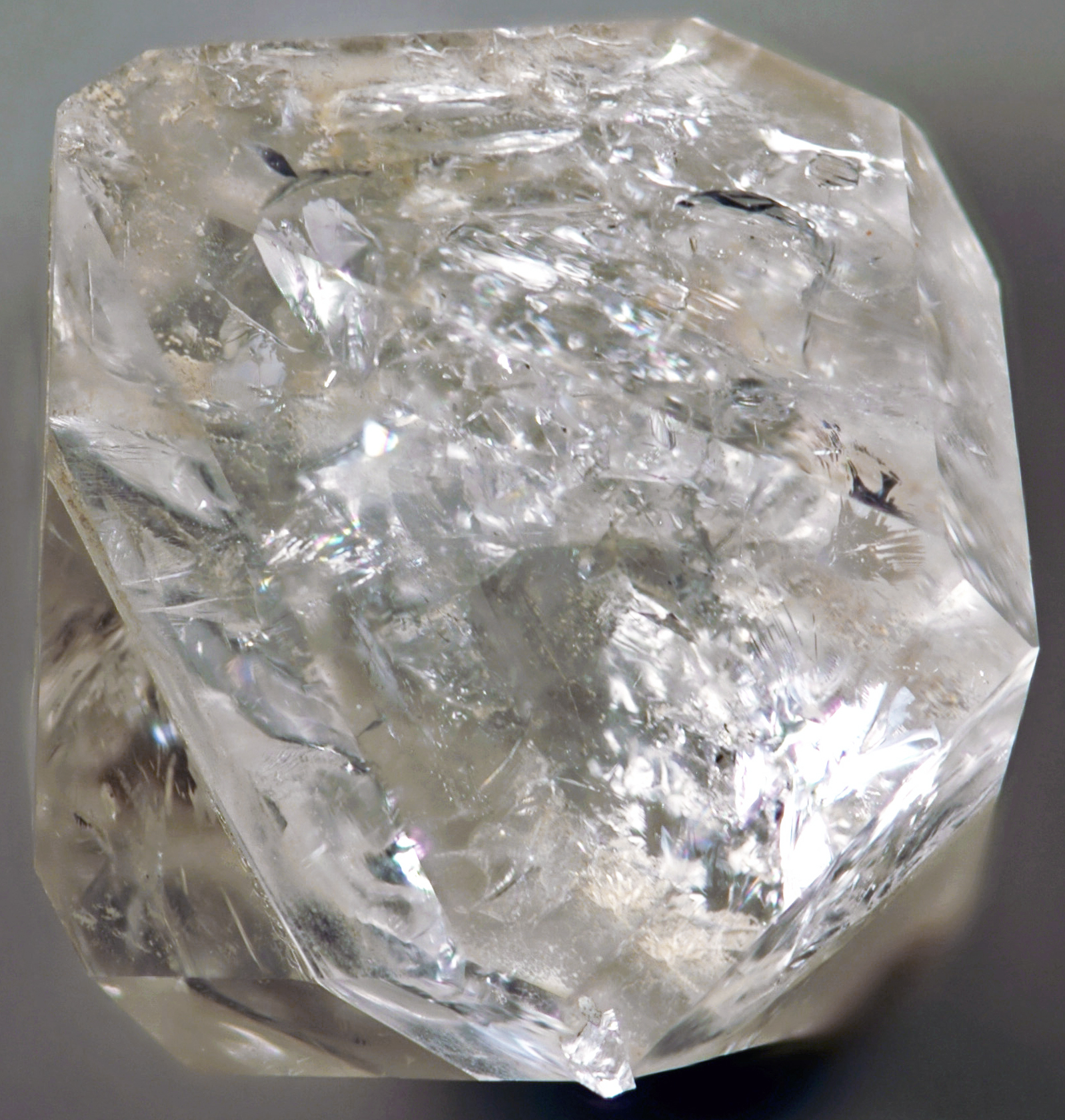
Photo: Wikimedia Commons
Search for specimens: View all specimens from New York, USA
For specimen collectors, “New York” should be read as a set of separate mineral districts rather than a single deposit. The Mohawk Valley Herkimer district is a low-temperature hydrothermal quartz-in-vug system developed in the Little Falls Dolostone, an Upper Cambrian dolostone unit exposed around Herkimer County, Middleville, Little Falls, Fonda, and adjacent parts of the valley. The crystals occur in cavities in hard dolostone, commonly with dolomite, calcite, anthraxolite, pyrite, marcasite, sphalerite, galena, chalcopyrite, hematite, and limonite reported from the formation. Productive zones are pockety: one boulder may be barren, while the next opens into a lined cavity with loose or attached quartz. Good pockets may yield bright, water-clear crystals with both terminations intact, minor hydrocarbon inclusions, skeletal growth, internal veils, or small sulfides.
The Orange County Amity-Edenville-Warwick area belongs to the northeastern continuation of the Franklin Marble belt, a mid-Proterozoic, granulite-facies metacarbonate assemblage. The mineral-producing rock is calcite-rich Franklin Marble, broken by chemically unusual lenses and horizons enriched in aluminum, boron, fluorine, magnesium, and other components. These lenses produced the classic black spinel octahedra of Amity, clintonite plates, chondrodite, phlogopite, forsterite, corundum, diopside, warwickite, edenite, fluorite, graphite, and rare amphiboles. The Amity “giant spinel” locality was already famous in the early nineteenth century, and early descriptions reported extraordinary single spinel crystals weighing up to 158 kg. The best collector pieces from the district are old, usually from historic farm or float occurrences, and are valued for sharp spinel form, white marble contrast, and credible old labels.
The Ellenville Mine, also known as the Ellenville Lead Mine or Ulster mine, is one of the classic northeastern United States quartz-sulfide localities. Its old workings in the Shawangunk Mountains produced quartz, chalcopyrite, pyrite, galena, and sphalerite. Nineteenth-century mining focused on ore, but the byproduct for collectors was far more enduring: cabinet specimens of quartz with brassy chalcopyrite and pyrite, some good enough to enter major museum and private collections. Today the locality is represented mainly by old specimens, scattered tailings, collapsed shafts, and remnants of mine structures; it should be approached as a historic site with serious safety and access limitations, not as an open collecting quarry.
New York’s magnetite story is split between great ore districts and specimen localities. The Adirondack Highlands contain iron oxide-apatite deposits associated with the Lyon Mountain Granite suite, especially in the Mineville-Port Henry, Cheever, Lyon Mountain, and related districts. These were industrial iron deposits first and specimen sources second, but they anchor New York’s iron-mining identity. In southeastern New York, Tilly Foster near Brewster is the legendary collector locality. A large magnetite deposit was discovered there early in the nineteenth century, serious mining began in 1853, the mine reached a depth of about 600 feet, and mining ceased after a catastrophic 1895 rock slide and final abandonment in 1897. Its magnetite, chondrodite, chlorite, serpentine-group minerals, calcite, dolomite, and associated species supplied old collections for decades.
The Balmat-Edwards-Pierrepont zinc district in St. Lawrence County is a metamorphosed carbonate-hosted sulfide district in the Grenville Lowlands of the northwest Adirondacks. The ore consists chiefly of sphalerite with pyrite and galena, with pyrrhotite and chalcopyrite locally present, replacing folded siliceous magnesian marbles. Zinc was first produced from Edwards in 1915 and from Balmat in 1930; the district has passed through St. Joe Minerals, Zinc Corporation of America, Hudbay, and Titan-related ownership, with the modern operation known as Empire State Mines. For collectors, Balmat-Edwards is important for sphalerite and calcite specimens, pink to purple tremolite known as hexagonite, pyrite, galena, fluorite, dravite-uvite series tourmalines, donpeacorite, and a long list of uncommon metamorphic and ore minerals.
Collecting access in New York is highly locality-specific. The principal legal and practical public access for mineral collecting is at fee-dig operations in the Herkimer district and organized tours or collecting opportunities connected with the Gore Mountain garnet locality. Most historic mines, including Ellenville, Tilly Foster, many Adirondack iron mines, and Balmat-Edwards workings, are private, active, flooded, reclaimed, dangerous, or legally restricted. On New York State lands, collection of minerals or scientific specimens generally requires appropriate permission or permit, and large-scale removal falls under mined-land and other environmental regulations. Serious collectors should treat old mine dumps, roadcuts, state lands, and posted farm localities as permission-only sites.
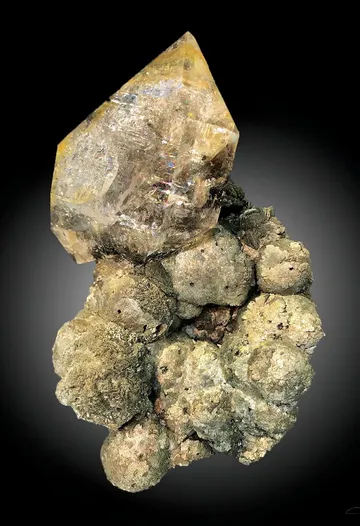
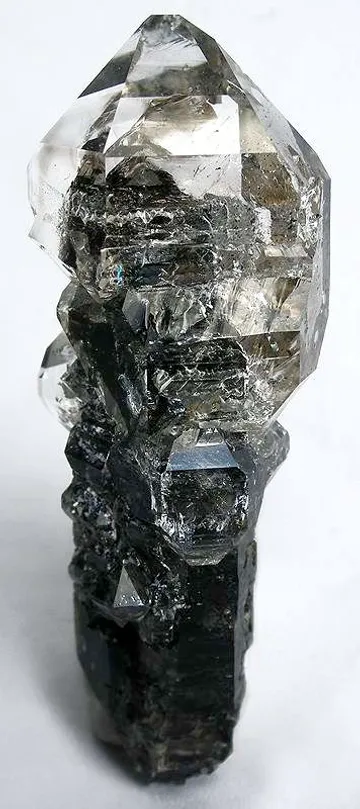
New York quartz is dominated in the collector’s mind by Herkimer “diamonds,” the clear, highly lustrous, doubly terminated crystals from vugs in the Little Falls Dolostone around Herkimer County and the Mohawk Valley; typical crystals range from thumbnail to miniature size, while exceptional loose or matrix pieces are judged on transparency, completeness of both terminations, freedom from bruising, and the liveliness of their natural faces. Associations that matter here are pale dolostone, dolomite and calcite linings, black anthraxolite, small pyrite or marcasite, sphalerite, and occasional galena or chalcopyrite. Ordinary pieces are simply bright loose quartz points; better New York pieces show balanced double termination, water clarity, skeletal or window growth, attractive hydrocarbon inclusions, or crystals still sitting in an opened dolostone vug. Outside the Herkimer district, Ellenville quartz has a different character: vein and fissure quartz with pyrite, chalcopyrite, galena, and sphalerite, prized when sharp crystal groups retain the old mine association rather than appearing as anonymous white quartz.
New York spinel means the Amity-Edenville-Warwick belt of Orange County, where black to brown-black octahedral crystals occur in Franklin Marble with calcite, chondrodite, phlogopite, graphite, clintonite, forsterite, corundum, and related high-grade metacarbonate minerals. Classic Amity pieces are old-time specimens, often small-cabinet or miniature, with octahedra from sub-centimeter size to crystals several centimeters across; historically, the district was famous enough for reports of giant individual crystals weighing far beyond normal cabinet scale. The finest collector specimens are sharp, lustrous, complete octahedra standing out cleanly from white marble or golden-brown mica, while lesser pieces are rounded, etched, embedded, broken, or ambiguous spinel-group material that may need analytical distinction from gahnite, franklinite, or other black octahedral oxides.
New York’s collector-grade chalcopyrite is best known from the Ellenville Mine in Ulster County, where nineteenth-century workings produced quartz-sulfide specimens that are still recognized as classics of the American Northeast. The mineral occurs with quartz, pyrite, galena, and sphalerite, commonly as brassy metallic crystals or crystal aggregates on quartz; reported and photographed Ellenville specimens include cabinet pieces with chalcopyrite crystals around the centimeter scale, and the appeal lies in the contrast between bright sulfide and pale to clear quartz. Good Ellenville chalcopyrite is sharp, visibly crystallized, and locality-rich, preferably on quartz rather than massive sulfide, with a natural brassy surface and intact crystal edges; ordinary pieces are dull, massive, overly tarnished, or stripped of the quartz association that makes the locality recognizable.
New York magnetite spans the massive iron oxide-apatite ores of the Adirondacks and the sharply crystallized classics of the Tilly Foster Iron Mine at Brewster. Mineville and related Adirondack districts supplied heavy, magnetic ore specimens, some with visible crystal faces, but the most desirable cabinet material is Tilly Foster magnetite: superb dodecahedral and striated octahedral groups, with individual crystals recorded to about 3 cm, associated with chondrodite, chlorite, calcite, dolomite, serpentine-group minerals, and skarn-like iron-mine assemblages. The best pieces have distinct metallic faces, recognizable form, old collection provenance, and minimal alteration; ordinary pieces are simply dense black ore, historically important but not visually competitive with the sharp Brewster crystals.
“Diamond” is the most treacherous New York label in the mineral trade because the state’s famous diamonds are overwhelmingly Herkimer diamonds, which are quartz, not carbon diamond. True diamond has been reported in connection with New York kimberlitic or peridotitic occurrences, including old references to a peridotite near Syracuse, and modern work has documented numerous Mesozoic kimberlitic dikes and small diatremes in the state, but New York is not a regular source of verified collector diamond specimens in the way Arkansas, South Africa, Russia, or Canada are. A serious New York diamond specimen therefore needs unusually strong documentation; in ordinary dealer usage, a “New York diamond” is almost certainly a bright doubly terminated quartz crystal from the Herkimer district, and its merit should be judged as Herkimer quartz rather than as diamond.
Pyrite is widespread in New York, but collector interest concentrates on a few settings: Ellenville quartz-sulfide specimens with pyrite and chalcopyrite, Herkimer vugs where pyrite and marcasite accompany quartz, Balmat-Edwards zinc ores where pyrite occurs with sphalerite and galena, and western New York sedimentary occurrences that can include pyritized fossils or nodules. Ellenville pyrite is most attractive when it is brassy and sharply crystallized on quartz, contributing sparkle and locality character rather than appearing as massive sulfide. Herkimer-associated pyrite is often small but desirable when it is included in or perched near quartz crystals. The best New York pyrite specimens have crisp form, stable surfaces, and a meaningful association; weaker examples are oxidized, crumbling, massive, or simply detached sulfide with no locality-defining matrix.
Other documented New York minerals form a deep bench behind these species. The Amity-Edenville-Warwick district includes important type-locality material for clintonite, edenite, and warwickite, as well as fluoropargasite, chondrodite, phlogopite, forsterite, corundum, graphite, fluorite, serendibite, sinhalite, and dissakisite-(Ce). Balmat-Edwards adds sphalerite, galena, pyrrhotite, calcite, dolomite, tremolite including pink-purple hexagonite, dravite-uvite tourmaline, donpeacorite, and rare metamorphic silicates. Gore Mountain is essential for almandine garnet megacrysts in amphibolite, with individual crystals historically recovered up to about a meter across, and New York’s industrial-mineral suite also includes wollastonite, talc-tremolite rock, halite, gypsum, bluestone, and fluorite from localities such as Macomb.
The most important authenticity issue is terminology. “Herkimer diamond” is a trade and locality name for doubly terminated quartz, not diamond. The phrase is legitimate only when used in that traditional sense, but the market often stretches it to any bright double-terminated quartz from anywhere. Serious buyers should look for a specific Herkimer-district label: Herkimer County, Middleville, Little Falls, Fonda, Crystal Grove, Ace of Diamonds, Herkimer Diamond Mines, Diamond Mountain, or another documented Mohawk Valley source. Loose, unlabelled double-terminated quartz should not be assumed to be New York material.
Matrix Herkimers deserve special scrutiny. Genuine crystals may occur loose, partly attached, or in opened dolostone vugs, but glued reconstructions and “improved” matrix pieces exist in the wider trade. Look for glue halos, mismatched contact surfaces, quartz sitting unnaturally on fresh broken dolostone, and suspiciously perfect crystal placement. Oil, wax, or resin can temporarily improve the wet look of fractured quartz; strong backlighting and magnification will reveal many of these treatments. Enhydro claims should also be verified directly, not accepted from label romance.
The Diamond category needs even stricter skepticism. A New York specimen sold as carbon diamond should carry analytical support or very strong provenance. If it looks like Herkimer quartz, is described as double terminated, or comes from Herkimer County, it belongs mineralogically under quartz. The word “diamond” on an old New York label may be historically interesting, but it is not by itself a species identification.
Amity spinel can be mislabelled because black octahedral minerals in Franklin Marble are not all the same species. Spinel, gahnite, franklinite, magnetite, and other dark oxides can be confused visually, especially in old collections. For high-value pieces, a precise species assignment should be backed by old provenance, locality context, and, when necessary, analytical work. In the Amity suite, associations are often more diagnostic than color: spinel with white Franklin Marble, chondrodite, phlogopite, calcite, graphite, or clintonite has a very different character from Franklin-Ogdensburg franklinite ore.
Condition is a major value divider. Herkimer quartz chips easily at terminations and along the prism edges, and even tiny bruises are conspicuous because the crystals are so transparent. Ellenville chalcopyrite and pyrite can tarnish, and brassy sulfides should be stored dry and handled sparingly. Pyrite from shale, nodules, or fossil occurrences may oxidize if unstable; keep suspect pieces dry, avoid sealed humid boxes, and watch for sulfur odor, white efflorescence, or cracking. Tilly Foster and Adirondack magnetite is tough but dense; heavy specimens damage labels, boxes, and neighboring minerals if stored loosely.
Fluorescence can be a bonus but should be locality-specific. Balmat sphalerite may show attractive fluorescence, including orange or multicolored responses, and Franklin Marble minerals from Orange County can include fluorescent calcite, fluorite, tremolite, and related species. Fluorescence alone, however, is not proof of a specific New York locality, especially because nearby Franklin and Sterling Hill, New Jersey, are far more famous in the fluorescent-mineral market and are often confused with New York Franklin Marble material.
Availability varies sharply by district. Herkimer quartz is continuously available because fee mines and commercial digging still produce new material, though top matrix specimens, large flawless crystals, skeletal crystals, and fine included pieces are much scarcer than tourist-grade loose crystals. Amity spinel, clintonite, and warwickite are mostly old-collection minerals. Ellenville quartz-sulfide specimens are classic and finite; good old labels matter. Tilly Foster magnetite and chondrodite are old-mine specimens with strong historical appeal. Balmat-Edwards material appears intermittently from old collections, miners, and recent mining-related availability, but active industrial mines are not public collecting sites.
The Ellenville mines have the kind of origin story that every old mineral district seems to acquire once the shafts collapse and the real paperwork grows thin. By the time the locality was written up as a classic, the beginning of mining had already vanished into “the fog of time.” Local legends assigned the workings to the Dutch, the Spanish, American Indians, and even aliens in UFOs supposedly mining energy from quartz crystals deep in the Shawangunk Mountains. What remains on the ground is less theatrical but more haunting: tailings piles, collapsed shafts, and broken foundations. What remains in collections is the real proof of the place—quartz and chalcopyrite specimens from the nineteenth-century glory years, good enough to sit in museums and private cabinets far beyond Ulster County.
At Tilly Foster, the specimens came from a mine that was famous, profitable, unstable, and ultimately unforgiving. The deposit lay near Brewster, about fifty miles north of New York City, and serious mining began in the 1850s after iron ore had long been known at the site. At its height the mine was about 600 feet deep, employed hundreds of men, and shipped large tonnages of ore by rail. In the 1870s, monthly production was reported around 7,000 tons. The ore was magnetite, and much of it became the industrial metal of a growing railroad nation, including Bessemer ore shipped to Scranton for steel rails.
The mineral specimens were a side effect of that industrial violence. Cavities and fissures in the iron ore and associated rocks yielded magnetite crystals, chondrodite, chlorite, serpentine-group minerals, calcite, dolomite, and other species. John N. Trainer Jr. later assembled an important suite of Tilly Foster minerals from material pulled from the mine and its workings; specimens from that collection were shared with Harvard, Yale, and the New York State Museum, and a selection is preserved at the Southeast Museum in Brewster. For collectors, that provenance matters because the old mine is no longer a simple field destination; the historic source is flooded, hazardous, and closed by both time and circumstance.
The engineering story at Tilly Foster became increasingly desperate. In the 1880s, large bodies of ore were known but could not be removed safely because they supported the hanging wall, shaft, and galleries. Attempts were made to replace ore supports with masonry and to strip away overlying rock so the ore could be recovered. The operation became an enormous open pit, but the fractured ground never stopped moving. Reports describe landslides, suspended work, unstable walls, and repeated attempts to make a shattered ore body behave like a predictable mine.
On November 29, 1895, the danger became catastrophe. About thirty men were working on the 400-foot level when the northwest wall failed in the afternoon. Contemporary reports described more than 100 tons of rock falling into the pit. Men ran; some escaped. Patrick H. Murtha was found pinned by a rock, lifted onto the cable car, hoisted to the surface, and taken home, where he died about thirty minutes later. More rock reportedly fell as rescuers returned. Thirteen men were killed. Mining ceased soon afterward, and by 1897 the mine was abandoned, leaving behind a flooded pit and one of New York’s most sobering mineral localities.
The name “Tilly Foster” itself carries one of those historical reversals that makes a field locality memorable. A 1935 New Yorker essay describes the writer encountering a local story that Tilly Foster had been a Revolutionary War heroine, “the rosy-cheeked daughter of a farmer,” only to discover in the historical record that the name belonged not to a girl spy but to Tillingham Foster, a male landowner associated with the property. The romantic heroine vanished; the mine remained.
The Herkimer district offers a very different field experience: not a tragic industrial pit, but the stubborn labor of cracking dolostone. The romance of the name makes people imagine faceted gemstones waiting in soil. The reality is harder and more interesting. Productive pockets occur in tough Little Falls Dolostone, and collectors search by breaking rock, tracing cavities, and reading the texture of the stone. A common day’s work produces bruised fingers, fragments, calcite-lined pockets, and small loose crystals. A good day opens a vug and reveals bright quartz that looks impossibly cut, although every face is natural.
_(near_Herkimer,_New_York_State,_USA)_(32165188920).jpg)