A collector's guide to Diamond Acres diggings, USA: its geology, mining history and notable minerals, illustrated with the 30 specimens documented from this locality on EarthWonders.
Key facts
Diamond Acres is one of the distinctive Fonda-area Herkimer-diamond localities on the south side of the Mohawk Valley in Montgomery County, New York. Collectors know it under several names—Diamond Acres, Hastings Farm, and simply “Fonda”—but the specimens are unmistakably of the Herkimer district: doubly terminated quartz crystals grown in cavities in the Little Falls Dolostone, commonly with dolomite, calcite, marcasite, clay, and black hydrocarbon material as the supporting cast. The “diamonds” here are not native diamond; they are the brilliant, naturally faceted, double-ended quartz crystals for which the Mohawk Valley became famous.
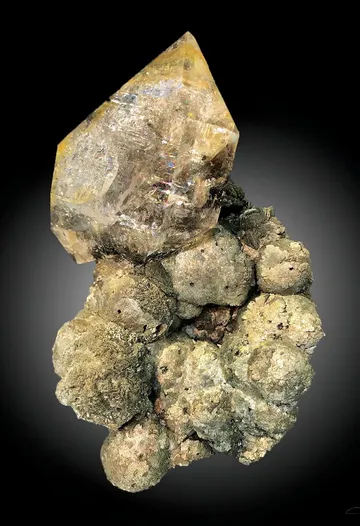
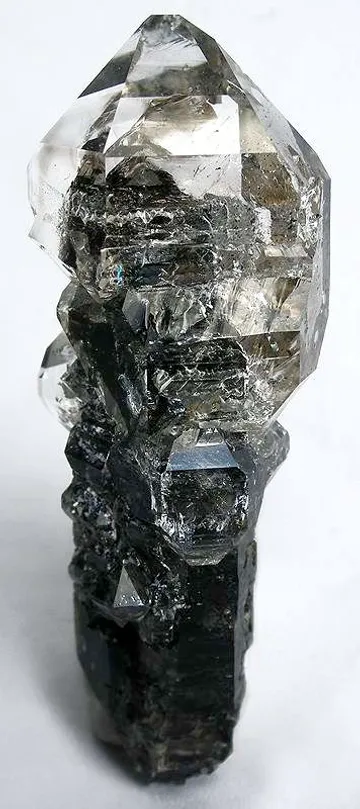
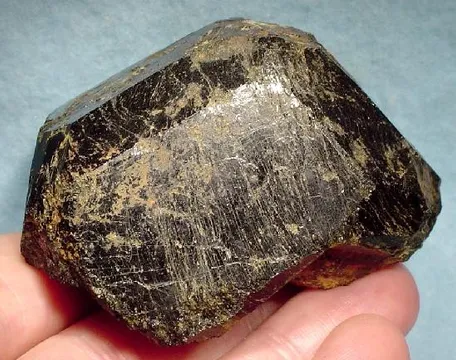
What gives Diamond Acres its own character is the combination of large crystals, heavy weathering, and dark drusy or hydrocarbon-rich matrix. The best pieces have sharp, lustrous faces, transparent to lightly smoky interiors, black pyrobitumen contrast, and the muscular presence collectors sometimes call “Fonda footballs.” Large individuals commonly show internal veils, fractures, rainbowing, smoky patches, and contact areas where the crystal grew against or partly enclosed pocket wall. Matrix specimens can be especially attractive: clear Herkimer-style crystals perched on black or dark drusy quartz over dolostone, rather than the loose, water-clear singles more typical of some better-known Herkimer County commercial mines.
The setting is a wooded, glacially scoured rise among small cultivated fields and outcrops of Little Falls Dolostone. Mineralization is pocket-controlled rather than vein-ore mining in the conventional sense: the collector is pursuing vugs and larger solution cavities in the dolostone, not an ore body. Within those cavities, several pulses of carbonate, quartz, sulfide, hydrocarbon, clay, and later weathering events produced the local texture of the deposit. Diamond Acres is especially noted in district-level collecting literature for dramatic weathering effects and for a strong Herkimer-diamond-forming event.
Regional View
Country View
Historically, Diamond Acres matters because it bridges the world of casual fee digging and serious hard-rock Herkimer mining. Day collectors could work loose rock, tailings, and shallow material, while clubs and claim holders pursued deeper pockets with saws, jackhammers, wedges, pumps, and long-term patience. Over decades, more than forty pockets were recorded by one long-running research collection from the site, and later claim work produced some of the most memorable Fonda stories: interconnected pockets, fist-sized crystals, black hydrocarbon-filled cavities, and pocket strings close enough together to turn a winter dig into a months-long run.
Search for specimens: View all specimens from Diamond Acres diggings, USA
Diamond Acres diggings are at Fonda, in the Mohawk township area of Montgomery County, New York, and are listed by Mindat under the historical name Hastings Farm. The locality lies within the broader Mohawk Valley Herkimer-diamond belt, where the Late Cambrian Little Falls Dolostone forms the hard carbonate host. At its type area near Little Falls, the Little Falls Dolostone is roughly 400 feet, or 122 meters, thick, and the unit is well known in the literature for exceptionally clear doubly terminated quartz crystals, anthraxolite or pyrobitumen-like hydrocarbon residues, stromatolites, varied dolostone and sandstone textures, and a carbonate-sulfide-quartz mineral assemblage.
The deposit type is best understood as a vug-and-pocket quartz occurrence in dolostone. The original carbonate sediment accumulated in a shallow marine setting, was lithified and dolomitized, and later acquired porosity through solution cavities, paleokarst-related openings, bedding-parallel porous zones, and fractures. Subsequent fluids introduced or remobilized silica, carbonate, sulfide, clay, and hydrocarbons. At Diamond Acres the mineralization sequence reconstructed from field observations includes early dolomite, later dolomite, sparse sulfides, several drusy quartz events, a significant hydrocarbon-and-clay event, the principal Herkimer-diamond quartz event, “baby floater” druse of tiny Herkimer-style crystals, marcasite needles, multiple calcite stages, and later weathering and quartz-healing effects.
There is no metallic ore body in the usual mining sense. The productive targets are pockets and cavity layers in the dolostone. Collectors work through soil, glacially broken rock, shattered dolostone, and finally the more coherent pocket layer. In at least one described claim, the pocket layer varied from several inches to more than two feet thick. Cavities may be barren, may contain clay and broken wall fragments, or may open into crystal pockets with loose quartz, matrix plates, black granular hydrocarbon, calcite, dolomite, and small bright Herkimer diamonds. Diamond Acres is especially associated with weathered cavity walls and large quartz crystals that show where dolostone pocket wall once contacted or was partly encapsulated by the growing crystal.
The documented mineral list is compact but important: calcite, dolomite, marcasite, pyrobitumen, quartz, and quartz variety Herkimer-style quartz. The broader Little Falls Dolostone assemblage includes additional sulfides and iron oxides at the district scale, but at Diamond Acres itself the repeatedly documented species are the carbonate-quartz-hydrocarbon suite. HerkimerHistory’s Diamond Acres work notes that early sulfides appear nearly absent in the weathered material, while later marcasite may be preserved as needles in calcite and sometimes in quartz. Calcite occurs in several generations, including common but often weathered forms; dolomite ranges from small rhombs to larger etched crystals; and the black carbonaceous material is an essential visual and genetic part of many Fonda specimens.
Mining and collecting history at Diamond Acres is unusually well documented through collector accounts. W. David Hoisington reported visiting the locality back to the early 1970s and studying a large suite collected over decades. The site has long functioned as private land where both day diggers and annual claim holders could collect for a fee, with claim boundaries laid out on the property and access dependent on the owner’s rules. A 2012 Rock & Gem account described the Hastings Farm property as a mixture of small cultivated fields, wooded glacially scoured dolostone outcrops, and a tree-covered rise bordered by fields and a large pond serving as a water source for Fonda.
Collecting access has been seasonal and fee-based, but rules, fees, tools, and available ground have changed over time and must be verified directly before travel. Public listings have placed Diamond Acres at 1706 Stone Arabia Road, Fonda, New York, and older tourism listings describe seasonal digging from May through October. Serious collectors should not assume that historical access, annual-claim availability, power-tool rules, or day-dig areas remain unchanged. Permission is mandatory, and collectors must stay out of active private claims unless explicitly invited. The older claim system made Diamond Acres attractive to committed diggers because a claim could be worked repeatedly over years; it also means that unmarked wandering across the woods is poor etiquette and potentially trespass.
The notable finds are pocket finds rather than mine-run production. HerkimerHistory records more than forty pockets across decades of collecting and describes a large Herkimer group habit called “goonies,” with rounded sandy dolostone contact areas, shiny flat faces, smoky patches, internal fractures, and one photographed specimen about 10 inches, or 25 centimeters, long. Rock & Gem’s best-documented episode came from Larry Michon and Rob LaPorte on a Berkshire Mineral Club claim: around Thanksgiving 2016 they entered an interconnected series of pockets only 4 to 6 inches apart, where previous cavities in other areas had been more like two feet apart. Some pockets held large crystals, some were barren, and some were packed with black granular hydrocarbon and hundreds of small bright Herkimer diamonds.
At Diamond Acres, “diamond” in collector usage means Herkimer diamond: naturally double-terminated quartz from the Fonda-Mohawk Valley pocket system, not native carbon diamond. The finest Diamond Acres “diamonds” are sharp, lustrous, transparent to lightly smoky quartz crystals, ranging from small loose gemmy individuals to large, internally fractured “Fonda football” crystals; many show rainbow veils, smoky wisps, black hydrocarbon inclusions, healed surfaces, or contact scars from dolostone pocket walls. Good examples are separated from ordinary pieces by symmetry, clean terminations, glassy luster, transparency, intact edges, attractive smoky zoning or black-inclusion contrast, and, for matrix pieces, a natural perch on dark drusy quartz, pyrobitumen, or dolostone rather than a loose single with bruised points.
Quartz is the defining mineral species at Diamond Acres and occurs chiefly as Herkimer-style doubly terminated crystals in vugs and pockets of Little Falls Dolostone, with subsidiary drusy quartz coatings ranging from white early druse to clearer or smoky “little mountain” druse and tiny baby-floater coatings of microscopic to small Herkimer crystals. The best quartz specimens from this locality combine bright, sharply developed faces with local character: black pyrobitumen or carbon-rich druse, dolostone matrix, pale to smoky interiors, skeletal features where present, and undisturbed pocket relationships. Ordinary pieces are abundant as small loose crystals and fragments from tailings or weathered rock, but collector-grade examples retain full double terminations, minimal bruising, strong transparency, and either impressive size or a composition that clearly shows the Fonda matrix association.
The associated minerals at Diamond Acres are few but revealing. Dolomite is the host-forming carbonate and occurs as small rhombs and larger etched crystals, locally unusually visible for the district. Calcite appears in multiple generations, but weathering at Diamond Acres has made some forms difficult to recognize; white, amber, fan-like, nailhead-like, and botryoidal or rounded later coatings have all been described in the local sequence. Marcasite is a documented rarity, especially as needle sprays preserved within calcite and occasionally quartz, while pyrobitumen is the black carbonaceous material that gives many specimens their dark contrast and links the deposit to the hydrocarbon history of the Mohawk Valley. Diamond Acres is not known as a type locality for any approved mineral species; its importance is aesthetic, genetic, and locality-specific rather than based on type-mineral status.
The first authenticity issue is terminology. A Diamond Acres “Herkimer diamond” is quartz, SiO2, not diamond, C. Serious dealers and collectors understand this, but casual labels can be confusing, especially when a specimen is listed simply as “diamond.” The locality should also not be blurred with every clear double-terminated quartz from Afghanistan, Pakistan, China, Arizona, or other “Herkimer-style” deposits. A real Diamond Acres specimen should have credible Fonda, Montgomery County, New York provenance, and better still a claim, collector, or old collection history.
The second concern is locality mislabelling within the Herkimer district. Diamond Acres material overlaps visually with Herkimer County, Fulton County, and other Montgomery County Herkimer-style quartz, but Fonda pieces often show a recognizable combination of larger crystals, dark drusy or pyrobitumen-rich matrix, weathered dolostone contacts, internal fractures, and smoky patches. Loose, water-clear singles are harder to assign unless accompanied by reliable labels. Matrix pieces on black druse or pyrobitumen over dolostone are more diagnostically persuasive, though not unique enough to replace provenance.
Condition is a major grading factor. Large Diamond Acres crystals frequently carry internal fractures, healed areas, contact spots, and detached or repaired sections from pocket collapse and tectonic stress. These features can be natural and expected, but edge bruises, chipped terminations, modern saw marks, glue repairs, and reattached matrix sharply affect value. HerkimerHistory’s Diamond Acres page documents reconstructed and restored groups, so collectors should inspect clusters and “pocket reconstructions” carefully and distinguish honest restoration from undisclosed repair.
Weathering is part of the locality’s look but also a condition problem. The same weathering that helps free crystals from pockets can etch dolomite, obscure calcite forms, rust sulfide remnants, and leave sandy or clay-coated surfaces. Cleaning should be conservative. Quartz itself tolerates careful washing well, but calcite, dolomite, marcasite, clay films, and pyrobitumen associations may be damaged by aggressive acids or prolonged soaking. Black hydrocarbon material is part of the specimen, not dirt; removing it can erase both the aesthetic contrast and the geological story.
Fluorescence and inclusions can add interest. Herkimer diamonds regionally may contain solid black hydrocarbons, liquid inclusions, gas bubbles, or multiphase inclusions, and hydrocarbon-bearing inclusions can show ultraviolet responses. At Diamond Acres, black carbonaceous material is strongly represented in the pocket system, so a UV lamp and a loupe are worthwhile tools for studying inclusions. Avoid heating, ultrasonic cleaning, or sudden temperature changes on included and internally fractured crystals; the best pieces often owe their beauty to precisely the veils, fluids, and carbonaceous inclusions most vulnerable to careless handling.
On the market, Diamond Acres specimens are available but not common in the way generic Herkimer diamonds are common. Small loose crystals and modest representatives appear regularly from old diggers, club members, and dealers, while strong matrix pieces from named claims such as Area 51, large Fonda crystals, skeletal examples, and clean crystals on black druse are much scarcer. Expect a premium for intact matrix, old labels, claim provenance, sharply balanced aesthetics, and size without severe bruising.
Diamond Acres rewards the patient digger, and the best recorded story begins not with a glittering pocket but with a long apprenticeship in stubborn rock. Larry Michon and Rob LaPorte were working a Berkshire Mineral Club claim at Hastings Farm, a private Fonda property divided between day-dig areas and annual claims. Their claim was only about 20 by 40 feet, one of a limited number on the property, and they had been at it for five years. Some years brought pockets; others brought thin returns. They worked around trees because the landowner did not want them disturbed, stripped soil and leaf litter, dug through several feet of glacially shattered rock, and then attacked the pocket layer with a gas-powered rock saw, electric jackhammer, sledgehammers, and wedges.
The winter setting makes the story feel almost contrary to common sense. A hard 2015 winter had stopped their mining entirely, but the winter after Christmas 2016 was mild enough to keep returning to the claim. Even then, each workday began with ice in the bottom of the excavation. Before they could dig, they had to break up and remove the ice, then start the pump to dewater the pit. This was not tourist picking in sunshine; it was cold-water hard-rock mining in a small hole in the woods.
Around Thanksgiving 2016, the claim changed character. Instead of cavities spaced roughly two feet apart, Larry and Rob encountered an interconnected series of pockets only 4 to 6 inches apart. The pockets were roughly oval in cross section and tended to have a rise in the center; crystals were commonly attached to or near that rise. The pockets averaged about 2½ feet in diameter. The first pocket in the chain announced itself with water. A trickle became a stream, the pit floor began to flood, and they eventually discovered the water was coming from an adjacent claim. Fortunately, the pump was already on site.
When they opened that first pocket, the reward was immediate: large Herkimer diamonds sitting loose on the floor. To see inside, the men had to lie on their sides in the muddy, wet bottom of the pit. The crystals were lightly coated with decomposed-dolostone mud, but the faces were distinct enough to see at once. A flashlight into the blackness showed that the cavity continued farther than the first opening revealed. Some individual crystals were as large as, or larger than, a fist.
The pocket did not surrender all at once. After removing the crystals they could reach, Larry and Rob had to enlarge the opening with jackhammer, sledgehammers, and wedges, then look again with the flashlight and pull more crystals from the floor. Many large crystals carried the internal fracturing familiar in big Herkimers. Some had broken into large pieces under later geologic stress; others remained attached to pieces of pocket wall that had separated from the ceiling or sides long before the pocket was opened.
Then the story became a run. After cleaning the back recesses and returning to dig down again to the pocket layer, they found another pocket only a few inches from the first. It too held many larger Herkimers. From November into January, they repeated the same cycle: break dolostone, open a hidden cavity, clean it out, move forward. Some pockets were barren. Some held mostly large crystals. Some were packed with black granular hydrocarbon and hundreds of small bright Herkimer diamonds. That mixture—hard winter labor, water, black carbon, and sudden glassy crystals—is Diamond Acres at its most vivid.
A second, quieter story comes from W. David Hoisington’s long study of the site. Diamond Acres was the area he visited most, going back to the early 1970s, and the cumulative work produced a collection representing more than forty pockets and several mineral zones. His locality page records not just pretty crystals but habits: the large local groups called “goonies,” rounded sandy dolostone contact areas, flat shiny faces, holes where dolostone once occupied crystal contacts, smoky patches, internal fractures, and rainbowing. One documented large specimen measured about 10 inches, or 25 centimeters, along its length. For a locality guide, that is invaluable because it shows what field collectors often know before the market does: a great Diamond Acres specimen is not merely a clear Herkimer, but a crystal carrying the memory of the exact pocket it grew in.