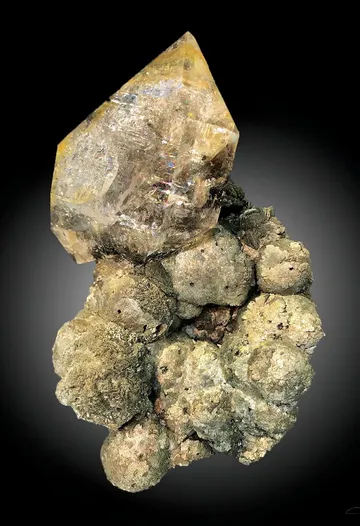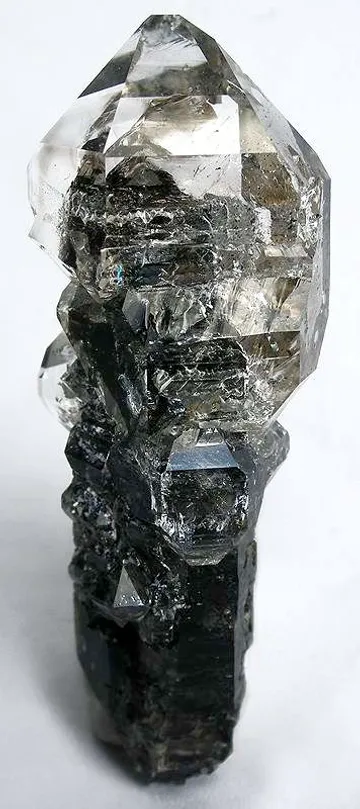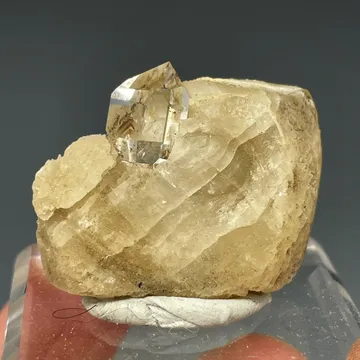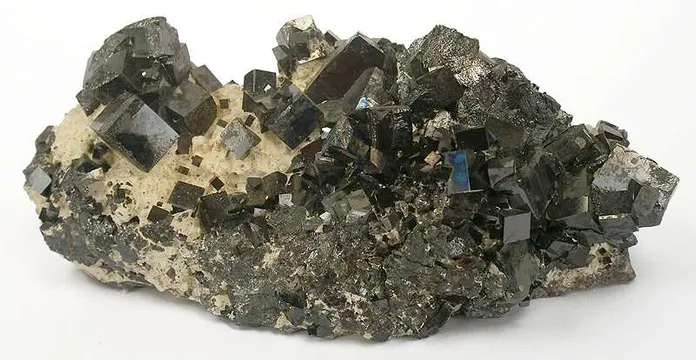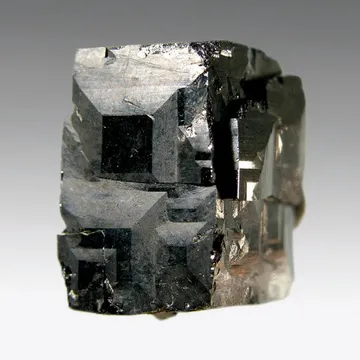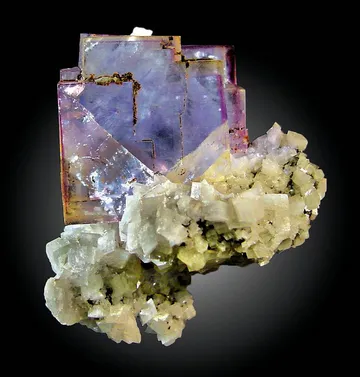
Penfield, USA — a classic Lockport Group locality famous for blue, glassy fluorite cubes on white saddle-dolomite, with diverse carbonate minerals in vugs.
Key facts
Penfield matters to collectors because it is one of the classic Lockport Group quarries of western New York: not an ore mine in the usual specimen-market sense, but an active crushed-stone operation whose vuggy Silurian dolostone has yielded a remarkably elegant suite of carbonate-hosted crystals. The locality known to collectors is the Penfield Quarry, or Dolomite Products Quarry, on Whalen Road in Penfield, just east of Rochester. Its best specimens come from solution vugs, fissures, stylolites, and cavities related to former corals and stromatoporoids in the Lockport dolostone. The quarry is famous above all for sharp, glassy fluorite cubes—usually pale blue to colorless, less often yellow, green, purple, or zoned—perched on bright white saddle-dolomite rhombs. The finest pieces have the clean architectural look collectors prize: an open pocket surface of pearly dolomite crystals, one or more isolated fluorite cubes standing clear of the matrix, and enough transparency to see zoning, phantoms, or internal veils in three dimensions.
Regional View
Country View
The locality’s importance is larger than fluorite alone. Penfield is a textbook collector’s example of low-temperature carbonate-hosted mineralization: dolomite, calcite, gypsum and selenite, celestine, sphalerite, galena, pyrite, marcasite, anhydrite, barite, quartz, strontianite, aragonite, and rare native sulfur have all been documented. The quarry has also played a role in regional stratigraphy. The Penfield exposure was used by Zenger as the type section of the Penfield Member, and later work on the quarry helped refine correlations of the Lockport Group in the Rochester area. To a collector, however, the appeal is immediate: blue-water-clear fluorite, white dolomite, amber-brown sphalerite, glassy selenite, and pale celestine in compact vugs cut from very hard gray dolostone.
Search for specimens: View all specimens from Penfield, USA
Penfield Quarry is a large active dolostone quarry in the Lockport Group at 746 Whalen Road, Penfield, Monroe County, New York. Older collector labels may read Penfield Quarry, Dolomite Products Quarry, Dolomite Products Co. quarry, or simply Penfield, Monroe County. The site has long been operated by Dolomite Products, now commonly associated with The Dolomite Group; modern business listings for the stone operation identify the Whalen Road Penfield stone office and scale office. The quarried rock is used as crushed stone, aggregate, road-paving material, road fill, landscape stone, asphalt, and related construction products rather than as a metal ore.
Geologically, the quarry exposes Silurian Lockport Group dolostone in the Rochester-area facies. Early field-trip guides described it broadly as dense gray Lockport Dolomite, hard, massive, petroliferous, and strongly bituminous when freshly broken. Later stratigraphic work resolved the exposure in greater detail: the quarry exposes a near-complete Lockport Group section and its contact with the underlying Clinton Group, including strata correlated with the DeCew, Gasport, Goat Island, and Eramosa intervals. Zenger’s Penfield Member at the quarry comprised about 19.2 meters, or 63 feet, of sandy dolostone and dolomitic sandstone, and later authors emphasized the sandy, quartz-rich Rochester-area character of the unit. The quarry walls and benches include massive to thick-bedded sandy dolostone, dolomitic sandstone, crinoidal grainstone lenses, biostromal beds, stylolites, vugs, and fossil-related cavities.
The specimen mineralization is not a single continuous vein system. It is a vug-and-fissure assemblage selectively developed in the upper parts and in particular horizons of the dolostone. Published field descriptions emphasize cavities ranging from small openings to vugs tens of centimeters across; one detailed guide noted collector minerals in vugs 20 to 50 cm in diameter at several horizons. Many cavities appear to have originated during dolomitization and solution, and some represent former coral or stromatoporoid heads. The paragenesis is expressed visually on specimens: white to pale pink dolomite rhombs line the cavity walls; calcite, sphalerite, galena, pyrite, marcasite, celestine, gypsum, selenite, anhydrite, quartz, and fluorite may follow or intergrow; and later clear gypsum can engulf earlier dolomite or celestine. Natural asphaltum and petroleum-like hydrocarbon residue are a recurring Penfield feature, appearing as black films, blobs, or greasy brown coatings in pockets.
The deposit has often been compared with Mississippi Valley-type mineralization because of its simple carbonate-hosted suite, sphalerite-galena-fluorite-calcite-dolomite associations, lack of nearby igneous source rocks, and open-space crystallization in limestone or dolostone. The precise heat source and fluid history have been debated for decades. Platt’s 1949 thesis argued for concentration of indigenous lead and zinc by circulating groundwater, citing the presence of lead and zinc throughout the Lockport dolostone and the enclosing shale barriers. Bassett and Kinsland later summarized the broader MVT comparison, while Kinsland’s 1977 fluid-inclusion work on Lockport fluorite indicated elevated formation temperatures on the order of 137 ± 5°C; a 1994 field guide described Penfield-area mineralization more generally as having occurred at roughly 150°C. For a specimen collector, the practical consequence of that history is a low-temperature open-space assemblage with unusually clean crystal growth rather than massive ore.
Mining and collecting history are intertwined. The quarry was developed as a crushed-stone operation and was already an established mineral locality by the time David E. Jensen published his 1942 account of minerals of the Lockport dolomite near Rochester. The Rochester Academy of Science, New York State Geological Association, and later mineral clubs repeatedly used Penfield as a teaching and collecting locality. By the 1950s and 1970s, field-trip guides treated it as a dependable source of dolomite, fluorite, gypsum, selenite, celestine, sphalerite, calcite, and minor sulfides. The best finds were never uniformly distributed: the quality varied dramatically as quarrying cut through favorable pocket zones. Fresh blasted boulders and newly exposed benches could be superb one year and nearly barren the next.
Historically, collecting access was by organized open houses or club field trips, not by casual entry. A 2017 field account describes collectors arriving before 7:00 a.m. for sign-in, welcome, and a safety meeting, then collecting from 7:00 a.m. until noon on a level set aside for the event. A 2018 Rochester Academy of Science notice required adults to wear hard hats, safety glasses, and sturdy footwear; children needed bicycle helmets, safety glasses, and close supervision; collectors were instructed to stay 20 feet back from walls and drop-offs and not to climb quarry faces. Power equipment was permitted at that event, but under safety restrictions. More recent public open-house notices from the operator have emphasized tours and family activities rather than specimen extraction, and at least one official Dolomite Group announcement explicitly stated that gem collection would not be allowed for safety reasons. Treat Penfield today as an active industrial quarry: no trespassing, no casual collecting, and no assumption of access unless the operator or an organized club has announced and approved a collecting event.
The notable finds that define Penfield are pocket pieces. Fluorite cubes on dolomite are the trophy form. Calcite occurs as white, yellow, or smoky scalenohedra, sometimes in large “dogtooth” crystals, and as clear rhombohedral microcrystals with marcasite on dolomite. Sphalerite appears as amber to reddish-brown tetrahedral or curved fan-like crystals and as fissure fillings. Celestine occurs as pale blue, white, or colorless elongate crystals, sometimes penetrating or enclosed by clear selenite. Gypsum ranges from massive white cavity fillings to optically clear selenite. The very best Penfield specimens preserve an intact vug surface with minimal blasting damage; loose single fluorite cubes can be beautiful, but the locality’s classic aesthetic is a gem cube still seated in its white dolomite-lined pocket.
Penfield fluorite is the locality’s signature mineral and is prized for isolated cubic crystals, high transparency, and pastel color on white dolomite. Published descriptions record crystals from sub-millimeter size to unusually large cubes approaching 10 cm on an edge, though most collected crystals are around 1–2 cm; Mindat’s locality data describe very clear crystals to 65 mm, most commonly colorless to pale blue and more rarely light green or yellow. Earlier field-trip notes add blue, purple, yellow, green, and colorless examples, with frequent color zoning and some highly etched faces or negative cavities. The finest pieces show a free-standing cube or cube group in a dolomite-lined vug, ideally with minimal bruising to the corners and enough clarity for internal zoning to show; ordinary pieces tend to be incomplete, cleaved, etched, detached from matrix, or lost visually against gray dolostone rather than framed by bright white saddle dolomite.
Other documented minerals from Penfield make the locality far more than a one-species fluorite occurrence. Dolomite is abundant as white to pale pink curved rhombs lining pockets, commonly 0.5–1 cm and forming the matrix for better fluorites. Calcite is a major collectible species, occurring as white, yellow, or smoky scalenohedra—reported up to 15 cm in older guides and to 9 cm in later compiled locality records—as well as clear rhombohedral microcrystals. Gypsum and selenite are important, from massive white fillings to transparent cleavable masses that can envelop celestine and dolomite; some clear selenite has been described as optical quality. Celestine forms white to pale sky-blue lath-like crystals or groups, in some cases several centimeters long and sometimes embedded in clear selenite. Sphalerite is the best sulfide, ranging from small brilliant amber crystals to larger dark amber or reddish-brown groups, with published examples up to about 2.5 cm. Galena is rare, generally as fissure fillings and only rarely as free-standing cubes. Marcasite forms tiny bronze to black bristles, blades, or cockscomb groups on dolomite and calcite and has historically been misidentified as rutile; pyrite forms tiny cubes and pyritohedra. Anhydrite, barite, aragonite, quartz, strontianite, and rare native sulfur round out the suite. No valid mineral species is known to have Penfield Quarry as its mineral type locality, but the quarry is scientifically notable as the type section of the Penfield Member/Formation in regional Lockport Group stratigraphy.
The first authenticity issue is locality precision. “Penfield” should mean Penfield Quarry/Dolomite Products Quarry in Monroe County, New York, not a generic western New York dolostone fluorite. Similar fluorite-dolomite-calcite-selenite assemblages occur at other Lockport Group quarries, especially Walworth and Lockport-area localities, and dealer labels may be shortened or confused. Penfield fluorite tends to be colorless to pale blue, commonly cubic and very transparent, often on white dolomite; Walworth and other regional pieces can be similar enough that old labels and provenance matter.
No well-documented treatment or manufactured-fake problem is associated with Penfield fluorite in the specimen literature, but condition is a major concern. Fluorite has perfect cleavage, and quarry blasting plus extraction from very hard dolostone commonly leaves chipped corners, bruised edges, cleaved faces, or detached crystals. Etching can be natural and locality-typical, so an etched back or modified corner is not automatically damage, but clean undamaged cubes on matrix are much rarer than loose or bruised crystals. High-grade Penfield specimens should be evaluated under strong light from several angles: look for corner repairs, glued reattachments, filled cleaves, and matrix trimming that has removed the vug context.
Hydrocarbon residue is another locality-specific handling issue. Bituminous coatings, asphaltum, or greasy brown-black films can be original pocket material, not dirt. Older guides noted that petroleum-like residue could sometimes be removed from greasy minerals with very hot water, but cleaning should be conservative: hot water can stress fluorite, loosen repairs, or damage associated gypsum, and solvents can alter labels, adhesives, or fragile secondary coatings. Selenite and gypsum are soft and easily scratched or cleaved; marcasite and pyrite microcrystals should be kept dry and stable because iron sulfides can deteriorate in humid conditions. Avoid acid cleaning unless you know exactly what is present: calcite and dolomite are central to the aesthetics and will be attacked, and the difference between colorless calcite rhombs, dolomite rhombs, selenite, barite, and celestine may not be obvious on a mixed Penfield plate.
Penfield fluorite is available on the market, but fine examples are not common. Small loose cubes and modest matrix pieces appear periodically, while large undamaged gem cubes on white dolomite, especially with old local collection provenance, are legitimately scarce. Specimens from the Bob Hiler, Charles Hiler, Lloyd Tate, William Pinch, and other regional collections carry added interest because those collectors were close to the Rochester-area Lockport Group tradition and some of their pieces have been published or exhibited. As access has narrowed and active-quarry collecting has become more restricted, the market has increasingly depended on older collections, show dispersals, and small dealer inventories rather than fresh production.
A Penfield collecting morning began early. At the 2017 open house, collectors were asked to arrive before 7:00 a.m. at the Whalen Road quarry, sign in, hear the official welcome, and sit through the safety talk before descending into the collecting area. The actual collecting window ran only from 7:00 a.m. until noon. That five-hour clock shaped the day: hard hats or bicycle helmets, eye protection, no sandals, and a scramble over blasted gray dolostone searching for the telltale broken edge of a vug. The reward was not a vein you could follow but a pocket you happened to open—a cavity lined with white dolomite and, if fortune held, a transparent cubic fluorite “sitting in a vug,” as Fred Haynes put it.
Penfield’s rock has a reputation among collectors for being unforgiving. Haynes’ field note is blunt: “The dolostone rock is hard, no, it is very hard!” Rock hammers and chisels were only the beginning; larger sledges were better, and ordinary household hammers were unsafe because they could break before the rock did. That hardness explains why so many Penfield specimens show sawn backs, trimmed bases, or bruised extraction points. The pockets can be delicate, but the enclosing rock is industrial aggregate—dense, tough, and built to become road metal.
The quarry has also produced surprises outside the mineral cabinets. A 1994 New York State Geological Association guide noted that the Gates Member in a sump pit near the western edge of the quarry yielded a spectacular occurrence of more than 1,000 complete crinoids of Dimerocrinites. That discovery belongs to the fossil record rather than the fluorite market, but it captures what makes Penfield scientifically rich: the same working quarry that sends crushed dolostone to roads has exposed fleeting windows into Silurian seafloor communities, dolomitization, vug formation, hydrocarbon migration, and later mineralizing fluids.
The human collecting story is just as important. Bob Hiler grew up on a fruit farm in Penfield and collected the quarry for much of his life; a 2017 account notes that his western New York fluorites were featured in Mineralogical Record’s Mineral Collections in the American Northeast. One illustrated Hiler specimen from Penfield was a 3.8 cm fluorite cube resting on white dolomite—a perfect summary of the locality’s aesthetic. Another Penfield fluorite photographed by Jeff Scovil and later recorded on EarthWonders measured 4.1 cm and was published in Mineralogical Record. These are not giant crystals by world fluorite standards, but for Penfield they are the kind of pieces that define a collection.