Benchmark Quarry, USA — notable eastern Herkimer-style locality in Cambrian dolostone; quartz pockets with doubly terminated crystals, calcite, and marcasite.
Key facts
Benchmark Quarry, at St. Johnsville in Montgomery County, New York, is one of the important collector localities on the eastern side of the Herkimer diamond district. Although it lies outside Herkimer County proper, it works the same vuggy Little Falls Dolostone that made the Mohawk Valley famous for brilliant, doubly terminated quartz. For collectors, Benchmark matters because it is not simply another “Herkimer” name on a label: it is a hard-rock aggregate quarry that has exposed fresh, unweathered vertical sections through mineralized dolostone, with quartz pockets, dolomite-lined cavities, calcite, marcasite, pyrite, and black pyrobitumen forming a compact but highly distinctive assemblage.
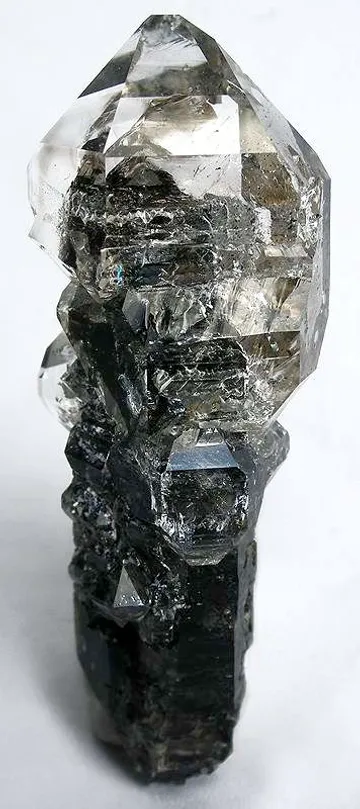
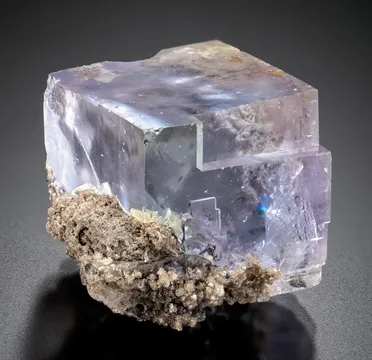
The deposit is a vug-and-fracture system in Cambrian dolostone rather than a vein mine in the usual ore-mining sense. The productive cavities occupy porous beds, bedding-plane openings, and vertical fracture zones in the Little Falls Dolostone. The quartz occurs as “Herkimer-style” crystals: bright, sharp, doubly terminated, commonly colorless but sometimes smoky, and often enlivened by black hydrocarbon inclusions or by tiny sulfide inclusions. The best pieces are not loose tourist-field singles; they are balanced matrix specimens in which a glassy quartz crystal stands on pale dolomite or gray dolostone, sometimes with amber calcite and glittering marcasite adding contrast.
Regional View
Country View
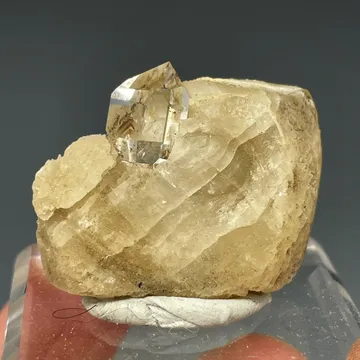
Benchmark’s reputation rests on quality more than quantity. The documented specimen suite is small compared with the great public Herkimer diggings near Middleville and Little Falls, but it includes striking combinations: smoky skeletal quartz, colorless doubly terminated quartz with black pyrobitumen, quartz capped by calcite, large amber calcite with marcasite needles, and attractive dolomite-rich matrices. A Benchmark label is especially meaningful when the piece preserves matrix, because the quarry’s hard blasting rock and pocket geometry make undamaged matrix specimens much less common than loose crystals.
Search for specimens: View all specimens from Benchmark Quarry, USA
Benchmark Quarry is recorded mineralogically as Benchmark Quarry, St. Johnsville, Montgomery County, New York, USA. The mapped position is just west of St. Johnsville in the Mohawk Valley, close to the Herkimer–Montgomery county line. In the industrial record the operation appears as the St. Johnsville or West St. Johnsville quarry, a dolomite aggregate source associated historically with Hanson Aggregates New York and, under the current corporate branding, Heidelberg Materials. New York State transportation and environmental records list the St. Johnsville source as a dolomite aggregate operation used for crushed stone, stone fill, riprap, asphalt, and related construction products.
The host unit is the Little Falls Dolostone, a Cambrian carbonate formation exposed along the Mohawk Valley. It is a thick-bedded, gray to buff-weathering dolostone with local quartzose beds, chert, stromatolitic structures, vugs, and hydrocarbon-bearing cavities. At the district scale, the quartz crystals known as Herkimer diamonds occupy openings in this dolostone. The classic pocket walls are commonly lined first by dolomite or drusy quartz, then by later quartz, calcite, sulfides, and black solid hydrocarbon material. At Benchmark the assemblage is notably clean and compact: quartz, dolomite, calcite, marcasite, pyrite, and pyrobitumen are the central verified minerals.
There are no ore bodies in the mining-company sense. Benchmark is an aggregate quarry, not a metal mine; the “ore” for commerce is the dolostone itself. For mineral collectors, however, the important mineralization is concentrated in vugs and fracture-controlled pockets. Collector documentation from the Herkimer district describes the Hanson-Benchmark exposure as unusually valuable because it shows vertical fracture zones and pocket development in fresh quarry walls. Where a vertical vein or fracture intersects a porous bed, a pocket may open along that plane. Some photographed Benchmark pockets show dolomite-lined walls, brown marcasite concentrations on the pocket floor, and mineralized fractures continuing above and below the cavity.
Mining records show the St. Johnsville quarry active as a permitted New York mined-land and air-permitted facility in the early 2000s, with later permits and source approvals continuing under Hanson Aggregates and then the Heidelberg Materials name. The quarry is not a public fee-dig Herkimer operation. Collecting access should be treated as closed unless explicit permission is obtained from the owner or operator. This point is important: Benchmark material in collections generally represents old-stock, exchanged, or limited-access quarry material, not specimens that visitors can legally collect on a casual trip.
Notable finds from Benchmark include sharp Herkimer-style quartz to at least several centimeters, quartz on matrix with dolomite and sulfides, smoky skeletal crystals, calcite-on-quartz combinations, and cabinet-scale amber calcite crystals included by marcasite needles. Older dealer and collection records repeatedly connect attractive Benchmark specimens with well-known New York collections, including material that passed through the Bill Hladysz, Robert Nowakowski, Blake Barnett, Michael J. Lundquist, and John Betts spheres of collecting. The locality is especially strong for combination specimens in which the Herkimer-style quartz is not isolated, but placed naturally among saddle dolomite, honey calcite, marcasite, and gray dolostone.
Benchmark quartz is the locality’s headline mineral: sharp, glassy, doubly terminated “Herkimer-style” SiO2 from vugs in the Little Falls Dolostone. Verified specimens include clear colorless crystals with black pyrobitumen inclusions, smoky skeletal quartz, quartz included by pyrite, quartz associated with dolomite and marcasite, and quartz partly capped or bridged with calcite. Size varies from small thumbnail crystals to showy pieces with individual crystals around 5 to 6 cm, with larger-looking specimens valued especially when the quartz remains naturally attached to dolostone or dolomite-rich matrix. The strongest Benchmark pieces are bright and undamaged, with crisp terminations, mirrorlike faces, good transparency, and enough matrix or associated calcite/marcasite to distinguish them from anonymous loose Herkimer singles.
Benchmark dolomite is more than host rock: it is an important pocket-lining and specimen-building mineral, commonly forming pale to white or tan rhombs and saddle-textured crystals on gray dolostone matrix. Collector studies of the Herkimer district single out the Hanson-Benchmark quarry for especially good second-phase dolomite, the opaque stepped or saddle-form dolomite that contrasts with earlier tiny clear rhombs. On Benchmark specimens it forms the sparkling to granular crystalline base for Herkimer-style quartz, honey calcite, and marcasite, and it is most desirable when it is fresh, lustrous, and texturally distinct rather than merely a dull buff coating. The best dolomite pieces from the quarry are judged by crystal definition, freshness, and the way the dolomite frames associated quartz or calcite without overwhelming the composition.
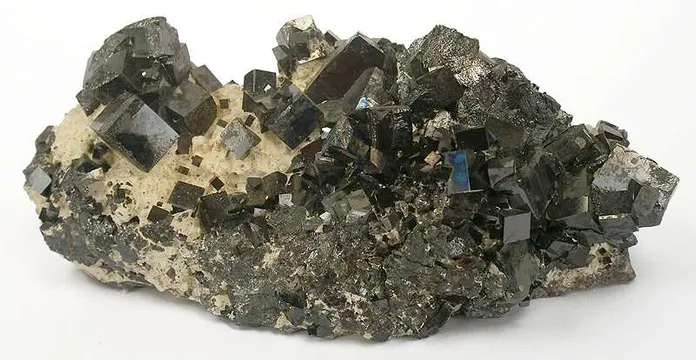
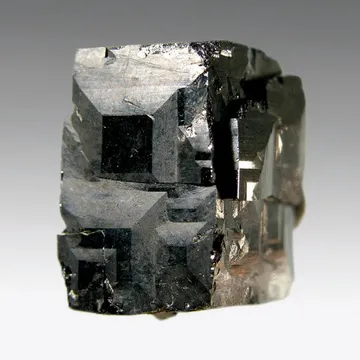
Other verified minerals from Benchmark Quarry include calcite, marcasite, pyrite, and pyrobitumen. Calcite is the most important companion species, appearing as amber, yellow-brown, translucent nailhead to rhombohedral crystals, sometimes large for the district and locally included by fine marcasite needles. Marcasite occurs as needles, sprays, drusy coatings, and larger crystals, including inclusions in calcite and, more rarely, associations with quartz. Pyrite is less conspicuous but documented. Pyrobitumen is central to the Herkimer character of the locality: black inclusions, coatings, and pocket fillings connect the Benchmark suite to the hydrocarbon-rich paragenesis of the wider Mohawk Valley. Benchmark is not known as a type locality; its rarities are not new species, but unusually fresh examples of pocket textures, hydrocarbon-bearing quartz, calcite-marcasite combinations, and fracture-controlled Herkimer mineralization.
Benchmark specimens should be bought for locality integrity as much as for sparkle. Loose Herkimer-style quartz crystals can be difficult to assign confidently without an old label, and “Herkimer diamond” is widely misused for doubly terminated quartz from outside New York, especially petroleum-bearing quartz from Pakistan and Afghanistan. For Benchmark material, the best labels should specify Benchmark Quarry, St. Johnsville, Montgomery County, New York, USA, not merely “Herkimer diamond” or “St. Johnsville.” Matrix association helps: gray dolostone, pale dolomite rhombs, amber calcite, marcasite, pyrite, and black pyrobitumen are all consistent with the documented Benchmark assemblage.
The major condition issue is breakage from extraction. The Little Falls Dolostone is hard, and quarry specimens commonly suffer bruised quartz points, cleaved calcite, broken pocket margins, or detached-and-repaired crystals. Reattachment is a known issue in the broader Herkimer market because crystals can pop loose from matrix during collecting, trimming, or cleaning. Repairs are not automatically disqualifying when disclosed, but undisclosed glued quartz-on-matrix pieces should be treated skeptically. Examine around the base of matrix-mounted quartz with a loupe and longwave or shortwave UV if available; many modern adhesives fluoresce or show bubbles, meniscus edges, or glossy bridges unlike natural hydrocarbon or carbonate contacts.
Calcite from Benchmark may fluoresce under shortwave UV, as documented on at least one dealer-recorded quartz-calcite-dolomite specimen, but fluorescence should be treated as an accessory observation rather than a diagnostic locality test. Marcasite deserves more care. Fresh marcasite can be attractive and stable in a dry cabinet, but iron sulfides from carbonate pockets may oxidize if stored in humidity. Keep Benchmark marcasite-bearing pieces dry, avoid washing them repeatedly, and do not leave them in foam-lined boxes where moisture and acids can accumulate. Pyrobitumen and black hydrocarbon inclusions are normal for the locality; they should not be cleaned away, because they are part of the geological story and can help distinguish true Mohawk Valley material from generic double-terminated quartz.
Market availability is limited. Benchmark appears regularly enough to be recognized by serious New York collectors, but not in the volume of classic public Herkimer dig material. Attractive quartz-on-matrix pieces, fine calcite-marcasite combinations, and old-collection specimens command more attention than loose small crystals. Ordinary single quartz crystals from the district are common; well-labeled Benchmark combinations with undamaged quartz, lustrous dolomite, amber calcite, and clean sulfide accents are the specimens to wait for.
The most vivid Benchmark story is written in the quarry wall itself. At Hanson-Benchmark, collector-researchers documented a fresh vertical exposure through the mineralized dolostone—a rare chance in the Herkimer district, where many collecting sites are low, weathered, or worked from broken rock rather than from a tall, clean quarry face. In one photograph, a seated man was used for scale beside the vertical mineralized section. Fracture zones could be traced upward from pockets into multiple veins, showing how the cavities were not random holes but part of a structural plumbing system.
One Benchmark pocket became especially useful for understanding pocket geometry. A vein could be followed from point 1 to point 2 for about 3 feet. Where it intersected a porous layer, the opening widened into a planar pocket following the fracture. The walls were lined with dolomite crystals, while brown marcasite gathered along the bottom. That one pocket explains much of what collectors see in hand specimens: dolomite as the lining, sulfide as the sparkling or brownish late accent, and quartz occupying the open space where the crystal could grow freely enough to become doubly terminated.
Another photographed Benchmark example showed a collapsed pocket associated with vertical structures above and below it. A ladder and crowbar in the image gave scale, and a nearby breccia was highlighted as part of the same fracture-and-fluid story. In a locality where the finished specimens can look jewel-like and almost delicate, those field photographs restore the violence and scale of the host rock: hard dolostone broken by fractures, pockets opened along planes, breccia cemented after movement, and mineralizing fluids threading through a carbonate platform long after its Cambrian sedimentary origin.