Treasure Mountain Diamond Mine, USA — renowned for doubly terminated scepter-bearing Herkimer quartz with dark, hydrocarbon-included stems and vug crystals.
Key facts
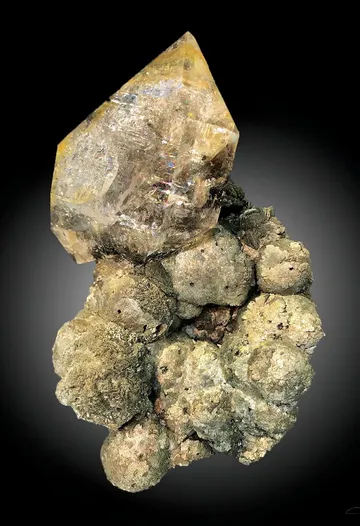
Treasure Mountain Diamond Mine at Little Falls, Herkimer County, New York, is one of the defining collector localities for the unusual scepter-bearing end of the Herkimer quartz district. The “diamonds” here are not native carbon diamond; they are brilliantly lustrous, naturally faceted, doubly terminated quartz crystals, SiO2, developed in vugs and pockets in the Late Cambrian Little Falls Dolostone. What elevates Treasure Mountain above an ordinary Herkimer-dig locality is its reputation for black-stemmed scepters: dark, hydrocarbon-rich early-growth quartz or bituminous cores capped by clear, glassy Herkimer-style quartz. Good specimens can look almost constructed—an inky shaft or smoky included stem carrying a water-clear quartz “head,” often with dolomite, calcite, marcasite, or pyrobitumen still present as matrix or inclusions.
The locality sits in the Mohawk Valley’s classic Herkimer environment, where dolostone, sandy dolostone, stromatolitic horizons, solution cavities, late carbonate mineralization, sulfides, and carbonaceous matter all become part of the collecting story. The best Treasure Mountain pieces have the crispness collectors expect from Herkimer quartz, but with locality-specific architecture: doubly terminated scepters, “barbell” forms, black hydrocarbon-included crystals, clear caps over dark stems, and occasional matrix pieces that preserve the vug context rather than merely presenting loose crystals. The mine is also historically important because its scepters were important enough to receive a dedicated Rocks & Minerals article in 2000 and to appear in the literature and collector market as one of the named Little Falls sources for rare Herkimer forms.
Regional View
Country View
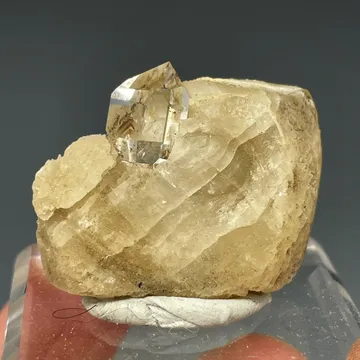
The most desirable Treasure Mountain specimens are not simply “clear Herkimers.” They are pieces with locality personality: a visibly included dark stem, a transparent cap, a complete doubly terminated form, and enough contrast to read across the case. Matrix examples are scarcer and more telling. When a sharp crystal remains attached to dolostone, etched dolomite, tabular calcite, or glittering marcasite microcrystals, the specimen records the pocket sequence and becomes much more than a loose gemstone-like quartz crystal.

Photo: Diamond Mountain Mining
Search for specimens: View all specimens from Treasure Mountain Diamond Mine, USA
Treasure Mountain Diamond Mine is recorded from Little Falls, Herkimer County, New York, within the Herkimer diamond belt of the central Mohawk Valley. Its host is the Little Falls Dolostone, the vuggy Late Cambrian carbonate unit famous for producing naturally doubly terminated quartz crystals. At Little Falls the formation is a dolostone-dominated succession with sandstone and mixed dolostone-sandstone beds, algal stromatolitic intervals, chert, glauconite, silicified ooids, late calcite, and abundant cavity development in the productive horizons. The collector’s target is not an ore body in the metallic-mining sense but a discontinuous system of vugs, pockets, solution cavities, fractures, and pocket tables within tough dolostone.
The quartz mineralization is best understood as late diagenetic to low-temperature hydrothermal cavity filling. Productive pockets may contain loose crystals in mud, crystals attached to pocket walls, dolomite or calcite lining, black carbonaceous material, and pyrite or marcasite. In the broader Herkimer district, fluid-inclusion and paragenetic studies have tied crystal growth to saline waters, carbonaceous residues, and burial-related circulation through the carbonate sequence. In practical collecting terms, the miner is looking for cavity structure and carbon-bearing zones: places where the rock has opened, dissolved, and then received silica-bearing fluids capable of growing free quartz crystals.
Treasure Mountain’s special fame rests on scepter quartz. In the classic Little Falls style, an earlier dark stem—commonly blackened by anthraxolite, pyrobitumen, or other hydrocarbon inclusions—was overgrown by clearer quartz, producing a striking scepter. Some examples show a distinct black rod or smoky first-generation crystal visible through the later cap; others are more heavily included and approach the “black diamond” trade style. The best pieces display the internal stem cleanly through transparent quartz, with the cap complete, lustrous, and doubly terminated. Matrix scepters with calcite or dolomite are rarer than loose crystals and carry a premium when the composition is natural and visually balanced.
The mining history is unusually tangled because “Treasure Mountain,” “Diamond Mountain,” and nearby Little Falls Herkimer operations overlap in collector literature, specimen labels, and later ownership narratives. Green Gem Company records acquiring a Herkimer diamond mine in Little Falls in 1997 and identifies Treasure Mountain Diamond Mine as its Little Falls, Herkimer County source, famous for black-stemmed sceptered Herkimer diamonds. The same source notes that a specimen from its Herkimer mine was featured on the July/August 2000 cover of Rocks & Minerals, with an accompanying article by Bob Borofsky. Later public-facing history from the region credits Dino Zampini and Bob Borofsky with developing Treasure Mountain Diamond Mine, while modern Little Falls collecting access is now most visibly represented by Diamond Mountain Mining, a reservation-based collector mine that promotes the same suite of black-stemmed scepters, barbells, skeletal crystals, hydrocarbon-included quartz, and classic clear Herkimer-style crystals.
Access today should be treated as private-property access, not casual open land. Historic labels reading “Treasure Mountain Diamond Mine” identify a specific and collectible Little Falls source, but anyone hoping to dig in the Little Falls Herkimer belt should verify the current operator, address, rules, reservation requirements, tool restrictions, age limits, and seasonal schedule directly before traveling. Modern Diamond Mountain Mining advertises reservation-only digging on Little Falls Herkimer-bearing property, with hand tools permitted in its public digging program and commercial mining areas handled separately. Serious collectors should never assume that an old Treasure Mountain label or an old fee-dig address still grants access.
Notable finds from the locality include black-stemmed scepters around the 3–5 cm range, larger scepters that are exceptional for the style, clear caps over smoky or black included stems, and matrix specimens showing quartz with calcite, dolomite, marcasite, and pyrobitumen. One documented Mindat specimen is a 4 cm scepter with the stem termination visible through a clear cap. Another shows a 33 mm black-stemmed scepter with attached calcite, the stem composed of multiple parallel-growth quartz crystals visible through the transparent cap. A prominent market-recorded matrix specimen measured 11.5 x 7.8 x 7.6 cm overall and carried a 6.5 x 5.9 x 5.7 cm Herkimer-style quartz crystal on silicified shale with dolomite rhombs and marcasite microcrystals. The truly elite Treasure Mountain pieces are those that combine size, completeness, strong black-and-clear contrast, and unambiguous locality provenance.
Quartz from Treasure Mountain Diamond Mine is the locality’s essential mineral and its whole reason for being known: naturally lustrous Herkimer-style SiO2 in vugs of Little Falls Dolostone, ranging from small loose doubly terminated crystals to miniature and cabinet scepters, matrix pieces, black hydrocarbon-included “diamonds,” and rare barbell-like growths. Ordinary pieces are clear to slightly smoky loose crystals with the familiar short-prismatic, double-ended Herkimer form; better Treasure Mountain specimens show a clear cap over a black or smoky included stem, a complete scepter habit, visible internal growth generations, and undamaged terminations. Matrix examples with etched calcite, dolomite rhombs, marcasite, or pyrobitumen are especially desirable because they preserve the pocket context. The strongest specimens have glassy luster, high transparency in the cap, sharp rhombohedral terminations, and a dark stem that is not merely a surface stain but a real included or early-growth feature visible inside the crystal.
“Diamond” on Treasure Mountain labels must be read in the historic Herkimer sense, not as native carbon diamond: the collectible material is quartz called Herkimer diamond because of its brilliance, clarity, hardness, and naturally faceted doubly terminated habit. No verified native diamond occurrence is documented for Treasure Mountain in the standard mineral locality records; the scientifically correct species for these “diamonds” is quartz, SiO2. At this locality, the term is most often attached to water-clear to smoky doubly terminated crystals, black hydrocarbon-included “black diamonds,” and especially black-stemmed sceptered Herkimer diamonds. Good “diamond” examples from Treasure Mountain are complete, sharply lustrous, transparent, and clean enough to show their internal architecture; the most locality-specific pieces display a water-clear Herkimer-style cap perched on or enclosing a darker hydrocarbon-rich stem.
Other documented minerals at Treasure Mountain are the pocket companions that make the quartz more intelligible: calcite, dolomite, marcasite, pyrite, goethite, glauconite, and pyrobitumen. Calcite occurs as late pocket filling and as tabular to rhombohedral crystals, sometimes etched away to expose quartz and dolomite. Dolomite may form small rhombs or lining crystals on matrix. Marcasite and pyrite appear as sulfide accessories and inclusions, including marcasite rods or microcrystalline fields on matrix pieces. Pyrobitumen and related anthraxolite-like carbonaceous material are central to the locality’s visual identity, producing black inclusions, dark stems, and the dramatic contrast that separates Treasure Mountain scepters from ordinary Herkimer quartz. Glauconite is recorded as small light blue to green balls in fine-grained sedimentary rock, tying the occurrence to the sedimentary mineralogy of the Little Falls Dolostone rather than to any igneous diamond-bearing setting. No type-locality mineral species is known from Treasure Mountain.
The first authenticity issue is nomenclature. Treasure Mountain “diamonds” are quartz, not diamond. Serious labels should say Quartz, var. Herkimer diamond, or Quartz var. scepter quartz from Treasure Mountain Diamond Mine, Little Falls, Herkimer County, New York, USA. A label that simply says “diamond” is mineralogically misleading unless the seller is clearly using the Herkimer trade name and not claiming native carbon diamond.
The second issue is locality substitution. Doubly terminated quartz occurs worldwide, and petroleum- or carbon-included quartz from Pakistan, Afghanistan, China, and other localities can be sold in ways that confuse casual buyers. Treasure Mountain material should have a Little Falls provenance and, for better pieces, preferably an old collection label, dealer history, or direct mine-source documentation. The black-stemmed scepter habit is a powerful locality clue, but it is not a substitute for provenance.
Condition matters intensely. Herkimer-style quartz is hard but brittle; terminations chip, edges bruise, and matrix can be fractured by extraction. A repaired or reassembled Herkimer cluster may still be attractive, but repair should be disclosed. Matrix pieces should be examined for glued crystals, trimmed matrix, repaired calcite, and artificial repositioning. On scepters, inspect the junction between stem and cap: natural growth should be continuous and convincing, not a modern adhesive join between unrelated crystals.
Hydrocarbon inclusions are not dirt or damage. Black specks, rods, clouds, and films can be normal and desirable in Treasure Mountain material, especially when they reveal an early growth stage or create the black-stemmed scepter effect. However, greasy pocket residue, iron staining, dull etching, bruised faces, and broken-off stems reduce value. A heavily black included crystal can be desirable as a “black diamond” style piece if it is complete and lustrous, but the finest scepters balance darkness in the stem with transparency in the cap.
Fluorescence is not the main buying criterion for Treasure Mountain quartz, but associated calcite and dolomite may respond under ultraviolet light. Handle sulfide-bearing pieces with reasonable care: marcasite can be unstable in some environments, especially if stored damp, and should be kept dry with good air circulation. Avoid ultrasonic cleaning for fractured crystals, included scepters, repaired pieces, and matrix specimens with calcite or sulfides. For cleaning pocket clay or residue, slow soaking, soft brushing, and patience are safer than aggressive acids or vibration.
Market availability is tiered. Small loose Herkimer-style crystals from the district are common, but correctly attributed Treasure Mountain scepters are much scarcer. Fine black-stemmed scepters, large complete scepters, gem barbells, skeletal forms, and matrix pieces with quartz plus calcite, dolomite, marcasite, or pyrobitumen are connoisseur-level specimens. The best examples are usually already in specialized Herkimer collections and appear only sporadically through fine-mineral dealers, auctions, or directly from mine-associated sources.
The modern story begins with a very old collecting impulse: people noticed bright crystals weathering from the Little Falls hills long before Herkimer diamonds became a tourist-mining brand. By the time Treasure Mountain entered the fine-mineral literature, collectors had already learned that Little Falls was not merely another place to find clear quartz. It was a place where the crystals could become architectural—dark rods, black cores, and scepters capped by transparent quartz.
Green Gem Company’s account places its Little Falls Herkimer mine in the company’s hands in 1997, after earlier success with the William Wise Fluorite Mine in New Hampshire. In that telling, Treasure Mountain became the New York half of a vertically integrated gem business: the owners mined the quartz themselves, faceted selected rough, and set the stones in jewelry. But the collector world noticed the mineral specimens first. A Herkimer specimen from the mine was important enough to appear on the July/August 2000 cover of Rocks & Minerals, accompanied by a feature article by Bob Borofsky. For a locality built on pockets and hand work, a journal cover is a kind of coronation.
The scepters were the key. Treasure Mountain’s signature image is a black stem with a clear Herkimer cap perched on top—so visually peculiar that even seasoned quartz collectors stop and look. One documented specimen is only 4 cm, yet its appeal is precisely that the stem’s own termination can be seen through the transparent cap. Another, 33 mm long, carries an attached calcite crystal; the black stem consists of multiple parallel-growth quartz crystals, and its termination is visible through the prism face of the clear cap. These are small objects, but they tell a long growth story in miniature: first a dark, included generation, then a clearer quartz overgrowth, all sealed inside a carbonate pocket.
In the collector market, the dramatic pieces earned their own mythology. A major 12.0 x 8.7 x 6.8 cm scepter from Treasure Mountain, described as complete, pristine, and about 5 inches tall, was remembered as far beyond the usual “inch or so” size expected for a good scepter. It was shown publicly in the 2008 American Treasures Exhibition at Tucson, among a small selection of pieces representing top American localities, and later surfaced with provenance through the Bill Metropolis collection, George Elling, David Daniel, and The Arkenstone. For a Herkimer scepter, that is serious mineral-world pedigree.
The modern Little Falls collecting landscape added another chapter when Larry Michon, a CPA and longtime rockhound, began searching in 2016 for Herkimer-bearing land of his own. According to Diamond Mountain’s account, he did not find a modest backyard claim. He found a large property with a stately old house and a local nickname that sounds made for a mineral story: “The Million Dollar Mountain.” The property had already been explored in small renegade digs, and machinery first worked it in 2015, revealing the quality of the crystal-bearing ground. Michon’s decision point was the collector’s dilemma writ large: keep the ground private and mine the best pieces quietly, or let other diggers experience the chase.
By 2022, local reporting found the Little Falls operation drawing reservation-based rockhounds from as far away as Colorado, Arizona, and Canada. Deena Bak, then director of sales, marketing, and programs, described the black-stemmed scepters as “the rarest of the rare,” explaining that they are crystals grown on top of a rod of solidified hydrocarbon surrounded by quartz. The same article gives a wonderfully unromantic glimpse of what happens after a pocket is opened: specimens must be washed, soaked, sorted, graded, trimmed, and sometimes repaired before they can enter the market. That is the hidden labor behind the glittering “diamond” in a display case.
The mine’s own advice to diggers is refreshingly honest. Herkimer mining is not a guaranteed harvest; the crystals occur in pockets, and the productive horizon has hot zones and dead zones. The operator compares it to a “crystal casino,” a phrase every Herkimer digger understands after a day of swinging tools into dolostone. One person may go home with a few small gems, another with nothing, and a lucky or skilled digger may hit a pocket. The thrill of Treasure Mountain and the Little Falls ground is exactly that uncertainty: under an ordinary-looking slab of dolostone, there may be only mud—or a black-stemmed scepter that no one has seen since it grew in the dark.