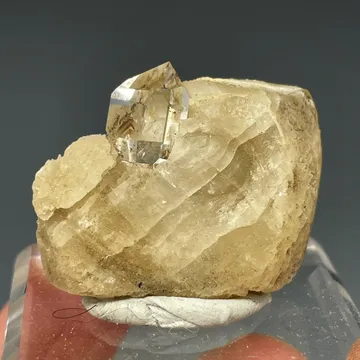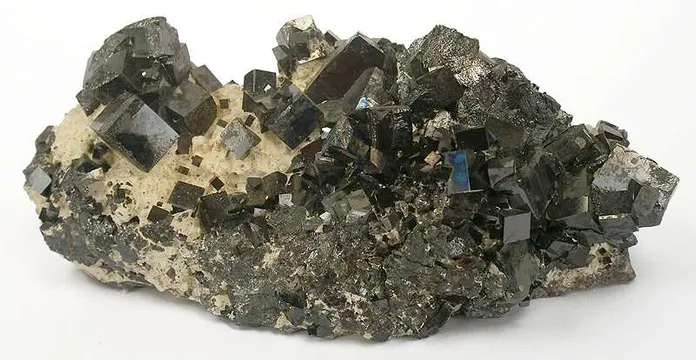
Balmat, USA: renowned zinc locality in the Adirondack Lowlands, yielding magnetite, sphalerite, calcite, and rare manganese minerals prized by collectors.
Key facts
Balmat is one of the great modern American zinc localities: a deep, active, metamorphosed ore district in the Adirondack Lowlands of northern New York where industrial mining and first-rank specimen recovery have repeatedly intersected. The locality sits in the Balmat–Edwards–Pierrepont zinc district, a Grenville-age marble belt of siliceous dolomitic and evaporite-bearing rocks that has been folded, faulted, metamorphosed, and remobilized almost beyond the limits of simple deposit diagrams. For collectors, that tortured history is exactly the point. It took originally stratiform zinc sulfide bodies, anhydrite-rich horizons, marbles, calc-silicate bands, shear zones, and late open spaces and turned them into a specimen suite with a look unlike the classic Mississippi Valley districts: jet-black cubic magnetite, gem yellow to amber sphalerite, lavender and pink calcite, purple anhydrite, halite-associated pockets, pyrite, quartz, galena, and rare manganese-arsenate and manganese-silicate species.
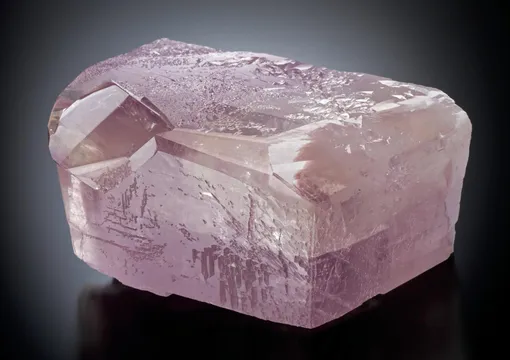
The mine’s collector reputation rests on several very different kinds of specimens. Older Balmat material includes blocky white calcite with baryte and chalcopyrite from the St. Joe No. 3 mine, yellow and brown sphalerite crystals from Balmat and related district workings, and cabinet-sized chunks of massive ore that record the district’s role as a major zinc producer. The 1991–1992 magnetite discovery from the Fowler orebody at ZCA No. 4 changed the locality’s standing for a common species: the Balmat magnetites are glossy, black, complexly modified cubic to tetrahexahedral crystals, often from halite- and talc-bearing assemblages, and are widely treated by collectors as among the finest crystallized magnetites known. More recently, finds from the Empire State Mine #4 have placed Balmat back in the center of the specimen market, especially the 2022–2023 pockets of purple, pink, peach, and lavender calcite and transparent gem sphalerite, followed by important anhydrite discoveries.
Regional View
Country View
Balmat is not a roadside collecting spot or a casual dig locality. Its finest specimens have come from operating underground zinc mines, historically through miners, mine geologists, company-approved recovery, and later distribution through knowledgeable dealers. That makes provenance unusually important: a label that names the specific mine, orebody, level, or pocket can add real interpretive value. “Balmat” may appear on labels for the hamlet, for individual St. Joe/ZCA/Empire State workings, or more broadly for material from the Balmat–Edwards district; the best labels narrow the locality to Empire State No. 4, ZCA No. 4, St. Joe No. 2 or No. 3, the Fowler orebody, New Fold, Lower Mahler, a level such as 2500, 3981, 3990, 4051, or 4075, or a named pocket such as the Bear Den.

Photo: Wikimedia Commons

Photo: Wikimedia Commons
Search for specimens: View all specimens from Balmat, USA
Balmat lies near Fowler and Gouverneur in St. Lawrence County, New York, in the northwestern Adirondack Lowlands. The zinc deposits are hosted in Proterozoic metasedimentary rocks of the Grenville Supergroup, especially siliceous dolomitic and evaporite-bearing marbles of the Upper Marble Formation. In simple collector language, this is a carbonate-evaporite zinc district that has been so thoroughly metamorphosed and deformed that the ore is not merely “in marble”; it is folded with marble, drawn along ductile faults, locally remobilized into shear zones and hinge zones, and in places associated with anhydrite, talc, tremolite, quartz, diopside, dolomite, calcite, and late open-space minerals.
The deposit has been interpreted in the literature as sedimentary exhalative to synsedimentary carbonate-hosted zinc-lead mineralization affected by later high-grade Grenville metamorphism. Sulfur, carbon, and oxygen isotope studies of the Fowler orebody and district concentrates were used to argue for an originally synsedimentary ore system, while later structural and petrographic studies emphasized extreme remobilization during metamorphism. Modern work on the Fowler orebody has described granoblastic ore and host rock, quartz-pyrite-rich domains, potassium-feldspar-rich domains, retrograde talc-rich domains, and evidence that small volumes of sulfide or sulfosalt-rich melt may have participated in ore remobilization during high-grade metamorphism.
The Balmat mine complex is structurally intricate. The No. 4 shaft area served the Fowler, Upper Fowler, Davis, and Mud Pond orebodies, with the Fowler orebody lying 1500 to 3500 feet northwest of the shaft and extending down-plunge for nearly 5000 feet, from about 1200 feet below surface to more than 3000 feet. The Fowler orebody has been divided into structural ore zones including Upper Limb, Horsetail, Cross-cutting, Lower Limb, and Upper Contact. The relatively simple ore mineralogy—sphalerite with pyrite, gray quartz, local galena, and gangue minerals—becomes texturally complex where the ore has been sheared, brecciated, recrystallized, or injected into cross-cutting structures. Horsetail ore was described as essentially massive coarse-grained sphalerite with very minor pyrite and quartz, while Upper Fowler ore includes fine- to medium-grained light chocolate-brown sphalerite in calcitic marble with abundant rounded inclusions that give classic Durchbewegung textures.
Mining history at Balmat spans more than a century of discovery, shutdown, acquisition, and restart. Zinc mineralization was reportedly discovered on the Balmat farm in 1838, near the later Balmat No. 1 shaft area. The district’s mine chronology begins in earnest in the early twentieth century: Edwards was discovered in 1908 and produced zinc beginning in 1915; Balmat No. 2 entered production in 1930; Balmat No. 3 was defined after surface drilling in 1945; and a systematic fence-drilling program across the Sylvia Lake Syncline discovered the Balmat No. 4 resource in 1965. St. Joe Minerals and predecessor companies operated in the district from 1915 to 1987, Zinc Corporation of America acquired the mines in 1987 and operated them until the 2001 shutdown, OntZinc/Hudbay acquired the idle Balmat assets in 2003, and Balmat No. 4 reopened from 2006 to 2008. Titan Mining’s Empire State Mines later restarted ESM #4 in January 2018; as of the company’s 2026 guidance, the operation is an active producing zinc mine with the ESM #4 mine feeding an onsite 5000 ton-per-day mill.
Production figures underscore why Balmat matters beyond the mineral cabinet. The Balmat #2, #3, and #4 mines have produced tens of millions of tons of zinc ore since 1930, and the larger Balmat–Edwards–Pierrepont district has produced more than 46 million tons grading over 9 percent zinc in historic and recent reporting. Yet the specimen story is highly selective. Open pockets are rare in a deep metamorphic ore system; most ore is massive, granular, or industrial. When voids did open, they were often mined through during production rather than carefully exposed for specimen recovery. The best pieces owe their survival to alert miners, mine geologists, and collectors with enough geological sense to recognize that a pocket in a zinc stope might hold material of national importance.
The classic magnetite find came from the Fowler orebody at ZCA No. 4. In 1991, during sphalerite mining, an altered zone of unusual mineralogy was encountered. Magnetite crystals occurred lining halite-filled veins with anhydrite, sphalerite, and calcite, and also locked in halite-talc matrix with pods of zoned massive sulfides. Labels and specimen records commonly place key pieces on the 2500-foot level. The best examples are glossy, sharply formed, complex cubic crystals and clusters, sometimes cabinet-sized, with forms that are far more intricate than ordinary octahedral magnetite.
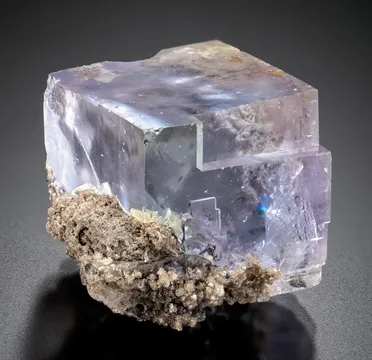
The modern calcite and sphalerite discoveries have centered on deep Empire State Mine #4 levels. In 2022, a 3981-foot-level New Fold pocket produced colorless, pink, and purple calcites, many as Rossie-habit twins with exceptional luster and transparency; the pocket was about 6 by 5 by 2.5 feet, worked through the summer and early fall, and later filled by mine personnel. A second comparable opening was encountered nearby on September 4. Another 2022 opening on the 3990 level, called the Bear Den, yielded yellow-brown to water-clear rhombohedral and twinned calcites. Sphalerite specimens from the New Fold area between the 3931 and 3971 levels included red, amber, black, and especially attractive yellow transparent crystals to several centimeters. In 2023, the 4051-level discovery surpassed the previous year’s finds: on June 8, miners opened the largest crystal pocket then known in Balmat’s history, recovering pale tan, pink, peach, lavender, and deeper purple calcite with rhombohedral, scalenohedral, highly modified, and Rossie-habit twinned forms. Subsequent market labels also record gem sphalerite with calcite from levels such as 3990, 3961, 4051, and 4075, with some pieces specifically tied to halite-rich boulders or deeper levels now no longer accessible.
Collecting access today is effectively closed to the public in the ordinary rockhounding sense. This is an active industrial underground zinc operation, not a fee dig. Legal specimens reach collectors through authorized mine-related recovery, former collections, museum deaccessions or exchanges, and established dealers. Pieces with fresh 2022–2024 provenance are legitimate modern mine-production specimens, but buyers should expect that the supply is episodic and controlled by mining conditions rather than by specimen demand.
Balmat magnetite is the locality’s most instantly recognizable classic: lustrous jet-black, predominantly cubic crystals with complex tetrahexahedral modifications, commonly from the Fowler orebody of ZCA No. 4 and especially associated with the early-1990s altered zone encountered during sphalerite mining. The best pieces came from halite-filled veins or halite-talc matrix with anhydrite, sphalerite, calcite, and zoned massive sulfides; collector labels often cite the 2500-foot level. Crystals range from sharp thumbnails around a centimeter or two to substantial cabinet specimens with individual crystals several centimeters across, and quality is judged by intact glossy faces, crisp stepped or curved modifications on the cube faces, three-dimensional clustering, minimal bruising, and contrast with pale calcite or evaporite matrix. Ordinary Balmat magnetite is merely black ore or damaged cubic material; the great pieces have a lacquered metallic surface and sculptural geometry that explain why this single find elevated Balmat into the first rank of world magnetite localities.
Balmat calcite ranges from older milky to colorless blocky rhombs, including St. Joe No. 3 material with baryte and chalcopyrite, to the extraordinary recent Empire State Mine #4 crystals that made the locality famous for pink, peach, lavender, and purple calcite. The 2022 3981-foot-level New Fold pocket produced lustrous transparent to translucent colorless, pink, and purple crystals, many as Rossie-habit twins, while the 3990-level Bear Den pocket yielded larger yellow-brown and water-clear rhombohedral to twinned forms. The June 8, 2023 4051-level discovery produced the broadest and most sought-after color range, from pale tan through pink and peach to lavender and deeper purple, with rhombohedral, scalenohedral, highly modified, and twinned crystals; surface textures may include glassy, satin-like, stepped, dissolved, or finely “sandy” pyrite-included faces. Top specimens combine saturated but natural color, transparency, undamaged termination geometry, aesthetic twinning, and association with sphalerite, pyrite, baryte, anhydrite, or halite; lesser examples tend to be cleaved, grayish, heavily contacted, or dulled by microscopic pyrite coatings.
Sphalerite is the ore mineral of Balmat and also, in fine crystallized form, one of its most desirable collector species. Most Balmat sphalerite is massive black or brown ore, but vugs in marble and remobilized zones have yielded crystals that are lower in iron and consequently more transparent, with colors reported from colorless and green through yellow, amber, red, brown, and black. Fine yellow crystals have been documented from Balmat #2, #3, #4, Pierrepont, and Hyatt, with equant to elongated spinel-law twinned examples reaching several centimeters; recent Empire State Mine #4 material from the New Fold area between roughly the 3931 and 3971 levels, and later labels from levels such as 3961, 3990, 4051, and 4075, produced gemmy yellow to golden sphalerite on calcite or quartz, sometimes with pyrite and halite associations. The best Balmat sphalerites are transparent, sharp, lustrous, and vividly colored, ideally perched on pale calcite rather than lost in massive ore; ordinary pieces are dark, massive, cleaved, or insufficiently isolated from the zinc ore matrix.
Beyond the three headline species, Balmat is notable for anhydrite, pyrite, quartz, galena, chalcopyrite, baryte, celestine, gypsum, dolomite, diopside, tremolite, talc, fluorapatite, fluorophlogopite, norbergite, haüyne, lazurite, hematite, ilvaite, willemite, native sulfur, graphite, realgar, orpiment, chalcocite, bornite, millerite, siegenite, arsenopyrite, dufrénoysite, tetrahedrite-group minerals, and several uncommon arsenate and manganese-silicate phases. The scientific standouts are donpeacorite, a manganese-rich orthopyroxene described from Balmat No. 4 as interlocking pale buff to yellow-orange grains up to about 3 mm in manganese-rich siliceous marble metamorphosed to upper amphibolite facies, and turneaureite, a chlorine arsenate member of the apatite group for which Balmat is a co-type locality with Franklin, New Jersey and Långban, Sweden; Balmat turneaureite is prized by fluorescent collectors because it can show bright orange shortwave response, commonly in association with donpeacorite-bearing matrix.
Balmat specimens reward precise locality data. “Balmat” alone is useful, but “ZCA No. 4, Fowler orebody, 2500-foot level,” “Empire State Mine #4, New Fold, 3981 level,” “Lower Mahler, 4051 level,” or “St. Joe No. 3” is much better. For the recent calcites and sphalerites, the level and pocket information can separate a merely attractive modern specimen from a historically important one. Ask whether the label came from the miner, mine geologist, original dealer, or a later reseller, and keep all old tags even if they are messy or incomplete.
There is no need to assume fraud when Balmat material looks unusually colorful; purple calcite, lavender calcite, gem yellow sphalerite, and purple anhydrite are all real from the modern Empire State Mine discoveries. The greater risk is loose or inflated labeling. Pink to purple calcite from Balmat can be confused in the marketplace with purple calcite from other localities, and “Empire State Mine” can also be ambiguous to non-specialists because the name resembles unrelated historic mining sites. Balmat calcite should be evaluated by crystal style, associations, label chain, and level/pocket data rather than color alone.
Condition is the central grading issue. These are underground mine-production specimens, many recovered in a blasting environment. Calcite commonly shows cleaved backs, contacted bases, small bruises on exposed edges, pyrite-dusted faces, or internal gray zones. The best examples have at least one clean display face with glassy luster and intact twinned or modified terminations. Sphalerite is softer and more brittle than its sparkle suggests; chips on crystal edges, bruised corners, and separation from calcite matrix are common. Magnetite is hard but dense, and its value depends heavily on mirrorlike surface quality; even small edge bruises interrupt the black, reflective geometry.
Fluorescence is a useful but species-dependent bonus. Recent Balmat calcite can fluoresce red to pinkish red under longwave, midwave, and shortwave ultraviolet, with particularly strong midwave response reported in analyzed modern material. Some gem yellow sphalerite fluoresces under longwave ultraviolet, commonly yellow to orange, but much Balmat sphalerite does not fluoresce, especially darker iron-rich material. Turneaureite-bearing pieces should be checked under shortwave ultraviolet for orange response, but because turneaureite and donpeacorite are fine-grained and visually subtle, serious identification should rely on reputable provenance or analytical confirmation.
Market availability is episodic. Massive sphalerite ore and small calcites can be affordable, while fine magnetite, gem sphalerite on calcite, purple to lavender calcite, and well-documented type-mineral specimens command much stronger prices. The 2022–2024 discoveries increased supply enough that good Balmat specimens are visible in the current market, but the finest pieces are already being absorbed into serious private collections and museums. For a focused locality suite, aim for one classic cubic magnetite, one representative lavender or purple calcite from the recent finds, one transparent yellow sphalerite, and, if possible, a documented fluorescent turneaureite/donpeacorite piece.
The place-name itself begins far from zinc ore. Balmat was named for John D. Balmat, a Parisian immigrant born in 1785 who fled the violence of revolutionary France with his mother and brother Peter after the family fell out of favor with Robespierre. In the North Country, the story hardened into local history: a refugee from aristocratic France settling in a rough, thinly populated corner of northern New York that later became one of America’s great zinc districts. In 1812 he married Nancy Gooder, whose father had served under Lafayette and was present at major Revolutionary War battles including Brandywine and Yorktown. John and Nancy had fourteen children, eight boys and six girls. A neighbor’s old memoir remembered the family with the strangely memorable observation that he never heard Balmat’s children “indulge in profane language.”
The most famous mineralogical surprise came in the early 1990s, when miners at ZCA No. 4 were not looking for a classic specimen pocket at all. They were mining sphalerite in the Fowler orebody, a stratabound zinc body deep in the mine, when an altered zone appeared with a mineral assemblage that seemed almost out of place for a Grenville zinc deposit. In the halite-filled openings were black, brilliant magnetite crystals, along with anhydrite, sphalerite, and calcite; elsewhere the crystals were locked in halite and talc with zoned massive sulfides. The crystals were not the ordinary octahedra familiar from so many magnetite localities. They were cubic, glossy, and complexly modified, with stepped and curved tetrahexahedral surfaces that made a black mineral suddenly theatrical. When good examples reached collectors, Balmat magnetite went from a geological curiosity to an American classic.
The modern Balmat renaissance began with pockets that would have been easy to underestimate in a working zinc mine. In 2022, the 3981-foot level in the New Fold area opened into a pocket roughly 6 by 5 by 2.5 feet. Its calcites were water-clear, pink, and purple, often in Rossie-habit twins, and many had the kind of luster that makes a common mineral look improbable. The pocket was worked by miners through the summer and early fall before mine personnel filled it in. On September 4, a second opening of comparable size was encountered beside it, extending the find and giving collectors another pulse of material.
The Bear Den, on the 3990 level, was different. It was not simply another purple-calcite repeat. It was a larger opening with yellow-brown rhombohedral calcites, water-clear crystals, and twinned tabular forms—less famous by color, perhaps, but very important in showing that the Empire State Mine’s new specimen production was not a single isolated accident. Around the same time, sphalerite from the New Fold area between the 3931 and 3971 levels began appearing in red, amber, black, and yellow, with transparent crystals several centimeters across. For a zinc mine whose everyday product is massive ore, the sight of gem sphalerite standing on calcite was a jolt.
Then came June 8, 2023. On the 4051 level, miners opened what has been described by those close to the find as the largest crystal pocket in Balmat’s history. The calcites were not all one color or one habit: pale tan, pink, peach, lavender, and deeper purple came out together, with rhombohedra, scalenohedra, modified forms, Rossie-habit penetration twins, and scalenohedral twins. Some faces were glassy; some had satin luster; some carried stepped growth, organized dissolution, or textures likened to tiny shark’s teeth. Others had sandy-looking surfaces caused by microscopic pyrite at or just below the faces. The best examples were transparent, lustrous, and deeply colored; the weaker ones were grayer, more included, or more heavily coated. For collectors who had long associated Balmat mainly with black magnetite and zinc ore, the 4051 pocket rewrote the locality’s visual identity almost overnight.