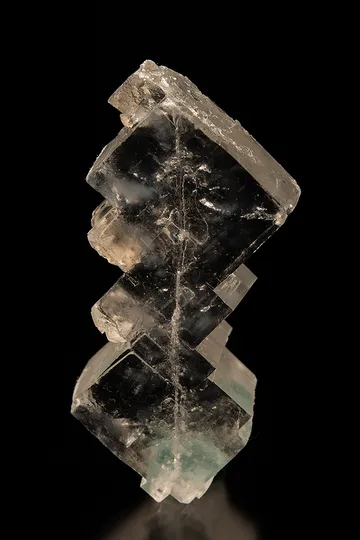
Neudorf, Germany: historic European lead-silver locality, famed for argentiferous galena with siderite, quartz, and sculptural crystals prized by collectors.
Key facts
Neudorf is one of the great old European lead-silver localities: a Lower Harz mining village whose name became shorthand for lustrous, architecturally complex galena perched on warm brown siderite and pale quartz. The collecting locality is not a single shaft so much as a historic ore field on the Neudorf-Straßberg vein system, a northwest-southeast chain of mineralized fault zones in the Harzgerode district of Saxony-Anhalt. The classic ore assemblage is argentiferous galena and freibergite in calcite-quartz-siderite veins, with sphalerite, bournonite, tetrahedrite-group minerals, chalcopyrite, pyrite and a distinctive tungsten suite appearing in the broader paragenesis.
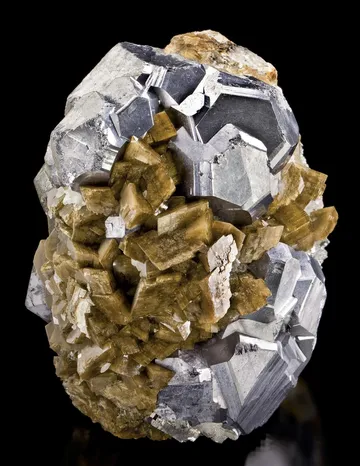
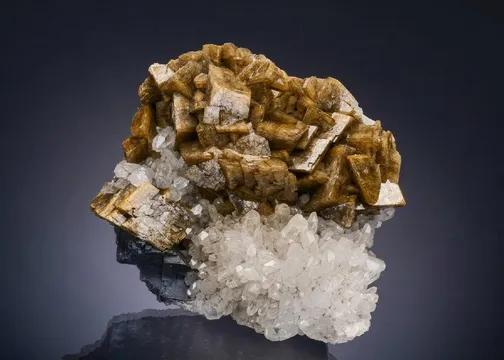
What makes Neudorf matter to collectors is the union of mineralogy, history and sculptural quality. The best specimens have a visual grammar that is immediately recognizable: silvery galena in the “Neudorf habit,” combining cube, octahedron and rhombic dodecahedron faces, set against sparkling quartz and honey-, clove- or tobacco-brown siderite rhombs. Fine old pieces from the Pfaffenberg and Meiseberg mines were already coveted in the 19th century, and the most important examples today tend to come from long-established European collections rather than from field collecting.
Regional View
Country View
The famous Neudorf look is a product of open-space vein growth. Quartz commonly forms the sparkling substrate; siderite provides the warm carbonate contrast; galena supplies the metallic geometry. In exceptional pieces the galena crystals are not merely cubic but richly modified, high-luster, and isolated enough to read as individual sculptures. The largest historical galenas reported from the district reached impressive sizes, but cabinet specimens with undamaged, well-separated crystals and strong matrix aesthetics have always been scarce.

Photo: Rob Lavinsky, iRocks.com, via Wikimedia Commons
Search for specimens: View all specimens from Neudorf, Germany
Neudorf lies south of Harzgerode in the eastern Lower Harz, in what collectors and German mining historians generally treat as the Harzgerode mining district. The productive mineralization belongs to the Neudorf-Straßberg vein system, known in German as the Neudorf-Straßberger Gangzug. These veins were mineralized fault zones rather than simple continuous ore lodes: ore shoots occurred in a southeast-to-northwest succession and were repeatedly pinched, displaced or interrupted by barren ground. For the collector, that geological discontinuity matters because it helps explain why the great specimen pockets were localized and why similar labels—Neudorf, Pfaffenberg, Meiseberg, Straßberg, Glasebach—can represent subtly different parts of a single historic mining landscape.
The vein filling is classically described as calcite-quartz-siderite carrying argentiferous galena and freibergite. Modern studies of eastern Harz vein mineralization treat the system as post-orogenic, epithermal to low-temperature hydrothermal mineralization hosted by Paleozoic sedimentary rocks, with a principal quartz-sulfide-siderite stage and a later calcite-fluorite-quartz stage. In the Neudorf collector suite, the first of these is the important one: quartz, siderite and base-metal sulfides dominate the specimens that made the locality famous. Fluorite occurs in the broader district, especially toward Straßberg, but it is not the mineral that defines classic Neudorf specimens.
The principal Neudorf specimen mines were Pfaffenberg and Meiseberg, both ancient lead-silver operations close to the village. Pfaffenberg is especially prominent on surviving specimen labels. Meiseberg and Pfaffenberg were linked historically and, in mining terms, became part of a larger struggle against water as workings reached greater depths. Water control was a central technical problem in the Lower Harz. The district used ponds, ditches, adits, water wheels, later steam power, and deep drainage adits to keep the mines productive. In 1823, a steam engine was installed for water control at Pfaffenberg, an important local step in mechanized drainage.
Mining around Neudorf has medieval roots. Records note a works or smelting site below the Pfaffenberg by the mid-15th century and a grant involving mining at the Meiseberg in 1457. Activity rose and fell over the following centuries, then the Neudorf mines became especially important in the Harzgerode region from the late 18th into the early 19th century. Their best years coincided with the period when Johann Ludwig Carl Zincken, the noted Harz mineralogist and mining official, directed the Anhalt-Bernburg mining and smelting works. The Neudorf mines closed in 1903, generally because the deposits were exhausted and the economics no longer justified continued operation.
A related but distinct engineering story belongs to the Tiefer Birnbaumstollen, the deep Birnbaum drainage adit in the Birnbaum valley. Work on this long water-drainage system helped make renewed mining possible on parts of the Straßberg-Neudorf vein system. It reached important connections during the 19th century, including the Glücksstern shaft in 1827, Meiseberg in 1865 and Pfaffenberg in 1882. Its role was not to produce specimens directly for collectors, but it shaped the mining history of the field: without drainage, the deeper ore could not have been exploited for long.
Specimen production was chiefly during active mining, not from modern collecting. Fine galena and bournonite specimens from Meiseberg and Pfaffenberg are repeatedly singled out in collector literature, and classic labels may simply read “Neudorf, Harz” or “Neudorf, Saxony” rather than giving a precise shaft. Historical sources and modern locality databases record galena crystals with the characteristic modified habit, bournonite crystals of exceptional size, tetrahedrite-group specimens, and scheelite on wolframite-group crystals among the celebrated finds. The most desirable pieces are old, matrix specimens with visibly integrated paragenesis rather than trimmed single crystals or massive ore.
Collecting access today should be approached as heritage-site rather than mine-dump collecting. The mines are long closed, old underground workings are hazardous, and land ownership, conservation and local regulations must be respected. The best way to understand the district in the field is by walking the Neudorf historical mining trail, which links old mining landscapes, water-management features, ponds and the Stahlquelle. Nearby Glasebach is preserved as a mining museum and show mine in the broader Straßberg-Neudorf mining landscape, but the classic Neudorf specimen supply now comes overwhelmingly through the specimen market, old collections and occasional collection dispersals.
Siderite from Neudorf is the warm, defining matrix mineral of the locality: lustrous rhombohedra in honey-brown, clove-brown, amber-brown to darker brown tones, commonly associated with quartz, galena, pyrite, tetrahedrite-group minerals, chalcopyrite, sphalerite and, less commonly, calcite. The classic material is especially tied to Pfaffenberg and Meiseberg, with Pfaffenberg labels frequent on old specimens. Crystals are often modest individually—centimeter-scale rhombs are already attractive—but their importance is aesthetic as much as dimensional: good Neudorf siderite forms bright, translucent to subtranslucent rhombs that contrast strongly with steel-gray galena and white quartz. Ordinary pieces are massive, dull, iron-stained or dominated by broken carbonate; superior examples show sharp rhombs, high luster, open spacing, and a balanced association with modified galena or sparkling quartz.
Galena is the mineral that made Neudorf a world classic. The best crystals show the celebrated Neudorf habit: sharply developed combinations of cube, octahedron and rhombic dodecahedron faces, often with brilliant metallic luster and enough modification to give the crystals a complex, almost architectural outline rather than a simple cubic block. Most collectible examples are thumbnail to small-cabinet scale, with galena crystals around 1–4 cm on many surviving display pieces, though historic reports record much larger crystals from the district. The finest specimens came from Meiseberg and Pfaffenberg during active mining and are typically set on siderite and quartz, sometimes with calcite, feather pyrite, sphalerite or tetrahedrite-group minerals. A top Neudorf galena is sharply crystallized, bright, well isolated on matrix, and substantially undamaged; an ordinary one is massive, edge-worn, darkened, crowded or missing the diagnostic modified form.
Quartz at Neudorf is rarely the headline species, but it is essential to the locality’s specimen architecture. It forms milky to colorless, sparkling druses and stubby crystals that line vein cavities and provide the pale ground on which brown siderite and metallic galena stand out. In some pieces quartz is merely a granular or greasy-looking vein matrix; in the better ones it is a bright crystallized bed that adds sparkle and depth without overwhelming the ore minerals. Quartz is documented from Pfaffenberg, Meiseberg, Hasenschacht, Glücksstern and the Birnbaum workings, consistent with its broad role in the Neudorf-Straßberg veins. Collectors should value Neudorf quartz for association, cleanliness and display balance: the best quartz-rich pieces carry crisp siderite, galena or bournonite, while quartz-only specimens from the locality are generally of more historical than species-level importance.
Calcite is a genuine part of the Neudorf vein assemblage but is much less available as a collector focus than galena, siderite or quartz. It occurs in the calcite-quartz-siderite gangue and appears on association pieces as whitish to cream crystals, including scalenohedral forms on some specimens with bournonite, galena, siderite and quartz. Its collecting value here lies in completing the paragenesis: a Neudorf specimen with calcite is especially appealing when the calcite is fresh, distinct and not merely a late dull crust over better minerals. Fine pieces show calcite adding contrast to brown siderite and metallic sulfides; ordinary examples are chalky, bruised, partially dissolved or visually subordinate. Because many classic specimens were trimmed and handled long before modern collecting standards, intact calcite on an old Neudorf matrix can be a useful sign of unusually careful preservation.
Sphalerite from Neudorf is a more elusive prize than the familiar galena-siderite combinations, even though it belongs naturally to the base-metal assemblage. It occurs as dark brown to nearly black crystals, locally in vugs in quartz-rich matrix and associated with siderite and calcite; iron-rich color is typical of many attractive examples. Documented specimens from Pfaffenberg show small, lustrous sphalerite crystals lining cavities in massive to drusy quartz, with olive-brown siderite rhombs and pale calcite as companions. Crystals are usually modest, around millimeter to subcentimeter scale in market specimens, so quality is judged by luster, translucency on edges, coverage, openness of the vug and association rather than size alone. A good Neudorf sphalerite is a refined locality specimen; an ordinary one can be visually lost among dark sulfides and iron-stained gangue.
Beyond these five species, Neudorf is unusually rich for a small historic district. Bournonite is the most important rarity for display collectors, with bright twinned crystals on quartz-siderite-galena matrices among the great old classics. Tetrahedrite- and freibergite-group minerals are central to the silver-bearing ore story, and chalcopyrite, pyrite, marcasite, acanthite, boulangerite, jamesonite, stibnite, cobaltite, löllingite, millerite, anilite, digenite and possible djurleite broaden the sulfide and sulfosalt suite. The tungsten minerals are especially notable for the Lower Harz: scheelite, wolframite-group minerals, ferberite and hübnerite are documented from Neudorf-area mines, with historical reports of scheelite on wolframite-group crystals. Secondary species include anglesite, cerussite, azurite, malachite, pyromorphite, wulfenite, wavellite, gypsum, aragonite, posnjakite and serpierite. No widely recognized type mineral is centered on Neudorf itself, but the locality’s rarity suite and historical crystallized galena give it type-level importance in the collector’s vocabulary.
Neudorf specimens need to be judged first as historical objects. The main authenticity concern is not widespread artificial treatment but provenance. Labels may use older political or geographic language—“Neudorf, Harz,” “Hartz,” “Saxony,” or “Sachsen-Anhalt”—and many old pieces do not specify Pfaffenberg or Meiseberg even when the style strongly suggests one of those mines. Conversely, specimens from neighboring parts of the Neudorf-Straßberg system, especially Straßberg and Glasebach, can be confused with Neudorf if the label has been shortened over generations. A strong Neudorf attribution is supported by the characteristic association of modified galena, brown siderite and quartz, by old labels, and by collection history.
Claims of recent production should be treated skeptically. The important Neudorf mines closed in 1903, and good matrix specimens generally come from old collections, estate material, museum deaccessions or long-held dealer stock. Pieces with 19th- or early-20th-century labels deserve careful preservation, even when the specimen itself is modest. Provenance to named collections can substantially affect desirability because it helps separate old Neudorf material from superficially similar European galena-siderite specimens.
Condition is crucial. Galena has perfect cubic cleavage and old Neudorf crystals commonly show bruised corners, cleaved faces, edge chips or contact marks from pocket extraction. Siderite rhombs are softer and easily dulled or chipped; old cleaning can leave them unnaturally matte or etched. Calcite is even more vulnerable to abrasion and acid. Quartz druse can conceal small repairs or reattachments, so examine the junctions of prominent galena crystals under magnification. Feather pyrite and marcasite-rich areas should be kept dry and stable, as iron sulfides can deteriorate in poor storage conditions.
Fluorescence is not a major selling point for the classic suite. Galena is not fluorescent and should be handled as a lead sulfide: avoid dust, do not trim without proper precautions, and wash hands after handling. Siderite and quartz are generally stable, but old specimens benefit from dry, moderate storage and minimal washing. Avoid aggressive acid cleaning; it can destroy calcite, etch siderite and alter the surface character that gives old Neudorf pieces their charm.
On the market, Neudorf is not rare as a name but rare as a high-grade specimen. Small, damaged or massive examples appear regularly enough for a patient collector, while cabinet-quality galena on siderite and quartz with strong luster, isolation, balance and old provenance is genuinely scarce. Bournonite from Neudorf is much less frequently available than galena and can command strong prices when well crystallized. Sphalerite and tungsten-species specimens are specialized and less common; they are best pursued with careful documentation rather than by appearance alone.
Neudorf’s mining history begins with the kind of record that turns a quiet Harz village into a long-running ore district: by 1454 a works existed below the Pfaffenberg, and in 1457 the Bishop of Halberstadt enfeoffed the Counts of Stolberg with mining at the Meiseberg. For centuries the mines rose and fell with water, ore and money. The village itself was refounded in 1531 as Neuendorf by Count Botho the Fortunate of Stolberg, but the deeper identity of the place was written underground.
The most dramatic local story is political as much as mineralogical. On February 9, 1848, two hated mining officials were murdered in Neudorf, an event later regarded as the opening act of the 1848 revolution in Anhalt. For a collector, that date matters because it places the great specimen era in a real social landscape: the same mines producing elegant galena and siderite for cabinets were also workplaces under pressure, with water problems, labor tension and official authority crowded into a small mountain community.
Water was Neudorf’s constant adversary. Meiseberg and Pfaffenberg were rich enough to justify ambitious drainage, but their depth was punishing for the Lower Harz. The Pfaffenberg adit gave only limited relief; ore reportedly persisted far below the easy drainage levels, and the water-control machinery could not keep pace indefinitely. The solution was the long, difficult extension of the Tiefer Birnbaumstollen. By 1865 it had reached Meiseberg, and only in 1882 did it connect with Pfaffenberg. The engineering achievement was enormous in local terms: the adit became the deepest and longest drainage adit of the Lower Harz pond-and-ditch system, and without it Neudorf mining would have ended earlier.
The village’s population curve tells the same story in human numbers. In 1806, Neudorf had 58 houses and 370 inhabitants, still living from farming, livestock, hauling coal and woodcutting as well as mining. As the mines became central to the Harzgerode district, the population grew from 456 in 1818 to 819 in 1843 and 951 in 1905. After the pits closed, the number fell sharply, to around 600 by 1912. The great mineral specimens that now sit in collections came from that brief industrial swell.
After mining, Neudorf reinvented itself around landscape, memory and water. The Stahlquelle, a strongly iron-bearing spring above the Schmale Wipper valley on the Wipperberg, was discovered in 1926 by Obersteiger W. Bock, who thought it might be the buried portal of an old mine. In 1931, during Neudorf’s 400th-anniversary year, it was opened to visitors. Its name reaches back into mining language: “Stahlstein,” steel-stone, was the miners’ term for siderite and iron ore. Today the spring is a hiking destination rather than an ore source, but its reddish deposits are a visible reminder that the same iron-rich waters and carbonate veins helped shape the specimens collectors prize.
The old mining trail preserves that double life of Neudorf. A walker can pass ponds, ditches, adits, the Stahlquelle and the “Menschentrappe,” a steep hollow way associated in local tradition with the Dankerode butter women returning from the Quedlinburg market. The ground that once produced galena crystals for cabinets is now read through hiking signs, museum stops and weathered mining monuments. For collectors, that is part of Neudorf’s appeal: the locality is not just a label, but a surviving landscape of shafts, waterworks, villages and old mineral fame.
Günther Neumeier, “Famous mineral localities: Neudorf, Harz Mountains, Saxony-Anhalt, Germany,” The Mineralogical Record, 43(1), 17–53, 2012 — The key modern collector-locality article devoted specifically to Neudorf and its classic specimens.
Neudorf, Harzgerode, Harz, Saxony-Anhalt, Germany — Mindat locality page — Essential mineral list, sublocalities, classic species notes and references for the Neudorf collecting locality.
Pfaffenberg Mine, Neudorf — Mindat locality page — The most important sublocality page for many classic galena-siderite-quartz specimens.
Meiseberg Mine, Neudorf — Mindat locality page — Mineral list and reference point for the other principal Neudorf specimen mine.
Glücksstern Mine, Neudorf — Mindat locality page — Documents another Neudorf-associated lead-silver mine on the Neudorf-Straßberg vein system.
Jens Schneider, Udo Haack and Klaus Stedingk, “Rb-Sr dating of epithermal vein mineralization stages in the eastern Harz Mountains (Germany) by paleomixing lines,” Geochimica et Cosmochimica Acta, 67(10), 1803–1819, 2003 — Establishes timing and paragenetic framework for the eastern Harz epithermal vein stages, including quartz-sulfide-siderite and calcite-fluorite-quartz mineralization.
Jens Schneider, Udo Haack and Klaus Stedingk, “A Sr isotope study on fluorite and siderite from post-orogenic mineral veins in the eastern Harz Mountains, Germany,” Mineralium Deposita, 38, 984–991, 2003 — Isotopic study of fluorite and siderite from eastern Harz veins, including samples from the Neudorf-Straßberg system.
O. Luedecke, Die Minerale des Harzes, Gebrüder Bornträger, Berlin, 1896 — Classic Harz mineral reference cited in modern locality records for Pfaffenberg and the broader district.
R. Junker, H. Krause, K. Schumann and J. Siemroth, “Sekundärminerale des Neudorf-Straßberger-Gangzuges im Unterharz,” Der Aufschluss, 42, 95–100, 1991 — Important article on secondary minerals of the Neudorf-Straßberg vein system.
G. Schnorrer, “Mineralogische Notizen VIII,” Der Aufschluss, 55(6), 381–384, 2004 — Source cited for several less common Pfaffenberg secondary species, including aragonite, gypsum and serpierite.
Terra Mineralia, “From East to West” — Museum display note describing a 12.5 cm wide Neudorf galena on siderite specimen and explaining the “Neudorf type” galena habit.
Wikimedia Commons, “Galena-Quartz-Siderite-tuc1028e.jpg” — High-resolution image and description of a cabinet Neudorf galena-siderite-quartz specimen photographed by Rob Lavinsky.
Neudorf locality page on Mindat — Best single online mineralogical index for Neudorf, including species, sublocalities, references and historical notes.
Pfaffenberg Mine on Mindat — Core reference for the most specimen-famous Neudorf mine.
Meiseberg Mine on Mindat — Companion reference for the other major Neudorf specimen mine.
Glücksstern Mine on Mindat — Useful for understanding the western Neudorf-Straßberg vein-system context.
Regionalverband Harz Geopark information panel: Stahlquelle Neudorf — Accessible geology, mining and mineral summary for visitors to the Neudorf mining landscape.
Landmarke 10 Auerberg, Regionalverband Harz — Regional geological context for the Lower Harz vein mineralization centered around Straßberg, Neudorf and Harzgerode.
Harzer Wandernadel: Stempelstelle 193 / Stahlquelle — Practical and historical information for the Stahlquelle and mining-trail landscape.
Harzinfo: Neudorf — Tourism overview for Neudorf, including the historical mining trail.
Harzlife: Der Neudorfer historische Bergbaurundwanderweg — Visitor-oriented description of the approximately 15 km mining-history trail around Neudorf.
Tiefer Birnbaumstollen — Useful overview of the major drainage adit that underpinned deeper mining on the Straßberg-Neudorf vein system.
Crystal Classics: Galena and Calcite with Siderite on Quartz — Dealer description of a high-quality Neudorf association specimen, useful for market-style specimen criteria.
Fabre Minerals: Bournonite with Galena, Siderite, Quartz and Calcite — Good example of the rarer bournonite-bearing Neudorf assemblage.
Wendel Minerals: Sphalerite, Siderite and Calcite from Pfaffenberg — Useful specimen description for Neudorf sphalerite habits and associations.
Mineral Auctions: Galena on Quartz, Carl Bosch Collection — Market and provenance example of a classic Pfaffenberg galena specimen.