Pfaffenberg Mine, Germany - historic Harz locality famed for Neudorf-habit galena on siderite and quartz, with classic cabinet specimens and prized provenance.
Key facts
Pfaffenberg is one of the classic names of Neudorf, the old lead-silver mining village in the Lower Harz of Saxony-Anhalt. For collectors, its importance is not that it produced a long modern run of specimen pockets, but that it belongs to the small circle of historic European localities whose best pieces helped define what a cabinet mineral should look like: metallic galena with the crisp “Neudorf habit,” set on glowing brown siderite and sparkling quartz, often with calcite, tetrahedrite-family minerals, chalcopyrite, or bournonite as sharply placed accents.
Geologically, Pfaffenberg sits on the Neudorf-Straßberg vein system, a mineralized fault-zone complex of the eastern Harz. The productive veins carried argentiferous galena and freibergite-subgroup ore in calcite-quartz-siderite gangue, with a distinctly Lower Harz paragenesis: galena, siderite, quartz and calcite at the aesthetic core, but with notable copper, antimony, tungsten, arsenic, nickel and secondary lead-copper minerals in the wider assemblage. The old mines of Neudorf and nearby Meiseberg are especially admired for galena crystals combining cubic, octahedral and dodecahedral faces, a form widely recognized by collectors as the Neudorf habit.
Regional View
Country View
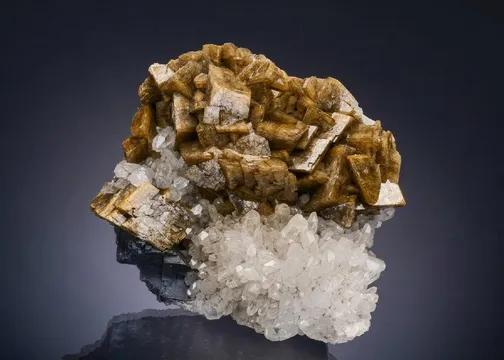
The finest Pfaffenberg pieces have the look of 19th-century European mineralogy: compact plates and small cabinets with sharply edged, lead-gray galena perched on a sugary to drusy quartz base and translucent, clove-brown to amber-brown siderite rhombs. Many surviving specimens carry old German or dealer labels, and that provenance is part of their desirability. Fresh finds are not the story here; survival, attribution, and old-collection pedigree are.

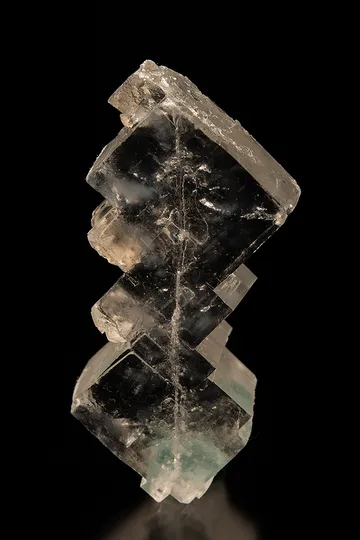
Photo: Rob Lavinsky, iRocks.com, via Wikimedia Commons
Search for specimens: View all specimens from Pfaffenberg Mine, Germany
Pfaffenberg Mine, or Grube Pfaffenberg, lies southeast of Neudorf, about four kilometres south of Harzgerode, in the historic Harzgerode mining district of Saxony-Anhalt. The locality is an old lead-silver mine of the Neudorf-Straßberg vein system. The surrounding mining field was part of the Lower Harz hydrothermal vein province, where post-orogenic mineralizing fluids moved through fault zones in the Harzgerode complex and deposited ore and gangue minerals in a discontinuous chain of ore shoots.
The economic ores were chiefly argentiferous galena and silver-bearing tetrahedrite-freibergite-group minerals in a gangue dominated by quartz, siderite and calcite. In specimen terms, the matrix is as important as the ore: white drusy quartz gives brilliance and contrast, siderite supplies the warm brown rhombohedral architecture, and galena provides the sharp metallic focal crystals. Wolframite-group minerals, scheelite, chalcopyrite, sphalerite, bournonite and several secondary lead-copper species round out the assemblage, but the classic Pfaffenberg identity remains galena-siderite-quartz.
The broader Neudorf district was historically one of the notable lead-silver producers of the Lower Harz. Mining at Neudorf is documented over centuries, with the Pfaffenberg and Meiseberg workings becoming especially important in the 18th and 19th centuries. A regional revival around Harzgerode and Neudorf followed the establishment of the Silberhütte smelting works in the Selke valley in 1692, and Pfaffenberg became one of the important Neudorf suppliers after the earlier Harzgerode mines had been established. Neudorf’s lead-silver mines reached their most productive period in the early 19th century, when Johann Ludwig Carl Zincken served as director of the Anhalt-Bernburg mining and metallurgical works.
Water was the persistent enemy of the district. Pfaffenberg’s workings were deep enough that drainage and pumping shaped the engineering history as much as the ore did. A local information panel records Pfaffenberg as the main mine of the Neudorf district, with three shafts and a principal shaft reaching roughly 242 m. The Fürst-Christian shaft is a key name in the mine’s later history: it was sunk in 1844, and from it a 288 m counter-heading was driven in the hope of eventually connecting with the Herzog-Alexis-Erbstollen drainage project. That ambitious drainage adit, begun on 22 April 1830 near Mägdesprung, reached more than 2.5 km, but the Pfaffenberg section was never joined; the full projected system would have extended about 7.2 km.
The mine is long closed. Regional accounts place the end of the Neudorf-area ore mining around 1903, with later attempts in the 1930s and 1950s to revive the district proving unsuccessful. For collectors, this means Pfaffenberg is essentially an old-collection locality. Former dump collecting has been reported as exhausted: smaller dumps were heavily reworked in the 1990s, and larger dump areas were lost or covered. Any modern visit should be treated as historical-field observation only unless current permission, land status, safety conditions and legal access are confirmed in advance.
The notable specimen finds are overwhelmingly historic. Many of the best galena-siderite-quartz pieces appear to date from the 1800s, and several published or dealer-documented examples carry old labels or museum provenance. A recorded 1843 Pfaffenberg specimen consists of galena with siderite and calcite, and old labels on other pieces suggest 19th-century recovery dates such as 1874. Surviving specimens show that the productive pockets yielded bright galena crystals from a few millimetres to around 2 cm on attractive cabinet pieces, while the wider Neudorf district is known for much larger galena crystals. At Pfaffenberg specifically, the collector premium lies in sharpness, balance, old provenance, and the classic association on siderite and quartz.
Galena is the signature mineral of Pfaffenberg and the reason the locality still appears in advanced European classic collections. The best crystals show the famed Neudorf habit: combinations of cube, octahedron and dodecahedron faces rather than simple cubes, giving compact, architectural, steel-gray crystals with bright metallic luster. On documented Pfaffenberg specimens, individual crystals commonly run from a few millimetres to about 1.5–2 cm across, with the most desirable pieces showing isolated or well-spaced galena on translucent brown siderite and sparkling quartz; calcite, chalcopyrite and tetrahedrite-subgroup crystals can add important accents. Ordinary pieces are massive, rubbed, or visually crowded, while a top Pfaffenberg galena has crisp faces, minimal cleavage bruising, strong contrast against white quartz, and preferably an old label tying it to Neudorf or Pfaffenberg rather than a vague “Harz” locality.
Siderite at Pfaffenberg is not merely gangue; it is the stage on which the locality’s classic galenas perform. It occurs as sharp rhombohedra, typically honey-brown, clove-brown, olive-brown or amber-brown, locally translucent and lustrous enough to be collectable in its own right. Good examples form sparkling carpets or stepped groups on quartz, and the best combination pieces carry bright galena, pyrite, chalcopyrite, tetrahedrite-subgroup minerals, sphalerite or calcite in balanced placement. Published and dealer-documented specimens show siderite crystals commonly in the millimetre to centimetre range, with fine Pfaffenberg pieces judged by luster, translucency, clean rhombohedral form, and lack of limonite staining or edge abrasion; siderite that reads as dull brown crust has far less appeal than sharp, glassy rhombs with metallic galena rising cleanly above them.
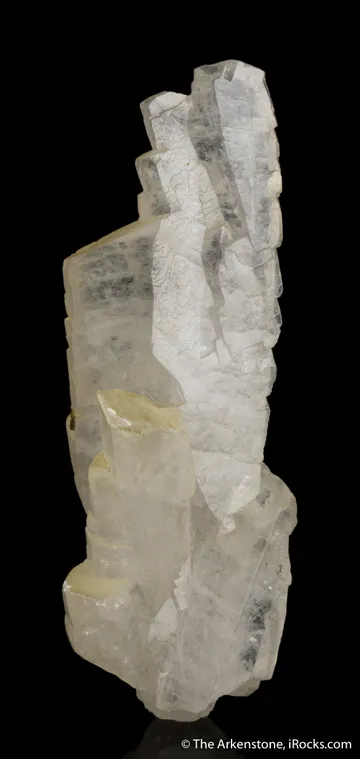
Quartz from Pfaffenberg is chiefly valued as the bright matrix of the galena-siderite association, but it is essential to the look of the locality. It commonly appears as white to colorless drusy coatings and short, sparkling crystals, in some specimens so compact that dealers describe the matrix as a total coating of quartz with little prism development. Collectors also encounter massive greasy-looking quartz in the Neudorf suite, sometimes called “Fettquarz” in German specimen descriptions. The best Pfaffenberg quartz does not need large individual crystals; it needs brilliance, cleanliness and texture, providing a snow-white or glassy ground for brown siderite rhombs and metallic galena. A strong quartz-bearing Pfaffenberg specimen is three-dimensional and lively, while ordinary examples are flattened, iron-stained, massive, or lack the galena-siderite contrast that makes the locality distinctive.
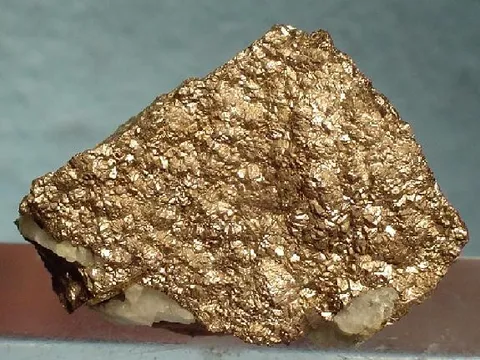
Beyond the three headline species, Pfaffenberg has a rich documented assemblage for a closed historic mine: acanthite, anglesite, anilite, ankerite, aragonite, arsenopyrite, azurite, boulangerite, bournonite, calcite, cerussite, chalcopyrite, cobaltite, digenite, probable djurleite, ferberite, fluorite, freibergite-subgroup minerals, gypsum, hübnerite, jamesonite, löllingite, malachite, marcasite, millerite, posnjakite, pyrite, pyromorphite, pyrrhotite, scheelite, serpierite, sphalerite, stibnite, tennantite-subgroup minerals, tetrahedrite-subgroup minerals, wavellite, wolframite-group minerals and wulfenite. No well-established type-locality mineral is tied to Pfaffenberg itself in the major modern locality records, but the mine is important for rarities within the Neudorf suite: old bournonite combinations, scarce fluorite, tungsten minerals, silver-copper sulfides, and “feather pyrite,” the delicate pyrite habit long noted by Harz collectors and sometimes discussed as pseudomorphous after pyrrhotite.
The chief authenticity issue with Pfaffenberg is locality precision. Many 19th-century specimens were labelled simply “Neudorf,” “Harz,” “Anhalt,” or “Sachsen-Anhalt,” and both Pfaffenberg and Meiseberg produced related galena-siderite-quartz material. A specimen with a vague Neudorf label may be entirely legitimate but not safely assignable to Pfaffenberg unless the old label, collection record, dealer chain, or specimen style supports the attribution. Conversely, a modern “Pfaffenberg” label without provenance should be read cautiously, especially on older-looking classic pieces.
No systematic modern fake trade specific to Pfaffenberg is well documented, but ordinary risks apply to high-value classic European specimens: relabeling from broader Neudorf material, repaired galena crystals, glued or reattached crystals, and over-cleaned or acid-brightened matrices. Galena has perfect cubic cleavage and bruises easily, so inspect high points and edges under magnification. Fresh silvery cleaves on a supposedly pristine old piece should be understood as damage, not necessarily fabrication. Siderite edges are also vulnerable; many otherwise fine plates have tiny bruises or cleaved rhombs from more than a century of handling.
Condition standards are high because the locality is so aesthetic. Fine Pfaffenberg galenas should have sharp faces, strong metallic luster, minimal dull oxidation, and a natural relationship to the siderite-quartz matrix. Siderite should not be heavily limonite-coated unless the piece has compensating rarity or provenance. Quartz is usually robust, but drusy surfaces trap dust, and aggressive cleaning can leave unnatural brightness, loosen small crystals, or expose repairs. Handle specimens over a padded surface; a short fall can cleave galena, detach siderite rhombs, or spall calcite.
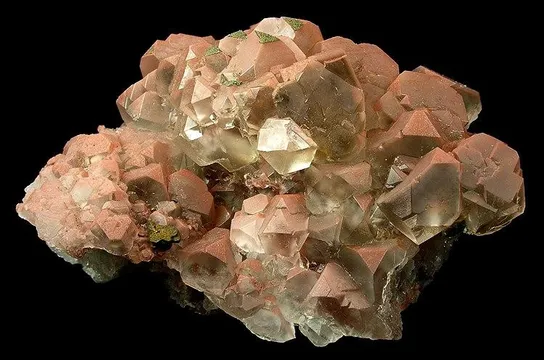
Fluorescence is not a major buying criterion for the classic galena-siderite-quartz material, though calcite and some associated minerals from the district may show responses depending on composition. If fluorite is present, it deserves special attention because crystallized fluorite from Pfaffenberg/Neudorf is much scarcer than the standard galena-siderite association.
Market availability is intermittent. Small examples and lesser fragments appear from old European collections, but well-balanced cabinet pieces with crisp Neudorf-habit galena, translucent siderite and clean quartz have become expensive classic-mineral material. Dealer records show modest small-cabinet and thumbnail combinations in the hundreds of dollars or euros, while exceptional, damage-free cabinet specimens with strong aesthetics and provenance can reach several thousand. A fine old label can materially affect value, especially if it ties the piece to Pfaffenberg rather than just Neudorf.
The story of Pfaffenberg is inseparable from water. In the 19th century the mines around Harzgerode and Neudorf had enough ore to justify grand engineering but enough groundwater to frustrate nearly every plan. Johann Ludwig Carl Zincken, then director of the Anhalt-Bernburg mining and metallurgical works, proposed a deep drainage solution in 1829: the Herzog-Alexis-Erbstollen, driven from the Selke valley near Mägdesprung toward the mines. Work began on 22 April 1830. The first light hole was placed 610 m from the portal to ventilate the heading, and the enterprise continued for decades. A major breakthrough came on 26 May 1862, by which time the tunnel had reached 2,134 m. More was driven, then stopped, then revived again from 1891 to 1893. At Pfaffenberg, the Fürst-Christian shaft was sunk in 1844, and miners drove 288 m from the mine side in the opposite direction, hoping to meet the great drainage adit. The meeting never happened. The Pfaffenberg section remained isolated, and the full projected 7.2 km drainage system was never completed.
Collectors tell a second, quieter story on the dumps. By the late 20th century, Pfaffenberg was already a locality of memory more than production. One field collector recalled that earlier visits yielded mostly siderite, sphalerite, löllingite crystals, a single 2 mm galena crystal, massive fluorite in sphalerite that was “very beautiful under UV,” and about 50 kilograms of feather pyrite still waiting to be cut or polished. The same account judged the dump possibilities essentially extinct: the smaller dump had been dug over repeatedly in the 1990s, and the larger dump lay beneath a refuse tip. Another collector remembered taking a pension in Neudorf for a week each May and ranging through the eastern Harz localities; in those days, the trip could still produce small treasures and local knowledge. Later, many sites had become off-limits, and a visit could quickly become an argument with the forester.
The old specimens carry their own field notes. One documented Pfaffenberg galena with siderite and calcite is recorded as an 1843 find. Another classic plate, now illustrated through Wikimedia Commons, is a 6.3 x 5.7 x 1.7 cm small cabinet specimen with sharp galena crystals to 1.25 cm on siderite and quartz; its old label appears to indicate an 1874 origin. Such dates matter. They place the specimen not in a modern collecting context, but in the era when European mineral cabinets, mining schools, aristocratic collections and early dealers were building the language of crystallography through hand specimens like these.