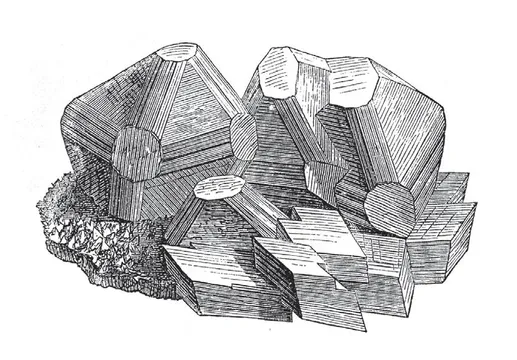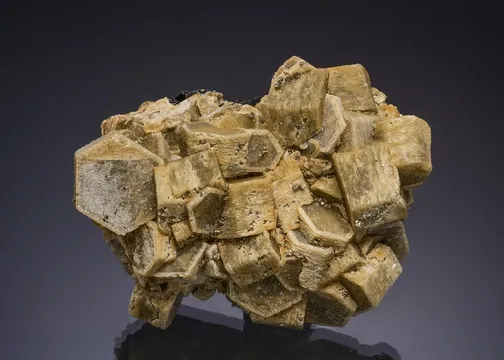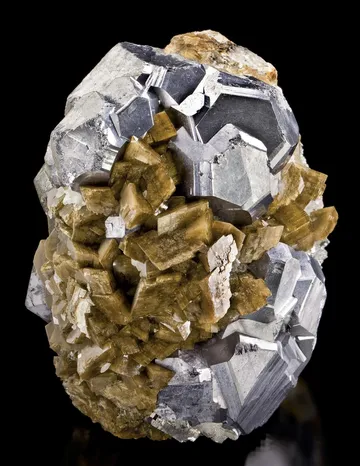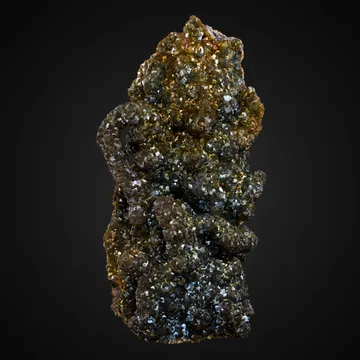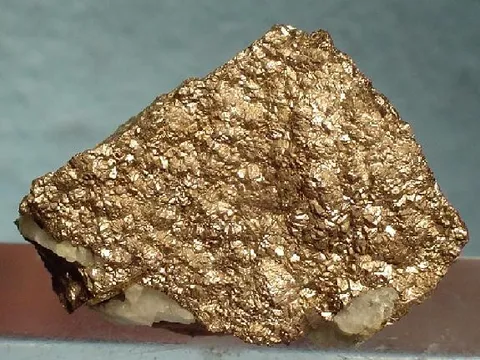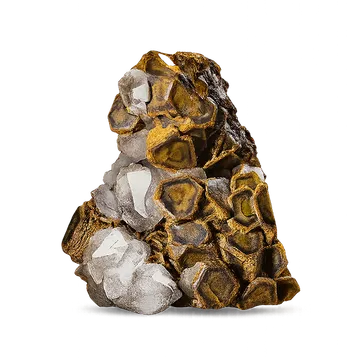
Neudorf siderite — classic Harz example with lustrous translucent rhombs in brown tones, often on quartz; valued for the Neudorf habit and ore associations.
Key facts
Neudorf siderite is one of the quiet aristocrats of European mineral collecting: not loud, not newly fashionable, but instantly recognizable to collectors who know the old Harz localities. Its best crystals are lustrous, translucent rhombs in clove-brown, olive-brown, greenish-golden, honey-tan, and amber shades, most often grown on sparkling quartz and, in the classic combinations, accompanied by lead-gray galena, dark bournonite, sphalerite, chalcopyrite, or calcite. The look is unmistakably nineteenth-century European: compact, mineralogically rich, sharply crystallized, and usually preserved on old matrix rather than as isolated show crystals.

Photo: Wikimedia Commons
The siderite belongs to the historic lead-silver mining district around Neudorf, in the Lower Harz of Saxony-Anhalt. The principal ores were argentiferous galena and freibergite, occurring in calcite-quartz-siderite veins of the Neudorf-Straßberg vein system. In modern geological language these were mineralized fault zones in the Harzgerode complex, forming a southeast-to-northwest succession of ore bodies broken by barren intervals. The mines were never economically dominant on the scale of the great Upper Harz districts, but mineralogically they were exceptional.
For collectors, Neudorf is often approached through its galena: the famous “Neudorf habit,” a complex combination of cubic, octahedral, and dodecahedral faces, is one of the district’s signatures. Yet siderite is not merely a supporting matrix here. Fine Neudorf siderite specimens are collected for the carbonate itself: sharp rhombohedra, high luster, translucency, pleasing greenish-brown color, and the glittering contrast of quartz. Siderite-only plates can be excellent, while combination pieces with galena or bournonite carry an additional historic charge because they express the full ore assemblage of the district.
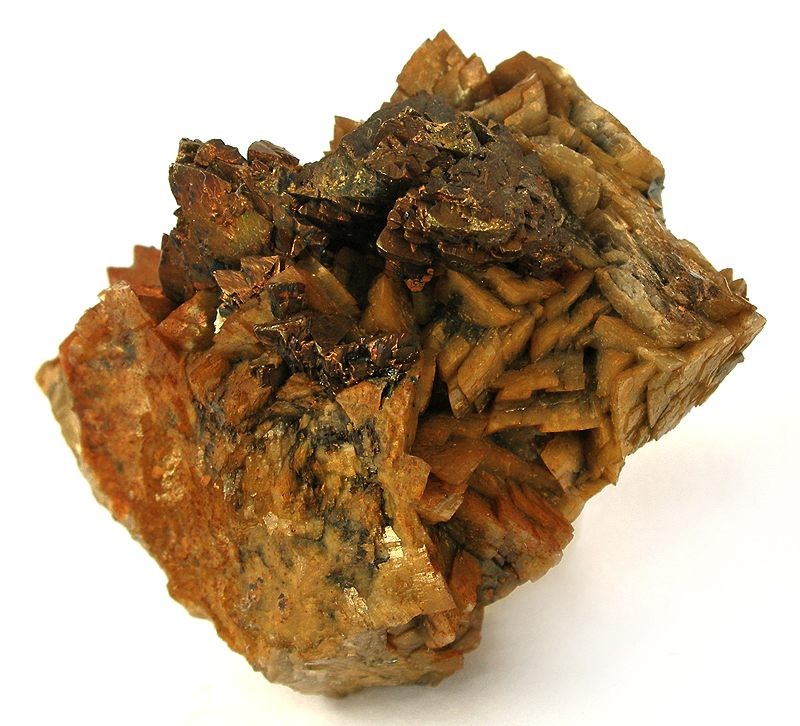
Photo: Wikimedia Commons
The locality’s importance is also historical. Meiseberg and Pfaffenberg were active long before systematic mineral collecting became a modern pursuit, and much of the best material entered collections through nineteenth-century and early twentieth-century channels. Today a good Neudorf siderite is usually an old specimen, often with hand labels, European dealer provenance, museum deaccession history, or collector lineage. That old-collection status is part of the appeal: a fine piece is both a carbonate specimen and a fragment of Harz mining history.
Search for specimens: View all siderite specimens from Neudorf, Germany
Neudorf is now a quarter of Harzgerode in the Harz district of Saxony-Anhalt, Germany, about 4 km south-southwest of Harzgerode. The mineral locality is not a single shaft in the narrow collector sense, but a small historic mining district whose best-known mines include Pfaffenberg, Meiseberg, Glücksstern, Hasenschacht, and the Birnbaum shafts. For siderite collectors, the names Pfaffenberg and Meiseberg are especially important, because many of the classic siderite-quartz-galena specimens trace to these workings.
The deposit is a hydrothermal vein system, specifically part of the Neudorf-Straßberg vein system. Its productive veins were calcite-quartz-siderite bodies carrying argentiferous galena, freibergite, and a rich suite of associated sulfides, sulfosalts, carbonates, tungstates, and secondary species. The veins followed mineralized fault zones in the Harzgerode complex, with ore shoots occurring discontinuously along a southeast-to-northwest structural trend. This discontinuity is important for understanding both the mining and the collecting: rich pockets could produce remarkable crystals, while adjacent stretches of the same structure might be nearly barren.
Mining in the district was directed primarily toward lead and silver, though siderite itself was also an iron ore. Local mining terminology preserved that dual role: siderite was known as an iron ore or “Stahlstein,” the root of the local Stahlquelle name. Sphalerite, bournonite, tetrahedrite-group minerals, chalcopyrite, pyrite, scheelite, wolframite-group minerals, and quartz all belong to the broader Neudorf mineralogical picture. The occurrence of tungsten minerals is a notable peculiarity in the Lower Harz context; early miners regarded wolframite unfavorably because it interfered with smelting.
The mining history is long. A smelter is recorded under the Pfaffenberg in the fifteenth century, and mining at Meiseberg was already formally granted in the same period. The district reached its highest productivity in the early nineteenth century under the Anhalt mining administration, when Carl Zincken was active as director; Zincken’s name survives in mineralogy through zinkenite. In 1823 a steam engine was introduced at Pfaffenberg for mine dewatering, an important technological step in a district where water handling was a persistent problem. A mine railway between Neudorf and Silberhütte began operating in 1889 and was discontinued in 1909. The miners celebrated their last Bergmannsfest at the Pfaffenberg festival ground in 1893, and the principal Neudorf mines were closed in 1903 after depletion and declining profitability.
Present-day collecting should be viewed realistically. The great specimen-producing period is over, the mines are long closed, and the classic material on the market comes overwhelmingly from old collections rather than new field recovery. Historic mine sites and dumps in the Harz may be on public, municipal, private, protected, or unsafe ground; no collector should assume access without explicit permission and current local safety information. For practical purposes, Neudorf siderite is a marketplace and old-collection locality, not a modern dig-your-own source.
Notable finds extended far beyond siderite. Galena crystals from Neudorf reached impressive sizes and gave the district its famous “Neudorf habit.” Bournonite, tetrahedrite-group minerals, scheelite on wolframite, sphalerite, and unusual pyrite forms also appear in the district record. But siderite is the visual binder of many of the most desirable specimens: the honey-brown to olive-brown carbonate rhombs that make the metallic minerals look staged rather than merely embedded in ore.
Neudorf siderite is most prized as sharply crystallized rhombohedra, typically lustrous and translucent, in tones ranging from tan and honey-brown through olive-brown, greenish-brown, clove-brown, and golden amber. The best crystals have clean edges, glassy to pearly faces, and enough translucency to glow under strong light. They may form individual rhombs on quartz, intergrown carpets of small crystals, dense plates of overlapping rhombohedra, or more flattened, tapered forms that can read visually as disks or stacked blades.
The common collector size is miniature to small-cabinet, with many individual crystals in the several-millimeter to 1 cm range. Better siderite rhombs can reach around 2 cm, and documented old specimens include crystals reported to about 2.3 cm across. Cabinet plates exist, but they are far less common in fine condition. Very large, aesthetic Neudorf plates should be treated as major old European classics rather than routine siderite specimens.
Quartz is the most important visual associate. It occurs as white to colorless drusy matrix, stubby milky crystals, sparkling quartz crusts, and more delicate clear prisms. On good pieces the quartz provides both structure and light: the siderite sits on or among it, and the quartz sparkle lifts the darker brown carbonate. Some specimens show siderite partly coated by tiny quartz crystals, giving faces a frosted or glittering surface. Others preserve isolated rhombs against open quartz vugs, the most desirable arrangement for collectors who value crystal definition.
Galena is the classic metallic partner. On the best combination specimens, lustrous gray galena crystals perch on or among the siderite and quartz, often showing complex combinations of cube, octahedron, and dodecahedron faces. Bournonite is less frequently encountered but highly desirable, especially when correctly recognized rather than casually labeled as galena. Sphalerite, chalcopyrite, pyrite, tetrahedrite-group minerals, calcite, and, in the broader district, scheelite and wolframite-group minerals add mineralogical depth. Calcite is not the dominant preserved aesthetic associate, but old siderite-calcite-quartz combinations can be especially attractive.
Quality in Neudorf siderite is a balance of five factors: crystal sharpness, luster, translucency, color, and association. Greenish-golden or olive-brown translucent rhombs with undamaged faces are superior to dull, opaque brown crusts. A little peripheral contact is expected on old pocket-wall plates, but central bruising, cleaved faces, or heavy iron-oxide dulling lowers desirability. The finest specimens combine intact siderite rhombs with bright quartz and a well-placed galena, bournonite, chalcopyrite, or sphalerite association. Provenance matters strongly: an old German, Krantz, museum, or named-collector label can be a meaningful part of the specimen’s value.

Photo: Wikimedia Commons
The central authenticity issue with Neudorf siderite is locality confidence. “Neudorf” is not a unique place name in Germany, and old European labels can be brief, translated, misspelled, or stripped down to “Neudorf, Harz.” A convincing specimen should match the classic mineralogical style: brown to greenish-brown siderite rhombs, quartz matrix, and the appropriate Harz lead-silver vein associations. Pieces labeled only “Germany” or “Harz” require caution unless their appearance, matrix, and provenance support the attribution.
No widely documented treatment industry is associated with Neudorf siderite in the way that some gem minerals have heat, dye, or coating histories. The more realistic concerns are old repairs, mixed labels, and optimistic relabeling. Repairs are not surprising on heavy galena-siderite-quartz combinations, especially where dense galena crystals sit on brittle quartz and carbonate matrix. A repaired specimen may still be collectible if the repair is disclosed, stable, and not visually disruptive. Label mismatch is also possible in old institutional or dealer material; one documented old-labeled siderite specimen has a number discrepancy between the label and specimen, interpreted as a likely mix-up rather than deliberate fraud.
Condition expectations should be age-aware. These specimens are commonly more than a century old, and many were removed from pocket walls rather than trimmed from fresh modern production. Minor edge contact, peripheral bruising, or small dings on exposed rhombs are common. Central display damage is more serious. Siderite is softer and less forgiving than quartz, so projecting rhombs may show rubbed edges or cleaved corners. On galena-bearing pieces, inspect for repaired galena clusters, concealed glue lines, and instability along the quartz-siderite contact.
Siderite can oxidize under weathering conditions to iron oxyhydroxides, especially in mine waste and damp tailings environments. Well-preserved cabinet specimens are usually stable if kept dry and away from acid fumes or aggressive cleaning. Avoid acids: siderite is a carbonate and can be damaged by acid treatment, even if it reacts less vigorously than calcite at room temperature. Ultrasonic cleaning is not recommended for old Neudorf combination specimens because quartz, siderite, galena, and repaired zones may respond differently to vibration.
Market availability is irregular but real. Neudorf siderites appear at auction and through specialist dealers when old collections recycle. Modest siderite-on-quartz or siderite plates may sell in the low hundreds of dollars depending on size and condition, while strong galena-siderite-quartz combinations can move into four figures. Exceptional cabinet specimens, pieces with major galena crystals, museum-level aesthetics, or elite provenance can command substantially higher prices. As always with old European classics, the spread is wide: a repaired but attractive miniature, a historic labeled siderite plate, and a top Neudorf-habit galena on siderite are not the same market.
Neudorf is a small place with a disproportionately large mineralogical shadow. The great mines did not roar through the modern age; they faded, closed, and left behind old shafts, postcards, museum drawers, and labels. That is part of the appeal. A Neudorf siderite rarely feels like a newly discovered specimen. It feels like something that passed through hands.
The Pfaffenberg and Meiseberg workings define the collector’s mental map. Pfaffenberg lay southeast of the village; Meiseberg was closer to the southwest side. These were not casual prospect holes but long-lived lead-silver mines whose fortunes depended on ore shoots hidden in fractured Harz rock. The district’s geology made the miners work for every rich zone. Mineralized stretches could give way abruptly to barren rock, then return again as lenses. In the specimen world that stop-and-start structure is reflected in the pieces themselves: a tight patch of quartz, a burst of siderite, a galena crystal perfectly emplaced as if the pocket briefly opened and then shut.
Water was one of the district’s persistent enemies. The story of Pfaffenberg includes the arrival of a steam engine for dewatering in 1823, a striking moment in a mountain landscape more often imagined through timber, shafts, ponds, and hand labor. That engine marks the transition from older mining rhythms to a more mechanized nineteenth-century operation. The broader Lower Harz water-management landscape still frames Neudorf; ponds and ditches around the district are not decorative accidents, but relics of an industrial hydrology built to keep mines alive.
The human calendar of the mines ended before the mineralogical one. In 1889 the Neudorf-Silberhütte mine railway began running, linking the village more tightly to the ore-processing world beyond it. Four years later, in 1893, the miners celebrated their last Bergmannsfest at the Pfaffenberg festival ground. By 1903 the principal mines were closed. The railway itself did not last much longer, ceasing operation in 1909. For collectors, those dates matter because they place the classic material firmly in the old-time era. When a Neudorf siderite carries a nineteenth-century label, the label is not romantic decoration; it belongs to the actual producing lifetime of the locality.
Old images keep the district’s afterlife visible. A postcard view of the abandoned Pfaffenberg Mine from about 1910 shows the remains of the Fürst-Christian-Shaft, recorded as 355 m deep. Another old aerial view from about 1930 looks across the Neudorf mining area toward the traces of Pfaffenberg and Meiseberg, already abandoned since 1903. These are not specimen photos, but they change how one sees the specimens: the small brown rhombs and gray galena crystals were once tied to a landscape of shafts, spoil, waterworks, and settlement.
The specimen trade adds another layer. August Krantz, one of the great nineteenth-century mineral dealers, handled Neudorf material, and later Krantz labels are treasured when they accompany siderite from the district. A small old paper label can carry almost as much atmosphere as the crystals: “Neudorf,” “Harz,” “Siderit,” maybe a dealer name, maybe a number. In one recorded case, a Neudorf siderite carried two old labels and a specimen number that did not quite match the number on the stone. The most plausible interpretation was not fraud but an old collection mix-up, the kind of clerical slippage that occurs when series of similar specimens pass through institutions and dealers over generations. For a collector, that is a reminder to love provenance but verify it.
There is also the recurring problem of the dark metallic associate. A good Neudorf specimen with black-gray blades may be too quickly called galena, because galena is the famous name. One old bournonite-associated siderite carried a later corrective note in German: “nicht Bleiglanz” — not galena. That small phrase is a collector’s lesson in two words. Neudorf’s fame rests partly on galena, but the district’s sulfosalt assemblage is richer than a single metallic gray mineral. On the best old pieces, careful identification matters as much as aesthetics.