






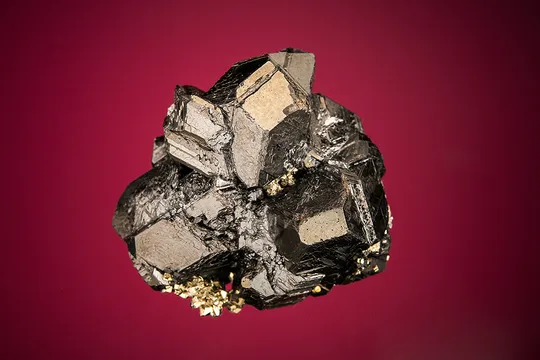
Naica, Mexico — famed locality for pale fluorite, galena, and gypsum, plus the Cave of the Crystals, a landmark of architectural crystals and science.
Key facts
Naica is one of the few mineral localities whose name carries two distinct meanings for collectors. In the cabinets, it means pale green to colorless fluorite with beveled, modified crystals; sharp metallic galena and sphalerite; lustrous pyrite; calcite; quartz; anhydrite; and gypsum from a major lead-zinc-silver system in the Sierra de Naica of Chihuahua. In the wider imagination, it means the Cave of the Crystals: an underground chamber of immense, transparent gypsum beams so large that photographs can look staged until the human figure in the frame reveals their scale.
The deposit is a classic Mexican carbonate-replacement and skarn-related system developed in Cretaceous limestone, with mantos, chimneys, skarn bodies, felsic dikes and sills, and a deep hydrothermal plumbing system capable of making both ore and spectacle. Naica’s best collectible pieces are not gaudy in the way of many oxidized Mexican localities; their beauty is generally cooler, cleaner, and more architectural. A fine Naica specimen often has a pale glassy fluorite crystal balanced on drusy calcite, a bright galena group rising from pyrite and sphalerite, or transparent gypsum with the silvery, moonlit look that made the mine famous long before the giant cave was known.
Regional View
Country View
Naica’s importance to specimen mineralogy is inseparable from mining. The ore system supplied lead, zinc, and silver from underground workings; the same workings intersected natural cavities lined with gypsum. The older Cave of Swords, known from the early twentieth century, produced great selenite blades and museum specimens. The much deeper Cave of the Crystals, discovered in 2000, was never a specimen source in the normal collecting sense; it became instead a scientific and cultural landmark, a place where crystal growth, heat, humidity, and geology all reached an almost impossible extreme.

Photo: Wikimedia Commons
The most collectible Naica pieces come from the mine’s ordinary specimen-producing voids and ore zones rather than from the protected giant-crystal chamber. Their appeal is local and recognizable: fluorite is commonly very pale green, colorless, or faintly purple, often with stepped or modified corners and occasional fluid inclusions; galena may form bright cubic, octahedral, cuboctahedral, or spinel-law-twinned groups; sphalerite can be black and highly lustrous; calcite supplies white to cream druse, rhombs, and scalenohedral accents; and gypsum spans everything from small cabinet selenites to historical “sword” crystals.
Search for specimens: View all specimens from Naica, Mexico
Naica lies in the municipality of Saucillo, Chihuahua, on and beneath the Sierra de Naica, southeast of Chihuahua City. The mine is developed in a broad northwest-southeast elongated dome of Lower Cretaceous limestone, with the ore hosted mainly by limestone of the Aurora Group and related carbonate units. The deposit belongs to the great family of northern Mexican carbonate-replacement deposits: hot metal-bearing fluids moved through fractures, faults, dikes, sills, and receptive carbonate beds, producing skarn, massive sulfides, mantos, and chimneys.
The structural style is a major part of why Naica produced so many collectible specimens. The district contains numerous steep sulfide chimneys and skarn bodies rather than only flat, massive ore. Some chimneys rose hundreds of meters, and brecciation and collapse within these vertical systems created open spaces where large crystals could grow. The ore assemblage is dominated by sphalerite, galena, pyrite or pyrrhotite, chalcopyrite, and arsenopyrite, with gangue minerals including calcite, quartz, dolomite, fluorite, anhydrite, and gypsum. Skarn minerals include garnet, epidote, vesuvianite, wollastonite, and related calc-silicates, with reported accessory and minor phases such as molybdenite, scheelite or powellite, cassiterite, sulfosalts, and bismuth-bearing minerals.
The early mining history began with near-surface oxidized ores. Mineralization was discovered in the district in 1794, but these oxide bodies were limited compared with the great sulfide resources later found at depth. By the mid-twentieth century, older named workings and oxide mines in the district had been consolidated into the Naica Mine, and collecting shifted overwhelmingly toward primary sulfide-zone specimens from the modern underground operation. This matters for labels: many old or dealer labels using names such as Gibraltar, Maravillas, Siglo XX, Lepanto, or other district mine names may be meaningful for genuinely old oxide specimens, but most later sulfide-zone fluorite, galena, sphalerite, pyrite, calcite, quartz, anhydrite, and gypsum specimens are more accurately labeled Naica Mine, Naica, Saucillo Municipality, Chihuahua, Mexico.
Formal exploitation began in 1900, and the mine came under Peñoles control in 1964. Under modern operation Naica was one of Mexico’s important lead mines, producing lead and zinc concentrates with significant silver. Peñoles lists the deposit type as underground strata and chimneys and reports an installed milling capacity of 954,000 tonnes of ore per year. In 2014, the final full year before suspension, reported production included 711,000 tonnes of milled ore, 1.855 million ounces of silver, 19,694 tonnes of lead, and 15,399 tonnes of zinc.
Water has always been part of Naica’s story. Hot, sulfate-rich groundwater invaded the workings repeatedly, and pumping was necessary for mining. In January 2015, a major natural inflow flooded a significant portion of the mine. After more than nine months of unsuccessful efforts to lower water levels enough to resume exploitation, Peñoles announced the indefinite suspension of the unit on October 13, 2015. For collectors, that closure sharply changed availability: fresh mine-run material became far less routine, and the market now depends heavily on older stocks, collections, and specimens mined before the flooding.
The gypsum caves form a related but distinct collecting story. The Cave of Swords, discovered in 1910 at roughly the 120-meter level, contained selenite crystals to about two meters and supplied historical specimens, some preserved in museum collections. Later research and exploration documented a more complex underground system, including deeper chambers such as Ojo de la Reina, Cueva de las Velas, and Cueva de los Cristales. The Cave of the Crystals, found in 2000 near the 300-meter level, contained giant transparent gypsum crystals up to roughly 11 to 12 meters long and tens of tonnes in mass, but those crystals were not removed for the specimen trade.
The best Naica specimen pockets were smaller voids, breccia cavities, chimneys, and cave-like openings encountered during ordinary mining. These produced the familiar collector assemblages: fluorite with calcite and pyrite, fluorite with sphalerite and chalcopyrite, galena on pyrite or calcite, sphalerite with quartz and fluorite, anhydrite crystals from sulfide-zone cavities, and gypsum from natural and, in some cases, mine-water-related growths. Naica is therefore both a great orebody locality and a cautionary labeling locality: a “Naica” specimen may be excellent, but the specific cave or old mine name on the label deserves scrutiny unless the provenance is unusually strong.
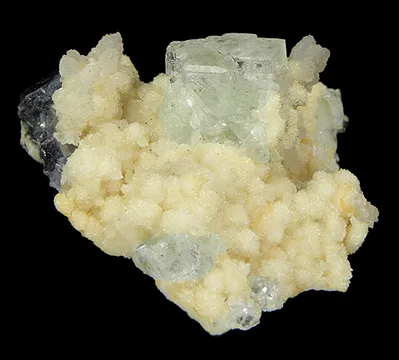
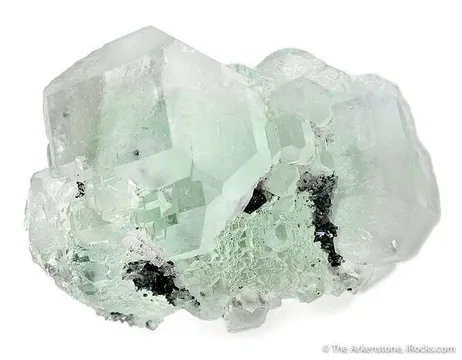
Naica fluorite is the locality’s signature cabinet mineral: typically colorless to very pale green, sometimes faint lavender or bluish purple, and commonly in sharp cubes, octahedra, cuboctahedra, and highly modified stepped crystals with beveled edges. Crystal size ranges from small drusy crystals to showy cabinet examples of several centimeters; fine examples reported from collections and dealers include transparent to translucent crystals around 5 cm across, often perched on calcite, pyrite, sphalerite, galena, quartz, or chalcopyrite. What separates a good Naica fluorite from an ordinary one is not saturation of color but clarity, luster, form, and association: a crisp pale green crystal with sharp modified edges, a clean calcite base, bright sulfides, and visible fluid inclusions has the unmistakable Naica look, while dull, bruised, or overly etched pieces can lose much of the locality’s quiet elegance.
Naica calcite is both a display mineral and the essential stage on which many of the mine’s better sulfide and fluorite specimens perform. It occurs as creamy to white druse, rhombic crystals, scalenohedral forms, botryoidal coatings in cave settings, and larger rhombs or masses carrying galena, chalcopyrite, pyrite, sphalerite, fluorite, quartz, or gypsum. The best pieces show contrast: metallic galena or black sphalerite set cleanly against lustrous white calcite, pale fluorite placed on sparkling calcite, or well-formed calcite crystals with minimal bruising. Because calcite is common in the district, rarity is not the point; form, freshness, and association are everything.
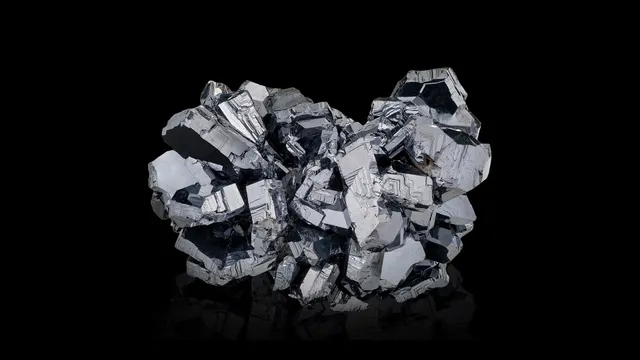
Naica galena ranges from bright cubic and cuboctahedral crystals to complex, platy, and spinel-law-twinned groups, commonly associated with pyrite, chalcopyrite, sphalerite, calcite, quartz, and pale fluorite. Good examples may show sharp modified octahedral crystals around the centimeter scale, while older dealer descriptions record larger complex crystals several inches across; the finest collector pieces combine metallic luster, crisp edges, and an uncluttered perch on contrasting white calcite or brassy pyrite. Naica galena is especially valued when it avoids the massive-ore look and instead displays clean crystal architecture, balanced sulfide contrast, and a credible Naica Mine label rather than an unsupported old district sub-mine name.
Naica sphalerite is usually dark brown to black, resinous to brilliant, and strongly tied to the mine’s lead-zinc-silver ore assemblage. It occurs as sharp crystals and groups with calcite, fluorite, galena, pyrite, quartz, and chalcopyrite; notable specimens include lustrous black crystals to several centimeters, sometimes with spinel-law twinning and a gemmy green fluorite accent. The best sphalerites from Naica have sharp form and reflective luster rather than merely massive ore texture, and they are most desirable when the black crystals stand out against white calcite or are joined by the classic pale fluorite and metallic sulfide suite.
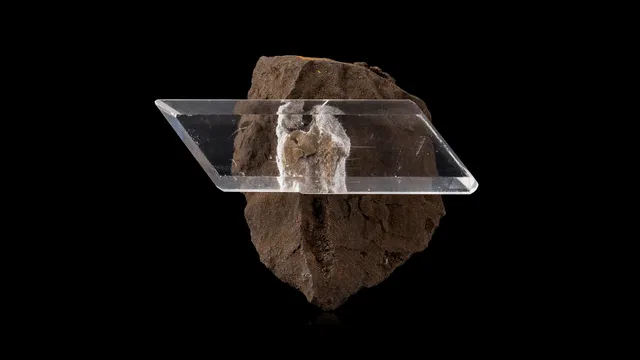
Gypsum is the mineral that made Naica world-famous, occurring as transparent to milky selenite, bladed “sword” crystals, stumpy crystals, cave linings, and, in the deepest chamber, giant beams beyond normal specimen scale. Historical Cave of Swords material includes colorless crystals from several inches to more than a foot, larger gray blades several feet long, and water-filled channels with movable bubbles; later Naica gypsum specimens in collections more commonly come from smaller natural cavities throughout the mine or from mine-water environments rather than from the protected Cave of the Crystals. A good collectible Naica gypsum is clear, lustrous, well terminated, and minimally cleaved, with reliable provenance; size alone is less important than preservation, transparency, and freedom from misleading “Cave of the Crystals” claims.
Naica pyrite occurs as brassy, lustrous crystals and drusy coatings in the sulfide assemblage, commonly accompanying fluorite, calcite, galena, sphalerite, quartz, and chalcopyrite. It is rarely the only reason to acquire a Naica specimen, but it is often what gives the best pieces their visual snap: bright pyrite scattered across white calcite, framing dark galena, or providing a golden base for pale green fluorite. The strongest pyrite specimens show sharp crystals, bright color, and stable surfaces; ordinary pieces are those in which pyrite is merely granular ore or dull background texture.
Selenite is the transparent, colorless to milky crystal habit of gypsum that defines the Naica caves. In collector pieces it appears as blades, spears, tabular crystals, and clear cleavable masses, with some historical crystals showing water-filled channels and movable bubbles. The finest Naica selenites have moonlike translucence, bright faces, complete terminations, and honest provenance from the Naica Mine or Cave of Swords-era material; claims of removable specimens from the Cave of the Crystals should be regarded as suspect because that chamber’s megacrystals were not a commercial specimen source.
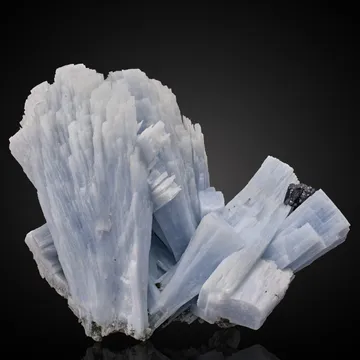
Anhydrite at Naica is more than an accessory sulfate; it is central to the geological explanation for the giant gypsum. Late hydrothermal anhydrite was present in the system, and the slow solution-mediated transition from anhydrite to gypsum under a narrow thermal window supplied the calcium and sulfate for the famous selenite megacrystals. Collectible Naica anhydrite appears from sulfide-zone and gangue cavities rather than as showy cave beams, commonly in pale, blocky to bladed masses or crystals associated with calcite, fluorite, quartz, sulfides, and gypsum; good pieces are clean, crystallized, and well documented, while ordinary pieces can be massive, cleaved, or difficult to distinguish visually without context.
Quartz is a subordinate but important Naica gangue mineral, reported with calcite, fluorite, sphalerite, galena, pyrite, chalcopyrite, and skarn assemblages. Collector pieces tend to show quartz as clear to white crystals, druse, or matrix rather than as large standalone quartz specimens; it is most attractive when it supports pale fluorite or dark sphalerite and gives additional sparkle to the calcite-sulfide association. Because quartz is common globally, Naica examples need locality character to matter: association with fluorite, galena, sphalerite, pyrite, and calcite, plus a reliable Naica Mine provenance, is what lifts them above generic hydrothermal quartz.
Chalcopyrite is a minor but visually important sulfide at Naica, occurring as brassy crystals and aggregates with sphalerite, galena, pyrite, calcite, quartz, and fluorite. Older specimen descriptions note sharp, bright chalcopyrite crystals to about an inch associated with galena and calcite, while modern collector pieces often show chalcopyrite as accents on sphalerite or fluorite combinations. The best Naica chalcopyrite specimens have distinct crystal form and clean metallic contrast; less desirable pieces are massive or tarnished sulfide fragments without the crisp fluorite-calcite-galena-sphalerite context that makes the locality recognizable.
Collectors should treat “spinel” on Naica material with special care, because the most common verified use of the word in Naica specimen descriptions is not the mineral species Spinel, MgAl2O4, but spinel-law twinning in galena and sphalerite. True spinel is not one of the famous display minerals of the Naica orebody in the way fluorite, galena, sphalerite, calcite, gypsum, and anhydrite are; any specimen offered as Spinel species from Naica deserves analytical confirmation and a careful look at whether the label is actually describing twinned galena or sphalerite. If present as a skarn accessory, it would be a locality rarity rather than a cabinet classic, and its value would rest on documentation more than showiness.
Barite is a scarce accessory in Naica collections, but it appears in older specimen descriptions as transparent tabular crystals associated with galena, pyrite, etched fluorite, and calcite. It is far less common than fluorite, calcite, galena, sphalerite, gypsum, or anhydrite, so a good Naica barite is primarily an association and provenance specimen: tabular, well terminated, clear to pale, and sitting in the classic sulfide-gangue matrix. Ordinary barite from Naica is easily overlooked unless it is distinct from the surrounding calcite and fluorite and backed by a reliable old label or collector history.
Pyrrhotite is part of the primary sulfide assemblage at Naica and is important geologically even though it is much less visible in the specimen market than galena, sphalerite, and pyrite. It occurs with the lead-zinc-silver sulfides and may be partly altered or replaced by pyrite in the ore system, making fresh, well-crystallized collector examples scarcer than its abundance in the ore might suggest. Good Naica pyrrhotite specimens require sharp form, attractive association, and stability; massive bronzy sulfide with alteration is more of an ore sample than a high-grade collector piece.
Amethyst is a minor and uncommon expression of quartz at Naica, far outside the mine’s main reputation for pale fluorite, metallic sulfides, calcite, anhydrite, and gypsum. Any purple quartz attributed to Naica should be judged conservatively: the most convincing pieces would show modest lavender to purple quartz in the expected Naica gangue and sulfide association, with old or reliable provenance, rather than isolated crystals that could belong to many other Mexican localities. Because Naica also produces pale purple fluorite, careful identification matters; color alone is not enough, and the best pieces are those in which the quartz habit, hardness, and associations make the attribution credible.
Other documented Naica minerals reflect both the orebody and the cave system. The sulfide-skarn assemblage includes arsenopyrite, molybdenite, scheelite or powellite, cassiterite, cosalite and other sulfosalts, hedenbergite, garnet, epidote, vesuvianite, wollastonite, dolomite, and magnetite, while cave-mineral studies have documented an unexpectedly diverse suite including calcite, aragonite, dolomite, celestine, opal, quartz, goethite, hematite, epsomite, and other soluble sulfates and secondary minerals. Naica is not chiefly celebrated as a type-locality district; its rarities are better understood as byproducts of an unusually complex skarn-carbonate-replacement deposit overprinted by hot sulfate waters and cave mineralization.
The single most important authenticity issue at Naica is not synthetic material; it is labeling. Specimens from the modern sulfide-mining era are often best labeled simply Naica Mine, Naica, Saucillo Municipality, Chihuahua, Mexico. Older district mine names may be valid for genuinely old oxide-zone material, but many labels assigning ordinary sulfide-zone specimens to Gibraltar, Maravillas, Siglo XX, or other pre-consolidation workings should be treated cautiously unless supported by strong provenance.
A second labeling problem concerns gypsum. No commercial specimens should be represented as having been collected from the Cave of the Crystals. The giant crystals are far too large, protected, and scientifically significant, and the chamber was not a specimen-producing pocket for the market. Many natural Naica gypsum specimens came from smaller caves and cavities throughout the mine, and some gypsum crystals grown in mine-water systems or pumping infrastructure can reach specimen size quickly. Such pieces may be attractive and legitimately Naica, but “Cave of Swords” or “Cave of the Crystals” claims require more than a dealer tag.
Condition is critical. Fluorite should be checked for edge bruises, cleavage, internal fractures, and repairs, especially on modified corners. Calcite is vulnerable to rubbing and contact marks; drusy white calcite can mask small scuffs until viewed under strong light. Galena commonly shows edge dings, dulling, or surface alteration; the best crystals have sharp reflective faces. Sphalerite may chip along edges and can look deceptively complete when dark crystals hide damage. Gypsum and selenite are soft, cleavable, and easily scratched by fingernails, so even small contact marks matter on transparent crystals. Large gypsum blades also need careful support in storage and shipping.
Fluorescence and optical effects add interest but should not be oversold. Naica fluorite may fluoresce and may contain fluid inclusions, including enhydro-style bubbles in some specimens; historical gypsum from the caves was also noted for water-filled channels with movable bubbles. These features are desirable when real and visible, but they should be verified with magnification and careful lighting. Avoid soaking gypsum, avoid acids on calcite-bearing specimens, and keep sulfide-rich pieces dry and stable.
Market availability remains good for Naica fluorite, calcite, galena, sphalerite, and gypsum because substantial material entered collections before the 2015 suspension. However, the supply is no longer the same as when the mine was producing fresh specimen pockets. Common small fluorite-calcite-pyrite pieces remain obtainable, while top examples with large sharp fluorite, fine spinel-law-twinned galena, lustrous sphalerite, old Cave of Swords gypsum provenance, or strong multi-mineral composition are increasingly collection-to-collection pieces.
In 1927, William F. Foshag described the older selenite caves of Naica in words that still feel like field notes from another era. To reach the camp, he traveled to Conchos on the Mexican Central Railroad, about 130 kilometers south of Chihuahua City, then continued by narrow-gauge line for roughly 30 kilometers to Naica. The famous cave in the Maravilla Mine was already treated as something worth protecting: it stood behind a heavy wooden door, guarded to prevent vandals from stripping its crystals. Beyond the door, a short passage led into a chamber whose walls and ceiling were crowded with colorless gypsum crystals from six inches to more than a foot long. Broken limestone blocks on the floor had been coated in botryoidal calcite and scattered with gypsum blades; between them, clear selenite crystals stood like figures in small niches.
Foshag’s route then descended into a stranger and larger part of the cave. There the gypsum reached four, five, and perhaps six feet long, growing from the floor in groups he compared to maguey plants on the Mexican hills. Some blades were gray with included mud but capped with clear white terminations. Farther in, a narrow opening just large enough for a man was lined with blade-like gypsum on every side, a passage so literal that “Cave of Swords” sounds less like a nickname than an inventory. Past that corridor, the floor rose at about 30 degrees and was banked with countless selenite blades one to three feet long. One radiating group stood more than four feet high, and nearby a single stumpy crystal, estimated around sixty pounds, carried a long blade nearly four feet in length.
For decades, that was the Naica legend: a hot Mexican mine with a guarded cave of swords. Then, in April 2000, brothers Eloy and Javier Delgado were driving a new tunnel roughly 1,000 feet down in the Naica Mine when the drill opened into emptiness. Eloy, then forty years old, climbed through a small hole into a cavern only about 30 by 60 feet, but packed with crystals on a scale no collector’s cabinet could prepare him for. His remembered description is still the best: “It was beautiful, like light reflecting off a broken mirror.” A month later, another team found a still larger adjacent chamber.
The first photographs seemed almost unbelievable because the cave reversed normal expectations. It looked icy, yet it was lethal with heat. Temperatures were commonly described around 50 to 58°C, with humidity near saturation. Explorer and photographer Richard Fisher compared stepping into the large cavern to entering a blast furnace; within seconds clothing became soaked with sweat. Without specialized protection, visits were measured in minutes. Fisher recalled having to concentrate intensely just to return to the door, only 30 or 40 feet away, after taking a few photographs.
Scientists arrived because the crystals were not just huge; they were an experiment nature had run for hundreds of thousands of years. Juan Manuel García-Ruiz and colleagues studied tiny fluid inclusions and argued that the giant gypsum grew at very low supersaturation from low-salinity waters near 54°C, just below the anhydrite-gypsum transition. In ordinary mineral collecting, “large” might mean a 5 cm fluorite crystal. In Naica’s deepest chamber, crystal growth had become structural geology: beams up to roughly 11 meters long and tens of tonnes in mass crossed the cave like transparent timbers.
The cave also became a proving ground for people. Researchers and film crews used orange cooling suits, ice vests, frozen air systems, and strict time limits. NASA astrobiologist Penelope Boston later recalled seeing early images of the cave and thinking they were a Photoshop hoax. When she finally entered with a National Geographic documentary crew in 2008, the crystals were taller than telephone poles and wider than tables, but she was looking for something smaller: possible microorganisms trapped in fluid pockets inside the gypsum. Even with cooling gear, she described a pushed visit of about 50 minutes as a near-fatal mistake. The grandeur of the cave was obvious; surviving long enough to study it was the hard part.
Naica’s most poetic dilemma was also practical. The giant caves were accessible only because mine pumping had removed the hot water that normally filled them. Stop pumping, and the caves would return toward their natural flooded state, protecting the crystals from dry-air deterioration and perhaps allowing growth to resume. Keep pumping, and people could study and photograph them, but the crystals would remain exposed. By 2015, the mine’s flood problems had overtaken the debate. For collectors, the lesson is sharp: Naica’s greatest crystals were never collectible in the ordinary sense. Their proper home was the mine itself, whether seen briefly by overheated humans or hidden again in hot, mineralized darkness.

_4_(49207138372).jpg)