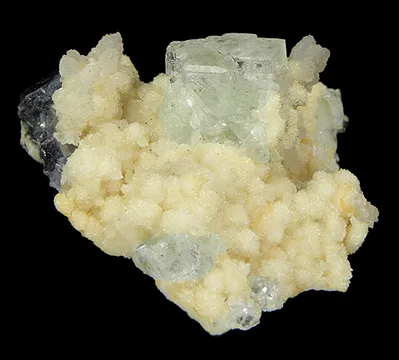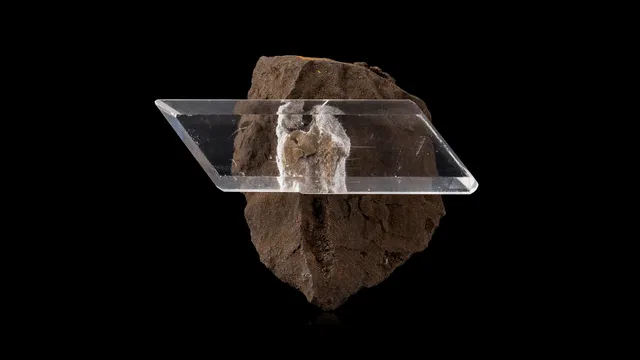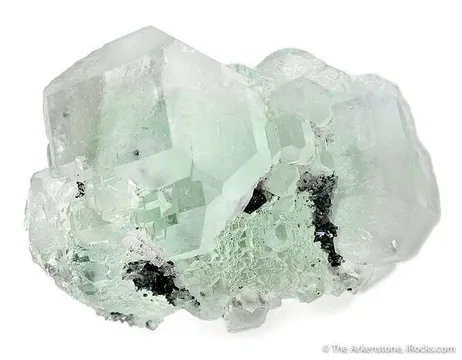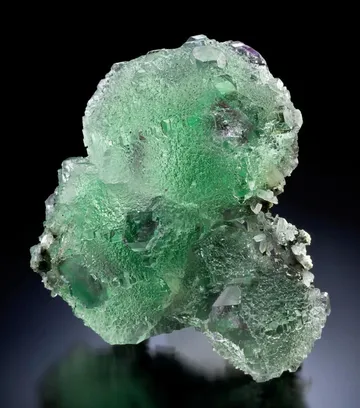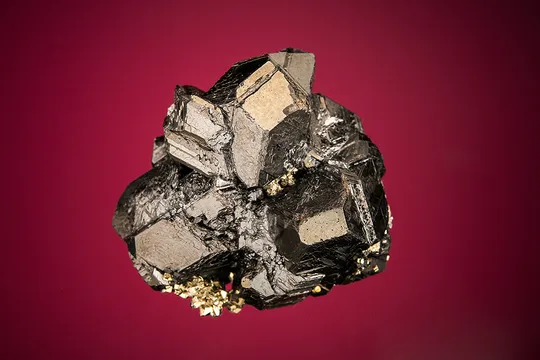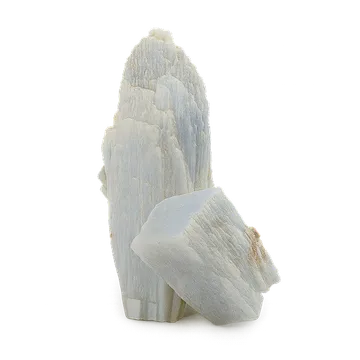
Anhydrite from Naica Mine, Mexico — pale blue prismatic blades in sprays with silky striations; a classic display mineral that boosted collector appeal.
Key facts
Naica anhydrite is one of the rare cases where a normally modest sulfate became a classic display mineral. The best specimens are immediately recognizable: pale blue to blue-gray prismatic blades of CaSO4, commonly in subparallel sprays or jackstraw clusters, with silky striations, pearly cleavages, and blocky, often ragged terminations. In fine examples the blue is cool and understated rather than electric—more glacial than gemmy—and the most aesthetic pieces show translucent blue blades rising from white to colorless calcite, sometimes with small sulfides or fluorite as accents.

Photo: Rob Lavinsky, iRocks.com, via Wikimedia Commons
The locality is famous to the wider world for the enormous gypsum crystals of the Naica caves, but those giant selenite beams are only one chapter in a broader calcium-sulfate story. Naica is a hot, deep, carbonate-hosted Pb-Zn-Ag skarn and replacement system in the Sierra de Naica of Chihuahua. Hydrothermal fluids moved through Cretaceous limestones, fractures, dikes, mantos, and chimneys, depositing sulfides, calc-silicates, fluorite, calcite, gypsum, and anhydrite at different stages. The same chemical pair—anhydrite and gypsum—links the cabinet specimens collectors pursue with the world-famous caves: anhydrite is the anhydrous calcium sulfate, gypsum the hydrated form, and Naica’s thermal waters sat close to the delicate stability boundary between the two.
For collectors, Naica’s importance is simple: it gave anhydrite a face. Before the major Naica discoveries reached the specimen market, anhydrite was better known as a rock-forming or evaporite mineral than as a cabinet species. Naica changed that by producing attractive, sizeable, visibly crystalline, pale-blue specimens with a habit distinct enough to be recognized across a room. The best pieces are not judged by color saturation alone; they are judged by the sculptural arrangement of blades, the preservation of terminations, the contrast with calcite, and the degree to which the specimen retains the soft, icy translucence that makes Naica material so different from massive “angelite”-type blue anhydrite.

Photo: Alcinoe, via Wikimedia Commons
Search for specimens: View all anhydrite specimens from Naica Mine, Mexico
The Naica Mine is at Naica, Saucillo Municipality, Chihuahua, Mexico, in the Sierra de Naica, southeast of Chihuahua City. It is an underground lead-zinc-silver mine developed in thick-bedded Cretaceous limestone, with mineralization localized by faults, fractures, felsite dikes and sills, skarn zones, mantos, and chimney-like replacement bodies. The deposit is not a simple evaporite occurrence; its collectible anhydrite belongs to a hydrothermal carbonate-replacement environment, part of a large and long-lived ore system whose paragenesis also includes calcite, fluorite, quartz, pyrite, galena, sphalerite, chalcopyrite, skarn silicates, and later gypsum.
Naica’s ore history is long. Mineral deposits were first found in 1794, formal exploitation began in 1900, and the mine came under Peñoles control in the 1960s. In its last full operating year before the flood shutdown, the mine produced lead, zinc, and silver concentrates and remained one of Mexico’s important lead mines. Water was always the central operational problem: Naica’s deep workings were held open only by continuous dewatering in a hot hydrothermal setting. A major flood began on January 1, 2015, and after months of unsuccessful efforts to lower the water level enough for safe production, Peñoles formally suspended operations indefinitely in October 2015.
The anhydrite specimens that collectors know were recovered from mine workings and crystal-lined faults, not from tourist collecting. The mine is a commercial underground operation, and collecting access has never been comparable to a public rockhounding site. Historically, specimens reached the market through miners, local trade, and dealers buying in the district, especially during the decades when Naica was active and producing. Since the 2015 suspension, fresh production has been sharply reduced or absent, so the market is increasingly dependent on older stocks, dealer inventories, and resold collection pieces.
The locality label deserves care. Many older Mexican sulfate specimens are loosely labeled “Naica,” and for most post-1950s material the most useful collector label is “Naica Mine, Naica, Saucillo Municipality, Chihuahua, Mexico.” Gypsum specimens from named caves such as the Cave of Swords or Cave of Crystals should not be casually transferred to anhydrite labels, and anhydrite specimens should not be romanticized as coming from the giant gypsum cave unless there is specific documentation. For most collector-quality anhydrite, “Naica Mine” is the accurate and sufficient locality.
Naica’s greatest public fame rests on the caves: the Cave of Swords at roughly the 120 m level, and the later-discovered deep caves at about the 290–300 m level, including Ojo de la Reina, Cueva de las Velas, and Cueva de los Cristales. These caves are not important because they supplied anhydrite cabinet specimens, but because they reveal the remarkable calcium-sulfate environment that makes Naica scientifically singular. In the caves, gypsum grew from solutions maintained near the gypsum-anhydrite equilibrium, while the collectible anhydrite crystals came from hydrothermal faults and cavities in the mine’s ore environment.
Naica anhydrite is typically pale blue, blue-gray, bluish white, or nearly colorless in thin transmitted light. The color is soft and cool; the finest specimens have enough translucence that the blue seems to sit inside the crystal rather than on its surface. Cabinet pieces often show elongated prismatic to bladed crystals grouped in parallel or near-parallel bundles. Many are “jackstraw” clusters, with blades crossing or fanning in several directions, while matrix specimens place the blue anhydrite on white to colorless calcite.
The classic habit is prismatic to bladed, with flat-looking ends that can be deceptive. Naica crystals may have multiple ragged terminations, but broken tips and cleavage surfaces are common. A slightly convex cleavage face across the top of a blade can look like a natural termination at first glance. Serious collectors examine the ends under magnification and raking light: true terminations tend to show growth geometry, while broken or cleaved ends show the smoother, more pearly character of anhydrite cleavage.
Size is one of the locality’s strengths. Fine miniature and small-cabinet specimens exist, but Naica is especially prized for cabinet-scale clusters. Documented specimens include groups in the 7–16 cm range, individual blades exceeding 10 cm, and large sprays with fan groups on the order of 10 cm or more. Small clusters can be very attractive if sharply composed, but the classic Naica look is a broad, pale-blue spray of blades large enough to show the species’ distinctive luster and cleavage.
Calcite is the most important associated mineral for display specimens. White, off-white, or colorless calcite provides contrast and helps support the anhydrite blades visually and physically. Fluorite, sphalerite, galena, chalcopyrite, pyrite, and skarn minerals occur in the broader Naica assemblage, though they are less common as direct associates on anhydrite specimens than calcite. When fluorite or sulfides are present in a balanced composition, the specimen gains locality context as well as color contrast.
Quality is governed by five factors. First is crystal architecture: sprays, fans, and parallel-growth groups are more desirable than massive or confused aggregates. Second is color: a natural pale blue is classic, but it should be judged in harmony with translucence and luster rather than as a demand for intense saturation. Third is preservation: undamaged terminations and crisp edges are scarce because anhydrite has good cleavage and is vulnerable to mining damage. Fourth is matrix: calcite matrix can elevate a specimen if it frames the blue blades without overwhelming them. Fifth is provenance: older labels, dealer history, and precise Naica Mine attribution matter more now that the mine is no longer a regular source.
Naica anhydrite is not commonly faked in the way that high-value gem crystals are, and no well-documented, locality-specific fake type appears to be established for Naica anhydrite. The more realistic concerns are mislabeling, repaired clusters, cleavage damage being described as termination, and confusion with massive blue anhydrite sold under lapidary trade names. True Naica collector specimens should show natural crystal habit—bladed to prismatic groups, often pale blue, commonly with calcite—not simply carved or polished blue anhydrite.
Condition is the chief challenge. Anhydrite has Mohs hardness about 3 to 3.5 and excellent cleavage, so bruised edges, contacted faces, and broken blade tips are common. Many specimens were extracted during mining rather than careful pocket collecting, and even attractive pieces may have small losses. On Naica material, the top of a crystal deserves special inspection: a flat, slightly rounded end may be a cleavage scar, not a termination. This is not automatically fatal to the specimen, because many classic pieces have some cleaved ends, but it affects value and should be disclosed.
Avoid soaking Naica anhydrite in water. Anhydrite is the anhydrous calcium sulfate phase, and while cabinet specimens are generally stable in normal indoor conditions, prolonged moisture is undesirable. Keep specimens dry, avoid ultrasonic cleaning, avoid acidic cleaners because of common calcite associations, and use only gentle mechanical dusting. If a specimen is on calcite matrix, cleaning choices must respect both minerals.
The market is finite. Naica produced enough anhydrite that specimens are not unobtainable, but genuinely fine pieces—large, sculptural, pale blue, well terminated, and on attractive calcite—are much scarcer than average examples. Since the 2015 flood shutdown and indefinite suspension of mine operations, new supply has not behaved like a normal active-mining locality. Many available specimens are older pieces moving between collections, dealer backstock, or material with broad “Naica, Chihuahua” labels rather than detailed modern labels.
For value, the strongest Naica anhydrites are not necessarily the biggest. A smaller specimen with fresh, translucent blue blades, minimal bruising, and an elegant fan on calcite can outrank a larger but heavily cleaved mass. Conversely, a large cabinet cluster with preserved blade tips and strong three-dimensional architecture is a true classic for the species and deserves treatment as more than just “blue anhydrite.”
The Naica story begins like many great mineral stories: with miners trying to solve an ore problem and finding something the orebody had kept hidden. In 1910, workings at about 120 m depth broke into the Cave of Swords, an 80 m long chamber whose entrance was reportedly sealed by selenite gypsum crystals, some reaching about 2 m. At the time, these were astonishing enough to make the cave famous. For much of the twentieth century, the Cave of Swords defined the public image of Naica’s crystals, and examples from that system entered major museum collections.
Then, in April 2000, the mine delivered a second revelation. At the -300 m level, Eloy and Francisco Javier Delgado encountered Ojo de la Reina while excavation and dewatering opened access to what had been part of the thermal aquifer. A few days later, miners found the Cueva de los Cristales, the cave now lodged in the global imagination: a hot chamber filled with giant prismatic selenite crystals. The first entries were brutally short. Without special gear, people could remain only minutes in nearly 50 °C air at almost 100 percent humidity. The crystals looked like ice, but the cave was closer to a wet furnace.
In January 2001, a first small team—geologists, engineers, one speleologist, and a mine-worker guide—entered for a formal visit. Later that year, members of the La Venta Exploring Team came to document the caves with photographs and video. The environmental measurements tell the story better than any exaggeration: in October 2002, the cave measured 47.38 °C with nearly saturated humidity. Human bodies became the cold objects in the room, and the cave punished them for it. To work longer than a few minutes, researchers developed protective systems with names as memorable as the cave itself: the “Tolomea” suit and the “Sinusit” cooling breathing system. With that equipment, visits of more than an hour became possible, and explorers’ temperature, blood pressure, and pulse were monitored as part of the operation.
The cave survey work was as exacting as it was theatrical. Between 2006 and 2007, teams mapped the Cave of Swords, Cave of Crystals, Cave of Sails, Ojo de la Reina, and nearby mine galleries. In the Cave of Crystals alone, 162 giant gypsum crystals were measured and geolocated. Their lengths clustered most commonly around 4–6 m, with preferred orientations recorded around 290° and 320° N. The public remembers the largest beams; the surveyors saw a three-dimensional population of crystals, each with a position, axis, and growth history.
The science of Naica’s gypsum led straight back to anhydrite. Researchers studying fluid inclusions, isotopes, and solubility concluded that the giant gypsum crystals grew because hot water remained near the equilibrium boundary where anhydrite dissolves and gypsum can precipitate. Anhydrite, already present from earlier stages of the hydrothermal system, supplied calcium and sulfate to a solution that was only barely supersaturated with respect to gypsum. That delicate state discouraged mass nucleation and favored the slow enlargement of a few crystals into immense beams. In a collector’s cabinet, a pale blue Naica anhydrite spray is therefore more than a handsome sulfate; it is a hand-sized expression of the same calcium-sulfate chemistry that produced Naica’s cavern-sized spectacle.
The anhydrite collecting story has its own underground drama. Reports from the specimen trade describe a 1981 blast into a fault lined with thousands of flat, pale gray-blue anhydrite crystals. When that material reached the market, Naica became the classic locality for collectible anhydrite almost at once. Later accounts describe additional recovery after miners again reached the same productive fault in the 2000s. These were not genteel museum excavations. They were episodes within an active, hot, wet, economically driven mine, where collecting could be tolerated, contested, or abruptly ended depending on the workings, the workers, and the company’s immediate priorities.
One of the most sobering field stories is not about discovery but preservation. In the deep caves, researchers found that the very act of making the caves accessible had changed them. Dewatering lowered the water table; air replaced the hydrothermal solution; condensation, dissolution, white patinas, abrasion, and broken edges appeared on crystals that had grown submerged. A person entering the cave was not neutral: at roughly body temperature, that person was a “cold object” moving through hot saturated air, encouraging condensation on crystal surfaces. By 2008, visits to the Cave of Crystals were limited to scientific purposes, and the cavity was protected by a steel door and later a transparent barrier so visitors could see without entering the deadly atmosphere.
The 2015 flood added a final turn. For mining, it was a shutdown. For the caves, reflooding was also a return toward the conditions that had preserved them before humans arrived. For collectors, it marked the end of Naica as a predictable source of new specimens. The anhydrite already above ground—pale, cleavable, blue, and unmistakably Naica—became a finite record of a mine that had briefly made anhydrite famous.
Mindat occurrence: Anhydrite from Naica Mine, Naica, Saucillo Municipality, Chihuahua, Mexico — The most useful collector-facing occurrence record for Naica anhydrite, including habit, color, associated minerals, photo counts, and locality references.
Mindat locality: Naica Mine, Naica, Saucillo Municipality, Chihuahua, Mexico — Broad locality record covering the mine geology, cave discoveries, mineral list, and production context.
Stone, John Grover. 1959. “Ore genesis in the Naica District, Chihuahua, Mexico.” Economic Geology 54(6): 1002–1034. DOI: 10.2113/gsecongeo.54.6.1002 — Classic ore-genesis paper for understanding Naica as a Pb-Zn-Ag replacement/skarn system rather than an evaporite-only locality.
Ruiz, Joaquin, and Mark D. Barton. 1985. “Geology and Geochemistry of Naica, Chihuahua, Mexico.” — Conference paper record summarizing Naica’s mantos, chimneys, Cretaceous limestone host rocks, felsite dikes, skarn assemblages, and isotopic interpretation.
García-Ruiz, J. M., Villasuso, R., Ayora, C., Canals, A., and Otálora, F. 2007. “Formation of natural gypsum megacrystals in Naica, Mexico.” Geology 35(4): 327–330. DOI: 10.1130/G23393A.1 — Key paper explaining the giant gypsum crystals through an anhydrite-gypsum phase-transition mechanism near the solubility boundary.
Gázquez, F., Calaforra, J. M., Forti, P., and Badino, G. 2016. “The Caves of Naica: a decade of research.” Boletín Geológico y Minero 127(1): 147–163 — Comprehensive review of Naica cave discovery, survey, microclimate, mineralogy, conservation, and research history.
Van Driessche, A. E. S., et al. 2011. “Ultraslow growth rates of giant gypsum crystals.” Proceedings of the National Academy of Sciences — Experimental work on the extremely slow gypsum growth rates relevant to Naica’s giant crystals.
Stawski, T. M., Smales, G. J., Scoppola, E., et al. 2021. “Seeds of imperfection rule the mesocrystalline disorder in natural anhydrite single crystals.” arXiv preprint — Study focused directly on large Naica anhydrite single crystals and their multiscale structural imperfections.
Wikimedia Commons: “Anhydrite-261625.jpg” — Rob Lavinsky photograph of a major Naica anhydrite specimen, useful for visual reference and specimen-scale description.
Wikimedia Commons: “Anhydrite HMNH1.jpg” — Photograph of a Naica anhydrite specimen displayed at the Harvard Museum of Natural History.
“Deadly Crystal Cave” — National Geographic — Short National Geographic video segment on the extreme environment and scientific interest of Naica’s giant gypsum cave.
“First in the Cave” — National Geographic — National Geographic video focused on entering and documenting the Naica crystal cave environment.
“Naica: Secrets of the Crystal Cave” — Documentary listing on Plex — Listing for the 2008 documentary devoted to exploration and study of the Naica crystal caves.
“Into the Lost Crystal Caves” — National Geographic coverage — Article tied to National Geographic’s cave-documentation work, useful for context on exploration and filming of the deeper Naica cave system.
Peñoles — Naica mining unit — Official operator page with mine history, ownership, production data, deposit type, capacity, and the 2015 flood shutdown.
NASA Science Photojournal — Naica Mine, Chihuahua, Mexico — Concise remote-sensing and locality overview noting Naica’s limestone setting, Cave of Swords discovery, and giant gypsum crystals.
Smithsonian Magazine — “Crystal Moonbeams” — Readable account of the 2000 cave discovery and the spectacular scale of Naica’s selenite.
National Geographic — “Giant Crystal Cave’s Mystery Solved” — Accessible report on García-Ruiz’s explanation of the giant gypsum crystals and the role of anhydrite-rich waters.
National Geographic — “Weird Life Found Trapped in Giant Underground Crystals” — Article on microbiological research from fluid inclusions in Naica crystals.
Expansión — “Naica, la otra mina que tuvo que cerrar por una inundación” — Spanish-language business report on the 2015 flood, production losses, and closure context.
Mindat anhydrite mineral page — General mineral data for anhydrite, including formula, properties, and global occurrence context.
Wikimedia Commons — Category: Minerals of Naica — Large image category with Naica anhydrite, calcite, fluorite, and other mineral photographs.