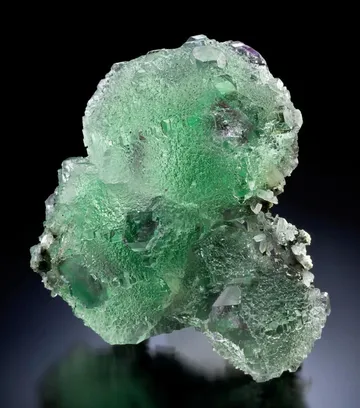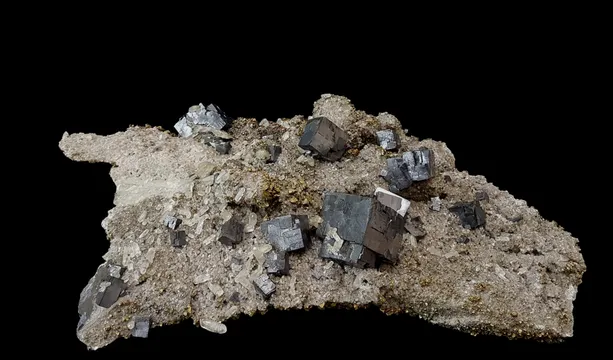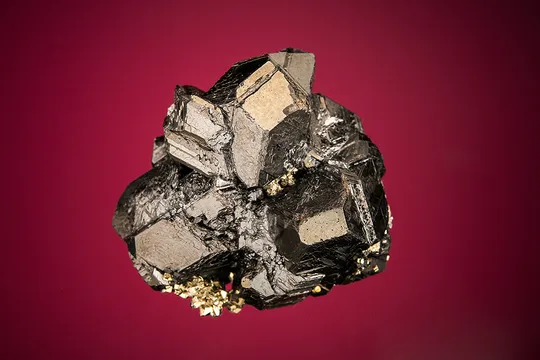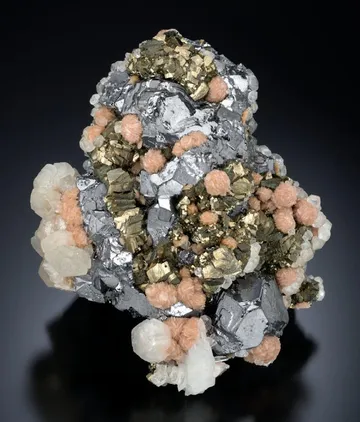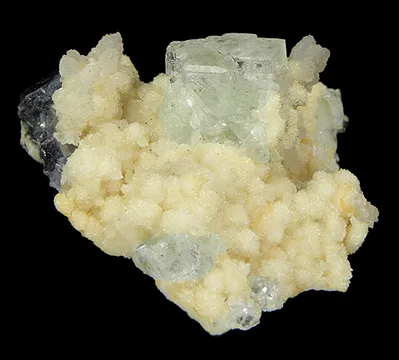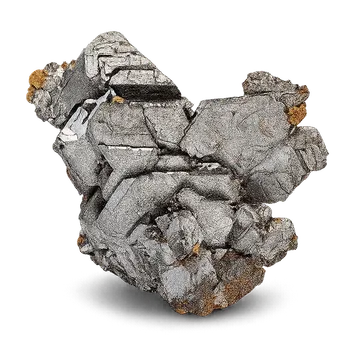
Naica Mine, Mexico — famed galena from a Pb-Zn-Ag system, with bright metallic cubes and striking associations to calcite, quartz, fluorite, and selenite caves.
Key facts
Galena from the Naica Mine belongs to one of Mexico’s great lead-zinc-silver systems: a hot, carbonate-replacement and skarn-related orebody in the Sierra de Naica of Chihuahua. For collectors, Naica galena is not merely “another” PbS occurrence. It is part of a locality whose specimens combine metallic sulfides with the pale, glassy, and fluorescent aesthetic of Naica’s gangue minerals—calcite, quartz, fluorite, pyrite, and sphalerite—while the mine itself is inseparable from the world-famous selenite caves opened by mining.
The best Naica galenas are bright, silvery to dark steel-gray, and sharply crystallized. They are often seen as clusters of modified cubes and cuboctahedral forms, skeletal aggregates, or spinel-law twins, commonly set into white calcite, drusy quartz, brassy pyrite, or pale green to colorless fluorite. The contrast can be exceptional: a hard metallic architecture against sugary white carbonate, glittering quartz, or gemmy fluorite. Fine examples have the clean, “Mexican sulfide” look collectors prize—strong luster, crisp form, and lively association—rather than simply massive ore.

Photo: Rob Lavinsky / Wikimedia Commons
Mineralogically, Naica is a large Ag-Pb-Zn replacement-skarn system localized by fractures, felsite dikes, and favorable Cretaceous limestone horizons. Sulfide mineralization is dominated by pyrite, galena, and sphalerite, with chalcopyrite and other sulfosalts and sulfides in lesser amounts. Fluorite, quartz, calcite, adularia, anhydrite, and gypsum add the specimen interest that separates Naica from many production-oriented lead deposits.
Historically, Naica’s fame rests on two parallel legacies. One is industrial: the mine became one of Mexico’s major lead producers and supplied significant zinc and silver as well. The other is mineralogical theater: mining exposed selenite-lined caverns, culminating in the 2000 discovery of the giant-crystal chambers. Those caves are not galena specimens, but they are part of the same hydrothermal-mining story and have made “Naica” one of the few mine names recognized far beyond the mineral-collecting world.
For serious collectors, the most desirable galena specimens from Naica are not simply the largest or heaviest. The best pieces show undamaged metallic crystals with strong separation from the matrix, classic Naica associations, and credible provenance. Fluorite-galena combinations, sharp spinel twins, bright skeletal groups, and old-stock specimens from before the 2015 flooding of the mine are especially appealing.
Search for specimens: View all galena specimens from Naica Mine, Mexico
The Naica Mine is located at Naica, in Saucillo Municipality, Chihuahua, Mexico, on the northeastern flank of the Sierra de Naica. The mine worked a major underground Ag-Pb-Zn system hosted principally by Cretaceous carbonate rocks. The ore occurs as mantos, chimneys, skarn-replacement bodies, and massive sulfide zones connected to a structurally controlled hydrothermal system.
The essential geological picture is a carbonate-replacement deposit with strong skarn affiliation. Felsite dikes and sills intruded the limestone and helped focus alteration and mineralization. Early calc-silicate assemblages—garnet, pyroxene, vesuvianite/idocrase, wollastonite, quartz, calcite, and scheelite among them—were followed or overprinted by sulfides. The main economic sulfides are galena, sphalerite, and pyrite, with chalcopyrite, pyrrhotite, arsenopyrite, and complex Bi-Sb-Ag sulfosalts also recorded. The sulfides occur along and around skarn bodies, as replacement chimneys, as mantos, and in structurally prepared zones.
Mining in the district reaches back to the late eighteenth century. The first concession is recorded for 1794, and small-scale work preceded formal exploitation. More systematic mining developed around the end of the nineteenth century and the early twentieth century under the Compañía Minera de Naica and successor operators. Through the twentieth century the property passed through several corporate hands before becoming associated with Peñoles control; Peñoles lists Naica under its control from 1964.
The mine was not a casual collecting locality. It was an active industrial underground mine, and collecting depended on mine access, miners, company permission, and later dealer networks. The most legitimate collector material in circulation generally comes from mine-produced specimens, old collections, or documented dealer stock. Public collecting access should be regarded as closed. The mine was suspended indefinitely in 2015 after serious flooding, and the underground workings and caves are not tourist collecting sites.
Before the flooding, Naica was a substantial producer. In 2014, Peñoles reported 711,000 tonnes of milled ore from Naica, with production of silver, lead, and zinc. The following year, a natural flooding event halted operations; after months of unsuccessful efforts to restore workable water levels, operations were suspended indefinitely. That closure changed the specimen picture: Naica galena still appears on the market, but much of what collectors see now is old-stock material, specimens released from older collections, or pieces that entered the trade before the flooding.
Naica’s most famous non-galena finds are its selenite caves. The Cueva de las Espadas, or Cave of Swords, was discovered in 1910 on the 120 level and is lined with swordlike gypsum crystals. In 2000, deeper mining encountered the giant-crystal chambers near the 290–300 m level. These caves made Naica world-famous, but they also underscore why the locality is not a collecting destination: the heat, humidity, flooding, scientific importance, and private mining status make unauthorized entry both dangerous and unacceptable.
Naica galena is classic lead sulfide, PbS: metallic, very heavy for its size, opaque, and silvery gray to dark steel gray. What distinguishes it as a collector material is its association and style. Rather than being valued mainly as isolated cubes, Naica galena is most often appreciated in combination specimens where the sulfide crystals sit on or among calcite, quartz, fluorite, pyrite, and sphalerite.
Crystal habits include sharp modified cubes, cuboctahedral crystals, skeletal or hopper-like aggregates, partial crystal groups, and spinel-law twins. Fine documented examples show brilliant metallic spinel-twinned galena crystals to about 9 mm on quartz and calcite, while larger cabinet specimens can carry clusters and partial galena groups across plates exceeding 15 cm. Massive to subhedral galena is also common in ore, but it is the crisp, lustrous, free-standing crystal groups that matter most to collectors.
The color range is narrow but expressive: fresh galena is bright silver to lead gray, often darkening toward steel gray or taking on a slightly iridescent sheen. The luster is a major quality factor. Naica’s better crystals can be mirror-bright, but damaged cleavage faces quickly interrupt the visual effect. Because galena has perfect cubic cleavage and is soft for a metallic sulfide, sharp corners, unbruised faces, and clean terminations are important.
Associations define much of the Naica look. White calcite is common and may occur as small dogtooth crystals or sugary coatings. Quartz can form drusy matrices that give a sparkling base. Pyrite provides brassy contrast, sometimes as fine crystals sprinkled through the matrix. Fluorite is especially desirable, occurring as colorless, pale green, seafoam-green, or sometimes purple to lavender crystals; Naica fluorite is itself a classic, and fluorite-on-galena or fluorite-with-galena combinations can be highly attractive. Sphalerite, chalcopyrite, and other sulfides appear in some assemblages.
Size varies widely. Thumbnail and small-cabinet pieces are common enough in old stock, particularly galena with calcite or quartz. Cabinet combinations with fluorite or broad sulfide matrices occur but are less frequently fine. Individual galena crystals in aesthetic specimens are often in the millimeter to low-centimeter range; large plates are judged less by maximum galena crystal size than by balance, luster, association, and lack of damage.
The strongest Naica pieces have several traits at once: bright metallic galena; recognizable crystal form rather than massive ore; contrasting white calcite or quartz; pyrite sparkle or fluorite color; and a stable, undamaged matrix. A galena-fluorite combination with gemmy fluorite crystals set against dark galena can be more desirable than a larger but visually monotonous galena mass.
Naica galena is collectible but not rare in the absolute sense; the mine was large, long-lived, and productive. What is scarce is top-quality material: sharp, undamaged, lustrous galena in balanced association with fluorite, calcite, quartz, and pyrite, especially with old labels or reliable mine provenance. Since the 2015 flooding and suspension of operations, fresh production-style availability has narrowed, and better examples increasingly circulate through old collections, auction lots, and established dealer inventories.
Condition is the first buying issue. Galena cleaves readily, and Naica specimens often sit on delicate carbonate or quartz matrices. Check for bruised corners, dull broken faces, rubbed high points, and edge chipping. On combination pieces, inspect the base of prominent galena crystals and the contact between galena and matrix for repairs. Heavy sulfides on friable calcite or drusy quartz can detach during mining, trimming, or shipping, so reattachment is not unusual in the broader galena market; it should be disclosed.
Naica fluorite-galena combinations require a second level of scrutiny. Fluorite can be chipped, cleaved, or internally fractured, and the contrast between bright fluorite and dark galena can hide small breaks. Look closely at crystal edges under a 10x loupe and use low, raking light to find glue seams, filled losses, or polished surfaces. A specimen can remain desirable with minor, disclosed repair, but undisclosed reconstruction should sharply reduce value.
No well-documented, locality-specific epidemic of fake Naica galena specimens has emerged in the standard collecting literature. The broader galena market, however, includes fabricated “galena geodes,” glued galena fragments, composite clusters, and artificially assembled pieces, so Naica labels should not be accepted blindly. The risk is greatest with unlabeled, dramatic-looking specimens sold without provenance, especially if the matrix looks artificial, the galena is sprinkled like crushed metallic gravel, or the crystal orientations make no geological sense.
Selenite from Naica carries its own authenticity and legal concerns. Loose “Naica crystal cave” selenite offered online may be misrepresented, illegally removed, or simply gypsum from another Chihuahua locality. That issue is not the same as galena collecting, but it affects the broader Naica market: a label reading “Naica” should be backed by credible source history, not just the fame of the name.
Because galena contains lead, specimens should be handled sensibly. Do not grind, sand, or dry-brush dusty material. Wash hands after handling, keep specimens away from children and food-preparation areas, and store friable pieces in trays or boxes that prevent abrasion. Properly kept, galena is stable as a display mineral; the practical hazard is dust and mishandling, not passive display in a cabinet.
Naica’s galena comes from an ore system already dramatic enough for any mining district: hot water, sulfides, dikes, skarn, carbonate replacement, and deep workings under a desert mountain. Yet the mine’s public imagination was transformed not by galena, but by gypsum.
The first great crystal story predates modern collecting. In 1910, miners working the 120 level broke into the Cueva de las Espadas, the Cave of Swords. The chamber was not the later cathedral of gigantic beams, but it was astonishing in its own right: walls, floor, and ceiling covered with selenite crystals, some more than 2 m long. For decades it stood as one of the mineralogical marvels of Naica, a hidden room of pale blades inside a lead-zinc-silver mine. Mid-century photographs show a cave already known and admired; later photographs show the same view still recognizable, an unusually durable witness in a working mine.
Then came April 2000. Deep underground, near the 290–300 m level, miners Eloy and Javier Delgado were driving new workings when they encountered a chamber filled with crystals on a scale that made the Cave of Swords seem almost intimate. Reports describe the first opening as small, the entry sudden, and the sight almost impossible to process: a cavern choked with immense translucent gypsum beams, some as long as trees. Eloy, then about forty, later described it as “beautiful, like light reflecting off a broken mirror.” That sentence remains one of the best descriptions ever attached to Naica, because it captures both the brilliance and the violence of the scene—light shattered and rebuilt as crystal.
The deeper crystal chambers were not friendly discoveries. They existed because mine dewatering had temporarily lowered the hydrothermal water table. The same water that had grown and preserved the gypsum had been pumped away for mining. Once exposed, the caves became fiercely hostile to human bodies. Temperatures in the giant-crystal environment reached around 58 °C, with humidity so high that sweat could not cool the skin. Researchers and camera crews needed carefully limited entries and specialized protection. Without cooling, useful time inside could be measured in minutes.
The scale was equally unforgiving. The Cueva de los Cristales lies roughly 300 m below the surface and contains some of the largest natural crystals ever documented: faceted selenite beams more than 10 m long. Scientific work on their growth found that they formed under extremely stable conditions near the gypsum-anhydrite boundary, where calcium sulfate could feed slow, steady crystal enlargement over immense spans of time. In the language of collecting, these are not “specimens” in any practical sense. They are the pocket itself, magnified to architectural scale.
For galena collectors, the lesson is subtle but important. The same mine that produced handsome metallic PbS combinations also revealed what hydrothermal patience can do when space, chemistry, temperature, and time align perfectly. Naica’s cabinet specimens—galena on calcite, fluorite on galena, pyrite-dusted quartz with sulfides—are hand-sized fragments of a much larger underground system. The famous gypsum caves are not a distraction from the ore minerals; they are the locality’s most spectacular proof that Naica was a living hydrothermal machine long after the sulfides had formed.
The final chapter, at least for now, arrived in 2015. Flooding forced Peñoles to halt production. After months of trying to lower water levels, the company suspended operations indefinitely. For the giant crystal caves, reflooding meant a return to the environment that had preserved them for so long. For collectors, it meant that Naica specimens became less a matter of future mine production and more a matter of what had already escaped the mine in the hands of miners, geologists, dealers, and old collectors.