






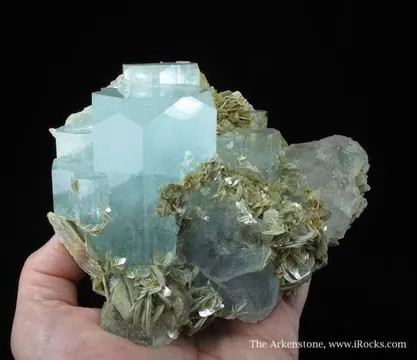
Nagar, Pakistan — a Karakoram pegmatite locality famed for pale aquamarine on mica, plus fluorite and apatite, prized for crystal form, luster, and rarity.
Key facts
Nagar, as collectors use the name, is above all the Chumar Bakhoor pegmatite field of the Sumayar Valley in Nagar District, Gilgit-Baltistan: a high Karakoram locality where pale blue aquamarine rises from blades of muscovite, sometimes with fluorite, fluorapatite, feldspar, quartz, and schorl in the same pocket-built composition. The locality sits in the northern Pakistan gem province, in granitic pegmatites associated with the Sumayar leucogranite and the southern Karakoram Metamorphic Complex. These are not industrial ore bodies in the usual sense; they are volatile-rich, miarolitic pegmatites whose cavities have produced the open-space crystals that collectors prize.
Historically, “Nagar” became a trade name before the more precise Chumar Bakhoor locality was consistently used. Older labels may read Nagar, Nagir, Hunza Valley, Gilgit District, Northern Areas, or simply Pakistan. Modern locality work has clarified the geography: Nagar town itself is the administrative center and not the specimen-producing mine; the famous aquamarine, fluorite, and apatite specimens come principally from the high workings at Chumar Bakhoor above Sumayar. For collectors, that label history matters because a fine old “Nagar” aquamarine on mica is often a Chumar Bakhoor specimen in all but name.
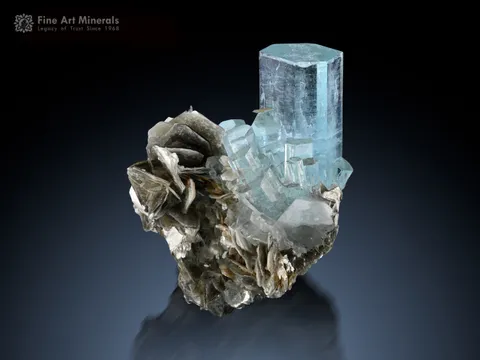
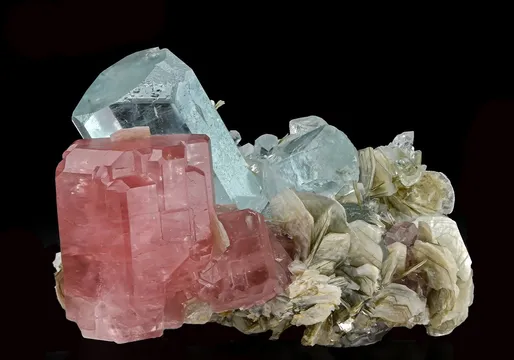
The best Nagar specimens have a visual grammar all their own. The aquamarine is usually not the saturated deep blue of the finest gem rough; it is icy, watery, pale blue to nearly colorless, and it succeeds by luster, transparency, termination, and the drama of placement. A stout hexagonal beryl standing naturally from a bronze-silver bed of mica can be more desirable than a darker loose crystal. The great combination pieces add pink fluorapatite or pink to green fluorite, giving the locality a palette of cool blue, warm mica, salmon-pink phosphate, and glassy fluorite.
Regional View
Country View
The pegmatites are reached only with real mountain commitment. Published and field accounts place the workings high above the valley, commonly around 4,600–4,800 meters, with the broader Chumar Bakhoor area or pass reported higher still. Access is seasonal, weather-bound, and tied to local mineral rights; this is a miner’s locality, not a casual collecting stop. The short alpine season and difficult extraction help explain why undamaged matrix specimens, especially large plates with intact mica and rooted beryl, command respect even when the aquamarine color is soft.


Search for specimens: View all specimens from Nagar, Pakistan
Nagar’s collector fame centers on Chumar Bakhoor in the Sumayar Valley of Nagar District, Gilgit-Baltistan, Pakistan. The locality is a field of granitic pegmatites near the village of Nagar/Sumayar, not a single conventional mine bench. The pegmatites occur as patches, pods, lenses, sills, and dikes in calc-silicate rocks and amphibolite of the southern Karakoram Metamorphic Complex, with an important spatial and genetic relationship to the Sumayar leucogranite. Modern geochemical work interprets the productive pegmatites as volatile-rich residual phases of the Sumayar granitic system, enriched in the components needed for beryl, fluorapatite, fluorite, schorl, feldspar, and related pocket minerals.
The productive bodies are best thought of as miarolitic gem pegmatites rather than ore veins. They are small, irregular, and pocket-dependent. Two field styles are especially relevant to specimens: muscovite-schorl pegmatites and quartz-muscovite-feldspar pegmatites. In the former, the collector sees the familiar sparkling mica groundmass and black schorl accents; in the latter, albite, microcline, quartz, and muscovite provide the pale feldspathic matrix on which beryl, fluorite, and apatite may sit. The individual pegmatite bodies reported in recent field summaries are narrow, commonly on the order of less than two meters thick, and the productive voids are unpredictable.
The assemblage is controlled by late-stage fluids in the pegmatite cavities. Aquamarine and pale beryl crystallized in open space with muscovite, albite, microcline, quartz, fluorapatite, fluorite, schorl, and locally calcite. The fluorine-rich character of the system is especially important: it helps explain why the locality produces not only beryl but also fine fluorite and fluorapatite, including the coveted combinations of aquamarine, pink fluorapatite, and fluorite on mica. The best specimens are pocket pieces, where crystals grew free enough to show glassy faces and sharp terminations rather than being intergrown as massive pegmatite constituents.
The discovery story most often repeated in the collector literature credits Muhammad Shah, a local hunter, with finding the gemstone deposits in 1984. By the mid-1980s and late 1980s, specimens were entering the trade, frequently labeled simply as Nagar or Hunza-Nagar. That explains why important older pieces may carry older administrative geography: Gilgit District, Northern Areas, Hunza Valley, Nagir, or Nagar. Nagar District itself was created later, and careful modern labeling should place the classic aquamarine locality at Chumar Bakhoor, Sumayar Valley, Nagar District, Gilgit-Baltistan, Pakistan.
Mining has remained small-scale and strongly local. Field reporting from 2007 describes the Chumar Bakhoor pegmatites as belonging to a well-organized miners’ association in Sumayar, with 55 groups of six men each permitted to work the deposits and proceeds benefiting the village. That is a striking figure: roughly 330 miners tied to a compact high-altitude pegmatite field. The same account places the workings around 4,800 meters and gives the practical mining season as late July to sometime in October, a short window dictated by snow, altitude, and mountain weather.
There is no casual collecting access in the way collectors might understand a roadcut or quarry dump. The pegmatites are high on steep slopes and are reached by a strenuous approach from the Sumayar side; various accounts describe a trek of several hours to the pegmatite area, with workings above 4,000 meters. Access is controlled by local rights, safety, and season. Specimens on the market should therefore be understood as mined material, not self-collected tourist pieces. Anyone considering field travel would need local permission, guides, appropriate altitude preparation, and a realistic view of mine hazards.
Notable finds include the September 2006 pink fluorite specimens shown at the Munich Show by Italian dealer Riccardo Prato, which Roberto Appiani later described in The Mineralogical Record. Those pieces helped establish Chumar Bakhoor as one of the world’s memorable pink fluorite localities, not merely an aquamarine source. The published record emphasizes that pink octahedral fluorite from Pakistan was known before, but the 2006 find stood out for quality, size, and association. Large matrix combinations where fluorite, aquamarine, and fluorapatite occur together remain among the most desirable Nagar specimens.
Another modern record of note is a 1418 ct light-blue Chumar Bakhoor aquamarine described in Gems & Gemology in 2025, measuring about 77 × 55 × 45 mm and containing twelve visible white octahedral fluorite inclusions. The inclusions, 5–10 mm across, were identified as fluorite by shape, hardness, and optical behavior. External fluorite with aquamarine is a recognized Nagar association; eye-visible fluorite enclosed within aquamarine is far more unusual and was described as essentially one-of-a-kind after decades of mining.
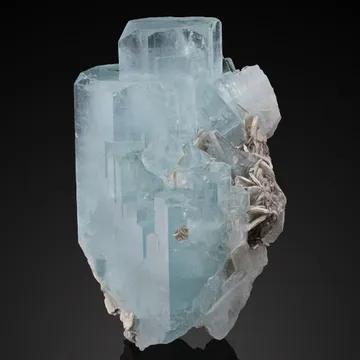
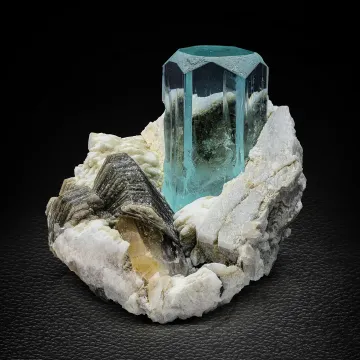
Aquamarine is the signature mineral of Nagar in the collector trade, especially from Chumar Bakhoor above Sumayar, where it forms stout to moderately elongated hexagonal prisms on bladed muscovite, albite, quartz, and locally fluorite or fluorapatite. The typical color is pale ice blue, water blue, or very weak blue rather than deeply saturated, and fine pieces are judged by glassy luster, transparency, sharp terminations, and believable rooted contact with the mica matrix. Crystals in small cabinet to cabinet specimens are commonly a few centimeters long, but documented display pieces reach substantially larger sizes; the most desirable examples keep the aquamarine upright and architectural on undisturbed muscovite, ideally with a salmon-pink fluorapatite or fluorite accent that looks grown with the beryl rather than merely added beside it.
Muscovite is the stage on which most classic Nagar aquamarines perform. At Chumar Bakhoor it occurs as pearly, bladed, tabular, silvery gray, bronze, golden-brown, or tan mica aggregates, commonly forming rosette-like or drusy beds around beryl, fluorapatite, fluorite, quartz, and feldspar. Good muscovite here is not valued as an isolated mica species so much as a matrix mineral: it must have brightness, texture, and structural integrity, with blades that flow naturally up to the aquamarine or fluorite contact. Ordinary examples are loose, bruised, or crumbly mica plates; superior pieces show crisp, lustrous blades that frame the blue beryl without distracting from it, and that survive trimming and transport without widespread bending or shedding.
Beryl from Nagar includes the pale blue aquamarine that made Chumar Bakhoor famous as well as nearly colorless material that borders visually on goshenite. The crystals are typically prismatic and hexagonal, with flat to slightly modified pinacoidal terminations, internal veils, and occasional inclusions or zoning visible through their pale bodies. In the field and trade, “beryl” is often the better name for the whole range of weakly colored to blue crystals from these pegmatites; the finest collector pieces are those in which the beryl has enough color to read as aquamarine but enough transparency and surface quality to glow against muscovite. Pieces lacking color can still be excellent if the prism is sharp, complete, and naturally seated on mica, albite, or quartz.
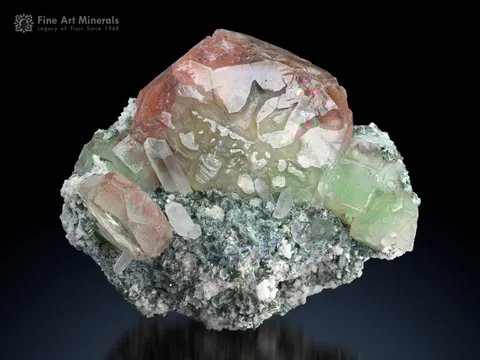
Fluorite is Nagar’s great supporting actor and, in some specimens, the star. Chumar Bakhoor has produced pink, green, pale, and color-zoned fluorite in octahedral, cubo-octahedral, cubic, and dodecahedral-influenced habits, usually on muscovite with albite and sometimes with aquamarine and fluorapatite. The locality is especially respected for pink octahedra and for large gemmy fluorite associated with beryl, including celebrated specimens from the 2006 find described in the mineralogical literature. Ordinary pieces may be frosted, contacted, or isolated from the classic assemblage; top pieces show transparent color, sharp form, minimal bruising, and a composition in which fluorite, mica, and aquamarine reinforce one another rather than competing visually.
The apatite of collector interest from Nagar is fluorapatite, most familiar as pink to salmon-pink, orange-pink, or deeper rosy crystals perched on muscovite, sometimes with aquamarine, quartz, and fluorite. Chumar Bakhoor apatites can form glassy, translucent to gemmy crystals on bright mica, and the best-known display style is the “pop” of pink phosphate set against pale blue beryl and silvery-gold muscovite. Crystals around the centimeter scale are common in specimen descriptions, while exceptional individual apatites may be several centimeters across; the finest examples are sharp, lustrous, richly colored, undamaged, and compositionally integrated with the aquamarine-muscovite matrix rather than appearing as a loose accessory.
“Mica” on Nagar labels usually means muscovite unless the specimen is from one of the district’s marble localities, where other micas can occur. In Chumar Bakhoor aquamarine specimens, mica is the collector shorthand for the bladed muscovite matrix: thin plates, books, and radiating aggregates that produce the locality’s glittering texture. It ranges from pale silver through smoky bronze and golden tan, and it may host aquamarine, fluorapatite, fluorite, quartz, albite, microcline, or schorl. The best mica-rich specimens are stable and visually coherent, with mica blades grown around the pocket crystals; lesser pieces are matrix scraps with loose aquamarines, excessive bruising, or mica disturbed around a suspicious crystal seat.
Apophyllite requires special caution under a “Nagar, Pakistan” label. The classic Chumar Bakhoor/Nagar pegmatite records document beryl, muscovite, fluorapatite, fluorite, albite, quartz, microcline, schorl, calcite, and rare beryllium minerals, but apophyllite is not part of the well-established Chumar Bakhoor assemblage. The few marketplace appearances I could verify appear to be locality-data problems, including a green apophyllite with heulandite listing whose description names “Nagar, Maharashtra, India,” a Deccan-trap style association, while the platform locality field places it in Pakistan. Treat any alleged apophyllite from Nagar, Pakistan as suspect unless it has independent locality documentation; a true Nagar pegmatite apophyllite would be an unusual and publication-worthy occurrence rather than a normal companion to the aquamarine-muscovite pieces.
Quartz from Nagar is mainly a pegmatite companion rather than the locality’s headline mineral. At Chumar Bakhoor it occurs with muscovite, beryl, fluorapatite, fluorite, albite, and microcline in quartz-muscovite-feldspar pegmatites, sometimes as clear to milky pocket crystals or as matrix intergrowths. Quartz can add structure and sparkle to an aquamarine specimen, but it is seldom the value driver unless it is sharp, transparent, and well integrated with the beryl or apatite. On many specimens, quartz is partly hidden among mica blades or feldspar; better pieces show clean terminations and natural contacts that help confirm a genuine pocket assemblage rather than a reconstructed mica base.
Albite, including pericline-style feldspar on some labels, is a common pale matrix mineral in Chumar Bakhoor pegmatites, occurring with muscovite, aquamarine beryl, fluorite, fluorapatite, quartz, and microcline. It may form white to cream blocky or tabular crystals that give a specimen a more feldspathic look than the classic all-mica bases. Good Nagar albite is important because it can anchor aquamarine and fluorite in a convincing pocket matrix; it also provides a visual contrast to bronze mica and pale blue beryl. Ordinary albite is dull, granular, or merely massive matrix, while better examples show defined crystal faces, clean contacts, and a natural relationship to the principal beryl or fluorite crystals.
Other documented minerals from the Nagar pegmatite suite include microcline, K-feldspar or adularia, schorl, calcite, bavenite, and rare or questionable herderite-group records. Beryllonite is also recorded from the Nagar District specimen trade and appears in older “Nagar” references, though collectors should distinguish district-level records from the Chumar Bakhoor aquamarine locality itself. Hydroxylherderite has been treated as an erroneous literature entry in the Chumar Bakhoor record, so specimens sold under that name deserve analytical confirmation. The broader Nagar District also contains very different marble-hosted ruby, sapphire, spinel, pargasite, phlogopite, and fuchsite assemblages at localities such as the Aliabad marbles; those are important Nagar District minerals, but they are not part of the aquamarine pegmatite paragenesis.
The main authenticity issue for Nagar specimens is not synthetic aquamarine. The aquamarine crystals are generally natural. The problem is reconstruction: loose aquamarines, fluorites, or apatites set into muscovite or feldspar matrix where they did not grow, repaired crystals not disclosed as repaired, and mica around a crystal base disturbed to disguise a join. This risk is especially high because Chumar Bakhoor’s natural style is so commercially attractive: a pale blue crystal emerging from a mica “flower” is easy to imitate if one has loose beryl and mica-rich matrix.
Inspect the contact zone before admiring the color. On a natural piece, mica blades should continue organically around the beryl base, sometimes even meeting or partly penetrating the crystal contact. Feldspar, quartz, and mica should look geologically intergrown, not carved away to create a socket. Warning signs include an unnaturally centered trophy crystal, a circular clearing in mica, crushed mica packed around a base, glossy seams, white filler, resin films, color pooled in a crevice, or a crystal that can be lifted slightly with a pin. Ultraviolet light may reveal some adhesives, but it is not a complete test; experienced fabricators can use glues that do not fluoresce conspicuously.
Repairs must be evaluated differently from fabrications. A crystal reattached to its original point of growth, clearly disclosed, is common in large matrix minerals and may be acceptable. A loose aquamarine mounted onto unrelated muscovite is a fake specimen even if every mineral species present is natural. The distinction is ethical and financial. Fine Nagar aquamarines on matrix command a premium precisely because intact pocket relationships are scarce.
Condition is equally important. Muscovite is mechanically delicate: blades bend, flake, bruise, and shed under careless handling. Aquamarine terminations chip, and fluorite edges are softer and more vulnerable than they appear. Pink fluorapatite can also be brittle. Store cabinet pieces so the mica does not carry weight, and avoid repeated handling by the crystal tops. Clean only with care; aggressive washing can loosen mica and expose repairs. Avoid acid or solvent experimentation unless you are specifically testing an already-questionable piece and are prepared for possible damage.
Treatment is less expected on intact matrix aquamarines than on cut gem material, but it should not be dismissed. Faceting aquamarine may be heated to improve blue color, and recent gemological reporting from Pakistan has documented reconstructed, dyed, oiled, and resin-treated gem and specimen material in local markets. On Nagar matrix specimens, the more likely concern is assembly or repair rather than color treatment, but unusually intense blue color on a very inexpensive mica-matrix specimen should invite skepticism.
Locality labeling also deserves scrutiny. “Nagar” may mean Chumar Bakhoor, the Nagar District, or simply a trade label applied in Peshawar or online. Older labels reading Hunza Valley or Northern Areas may be historically normal, but modern high-end specimens should ideally specify Chumar Bakhoor, Sumayar Valley, Nagar District, Gilgit-Baltistan, Pakistan. Be especially cautious with species that do not fit the Chumar Bakhoor assemblage, such as apophyllite with zeolite associations, which may point to India rather than Pakistan.
Market availability is good at the representative level and tight at the elite level. Small to medium aquamarine-on-muscovite pieces appear regularly, and pale blue crystals on mica are among the more recognizable Pakistani minerals in commerce. Truly fine examples—sharp, glassy, undamaged, naturally rooted, well composed, and accompanied by pink fluorapatite or fluorite—are much scarcer. Large plates with pristine muscovite and convincing natural contacts should be bought from dealers who will stand behind repair and locality disclosures.
The Nagar story begins with a hunter. The discovery of the Chumar Bakhoor gemstone deposits is attributed in the collector literature to Muhammad Shah, a local man who found the deposits in 1984. That date matters: Chumar Bakhoor is not a nineteenth-century classic whose best specimens vanished into museums generations ago. It is a late twentieth-century locality that entered the modern specimen market while Pakistani pegmatites were becoming a global force. Before the name Chumar Bakhoor became familiar, pieces traveled under broad labels—Nagar, Nagir, Hunza Valley, Gilgit District, Northern Areas—and some of those older labels still sit in collection drawers under unmistakable pale blue beryl on glittering mica.
A field account from Jim Clanin’s 2007 reconnaissance in northern Pakistan gives the locality a human scale. The pegmatites of Chumar Bakhoor were not described as a free-for-all of isolated diggers; they belonged to a miners’ association in Sumayar. The association allowed 55 groups of six men each to work the deposits. In other words, a compact high-altitude mineral field was organized around 330 miners and a village economy. The same account gives the working elevation as about 4,800 meters and the season as late July into October. That short window is part of every undamaged Nagar matrix specimen: a few weeks of mountain access, then snow and altitude close the door again.
Clanin’s wider description of Pakistani mountain mining explains why these pieces are so often bruised, repaired, or incomplete. He wrote of near-vertical cliffs rising 3,000 to 4,000 feet or more, frozen pockets, engines that do not function well at elevation, thin air that limits pneumatic tools, and mines where everything must be carried by animal or by the miners themselves. In some places, miners literally hang from ropes on cliff faces while using gasoline-powered drills and dodging falling rock. Against that background, a clean aquamarine still naturally seated in fragile muscovite is not just pretty. It is a survival.
One of the most memorable modern Nagar records is almost microscopic in story but monumental in implication: a single aquamarine crystal with fluorite sealed inside it. In 2025, Gems & Gemology described a light-blue Chumar Bakhoor aquamarine weighing 1418 ct and measuring about 77 × 55 × 45 mm. It contained twelve white octahedral fluorite crystals, each 5–10 mm across, visible within the aquamarine. Chumar Bakhoor is famous for external fluorite with aquamarine, but here the fluorite was not beside the beryl—it was entombed in it. After roughly four decades of mining, that specimen was still considered a surprising one-off.
The 2006 pink fluorite find has its own show-floor drama. At the Munich Show, Italian dealer Riccardo Prato exhibited five extraordinary fluorite specimens from Pakistan that had been collected in September 2006. Fluorite from Pakistan was not new, and pink octahedra associated with aquamarine and fluorapatite on muscovite had already been known for years. What made the 2006 material memorable was the leap in quality. Roberto Appiani’s Mineralogical Record article framed the find as exceptional enough to place the best Chumar Bakhoor pink fluorites among the important examples of the species.
There is also the cautionary story collectors keep retelling at shows: the afterlife of a broken Nagar aquamarine. Mica matrices are fragile, and crystals detach during mining, trimming, shipping, or resale. Some are honestly reattached. Others are inserted into mica where they never grew. The detective work has become part of Nagar connoisseurship. Follow the mica blades. Look for a bored-out socket. Watch for crushed mica paste around the base. Test suspicious seams, but do not trust UV alone. The question is not whether the aquamarine is real; it is whether nature, not a workshop, composed the specimen.
_2.JPG)
-Muscovite-171915.jpg)
