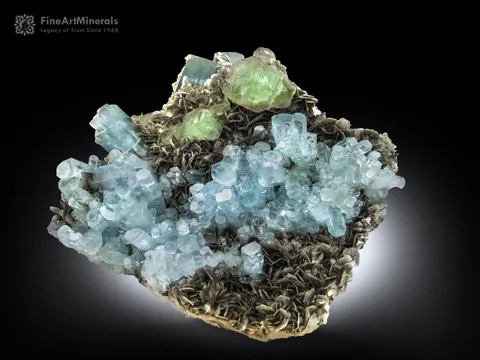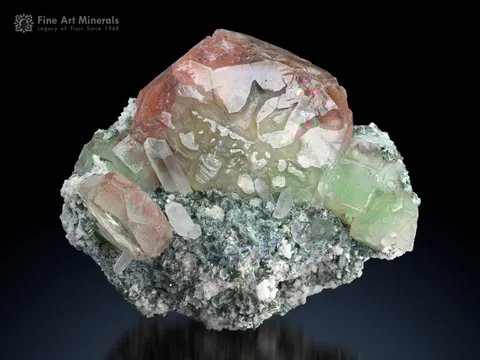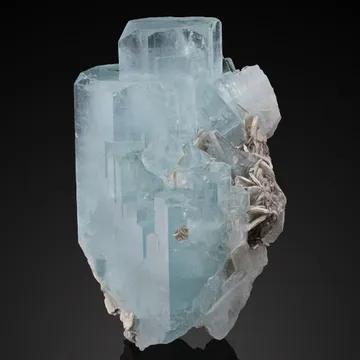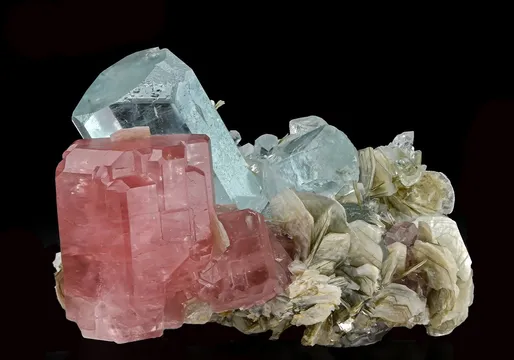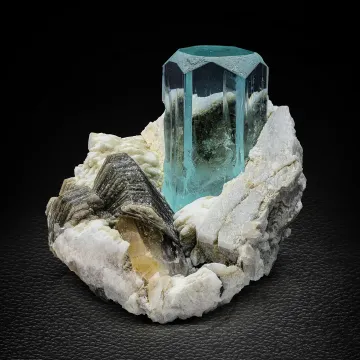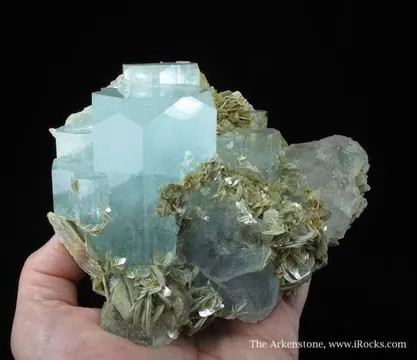
Nagar District, Pakistan — Chumar Bakhoor pegmatites yield ice-blue beryl prisms on muscovite from miarolitic pockets, a premier collector locality.
Key facts
Nagar District sits in one of the great mineral specimen provinces of the high Karakoram, where granitic pegmatites and metamorphosed carbonate rocks are stacked into a steep, highly tectonized mountain belt. For collectors, the district is dominated by one name above all others: Chumar Bakhoor, the high pegmatite field above Sumayar that made “Nagar” aquamarine a recognizable specimen style in the world market. The classic pieces are not loose gem crystals, but complete pocket fragments: pale to medium ice-blue beryl prisms rising from glittering, bladed muscovite, often with albite, microcline, quartz, schorl, fluorapatite, or fluorite joining the composition.
The setting matters. Chumar Bakhoor belongs to the southern Karakoram Metamorphic Complex, near the Sumayar leucogranite, where pegmatitic bodies cut calc-silicate rocks and amphibolite. Modern work describes the pegmatites as miarolitic and productive, with the open cavities that specimen collectors dream about: spaces where beryl, fluorite, fluorapatite, feldspar, quartz, mica, and tourmaline could crystallize with free faces instead of being crushed into massive rock. Unlike lithium-rich Pakistani pegmatites famous for elbaite, this is better understood as a beryl-, fluorine-, and boron-bearing pegmatite environment, with topaz-beryl affinities and a strong fluorite-fluorapatite signature.
Historically, Nagar specimens entered the market under a changing label vocabulary: “Nagar,” “Hunza-Nagar,” “Hunza Valley,” “Northern Areas,” and later the more precise “Chumar Bakhoor” or “Chumar Bakor.” That old label history still matters when interpreting collection pieces from the late twentieth century. The deposit is reported to have been discovered in 1984 by Muhammad Shah, a local hunter, and by the late 1980s and 1990s its aquamarine-on-muscovite style had become one of Pakistan’s defining contributions to modern mineral collecting.
Regional View
Country View
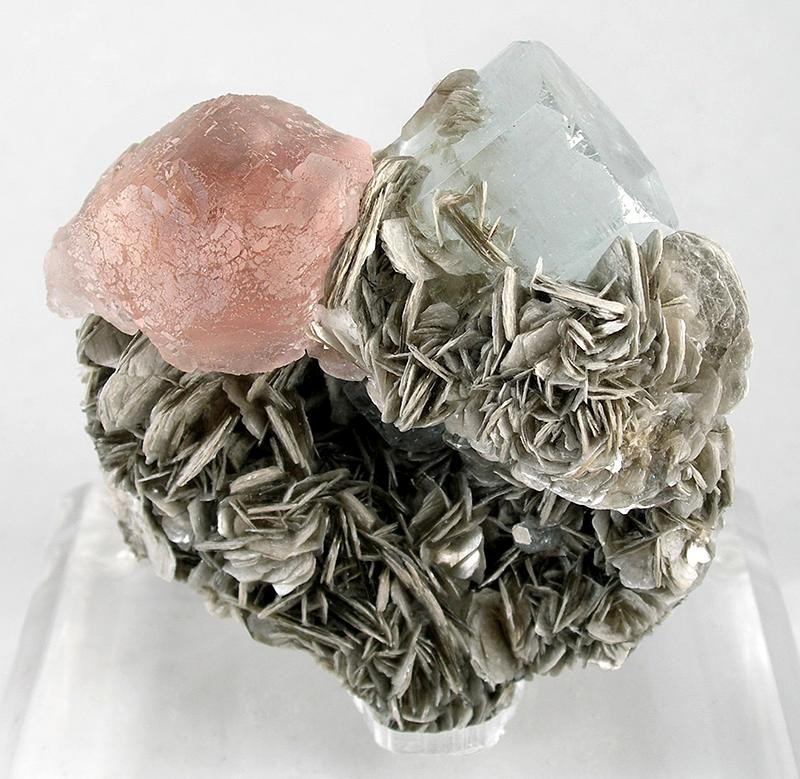
The best Nagar specimens have a very particular visual grammar: watery blue aquamarine, pearly bronze-silver muscovite, and enough natural matrix to make the crystal look grown, not parked. Fine fluorite from the same district can be just as distinctive—pink to pink-and-green, commonly octahedral or modified, sometimes transparent enough to rival classic alpine material. Fluorapatite adds a third collector color: rose, raspberry-pink, and orange-pink tabular crystals on the same mica-rich pegmatite matrix. Taken together, aquamarine, muscovite, fluorapatite, and fluorite give Nagar a palette unlike any other Pakistani district.
Search for specimens: View all specimens from Nagar District, Pakistan
Nagar District is in Gilgit-Baltistan, in the high mountain corridor where the Asian plate and Kohistan-Ladakh arc are juxtaposed along the Main Karakoram thrust system. The district-level mineral record includes both pegmatite specimens and marble-hosted metamorphic gems, but the collector identity of Nagar is anchored in the Chumar Bakhoor pegmatites of the Sumayar Valley. Chumar Bakhoor is a high-altitude gemstone mining area above Sumayar and near Nagar, reached by a steep mountain approach rather than by ordinary road collecting. Published locality descriptions commonly place the pegmatites above 4,000 meters, with mining elevations around the 4,600–4,800 meter range and broader Chumar Bakor topographic references near 5,520 meters.
The Chumar Bakhoor deposit is a field of granitic, miarolitic pegmatites. The bodies are described as patches, pods, lenses, veins, and dikes cutting calc-silicate rocks and amphibolite, spatially associated with the Sumayar leucogranite. The economically and aesthetically important zones are not large ore bodies in the industrial sense; they are pocket-bearing pegmatites. Their value lies in individual cavities lined with mica, feldspar, quartz, beryl, fluorapatite, and fluorite. Geological work distinguishes muscovite-schorl pegmatites and quartz-muscovite-feldspar pegmatites, an observation that neatly matches the specimen trade: aquamarine and fluorapatite commonly emerge from mica-rich bases, while feldspar and quartz appear in many natural compositions.
Mineralization is controlled by late-stage pegmatitic fluids enriched in beryllium, boron, fluorine, chlorine, and water. That chemistry explains the strong beryl-fluorite-fluorapatite-schorl association. The Chumar Bakhoor assemblage is therefore quite different from the elbaite-dominant LCT pegmatites that many collectors associate with Stak Nala or some Afghanistan localities. Here, the repeated signature is Be-F-rich pocket mineralogy: aquamarine and pale beryl, muscovite books and blades, fluorapatite tablets, pink-to-green fluorite, albite and pericline, microcline and adularia, quartz, schorl, calcite, and rarer bavenite or herderite-group reports.
Mining has been artisanal, seasonal, and locally organized. A field account by Jim Clanin describes the Chumar Bakhoor pegmatites as belonging to a miners’ association in Sumayar, with 55 groups of six men each allowed to work the pegmatites and the money benefiting the village. Because the workings sit so high, the practical season is short, roughly from late July into October in that account, before snow, cold, and mountain conditions shut down production. Production is therefore episodic: a summer may yield fine pockets, modest commercial material, or little of consequence.
The early history is unusually vivid for a specimen locality. The gemstone deposits are reported to have been discovered in 1984 by Muhammad Shah, a local hunter. Some accounts describe a period when surface seams or shallow workings could yield aquamarine with simple tools; later, as the easy material was exhausted, miners had to tunnel several meters or more into the mountain. By the 1990s, Nagar aquamarine on muscovite was firmly established in the international trade. Fine pink and pink-green fluorite, including important mid-1990s and 2006-era material, added a second layer of prestige to the locality. Fluorapatite, particularly rose to raspberry-pink tabular crystals on muscovite, also became a recognized specialty of the district.
Collecting access today should be thought of as mining access, not casual hobby collecting. The Chumar Bakhoor workings are high, steep, locally controlled, seasonally accessible, and potentially dangerous. Specimens reaching collectors usually pass through miners, Sumayar and Gilgit-Baltistan trading networks, Pakistani dealers, Peshawar markets, international dealers, and auction houses. A visiting collector should not treat the locality as an open collecting site; local permissions, guide arrangements, mountain fitness, weather, and safety are decisive.
The district also has metamorphic gem associations. Records under the Nagar District hierarchy include marble-hosted ruby, sapphire, spinel, pargasite, phlogopite, and related minerals at localities such as Ganish marbles and Bari/Aliabad entries. These belong to the broader Hunza-Nagar marble belt rather than to the Chumar Bakhoor pegmatite system. For most specimen collectors, however, Nagar’s essential contribution remains the pegmatite pocket aesthetic: aquamarine, mica, fluorapatite, and fluorite in balanced, natural, high-mountain compositions.
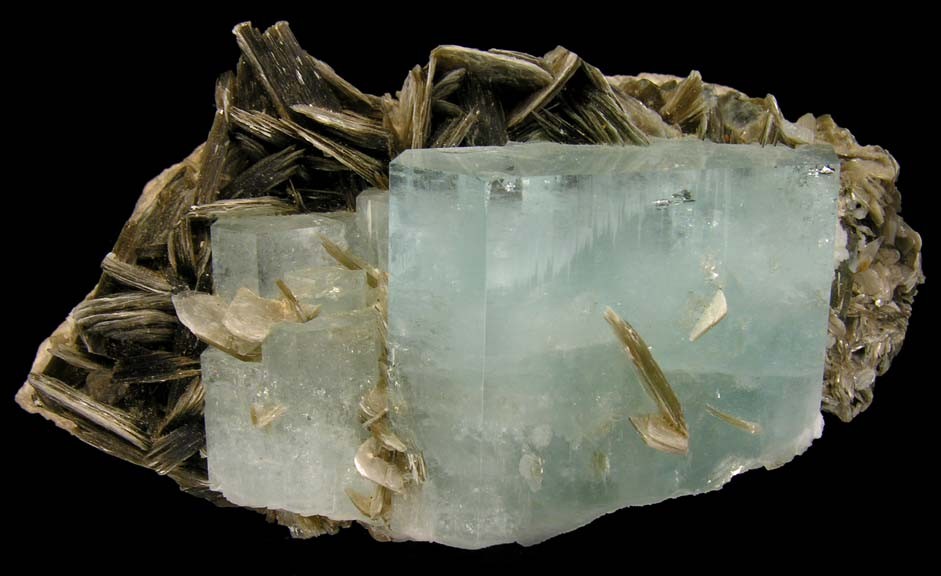
Nagar aquamarine is best known from the Chumar Bakhoor pegmatites, where it forms stout to moderately elongated hexagonal beryl prisms in pale water-blue, icy blue, and locally medium blue tones; the crystals are commonly transparent to translucent, with flat to subtly modified pinacoidal terminations, internal veils, healed fractures, and occasional mica inclusions or attached muscovite blades. Small cabinet pieces may carry aquamarines in the 2–5 cm range, while good display specimens can show crystals of 6–12 cm or more; large cabinet and museum-scale clusters are known, but the finest quality is judged less by sheer size than by sharpness, glassy luster, intact terminations, clean color, and believable growth from the matrix. The classic association is aquamarine on silvery to bronze muscovite, with albite, pericline, microcline, fluorapatite, fluorite, quartz, schorl, and occasional topaz adding context. What separates a superior Nagar aquamarine from an ordinary one is architecture: the crystal should rise naturally from the mica or feldspar, not sit in a suspicious socket; the best specimens preserve the pocket relationship between beryl and matrix and have enough transparency to glow against the metallic shimmer of muscovite.
Muscovite is the mineral that gives Nagar aquamarine its unmistakable stage, occurring at Chumar Bakhoor as bladed, tabular, foliated, book-like, and rosette-like aggregates in silvery gray, silvery tan, bronze, golden-brown, and locally greenish tones. It forms both matrix and pocket lining, commonly with aquamarine rooted among mica blades and with fluorapatite or fluorite perched on the same sparkling base. Individual mica books and sprays may be modest in size, but cabinet specimens can show broad carpets of overlapping plates, sometimes creating the “field of petals” look prized in Nagar aquamarine pieces. The best muscovite specimens from the district are not merely scraps under beryl; they are intact, lustrous, sculptural matrices with clean blades and minimal bruising. Ordinary pieces have crushed, bent, or shedding mica, while fine ones display a continuous natural texture around the beryl, fluorapatite, or fluorite contacts, which is also one of the key clues to authenticity.
“Mica” on Nagar specimen labels usually refers to the muscovite-rich matrix of Chumar Bakhoor, though district records also include white mica, biotite, phlogopite, fuchsite-bearing muscovite, margarite, and mica-group minerals from non-pegmatite settings such as Chalt and marble-hosted gem localities. In the pegmatite specimens that dominate the market, mica occurs as lustrous flakes, books, sprays, and bladed aggregates forming the base for aquamarine, fluorite, and fluorapatite; colors range from silver and pewter to tan, bronze, and brown. The collector challenge is that “mica” is often used loosely in dealer descriptions, so the best labeled pieces specify muscovite when appropriate and preserve a matrix texture that makes geological sense. Fine mica-rich Nagar specimens show undisturbed blades wrapping around aquamarine or fluorite, whereas lesser examples are unstable, bruised, artificially consolidated, or used as a convenient platform for repaired or assembled crystals.
Nagar fluorite is one of the great surprises of Chumar Bakhoor: a pegmatite fluorite that can be pink, rose, pale green, white, or pink-and-green bicolored, most famously as octahedral to modified octahedral crystals on muscovite, with cube, dodecahedral, cuboctahedral, and complex modified habits also reported in the literature and specimen record. Crystals in the 2–4 cm range are already desirable when transparent and undamaged; notable cabinet examples reach roughly 5–6 cm across, and larger heavily etched crystals are known. Associations with muscovite are classic, while aquamarine, fluorapatite, albite, quartz, schorl, and feldspar elevate combination pieces. The best Nagar fluorites show saturated but natural pink or pink-green color, transparency, crisp geometry, lively surface microfaceting, and a secure natural seat on mica. Ordinary examples tend to be contacted, rounded, cloudy, or poorly composed; a fine one can stand beside alpine and Peruvian pink fluorite in a serious fluorite suite while still looking unmistakably Pakistani.
Beyond aquamarine, Nagar beryl from Chumar Bakhoor includes very pale blue, nearly colorless, and colorless-to-goshenite-like crystals, commonly in the same hexagonal prismatic habit and muscovite-rich matrix setting. Studied Chumar Bakhoor beryls include small, clean euhedral analytical samples as well as display crystals and matrix groups familiar from the specimen trade. The association suite overlaps with aquamarine: muscovite, albite, microcline, fluorapatite, fluorite, quartz, schorl, and calcite. Good beryl pieces from Nagar are judged by crystal form, luster, transparency, termination, and matrix integrity rather than by deep color. A pale or nearly colorless beryl can still be excellent if it is sharp, glassy, well placed, and naturally integrated with the mica; ordinary beryl specimens are commonly more fractured, contacted, awkwardly trimmed, or visually lost in damaged muscovite.
Other documented minerals from Nagar District include fluorapatite, albite, pericline, microcline, adularia, quartz, schorl, calcite, bavenite, beryllonite, pyrite, hematite, magnetite, epidote, titanite, rutile, zircon, actinolite, kyanite, kaolinite, talc, chlorite-group minerals, clinochlore including sheridanite, fuchsite-bearing muscovite, phlogopite, margarite, norbergite, pargasite, spinel, ruby, and sapphire. Fluorapatite deserves special attention even though it is not one of the supplied species blocks: Chumar Bakhoor has produced rose to raspberry-pink and orange-pink tabular hexagonal crystals on muscovite and albite, sometimes reaching several centimeters and forming superb combinations with aquamarine or fluorite. Rarities and cautionary entries include bavenite and beryllonite, while herderite is recorded with uncertainty and hydroxylherderite appears as an erroneous or rejected entry in the locality record.
The principal authenticity problem for Nagar specimens is not whether aquamarine, muscovite, or fluorite exists there—it certainly does—but whether a given matrix specimen is naturally assembled. Chumar Bakhoor aquamarine on muscovite is an attractive target for fabrication because loose blue beryl crystals and loose mica-rich matrix can be combined into a saleable “specimen.” Older collector discussions and later gemological reporting both document deceptive practices in Pakistani specimen markets, including glued crystals, reconstructed matrix pieces, resin-like adhesives, crushed host-rock filler, dyeing, oiling, and undisclosed repairs.
Examine the contact zone first. On a natural Chumar Bakhoor specimen, the beryl, fluorite, or fluorapatite should meet mica, feldspar, quartz, or other pocket minerals in a way that looks grown-in. Mica blades should continue around the base rather than stop at a carved socket. Beware of glossy glue films, white filler, crushed mica paste, resin pools, unnatural gaps, scraped matrix, or a crystal that appears too perfectly centered in an excavated seat. Ultraviolet light can reveal some adhesives, but a non-fluorescent join is not proof of authenticity. Magnification, side lighting, and comparison with well-documented examples are more useful.
Repairs should be separated from fakes. A crystal reattached to its original matrix after breakage may be acceptable in the specimen market if the repair is disclosed and priced accordingly. A loose aquamarine mounted onto unrelated muscovite is a fabricated specimen, even if every mineral component is natural. This distinction is especially important for Nagar material because the legitimate natural combination—blue beryl on mica—is precisely the look that fakers try to imitate.
Labels need interpretation. “Nagar,” “Hunza Valley,” “Northern Areas,” and “Chumar Bakhoor” may all appear on real older material, depending on when and through whom the specimen entered the trade. Conversely, a label from another Pakistani pegmatite district should not be accepted blindly if the specimen has the classic Chumar Bakhoor mica-and-aquamarine style. Stak Nala, Shigar, and other Gilgit-Baltistan localities can produce beryl, but their matrix styles and accessory minerals differ; locality refinement should be based on association, habit, matrix, provenance, and credible dealer or collection history.
Condition is central. Aquamarine crystals are hard enough to survive handling better than the matrix, but the muscovite is soft, platy, and easily bruised. Many otherwise handsome pieces have bent mica blades, edge wear on beryl terminations, bruised fluorite faces, contacted backs, or pocket-wall scars. Fluorite is much softer than beryl and should be protected from abrasion; pink and pink-green examples often show contacts or cleaving at rear faces. Fluorapatite can be brittle and should be handled as a fragile accessory mineral rather than a rugged matrix component.
Fluorescence is not a defining collector feature for the classic Nagar assemblage in the way it is for some calcite or willemite localities, though fluorite may respond variably and adhesives may fluoresce. Do not rely on fluorescence alone for identification or authenticity. Handle all mica-rich specimens from below, avoid picking them up by the aquamarine, and keep them away from vibration, ultrasonic cleaning, water soaking, and aggressive compressed air. Dust removal is best done gently with a bulb blower and a soft brush.
Market availability is mixed. Representative aquamarine on muscovite from Nagar remains available because Chumar Bakhoor has been a productive locality for decades, and modest specimens appear regularly through Pakistani dealers, online marketplaces, and show circuits. Truly fine examples—sharp, gemmy, undamaged, naturally composed, and aesthetically set on intact muscovite—are much scarcer. Fine pink or pink-green fluorite on muscovite is significantly less common than aquamarine, and strong fluorite-aquamarine or fluorapatite-aquamarine combinations command special attention. Old, well-provenanced pieces from 1990s production, documented collections, or major dealers are especially worth preserving with their labels.
The story most often repeated about Chumar Bakhoor begins not with a geologist, but with a hunter. In 1984, Muhammad Shah is said to have discovered the gemstone deposits above Sumayar, opening what would become the best-known “Nagar” aquamarine source. It is an appropriately Karakoram origin story: a high slope, a local eye, and a pocket mineral that would eventually travel from village workings to international mineral shows, museums, auctions, and private cabinets.
Early accounts describe a very different deposit from the one miners face today. In the first years, aquamarine could reportedly be found in surface seams or shallow pockets, with simple tools sufficient to pry crystals from the mountainside. Later, as the easy seams were exhausted, crews had to tunnel deeper into the pegmatites. One field account describes a crew of six or seven men giving an entire summer to a single tunnel, not knowing whether it would open into a commercial pocket or into nothing. That is the hidden arithmetic behind a fine matrix specimen: one pocket might produce a cabinet piece in a few meters; another might consume months of labor without reward.
The altitude gives the locality its own rhythm. Chumar Bakhoor is not a low quarry with a year-round bench. The mountain is snowbound for much of the year, and the working season is compressed into a short summer window. Jim Clanin’s account records a village miners’ association in Sumayar allowing 55 groups of six men each to work the pegmatites, with proceeds benefiting the village. That is 330 miners tied to a high, compact field of pegmatites at roughly 4,800 meters, where the season runs from late July into October. Every good piece from such a setting is partly a mineral specimen and partly a record of weather, altitude, local rights, and timing.
Local field narratives add the domestic details that specimen labels omit. Chumar Bakhoor camps have been described as seasonal stone shelters with improvised roofs, kerosene or oil heaters, generators, blasting supplies, and rooms shared by entire teams. Wood is scarce at that elevation. Frozen water must be cleared from mines at the start of a season. One photographic field story records miners returning each year to pump or remove water from deep workings before meaningful excavation can resume. The specimens may look serene in a cabinet, but their first environment after crystallization is often mud, ice, diesel fumes, cramped sleep, and cold rock.
The fluorite story gave Nagar a second burst of fame. Aquamarine had already made Chumar Bakhoor important, but pink and pink-green fluorite elevated the locality into fluorite collecting. Mid-1990s and later pieces entered the market as sharp, gemmy octahedra on muscovite; in 2006, exceptional pink fluorite specimens from Chumar Bakhoor were shown in Europe and discussed by collectors as a notable event. These were not merely accessory crystals. Some were large, transparent, richly colored fluorites on mica, and their association with aquamarine and fluorapatite made them uniquely Pakistani. A good Chumar Bakhoor fluorite today still carries that excitement: the unexpected appearance of alpine-style color in a high Karakoram pegmatite pocket.
A smaller but scientifically memorable episode concerns a single aquamarine described by GIA in 2025. The crystal weighed 1418 ct and measured about 77 × 55 × 45 mm. It was a sharp, light-blue hexagonal aquamarine from Chumar Bakhoor with attached muscovite—but inside it were twelve visible white octahedral fluorite inclusions, each about 5–10 mm. Most collectors think of Nagar fluorite as crystals on muscovite beside aquamarine. This specimen put fluorite inside the aquamarine itself, a tiny pocket narrative sealed within beryl.