






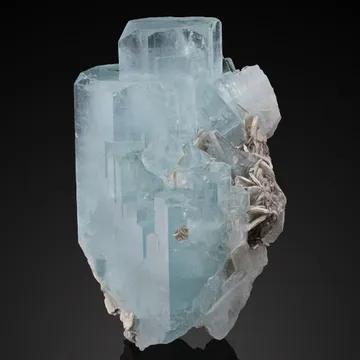
A collector's guide to Chumar Bakhoor, Pakistan: its geology, mining history and notable minerals, illustrated with the 297 specimens documented from this locality on EarthWonders.
Key facts
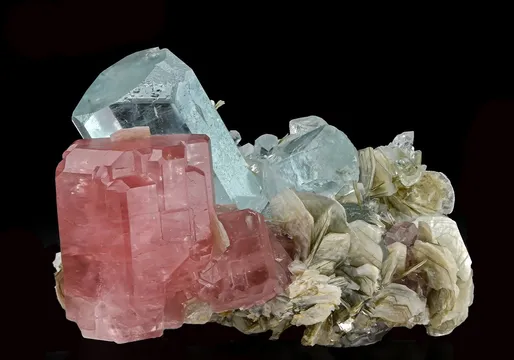
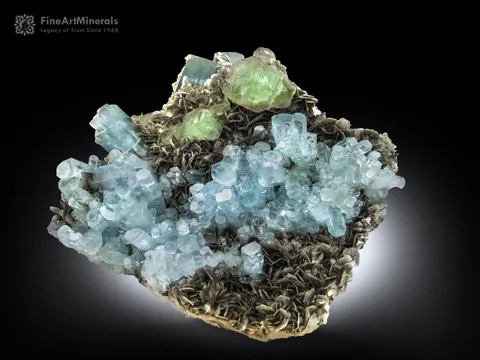
Chumar Bakhoor is one of the modern classic pegmatite localities of the Pakistani Karakoram: a high, seasonal gemstone mining district above the Sumayar Valley of Nagar, Gilgit-Baltistan, where pocket-bearing granitic pegmatites yield pale aquamarine, pink and green fluorite, hot-pink fluorapatite, and gleaming muscovite matrix specimens. Its importance to collectors rests less on deep color than on architecture. The best Chumar Bakhoor pieces have the unmistakable Nagar look: glassy, pale ice-blue beryl crystals standing out of bright books and blades of mica, sometimes with salmon-pink apatite or rose-pink fluorite perched in the same pocket assemblage.
Geologically, the locality is a field of productive, miarolitic granitic pegmatites associated with the Sumayar leucogranite system and the southern Karakoram Metamorphic Complex. Published work describes pegmatites occurring as patches, pods, lenses, and dykes in calc-silicate rocks and amphibolite, with cavities that carried volatile-rich gem-forming fluids enriched in Be, B, F, Cl, and H2O. That chemistry explains the collector assemblage: beryl and schorl from Be- and B-bearing melts, fluorite and fluorapatite from F-rich fluids, with feldspar, quartz, and muscovite providing the pocket framework.
Historically, Chumar Bakhoor became prominent in the 1980s, first as a source of aquamarine-on-muscovite specimens and then as one of Pakistan’s showpiece fluorite localities. The locality’s reputation rose sharply after the extraordinary pink fluorites shown at Munich in 2006, specimens large enough and fine enough to enter the literature almost immediately. Since then, “Chumar Bakhoor” and “Nagar” have become near-synonyms in the trade for pale aquamarine on mica, though the most carefully labeled specimens specify Chumar Bakhoor, Sumayar Valley, Nagar District.
Regional View
Country View
The finest specimens are pocket pieces rather than mere gem rough. They should look naturally grown: mica blades continuing around the base of the beryl or fluorite, no suspicious socketing, and enough relief in the matrix to show that the crystal was born in place. Aquamarine crystals may be colorless to light blue, often transparent to translucent, with flat to modified terminations; fluorite may be pink, green, colorless, or pale blue, in octahedral, cubic, dodecahedral, and mixed forms; fluorapatite is typically pink to salmon or raspberry, most prized when gemmy and sharply terminated on a contrasting muscovite plate.


Search for specimens: View all specimens from Chumar Bakhoor, Pakistan
Chumar Bakhoor lies in the Sumayar Valley of Nagar District, Gilgit-Baltistan, in the high Karakoram mountains above the Hunza-Nagar region. The name appears in several spellings in the literature and trade, including Chumar Bakor, Chumar Bakur, Chumar Bakoor, Chumar Bakhur, and, more loosely, “Nagar.” The collecting locality is best understood not as a single quarry face but as a high-altitude pegmatite mining area, reached from the Sumayar side by a steep mountain approach. Published and field accounts place the workings around 4,400–4,600 meters, with the broader Chumar Bakor pass or mountain area sometimes given higher; snow, altitude, and the short summer-to-autumn working season are fundamental to the locality.
The deposit type is productive miarolitic granitic pegmatite. Modern geochemical work places the Chumar Bakhoor pegmatite field in the upper Sumayar Valley, between the Silkiang and Bualtar glacier area, within calc-silicate rocks and amphibolite of the southern Karakoram Metamorphic Complex and in association with the Sumayar pluton. The pegmatites are described as marginal, unzoned, miarolitic, and productive, and their gem minerals are magmatic-hydrothermal in origin. Their field forms include patches, pods, lenses, dykes, and segregations with sharp contacts against the enclosing rocks.
The gem-producing bodies are small-scale pocket systems, not industrial ore bodies. One study records pegmatitic components with thicknesses ranging from centimeters to less than a meter scale, while another local survey describes pegmatite bodies around 0.5 to 1.5 meters thick. The important features for collectors are the cavities: mica-lined openings in which beryl, fluorite, fluorapatite, topaz, adularia, and calcite could grow into open space. Two petrographic groupings are especially useful for understanding specimens: muscovite-schorl pegmatites, rich in black tourmaline, and quartz-muscovite-feldspar pegmatites, the more common pale pegmatites that provide much of the feldspar-mica-quartz matrix seen on cabinet pieces.
Mining has been local, seasonal, and artisanal to small-scale. Community accounts describe Chumar Bakor as belonging to the people of Sumayar, with miners working in groups during a short season from mid-July to mid-October. A development report on Nagar described it as the largest gemstone mining source in the valley, owned by households and villages along the Chumar Bakor watershed, and noted that a number of mining groups from nearby villages participate. These are not public collecting diggings; access is governed by local ownership, mining rights, safety conditions, weather, and the practical realities of high-altitude work.
The best-known production began in the mid-1980s. A widely repeated account, attributed through the Chumar Bakhoor literature, credits a local hunter, Muhammad Shah, with the 1984 discovery of the gemstone deposits. By the later 1980s, aquamarine-on-muscovite and pink fluorapatite specimens were already moving into the trade, and a documented 1989 specimen of aquamarine with hot-pink fluorapatite on muscovite later appeared as a notable contemporary classic. For many collectors, the great turning point for fluorite was the 2006 pocket that produced large pink crystals shown by Riccardo Prato of Pregi Gemme at the Munich Show; those pieces established Chumar Bakhoor as a world-level pink fluorite locality, not merely a prolific aquamarine source.
Current production is irregular. Representative aquamarine-on-muscovite specimens remain available on the market, from thumbnails and miniatures to large-cabinet groups, but the finest undamaged, unrepaired, naturally balanced pieces are far less common than the number of loose or ordinary crystals might suggest. Fluorite and fluorapatite are scarcer in top condition, particularly when gemmy, well exposed, and naturally composed with aquamarine or mica. New pockets still appear from time to time, but the locality’s altitude, seasonality, and local ownership make production episodic rather than steady.
Fluorite from Chumar Bakhoor is the locality’s great surprise: not just an accessory to aquamarine, but a world-class pocket mineral in its own right. The finest examples are transparent to translucent pink, green, colorless, or pale blue crystals on muscovite, sometimes with aquamarine and fluorapatite, and they may show octahedral, cubic, dodecahedral, cubo-octahedral, or complex mixed forms; spinel-law twins are among the most celebrated. The 2006 find made the locality famous for pink fluorite, with crystals reported up to exceptional cabinet size and a documented 14.5 cm fluorite twin on muscovite photographed for Mindat. Geochemical study found Chumar Bakhoor fluorites to be essentially stoichiometric CaF2, with pink, green, and blue crystals compositionally similar despite their color differences. Good pieces here are judged by size, transparency, undamaged edges, balanced placement on muscovite, and natural association; ordinary pieces are often pale, partial, cleaved, bruised, or visually lost in mica.
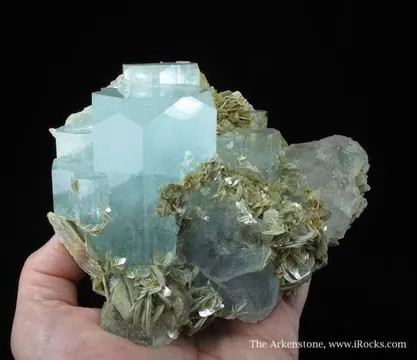
Muscovite is the stage on which Chumar Bakhoor performs. It occurs as coarse books, stacked blades, rosettes, and drusy mica plates ranging from silvery to golden brown, often forming the glittering matrix for aquamarine, fluorite, fluorapatite, albite, microcline, quartz, and schorl. In the quartz-muscovite-feldspar pegmatites, muscovite flakes may form clustered domains several centimeters across or fan into radiating aggregates, and in specimen terms those mica fans are critical: they make a pale blue aquamarine readable from across a room. Fine muscovite matrix should be sharp, bright, stable, and continuous around the bases of attached crystals; dull, crushed, heavily trimmed, or suspiciously excavated mica is a warning sign as much as an aesthetic defect.
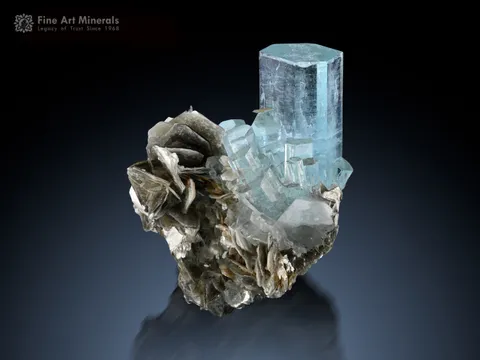
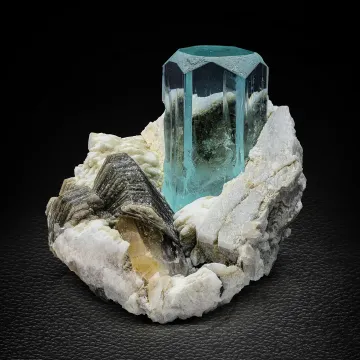
Chumar Bakhoor aquamarine is typically pale ice-blue to nearly colorless beryl, most admired as hexagonal prisms or crystal groups rising naturally from muscovite. The locality produces small crystals, cabinet-size clusters, and large crystals used for carving, cabochon, and bead material; specimen crystals commonly range from a few centimeters to large display pieces, with many of the most attractive examples in the 3–10 cm crystal range on matrix. Associations include muscovite, albite or pericline, microcline, quartz, schorl, fluorapatite, topaz, and pink or green fluorite. A 2025 GIA report described a 1418 ct Chumar Bakhoor aquamarine measuring about 77 × 55 × 45 mm with attached muscovite and a dozen visible white octahedral fluorite inclusions, an unusual reminder that the same pocket chemistry could trap fluorite inside beryl as well as grow it beside it. The best aquamarines here are not the darkest blue; they are sharp, lustrous, transparent, well terminated, unrepaired, and convincingly rooted in mica.
Fluorapatite from Chumar Bakhoor is one of the most desirable associated minerals from the locality, occurring as pink, salmon, raspberry, and sometimes paler hexagonal crystals on muscovite, albite, microcline, or with aquamarine. Published chemical work confirmed analyzed apatite from the pegmatites as fluorapatite, compositionally homogeneous from core to rim, with fluorine contents consistent with Ca5(PO4)3F. Fine crystals may be tabular to stout, glassy, and sharply terminated; documented specimens include clusters with crystals around 2 cm, a raspberry-pink tabular crystal about 3 cm across on muscovite, and larger individual crystals photographed and displayed from the locality. The collector premium goes to vivid pink color, high luster, complete terminations, freestanding exposure, and strong contrast against mica; bruised apatites, buried crystals, and pieces mislabeled as “pink fluorite” are common enough to merit careful checking.
Beryl at Chumar Bakhoor is represented chiefly by aquamarine and goshenite, and the abundance of beryl is sufficient for the pegmatites to be described as beryl pegmatites. Crystals are typically hexagonal, colorless to light blue, and can be gemmy, translucent, or internally veiled; the best matrix examples are complete, naturally placed prisms or clusters on muscovite, albite, feldspar, or mixed pocket matrix. Published microprobe work on 15–20 mm inclusion-free crystals of aquamarine and goshenite found compositions corresponding to typical beryl, while the specimen trade records much larger display groups and large crystals for lapidary use. Good beryl specimens from Chumar Bakhoor stand apart by luster, clarity, termination quality, matrix integrity, and natural composition; weak color alone is not a defect if the crystal is sharp, glassy, and architecturally strong.
“Mica” labels from Chumar Bakhoor usually refer to muscovite-rich matrix, though older or less precise labels may use mica generically when the collector focus is aquamarine, fluorite, or apatite. The mica habit is locality-defining: books, flakes, plates, and radiating blades forming dense glittering beds that can be silvery, tan, bronze, or brown depending on surface and thickness. In the finest pieces the mica is not background rubble but part of the composition, creating flower-like texture around beryl or fluorite and emphasizing the high-contrast pocket aesthetic. Better mica-associated specimens show sharp blades, intact books, and natural crystal contacts; lower-grade examples have mica crushed by trimming, shed-prone edges, dirt-filled books, or suspiciously disturbed pockets around inserted crystals.
Apatite from Chumar Bakhoor is best treated with care because much of the prized “apatite” from the locality is specifically fluorapatite, and older specimen labels may not distinguish the species. In collector terms, the Chumar Bakhoor apatite style is pink to salmon hexagonal crystals on muscovite, albite, or in combination with aquamarine and fluorite, with some pieces showing lustrous tabular faces and others stout barrel-like forms. Its pockets overlap the aquamarine-fluorite system rather than representing a separate ore stage, and the strongest pieces are small-cabinet to cabinet specimens where a vivid apatite crystal is isolated enough to be seen but still clearly grown into matrix. Ordinary examples are often pale, chipped, partly embedded, or visually confused with pink fluorite; UV response and crystal form can help sort questionable labels.
Albite at Chumar Bakhoor is a common feldspar companion in the pocket assemblage, including pericline-labeled material on some specimens. It appears as white to colorless blocky, platy, or bladed feldspar crystals with aquamarine, muscovite, fluorite, fluorapatite, quartz, and microcline; in matrix pieces it often provides a brighter, more rigid base than mica alone. Geochemical and petrographic descriptions of the quartz-muscovite-feldspar pegmatites note plagioclase with albite twinning and partial alteration to sericite or clay, while specimen records show albite functioning as a clean contrasting matrix for aquamarine or pink fluorite. The best albite-bearing pieces are crisp, white, and three-dimensional, with crystals supporting rather than hiding the main gem mineral; dull, altered, or crumbly feldspar weakens both aesthetics and durability.
Schorl is the black tourmaline member of the Chumar Bakhoor assemblage and is especially tied to muscovite-schorl pegmatites. Published work describes abundant schorl in these bodies, with crystals generally 5–12 cm long, zoned but chemically homogeneous in analyzed material. On specimens, schorl appears as black prismatic crystals or sprays with muscovite, quartz, feldspar, aquamarine, fluorite, and fluorapatite; it is less often the primary display mineral than a graphic, dark accent that gives pale beryl and mica compositions more contrast. Good schorl-bearing Chumar Bakhoor pieces have sharp, terminated black prisms integrated with the pocket minerals; ordinary material is broken, buried, or visually reduced to black needles and shards in mica.
Other documented minerals from Chumar Bakhoor include quartz, microcline, K-feldspar including adularia, calcite, topaz, tourmaline group minerals, axinite group material, and bavenite; lepidolite, limonite, and doubtful or erroneous herderite-group labels also appear in locality data or photo associations. Chumar Bakhoor is not known as a type-mineral locality; its rarities are mostly specimen rarities and association rarities—particularly fine fluorite-aquamarine-fluorapatite combinations, pink apatite on muscovite, large fluorite twins, and unusual inclusions such as fluorite inside aquamarine.
The main authenticity issue at Chumar Bakhoor is construction, not synthetic mineral growth. The aquamarine, fluorite, and apatite crystals are usually natural, but matrix specimens from Pakistan have a known problem with repair, reattachment, and outright assembly. A broken aquamarine or fluorite glued back to its original matrix is a repair and may be acceptable if disclosed. A loose crystal seated into an unrelated mica matrix is a manufactured specimen and should be priced accordingly, no matter how attractive it looks.
Examine the contact first. Natural Chumar Bakhoor pieces should show mica, feldspar, quartz, or other pocket minerals growing believably around the base of the main crystal. Red flags include carved mica sockets, scraped-out matrix, powdery mica-and-glue filler, glossy seams, resin pools, crushed mica packed around the base, and crystals that look too perfectly centered or too upright for the surrounding growth. A 10x loupe, a strong side light, and sometimes long-wave UV can reveal repairs, though not every adhesive fluoresces.
Mislabelling is common. Many specimens are sold simply as “Nagar,” “Hunza,” or “Gilgit,” which may be accurate in a broad trade sense but is less precise than Chumar Bakhoor, Sumayar Valley, Nagar District. Some older labels may say “Apatite-(CaF)” or simply “apatite” for fluorapatite. Pink fluorapatite and pink fluorite can be confused by inexperienced sellers, especially when crystals are partly embedded in mica. Crystal habit, cleavage, hardness, and fluorescence can be useful checks: fluorite is softer, has perfect octahedral cleavage, and commonly fluoresces blue to violet; fluorapatite is harder, hexagonal, and may show yellowish fluorescence in some examples.
Condition is a serious factor. Muscovite matrix sheds easily and can hide bruising at the bases of crystals. Aquamarine terminations chip along edges, fluorite cleaves and bruises readily, and fluorapatite can show tiny impact marks that are easy to miss until strong light catches them. Large Chumar Bakhoor matrix pieces should be handled from the matrix, not by the main crystal, and transported with enough clearance that mica blades are not crushed.
Treatments are less common as a concern for matrix specimens than for cut aquamarine, but they should not be ignored. Aquamarine in the jewelry trade may be heated to modify color, and loose beryl can be irradiated; for intact matrix specimens from Chumar Bakhoor, the greater risk is added color through photography, wetting, oiling, or lighting rather than laboratory treatment. Be wary of images that make pale Nagar aquamarine look saturated electric blue or pink fluorite look unnaturally intense.
Market availability is broad at the entry level and tight at the top. Small aquamarine-on-mica pieces and ordinary pale beryl groups appear regularly, but excellent undamaged cabinet pieces with natural composition, transparency, and strong matrix presence are much scarcer. Top fluorite is rarer still, especially pink crystals with size, luster, transparency, and provenance to the classic 2006-type material. Fine fluorapatite on muscovite or in combination with aquamarine is a specialist prize and is often underappreciated until collectors realize how few truly sharp, vivid pieces exist.
The locality’s origin story begins with a hunter. The account repeated in the collector literature credits Muhammad Shah with finding the gemstone deposits in 1984 while moving through the Sumayar high country. It is a typical Karakoram discovery in one sense—a local person reading difficult ground better than any outsider—but the consequences were far from ordinary. Within a few years, Chumar Bakhoor material began to travel from a remote valley above Nagar into the international mineral trade, and pale aquamarine on mica became one of the signature looks of Pakistan.
A field account from September 1, 1994 captures the physical reality behind those tidy show labels. Dudley Blauwet was in the power house at Sumayar village when Fida Hussain, president of the miners’ union, suddenly asked if he wanted to go to Chumar Bakhoor. Within minutes they were moving with a backpack of essentials. The climb began around 8000 feet, later joined the Sinkiang Glacier, and rose steeply to a base camp at 15,200 feet. They covered at least six horizontal miles and made the ascent in 5¾ hours. The camp then was only a scatter of canvas tents anchored with rocks. After climbing higher to inspect the mining sites, Blauwet spent the night in a tent with about eight miners, sleeping under the head of a freshly killed yak. He knew the altitude risk was real, but relied on his own “30 hour window” before altitude sickness would catch him, visited the mines the next morning, and descended within that time.
The 2006 fluorite pocket is the locality’s great show-floor drama. At the Munich Show, Italian dealer Riccardo Prato of Pregi Gemme exhibited five extraordinary pink fluorites from Chumar Bakhoor, collected in September of that year. Pakistani fluorite was already known, including pink octahedra with aquamarine and fluorapatite on muscovite, but these pieces were different in scale and quality. Contemporary reports describe them as among the finest known examples of the species. Later discussion of two MIM Museum specimens from the find identifies one as a 12 cm specimen carrying a crystal 9 cm on an edge—the largest crystal in the pocket—and another as a 16 cm specimen with transparent pink crystals up to 5 cm on an edge. For collectors who had thought of Chumar Bakhoor mainly as an aquamarine locality, the Munich specimens changed the locality’s rank overnight.
The human scale of the mines is just as memorable as the specimens. A 2021 photo project described Chumar Bakor as a village-owned mining area above Summayar, around 14,000 feet, worked for only about three months from mid-July to mid-October. In that short season, miners search for aquamarine, fluorite, apatite, topaz, and quartz before snow shuts the mountain again. The project records roughly 700–800 miners trying their luck there, organized into about 110 groups of seven members each, with additional shareholders supporting food, fuel for generators, gunpowder, and supplies. Income is split among thirteen shareholders per team. Each team has one room on the mountain, built of rock and roofed with heavy cloth and plastic.
One miner’s story reads like a parable of pegmatite luck. Wajahat had worked for a decade through debt and failure, chiseling and blasting through rock that seemed worthless. One winter-edged morning, abandoned by his fellow miners and preparing to leave, he looked back at the settlement as sunlight hit the huts of colored stones. He decided he had to return. The next year he came back with a new group of close family friends, and the barren mine finally opened into mounds of precious stones. Within a year, he earned more than he had in the previous decade.
Other details from the same account feel painfully specific. Phone calls are made at “mobile booths” with no phones attached: little spots where a weak signal can be caught if a mobile is balanced on stacked rocks and left on speaker—move it an inch and the call drops. Nasir Hussain’s brother and another miner died in an avalanche; their bodies were found the following summer. Nasir worked a mine active for 17 years with six others, blasting, hauling debris, and looking for gem traces. Because the mountain stays snow-capped for eight or nine months, mines fill with frozen rainwater; Nasir said it takes at least a month to remove water from their 500-foot-deep mine when they return each year.
Even the afterlife of the stones has its own mountain economy. Muhammad Hussain set up cutting facilities for miners with larger pieces, sometimes wearing a mask but often treating dust as part of a normal workday, while ration supplies arrived by mule. Zawar Iqbal, a leader in Khair ul Amal and a former miner himself, explained that the best stones become showpieces or museum pieces, while residues and leftovers are processed for jewelry. In his office, a buyer from Peshawar sat through an auction where the gemstones were valued in millions.
Khoshhall, Amjad Hussain; Shah, Muhammad Tahir; Arif, Mohammad; Agheem, Muhammad Hassan; Mughal, Muhammad Saleem; Ullah, Shakir; Hussain, Syed Asim; Sadiq, Izhar; and coauthors. “Chemical composition of gemstones and characterization of their host pegmatites and country rocks from Chumar Bakhoor, Gilgit-Baltistan, Pakistan: implications for the source of gem-forming fluids.” Arabian Journal of Geosciences, 14, article 1303, 2021. The key modern geological and geochemical paper on the pegmatite field, its host rocks, and the origin of the gem-forming fluids.
Smith, Bill; Smith, Carol; Blauwet, Dudley. “A Guide to the Mineral Localities of the Northern Areas, Pakistan.” The Mineralogical Record, 28(3), 183–200, 1997. Foundational locality guide for northern Pakistan, cited for Chumar Bakhoor species records.
Blauwet, Dudley; Muhammad, Shafiee. “The Pegmatites at Chumar Bakhoor: Nagar’s Treasure Trove.” In Pakistan: Minerals, Mountains & Majesty, extraLapis English No. 6, Lapis International LLC, pp. 48–53, 2004. Important collector-oriented article on the Chumar Bakhoor pegmatites and early locality history, cited in the Mindat locality references.
Blauwet, Dudley; Smith, Bill; Smith, Carol. “Table of Mineral Localities of the Northern Areas of Pakistan and Other Selected Sites.” In Pakistan: Minerals, Mountains & Majesty, extraLapis English No. 6, Lapis International LLC, pp. 86–93, 2004. Useful tabular source for species and locality cross-checking in the northern Pakistan pegmatite belt.
Appiani, Roberto. “Pink fluorite from an exceptional find at Chumar Bakhoor, Pakistan.” The Mineralogical Record, 38(2), 95–100, 2007. The essential publication on the 2006 pink fluorite find that elevated Chumar Bakhoor among world fluorite localities.
Appiani, Roberto. “Fluorite. Nuovo ed eccezionale ritrovamento al Chumar Bakhoor, in Pakistan.” Rivista Mineralogica Italiana, 30(4), 250–253, 2006. Italian-language report on the same important fluorite discovery.
Lyckberg, Peter. “Edelstein-Pegmatite in Pakistan: Chumar Bakhoor.” Mineralien-Welt, 22(4), 67–77, 2011. Dedicated article on the Chumar Bakhoor gem pegmatites, cited in Mindat and later gemological literature.
Thompson, Wayne A. Ikons, Classics, and Contemporary Masterpieces of Mineralogy. The Mineralogical Record Special Supplement, Vol. 38(1-S), 2007. Includes notable Chumar Bakhoor specimens, among them aquamarine with fluorapatite and fluorite combinations from the early period of locality fame.
Behnke, Russell E. “Aquamarine with Fluorite Inclusions.” Gems & Gemology, Spring 2025, Vol. 61, No. 1. Documents a Chumar Bakhoor aquamarine containing visible octahedral fluorite inclusions, an unusual micro-world record for the locality.
Alam and coauthors. “A Preliminary Investigation of Gemstones, Mines, Miners and Problems in Gilgit-Baltistan, Pakistan.” Journal of Mountain Area Research, 7, 37–43, 2022. Provides field-scale context for Chumar Bakor elevation, mined species, host rocks, and pegmatite dimensions.
“Exploring the Hidden Treasures of Chumar Bakhoor Mine: Aquamarine Discovery!” — GEMSVISOR Short field-style video connected to Chumar Bakhoor aquamarine mining and specimen discovery.
“Aquamarine Specimen From Chumar Bakoor Mine Summyar Valley” — YouTube Locality-focused video presenting aquamarine specimen material and background on the Chumar Bakor mining area.
“Tracing Gems Of Hope” — M. Musa Yawari, Pakistan Photo Festival Fellowship 2021 Photo essay and field narrative on Chumar Bakor miners, seasonal work, village ownership, and life at the high-altitude mining camp.
Mindat locality page: Chumar Bakhoor, Nagar District, Gilgit-Baltistan, Pakistan Best single reference hub for the locality name, mineral list, photo data, and bibliography.
Mindat photo gallery: Chumar Bakhoor Large visual archive of Chumar Bakhoor specimens, especially aquamarine, fluorite, fluorapatite, and muscovite associations.
ResearchGate: Khoshhall et al. 2021 Chumar Bakhoor pegmatite geochemistry Modern scientific treatment of pegmatite petrogenesis, host rocks, and gem chemistry.
GIA Gems & Gemology: Aquamarine with Fluorite Inclusions Gemological note documenting a rare Chumar Bakhoor aquamarine with visible fluorite inclusions.
Mineralogical Record back issue: Vol. 38, No. 2, 2007 Source issue containing Appiani’s article on the exceptional Chumar Bakhoor pink fluorite find.
Mindat reference: Appiani 2007 pink fluorite article Bibliographic record for the key Chumar Bakhoor fluorite publication.
Mindat reference: Smith, Smith & Blauwet 1997 northern Pakistan locality guide Bibliographic entry for the classic Mineralogical Record guide to northern Pakistan mineral localities.
Mindat reference: Lyckberg 2011 Chumar Bakhoor article Bibliographic record for the dedicated Mineralien-Welt article on Chumar Bakhoor gem pegmatites.
Pakistan Photo Festival: Tracing Gems Of Hope Valuable field narrative and photographs on miners, camp life, seasonal work, and local ownership at Chumar Bakor.
District Nagar report excerpt on gemstone mining Development-planning source with information on Chumar Bakor ownership, mining groups, and gemstone-sector issues in Nagar.
Mindat discussion: Aquamarine specimens from eBay—Nagar Useful collector discussion of glued, repaired, and manufactured Nagar/Chumar Bakhoor aquamarine-on-muscovite specimens.
Mindat discussion: Fluorites from Pakistan, seen in Munich Period collector discussion around the 2006 Munich pink fluorite specimens from Chumar Bakhoor.
Friends of Minerals Forum discussion of MIM Museum Chumar Bakhoor fluorites Notes on two major MIM Museum specimens from the 2006 Chumar Bakhoor fluorite find.
Wikimedia Commons: Aigue-marine, muscovite 1.JPG Freely licensed photograph of classic aquamarine on muscovite from Chumar Bakhoor.
Wikimedia Commons: Beryl, mica, tourmaline.jpg Public-domain image showing Chumar Bakhoor aquamarine, muscovite, and schorl association.
Wikimedia Commons: Beryl-Apatite-(CaF)-139605.jpg Photograph of a Chumar Bakhoor aquamarine and apatite-(CaF) specimen formerly from the Jack Halpern collection.


-139605.jpg)