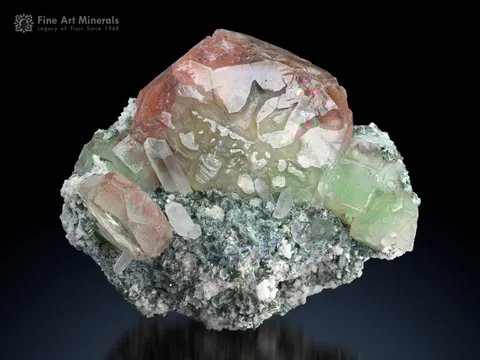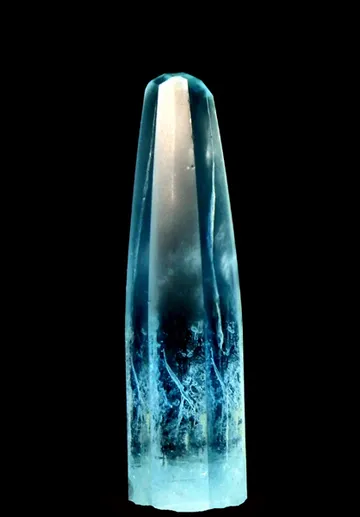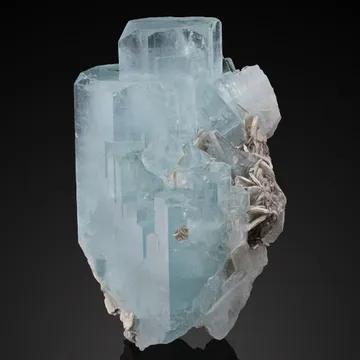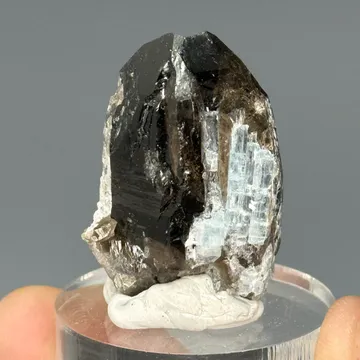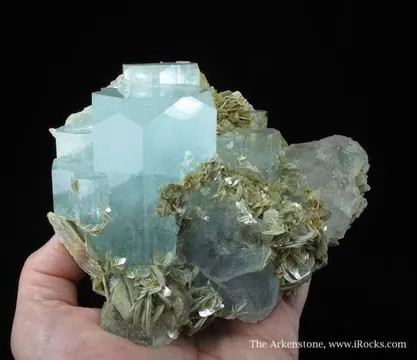
Chumar Bakhoor aquamarine is one of the defining specimen styles of the Pakistani Himalaya: pale to medium ice-blue beryl standing upright from glittering beds of bladed muscovite, sometimes accompanied by pink fluorapatite, pink to green fluorite, albite, microcline, quartz, topaz, schorl, and adularia. The locality is not famous simply because it produces aquamarine; it is famous because so much of its best aquamarine occurs as complete, displayable matrix specimens rather than as isolated gem rough. The classic Chumar Bakhoor “look” is a sharp hexagonal prism, glassy and transparent to translucent, set against a mica-rich pegmatite matrix that gives the blue color a cool metallic contrast.
Key facts
Chumar Bakhoor aquamarine is one of the defining specimen styles of the Pakistani Himalaya: pale to medium ice-blue beryl standing upright from glittering beds of bladed muscovite, sometimes accompanied by pink fluorapatite, pink to green fluorite, albite, microcline, quartz, topaz, schorl, and adularia. The locality is not famous simply because it produces aquamarine; it is famous because so much of its best aquamarine occurs as complete, displayable matrix specimens rather than as isolated gem rough. The classic Chumar Bakhoor “look” is a sharp hexagonal prism, glassy and transparent to translucent, set against a mica-rich pegmatite matrix that gives the blue color a cool metallic contrast.

Photo: Géry Parent / Wikimedia Commons
Geologically, the locality belongs to the gem pegmatite belt of northern Pakistan, in the high Sumayar Valley of Nagar District, Gilgit-Baltistan. Modern work on the deposit describes Chumar Bakhoor as a field of granitic pegmatites in calc-silicate rocks and amphibolite of the southern Karakoram Metamorphic Complex, close to the Sumayar leucogranite. The pegmatites are simple and unzoned, but miarolitic: their cavities are the pocket environments that allowed aquamarine, fluorapatite, fluorite, topaz, and other minerals to crystallize freely.
What collectors prize most is the balance of color, transparency, termination, and natural composition. A Chumar Bakhoor aquamarine does not need to be dark blue to be important; many of the best pieces are a bright, watery, pale blue. The finest specimens have undisturbed terminations, glassy prism faces, a clean front display angle, and aquamarine that is visibly rooted in muscovite rather than awkwardly perched. Combination pieces with pink fluorapatite or fluorite can be especially desirable when the accessory mineral is not merely present, but compositionally integrated into the specimen.
Historically, Chumar Bakhoor also carries the romance of a locality that entered modern mineral collecting comparatively late. The gemstone deposits are reported to have been discovered in 1984 by Muhammad Shah, a local hunter, and the area became known internationally as “Nagar” material before the locality name Chumar Bakhoor became familiar on specimen labels. Since the mid-1980s it has been a major source of matrix aquamarine and fluorite specimens from Pakistan, and its aquamarines have appeared in major private collections, dealer inventories, museum displays, and the mineralogical literature.
Search for specimens: View all aquamarine specimens from Chumar Bakhoor, Nagar District, Pakistan
Chumar Bakhoor, also spelled Chumar Bakor or Chumar Bakur, lies in the Sumayar Valley of Nagar District, Gilgit-Baltistan, Pakistan. Published descriptions place the gemstone workings high above the valley; figures vary by source, with working elevations commonly described around 4,600–4,800 meters and the broader Chumar Bakor locality or pass given at about 5,520 meters. The pegmatites crop out on steep mountain slopes above 4,000 meters and are reached by a several-hour trek from the Sumayar side. This is not a roadside locality in the casual collecting sense; it is a high-altitude mining area where season, snow, local rights, and mountain conditions control access.
The deposit type is granitic, miarolitic pegmatite. The Chumar Bakhoor pegmatite field occupies the upper Sumayar Valley between the Silkiang and Bualtar glaciers, in the southern Karakoram Metamorphic Complex. The pegmatites occur as patches, pods, lenses, and dikes with sharp contacts in calc-silicate rocks and amphibolite, and they are spatially associated with the nearby Sumayar leucogranite. A 2021 geochemical study classified the pegmatites as marginal, unzoned, miarolitic, and productive, with an affinity to the NYF topaz-beryl class rather than the lithium-rich LCT family. In collector terms, that helps explain the Chumar Bakhoor assemblage: beryl, fluorite, fluorapatite, topaz, schorl, muscovite, feldspar, and quartz, rather than the elbaite-rich suites better known from some other Pakistani pegmatites.
Mining has been small-scale and specimen-driven. A field account by Jim Clanin for Pala International described the Chumar Bakhoor pegmatites as belonging to a well-organized miners’ association in Sumayar, with 55 groups of six men permitted to work the pegmatites and the proceeds benefiting the village. Because the workings are concentrated in a high, compact area, the practical season is short, roughly late July into October in that account. Other regional reports similarly note that high-elevation gemstone mines in northern Pakistan are generally accessible only during the summer into early autumn.
The best-known production period began after the 1984 discovery attributed to Muhammad Shah. By the late 1980s and 1990s, specimens were entering international circulation under labels such as Nagar, Hunza-Nagar, or Northern Areas, Pakistan. The locality later became especially celebrated for aquamarine on muscovite, pink fluorite on muscovite, and pink fluorapatite specimens, with the most desirable pieces showing two or more of these species together. A number of notable examples reached important collections: aquamarine with muscovite in the Tiziano Bonisoli collection, aquamarine with muscovite in the Gail and Jim Spann collection, and an exceptional Chumar Bakhoor aquamarine displayed by the Museum of Nature and Humankind at the University of Padua.
Collecting access should be regarded as controlled, local, and mining-rights dependent. This is a working gemstone area rather than an open recreational collecting site. Any visit requires local permission, realistic high-altitude planning, and current knowledge of safety, ownership, and seasonal conditions.
The characteristic crystal habit is the hexagonal beryl prism, generally stout to moderately elongated, with flat pinacoidal terminations that may be subtly modified. Good crystals are glassy, sharply edged, and often transparent enough to show internal veils, growth zoning, or reflected color from the muscovite beneath them. Many crystals are pale “water blue” or ice blue rather than saturated Santa Maria blue; in this locality, brightness, clarity, and specimen architecture often matter more than depth of color.
The classic matrix is muscovite. Chumar Bakhoor muscovite commonly forms bladed, tabular, silvery to golden-brown plates, sometimes in radiating or drusy aggregates. Aquamarine rising from this mica produces one of the most recognizable visual signatures in Pakistani pegmatite specimens. Albite and microcline may also be present, and some pieces show aquamarine on albite with muscovite rather than on an all-mica base.
Published and photographed specimens document a broad size range. Analytical work on Chumar Bakhoor beryls used inclusion-free euhedral aquamarine and goshenite crystals in the 15–20 mm range. Dealer, museum, and Mindat records document display specimens with aquamarine crystals around 4–6 cm, and some larger cabinet pieces reach substantially beyond that. A Collector’s Edge specimen, for example, is described as an aquamarine crystal group nearly 12 cm tall, while a Chumar Bakhoor aquamarine with muscovite in the Gail and Jim Spann collection is recorded at 21.0 × 17.6 × 22.4 cm overall. These larger pieces are not the norm in quality, but they show the scale the locality can achieve.
Associated minerals are important to attribution and value. The most frequent collector associations include muscovite, albite, fluorapatite, fluorite, microcline, quartz, schorl, topaz, adularia, and calcite. Pink fluorapatite is especially characteristic in high-end combination pieces; it may occur as light pink to deep orange-pink euhedral crystals, sometimes up to about 4 cm across, on albite and muscovite with aquamarine. Fluorite from Chumar Bakhoor is also important in its own right, occurring in pink, green, light blue, and other colors, and some of the most coveted specimens combine aquamarine with pink fluorite on the same muscovite-rich matrix.
Chemically, the beryls studied from Chumar Bakhoor are typical alkali-poor beryls. The blue color of the aquamarine is attributed principally to iron, with the 2021 study reporting aquamarine at about 0.32–0.50 wt% total FeO, distinctly higher than the goshenite measured from the same pegmatite field. That is a useful collector point: Chumar Bakhoor also produces colorless beryl, but the aquamarine owes its identity to the iron-bearing chemistry of the residual pegmatite fluids.
The best Chumar Bakhoor aquamarines are distinguished by four things at once: a complete crystal, a natural and attractive matrix, visible blue color without over-reliance on backlighting, and a composition that reads from across a room. A single flawless miniature can be more desirable than a larger but pale, contacted crystal. Conversely, a big cabinet specimen can be superb if the aquamarine is fully terminated, the muscovite is undisturbed, and the crystal is not lost in a confused plate of mica.
The most common authenticity concern is not synthetic aquamarine; it is construction, repair, and labeling. Chumar Bakhoor aquamarines commonly occur on delicate muscovite, and the contrast between a blue crystal and a glittering mica bed tempts dishonest assembly. Mindat discussions have specifically warned that some “Nagar” aquamarine specimens have been fabricated by fitting loose aquamarine crystals into carved or scratched-out muscovite matrix. A repaired crystal reattached to its original matrix can be acceptable if disclosed; a loose crystal mounted onto unrelated mica is a fake specimen, even if the aquamarine crystal itself is natural.
Examine the contact zone carefully. Natural Chumar Bakhoor pieces should show believable crystal-matrix relationships: mica blades continuing around the base, feldspar or mica contacts that make geological sense, and no suspicious glossy seam, white filler, carved socket, or unnaturally centered “trophy” crystal. Under 10x magnification, look for glue lines, discontinuous growth striations across a break, mismatched luster at the base, and mica that appears scraped away to seat a crystal. Longwave UV can sometimes reveal fluorescent adhesive, though it is not a complete test.
Labeling also deserves attention. Much older material may be labeled simply “Nagar,” “Hunza Valley,” “Northern Areas,” or “Pakistan.” Those labels are not automatically wrong; they reflect how the locality was marketed during different periods. However, a precise Chumar Bakhoor attribution should be supported by species association, specimen style, collection history, and ideally a reputable dealer or collection provenance. A piece labeled Stak Nala but showing classic Chumar Bakhoor aquamarine-on-muscovite style should be scrutinized, because Stak Nala is far better known for tourmaline-bearing LCT pegmatites and not for this aquamarine association.
Treatments are less of a concern for matrix specimens than for cut gems, but they should not be ignored. Faceting-grade aquamarine is commonly heated to reduce greenish tones and improve blue color, while complete matrix specimens are much less likely to be heated because associated mica, feldspar, inclusions, and the risk of thermal damage make the process unattractive. Still, unusually intense color on a loose or repaired crystal should prompt questions. Polished or re-cut terminations are another concern: a natural termination should show growth textures, subtle edge relationships, and appropriate luster, not a uniformly mirror-like plane with rounded or abraded edges.
Condition is central to value. Chumar Bakhoor aquamarine often has internal veils, healed fractures, and small edge bruises; these are common and do not necessarily ruin a specimen. More serious issues include missing terminations, obvious cleaves through the prism, broken crystal bases, mica loss around the display face, and repaired crystals that sit at an unnatural angle. Muscovite is fragile and can shed or crease, so old collection pieces may have peripheral matrix wear even when the aquamarine itself is excellent.
Rarity is quality-dependent. Representative aquamarine-on-muscovite specimens from Chumar Bakhoor are regularly available on the market, but truly fine examples—sharp, undamaged, water-clear, well composed, and on undisturbed matrix—are much scarcer. Combination pieces with aquamarine plus pink fluorapatite or fluorite are actively sought, especially when the accessory mineral is large, gemmy, and naturally integrated. Current availability ranges from affordable small cabinet examples with modest color or minor contacts to expensive cabinet pieces and museum-grade combinations priced for aesthetics, provenance, and condition rather than size alone.
The Chumar Bakhoor story begins, fittingly, with a hunter. The discovery of the gemstone deposits is attributed to Muhammad Shah in 1984, a local man whose find opened one of the most recognizable aquamarine localities of the modern Pakistani mineral trade. Before the name Chumar Bakhoor became familiar to Western collectors, specimens often traveled under broader labels—Nagar, Hunza-Nagar, Northern Areas—labels that still appear in older collections. For collectors, that early label history is more than trivia: it explains why two specimens with the same unmistakable mica-and-aquamarine look may carry different historical locality names.
A later collecting discussion preserves a sharper version of that label story. One collector argued that Chumar Bakhoor aquamarine was discovered in 1984 but “secretly mined until 1987,” and that early labels sometimes concealed the real source. The case under discussion involved an aquamarine on albite and muscovite labeled Stak Nala. The specimen’s muscovite bed and modified pinacoidal termination looked, to experienced eyes, much more like Chumar Bakhoor. Whether every detail of that early market history can be generalized or not, the episode captures an important truth about Pakistani aquamarine: old labels are historical evidence, but the specimen itself must also be read.
The field logistics are equally memorable. Jim Clanin’s account for Pala International describes the Chumar Bakhoor pegmatites as being worked through an organized miners’ association in Sumayar. The system he recorded allowed 55 groups of six men each to work the pegmatites, with the proceeds benefiting the entire village. At roughly 4,800 meters, with a mining season compressed into late July through October, every good specimen represents not only a pocket but a brief weather window, a long climb, and a communal mining structure rather than a single private claim.
That communal model gives Chumar Bakhoor specimens a different character from many classic mines. The aquamarine may end up in a European cabinet, a North American dealer case, or a university museum, but its first sorting happens in a high mountain village economy where work groups, seasonal access, and village benefit are part of the deposit’s identity. A good matrix aquamarine from Chumar Bakhoor is therefore not just a pegmatite specimen; it is an object from a short-season, high-altitude mineral culture.