






A collector's guide to Muzo Mine, Colombia: its geology, mining history and notable minerals, illustrated with the 219 specimens documented from this locality on EarthWonders.
Key facts
Muzo is the name that defines the collector’s idea of Colombian emerald: saturated green beryl set in pale carbonate veins, commonly with glittering pyrite, gray-black shale, and the occasional rare-earth fluorocarbonate parisite-(Ce). The mine lies in western Boyacá on the western flank of Colombia’s Eastern Cordillera, where emerald was not made in pegmatite but in organic-rich Cretaceous black shales and carbonate-rich fault-vein systems. That setting is the great geological distinction of Muzo. Hot saline basinal fluids moved through fractured, folded, carbonaceous sedimentary rocks; evaporite-derived brines, carbonates, sulfur chemistry, and wall-rock interaction supplied the conditions that allowed Be, Cr, and V to meet in a non-granitic environment and grow emerald.
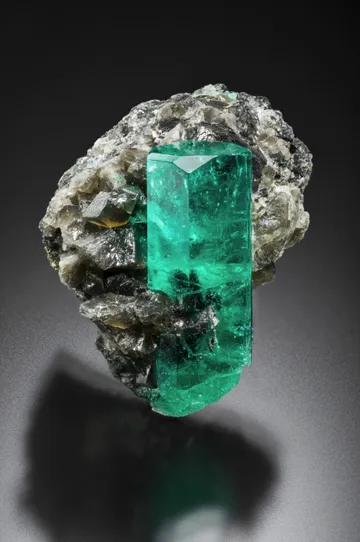
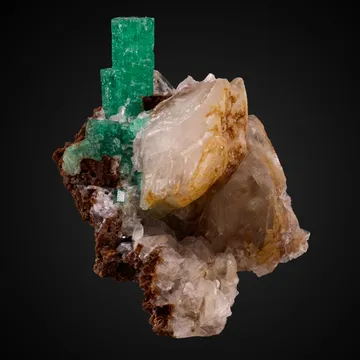
Historically, Muzo is equally hard to overstate. The mines were worked before the Spanish conquest, became one of the great royal emerald sources of colonial Spanish America, drew early geological attention in the nineteenth and early twentieth centuries, and supplied crystals that entered royal, museum, and elite private collections. For specimen collectors, the best Muzo pieces have a very specific look: a lustrous hexagonal prism of emerald, often doubly terminated or cleanly terminated, rising from white to gray calcite or dolomite, with black shale for contrast and pyrite crystals flashing like brass points around the green. Superb pieces combine color, translucency, intact termination, natural matrix contact, and an unmistakable three-dimensional setting rather than simply a bright loose crystal stuck in carbonate.
Regional View
Country View
The deposit is a textbook exception to the casual “emerald equals pegmatite” simplification. At Muzo, emerald occurs in hydrothermal carbonate veins, breccias, tension gashes, and sheared zones in black shale sequences assigned in the literature to Lower Cretaceous rocks of the western emerald belt. The collector mineralogy is compact but distinctive: emerald/beryl, calcite, dolomite, pyrite, quartz, albite, barite, fluorite, graphite or bitumen, white mica, apatite, and parisite-(Ce), with the latter giving Muzo a permanent place in systematic mineralogy as a co-type locality.

Photo: IUGS Geoheritage — The Muzo emerald deposit

Search for specimens: View all specimens from Muzo Mine, Colombia
The Muzo Mine is in the municipality of Muzo, Western Boyacá Province, Boyacá Department, Colombia, in the western emerald belt of the Eastern Cordillera. Modern locality references place the mine near 5°32'N, 74°08'W, northwest of Bogotá. The deposit is hosted by organic-rich black shales, calcareous shales, and dolomitic carbonate-bearing sedimentary rocks. In early descriptions the productive rocks were discussed as an “emerald formation” overlying the Cambiado; modern structural studies emphasize thrusts, tear faults, hydrothermal breccias, carbonate veins, en-echelon tension gashes, and shearing related to Paleogene deformation and fluid flow.
Muzo’s ore is not a conventional metal orebody but a structurally controlled emerald-bearing hydrothermal vein and breccia system. The main collector assemblage fills carbonate veins and cavities: calcite and dolomite are the dominant gangue minerals, pyrite is common, and quartz, albite, barite, fluorite, bitumen or graphite, Cr-bearing mica, emerald, and parisite-(Ce) are characteristic accessory minerals. The emerald-bearing veins cut black shale and carbonate-rich beds; some older descriptions note that emerald is found chiefly in calcite veins rather than isolated in unmineralized shale. Wall-rock alteration at Muzo includes albitization, carbonatization, and pyritization, all of which are important to understanding why such high-quality emerald could form in a sedimentary basin setting.
The age of the host rocks and the age of mineralization are different things. The black shale host belongs to the Cretaceous sedimentary succession of the Eastern Cordillera, while emerald mineralization is widely discussed as Paleogene. Recent U-Th-Pb work on parisite associated with emerald in the Muzo region yielded ages of roughly 47–51 Ma, a result that has sharpened discussion of the timing of western-belt emerald formation and the suitability of parisite as a geochronometer in this unusual deposit type.
Mining has moved through several distinct eras. Indigenous peoples exploited emeralds before European arrival, and Spanish colonial accounts place systematic Spanish interest in the Muzo district in the sixteenth century. By the late sixteenth and early seventeenth centuries, Muzo became one of the great emerald sources of the Spanish empire, with production and control alternating through royal administration, private leases, republican government oversight, concessions, suspensions, and renewed private operation. Joseph E. Pogue’s 1915 field visit caught the mines during a suspended period after work had ceased on January 1, 1913; his report remains one of the classic early geological and mining descriptions of Muzo.
In the contemporary period, the name Muzo is closely tied to Puerto Arturo and The Muzo Companies Colombia. Modern company materials describe Puerto Arturo as an emerald operation of more than 55 hectares between the villages of Sábripa in Muzo municipality and Mata de Fique and Note in Quípama. The Muzo Companies trace their modern operating phase to 2009, initially through Minería Texas Colombia, with Esmeraldas Mining Services later taking over the mining-extraction role after corporate restructuring. The present mining model is underground, formalized, mechanized where possible, and traceability-focused, with galleries including Puerto Arturo, Tequendama, Catedral, Volvere, and the spiral-bored La Rampa.
For collectors, this means Muzo is not a casual collecting locality. It is an active emerald mine and a controlled commercial gemstone operation, not a public dig site. Material reaches the market through mining, sorting, gem channels, historic collections, dealers, auctions, and estate dispersals. Old matrix specimens are especially desirable when accompanied by credible provenance, because high-grade Muzo emerald has long been prized first as gem rough; intact mineral specimens with emerald still naturally seated on calcite, shale, quartz, or pyrite matrix were never the majority of what the mine was designed to save.
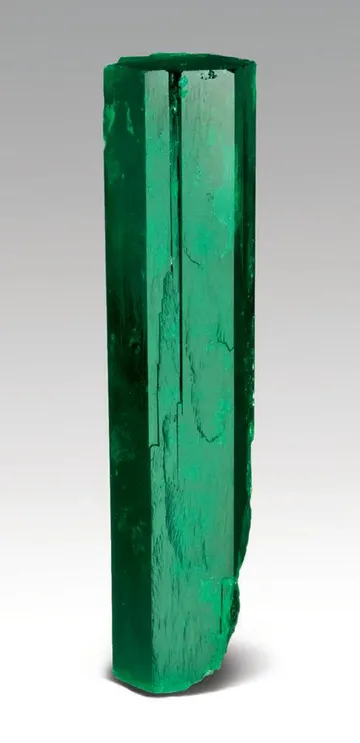
Notable finds range from small thumbnail crystals in calcite seams to cabinet specimens with lustrous emerald prisms several centimeters long. The mine and district are also famous for trapiche emeralds, where dark inclusion-rich arms radiate from a central core in a six-rayed pattern; these are especially associated with the western Colombian emerald belt and have been documented from Muzo and related western-belt deposits. In 2020, the mine publicized the “Green Obsession,” a 1,350 ct emerald crystal reportedly unearthed on September 16 along a Puerto Arturo shaft, notable for its planar hexagonal faces and sharp termination. Such headline crystals are part of Muzo’s gem legacy, but the mineral-specimen ideal remains different: a crystal that is both beautiful and convincingly natural on its original matrix.
Muzo emerald is the locality’s defining mineral and occurs as six-sided beryl prisms, commonly with flat basal terminations, in calcite-dolomite vein material cutting black carbonaceous shale; crystals range from millimetric fragments and small matrix points to rare multi-centimeter prisms and exceptional gem crystals measured in hundreds or thousands of carats. The color that made Muzo famous is a rich, vivid green produced by chromium and vanadium in a beryl lattice grown from hydrothermal brines rather than pegmatitic melt, and the best specimens show strong saturation, lively translucency, sharp prism faces, undamaged terminations, and natural seating in white to gray calcite, black shale, quartz, pyrite, or rare parisite-(Ce). Ordinary pieces are pale, etched, broken, heavily included, or massive in calcite; great ones have the “lit from within” Colombian body color, matrix contrast, and visible geological context that separates a mineral specimen from a loose gem crystal.
At Muzo, beryl is overwhelmingly represented by its green gem variety emerald, but the broader beryl entry is useful because not every green beryl crystal from the mine is equally saturated, transparent, or gem-grade; some crystals are pale bluish green, fractured, cloudy, included with carbonaceous matter, or partly embedded in carbonate gangue. The habit remains classic beryl: hexagonal prisms with basal pinacoids, occurring in carbonate veins and pockets with calcite, dolomite, pyrite, quartz, albite, apatite, and parisite-(Ce). Fine beryl specimens from Muzo are judged less by size alone than by the natural architecture of the piece: a clean prism emerging from calcite or shale, good luster on prism faces, visible termination, and matrix relationships that show the crystal belongs exactly where it grew.
Calcite is the great stage on which Muzo emerald performs: it forms emerald-bearing veins in the black shale sequence, barren veins in the Cambiado described by early workers, vuggy crystal linings, massive white to gray vein material, and conspicuous rhombohedral aggregates in the Cama. Early geological descriptions distinguish water-clear, gray, white, opaque, and carbon-darkened calcite, with rhombohedral and prismatic habits, and note close association with emerald, pyrite, dolomite, quartz, and parisite. Collector-grade calcite from Muzo is usually valued as matrix rather than as a standalone carbonate specimen; the best pieces are fresh, unetched, structurally coherent plates or seams that contrast with emerald and pyrite while preserving the natural pocket texture around the green beryl.
Parisite from Muzo, properly parisite-(Ce) where the rare-earth dominance is established, is one of the locality’s great systematic-mineral prizes: a rare calcium cerium fluorocarbonate first recognized from the Muzo emerald environment and named for José Ignacio París Ricaurte, an early lessee and manager associated with the mine. At Muzo it occurs in immediate association with emerald-bearing carbonate gangue, commonly as brown to honey-brown, translucent to resinous crystals or crystalline masses, often pseudohexagonal or doubly pyramidal in appearance; many crystals are small, and well-formed examples around a centimeter or more are genuinely notable. The best specimens show sharp parisite-(Ce) crystals naturally perched on shale, quartz, calcite, or emerald-bearing matrix, while ordinary pieces may be small, incomplete, dull, or analytically ambiguous among visually similar rare-earth fluorocarbonates.
Quartz at Muzo is a subordinate but visually important vein mineral, occurring as colorless to pale greenish crystals in emerald-bearing carbonate veins, in the Cama with calcite rhombs, and in some descriptions in pegmatitic or late vein material near older bancos. It can host inclusions or close intergrowths of pyrite, parisite, and emerald, and in good matrix pieces quartz adds sparkle and structural relief between black shale and white carbonate. Fine Muzo quartz is not sought for size or rarity in the abstract; its value lies in association, especially when transparent quartz points frame emerald crystals or help document an undisturbed hydrothermal pocket rather than a reconstructed display piece.
Pyrite is one of Muzo’s signature accessory minerals and is part of both the geology and the visual drama of the specimens, occurring as disseminated crystals, seams, concretions, and well-formed crystals in emerald veins, the emerald formation, the Cenicero, and the Cambiado. Early descriptions note cubic, octahedral, and pyritohedral habits, with sizes from tiny grains to crystals several centimeters across, while collector specimens most often show bright brassy pyrite crystals scattered across white calcite or dark shale near emerald. The best Muzo pyrite associations are crisp, lustrous, naturally positioned crystals that balance the green beryl; dull, oxidized, rubbed, or artificially planted pyrite reduces confidence and value.
Dolomite at Muzo is a carbonate gangue mineral intimately tied to emerald formation, occurring in veins and in the Cenicero as small transparent to honey-yellow rhombs, and as part of the broader calcite-dolomite-pyrite vein assemblage. It is not usually the headline species, but it can be important on well-preserved matrix specimens where rhombic dolomite crystals provide warm color and fine-scale texture around emerald, pyrite, quartz, and calcite. Good dolomite-bearing Muzo specimens retain sharp rhombs and fresh carbonate surfaces; ordinary material is massive, sugary, crushed, or visually overwhelmed by calcite and shale.
Other minerals documented from the Muzo Mine and immediate Muzo area include albite, apatite-group minerals, barite, fluorite, graphite or bituminous carbon, chalcopyrite, sphalerite, halite, azurite, malachite, monazite-group minerals, and white mica; older regional lists also note gypsum, marcasite, native sulfur, pyrophyllite, allophane, ankerite, and fuchsite from the broader Muzo municipality. Parisite-(Ce) is the key type-locality mineral for systematic collectors, and the Muzo rare-earth fluorocarbonate suite is especially important because parisite has been used in recent geochronological work to date Colombian emerald mineralization. For display collectors, however, the enduring “Muzo look” remains emerald with calcite, pyrite, shale, quartz, dolomite, and, in the finest rarities, parisite-(Ce).
Muzo emerald specimens demand unusually careful authentication. The value gap between a loose emerald crystal and a convincing matrix specimen has encouraged glued, rebuilt, and cosmetically improved pieces for decades. A classic suspect construction is a genuine Colombian calcite-shale matrix with a real emerald crystal attached later, sometimes with crushed calcite packed around the base to disguise the join. Pyrite crystals can also be repositioned or added for composition. Under magnification, inspect the crystal-matrix contact for glue films, bubbles, unnaturally smooth collars, repeated packed grains, fluorescence from adhesive, or a contact geometry that lacks pressure shadows, intergrowth, or pocket continuity. Long-wave UV can help reveal some glues and fillers, but it is not definitive because some modern adhesives are weakly fluorescent or non-fluorescent.
Treatment disclosure matters. In the gem trade, Colombian emeralds are commonly cleaned and clarity enhanced with oils or resins to reduce the visibility of surface-reaching fissures; Muzo’s own modern marketing states that its treatment policy uses cedar oil when necessary and documents treatment in its traceability system. For mineral specimens, the issue is broader: oil, resin, wax, artificial luster enhancement, and impregnation can alter the appearance of emerald, calcite, and fractures. A matrix specimen sold as “natural, untreated” should be examined with the same skepticism used for fine gem rough, especially if it is exceptionally transparent, clean, and vivid.
Condition is central. Emerald is hard, but it is commonly fractured and can be brittle in specimen form. Pogue noted that some Muzo crystals that appeared clear when removed from matrix later developed cracks, and some fell apart after extraction. The practical collector lesson is simple: do not judge emerald by Mohs hardness alone. Avoid thermal shock, ultrasonic cleaning, prolonged soaking, and aggressive solvents unless a professional has evaluated possible oil, resin, glue, and carbonate sensitivity. Calcite matrix is soft and acid-reactive; pyrite can tarnish or, in poor storage conditions, oxidize; shale matrix can shed or undercut. Handle matrix specimens by the rock, not the emerald.
Muzo labels need precision. “Muzo” may mean the actual Muzo Mine or Puerto Arturo operation, the municipality, the wider western emerald belt, the historical Muzo district, a trade color term, or simply a Colombian emerald of desirable hue. Serious collectors should prefer labels that state “Muzo Mine,” “Puerto Arturo,” or another specific mine, with old dealer labels, auction records, mine paperwork, laboratory origin reports for gem crystals, or credible collection history. Be especially cautious with vague labels such as “Muzo type,” “Muzo color,” or “from the Muzo region” when pricing is based on the fame of the mine.
Top matrix specimens remain much scarcer than loose cut stones or rough fragments. Small emerald-in-calcite pieces are regularly available, but excellent undamaged matrix specimens with saturated emerald crystals, natural contacts, pyrite sparkle, and attractive shale-carbonate contrast are difficult and expensive. Parisite-(Ce) from Muzo is rarer still in sharp display-quality crystals, especially with emerald association. For the advanced collector, the best Muzo purchases are not necessarily the biggest emeralds; they are the pieces that preserve geological truth, aesthetic balance, and defensible provenance at the same time.
Joseph E. Pogue reached Muzo in July 1915 and spent six days studying the mines, a short field campaign that produced one of the classic English-language accounts of the locality. His route says as much about old Muzo as any mineral description: although the mines were only about 60 miles in a direct line from Bogotá and only about 33 km from La Dorada on the Magdalena route, practical access from Bogotá meant rail to Zipaquirá or Nemocón and then roughly two and a half days by mule over a trail he called nearly impassable in the rainy season. The mine lay not at a neat industrial camp but in a steep-walled tropical valley, where heat, humidity, jungle growth, and poor access made abandoned workings vanish quickly.
Pogue’s field descriptions preserve the old open-cut mine before modern underground development changed the working style. The steep slopes were stripped of jungle and cut into terraced bancos. Lines of workers stood on benches with long iron crowbars, breaking soft shale and limestone by hand rather than blasting, because blasting could shatter the emerald crystals. Emerald-bearing calcite veins were removed carefully and carried to a sorting shed above the workings. Debris accumulated on the stair-stepped slopes until water, led from mountain reservoirs, swept it down to the creek below. In the shed, vein calcite was broken by hand, emeralds were picked out, and fine material was washed on sloping tables while boys recovered gem fragments from the flow.
The old security regime was just as vivid. Pogue described military police at the mines, guarded exits, watchmen in small guardhouses above the workings, overseers present through working hours, and workers kept inside until searches were completed. It was a system built around the fact that an emerald small enough to hide could outweigh a month of labor. The product then went by mule to Bogotá, where it waited for shipment to London in larger consignments.
Pogue also caught Muzo at a strange pause in its productive history. A partnership with the London-based Colombian Emerald Mining Company had begun in 1909, but operations were suspended on January 1, 1913. When Pogue arrived two and a half years later, the property was being maintained rather than vigorously exploited. He refused to give a total production estimate, saying the irregular history and incomplete records made a fair calculation impossible, yet he still concluded that historic output had to be counted in tens of millions of dollars and that some single years had likely produced one to two million dollars or more in value.
One of the most famous objects tied to Muzo never needed a matrix to become a mineral legend. The Duke of Devonshire Emerald, a huge uncut hexagonal crystal of about 1,384 carats, is traditionally assigned to Muzo and was given or sold by Dom Pedro I of Brazil to William Cavendish, the 6th Duke of Devonshire, around 1831. It was shown at the Great Exhibition of 1851 and is now associated with the Natural History Museum in London’s celebrated gem displays. As a specimen, it represents the other side of Muzo: not the calcite-and-shale pocket piece, but the nearly mythic single crystal whose provenance, size, color, and survival made it a symbol of Colombian emerald itself.
The mine’s modern chapter produced its own named crystal on September 16, 2020, when the “Green Obsession,” a 1,350 ct emerald crystal, was reported from one of the Puerto Arturo shafts. The published description emphasized the qualities that specimen people immediately understand: a pristine hexagonal form, six planar prism faces, a remarkable termination, and sharp edges without obvious nicks. Whether kept as a gem object, a brand emblem, or a geological trophy, such a crystal shows why Muzo still commands attention after centuries of mining: the deposit remains capable of producing objects that feel impossibly old and startlingly new at the same time.

_(32688929206).jpg)
-169960.jpg)