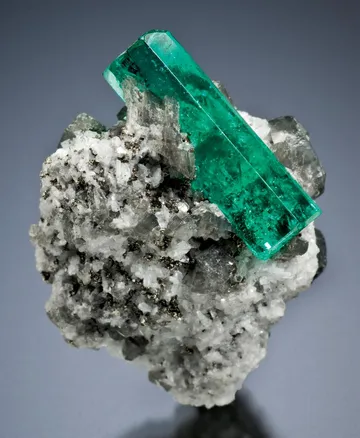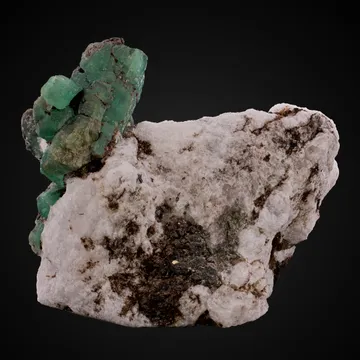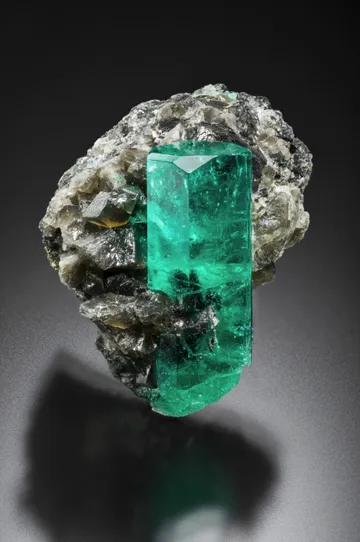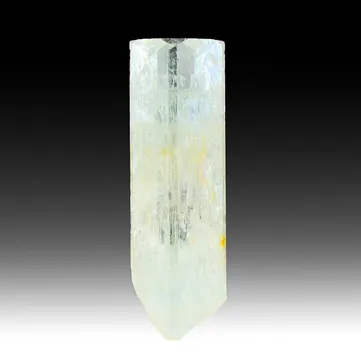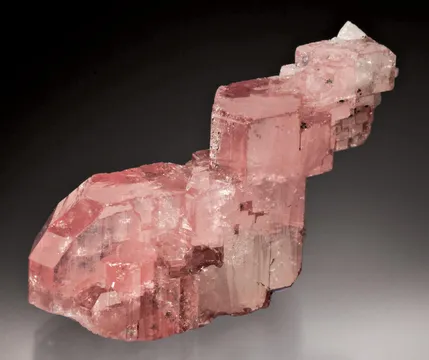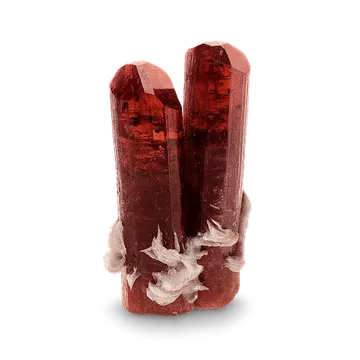
Muzo Emeralds, Colombia: famed beryl from a black-shale carbonate vein system, renowned for vivid green color, glassy hexagonal prisms, and collector appeal.
Key facts
Beryl from Muzo Mine means emerald in its most storied Colombian expression: saturated green Be3Al2(Si6O18), colored chiefly by chromium and vanadium, set against white calcite, black shale, pyrite, and, more rarely, quartz. To collectors, the finest Muzo pieces are not simply “emerald specimens”; they are the reference point by which many other emerald localities are judged. The best examples combine a vivid, slightly velvety green with a glassy luster, sharply hexagonal prism form, and a matrix that tells the whole geological story at a glance: green crystal, white carbonate vein, dark carbonaceous host rock, and metallic pyrite.

Photo: Didier Descouens, Wikimedia Commons
The deposit is one of the great exceptions in emerald geology. Most emerald deposits worldwide are tied in some way to igneous or metamorphic systems, where beryllium-bearing fluids meet chromium- or vanadium-bearing rocks. Muzo belongs to Colombia’s black-shale emerald province, where mineralization formed in organic-rich Lower Cretaceous sedimentary rocks of the Eastern Cordillera. Hot, saline basinal brines moved through faults, breccias, and carbonate veins, interacting with evaporitic and carbonaceous sedimentary units. The same broad process supplied and mobilized the ingredients needed for emerald crystallization: beryllium, aluminum, silica, chromium, and vanadium.
That geological peculiarity gives Muzo specimens much of their collector personality. The emeralds commonly sit in calcite-dolomite-pyrite vein material rather than in the pegmatitic or schistose matrices familiar from many other beryl localities. A classic Muzo specimen may show a single prismatic emerald growing upright from snowy calcite, with flecks or cubes of pyrite and traces of black shale or bitumen. Strong contrast is part of the appeal: an emerald of gemmy green hovering in a monochrome sedimentary world.

Photo: Géry Parent, Wikimedia Commons
Historically, Muzo is inseparable from the global emerald trade. Indigenous mining predates the Spanish conquest, and Spanish exploitation made Colombian emeralds a major luxury material in Europe, the Middle East, and India. In modern mineral collecting, Muzo’s prestige rests on two parallel traditions: the gem trade’s reverence for “Muzo color,” and the mineral collector’s pursuit of crystals that still retain their natural faces, matrix, and context. The finest matrix specimens are scarcer than cut stones because production is overwhelmingly directed toward gem recovery. A complete crystal in matrix therefore carries a double premium: locality prestige and specimen survival.
Collectors look first for color that is rich without going opaque, then for transparency, luster, and crystal definition. Terminated prisms, doubly terminated crystals, emeralds standing clearly on calcite, and specimens with well-balanced pyrite or quartz associations are especially prized. Trapiche emeralds from the broader Muzo district form a separate collecting category: six-rayed growth-sector stones whose dark carbonaceous arms radiate through the crystal. True, well-documented Muzo trapiche material is among the most recognizable Colombian emerald forms.
Search for specimens: View all beryl specimens from Muzo Mine, Colombia
Muzo Mine lies near Muzo Municipality in western Boyacá, on the western flank of Colombia’s Eastern Cordillera, roughly 100 kilometers north of Bogotá. In mineral-locality usage, “Muzo” may be used loosely for the mining district, but the historic Muzo Mine locality is a specific world-class emerald source within a broader western emerald belt that also includes Coscuez, Quípama, Maripí, La Pita, and other mines and prospects.
The emerald-bearing rocks are organic-rich black shales with interbedded dolomitic limestones of Lower Cretaceous age, especially units assigned in the literature to the Rosablanca and Paja formations. The deposit is structurally controlled. Emerald occurs in and near hydrothermal carbonate veins, breccias, tension gashes, faults, and related shear structures formed or reactivated during Paleogene compression. The vein assemblage is characteristically carbonate-rich: calcite and dolomite dominate, with pyrite common, and quartz, barite, fluorite, bitumen, Cr-bearing mica, parisite-(Ce), and emerald as notable accessory or collector minerals.

The accepted genetic model is hydrothermal-sedimentary rather than pegmatitic. Hot, hypersaline brines circulated through the sedimentary pile, dissolved evaporitic components, and reacted with organic-rich black shales. Thermochemical sulfate reduction and wall-rock interaction were central to forming the carbonate-pyrite-bitumen-emerald assemblage. In collector language, this is why the best Muzo emeralds seem so improbable: gem beryl crystallized not in a bright granitic pocket, but in fractured, carbonaceous marine sediments.
Mining history at Muzo is deep and turbulent. Indigenous peoples worked emeralds before Spanish arrival, and Spanish colonial exploitation was underway by the 16th century. The mine became a royal source, and emeralds from the district moved through imperial trade routes into European courts and, later, Indian jewelry traditions. After Colombian independence, ownership and management shifted repeatedly between state and private interests. The 20th century brought periods of informal working, private concessions, intense competition, and violence in the emerald zone. The late 1980s “Green War” remains a defining chapter in modern Colombian emerald history.
Modern operations are controlled, industrial, and not open to casual collecting in the way a classic hard-rock mineral locality might be. The current mine environment includes underground tunnel systems, mechanized access, air handling, pumping, security, sorting, and traceability procedures. Historic open cuts and informal digging have largely given way to underground mining. Around the district, however, emerald trading and small-scale recovery traditions remain visible: miners, dealers, and guaqueros have long sold rough in town markets, mine markets, and nearby river areas where tailings are washed. Any collecting or buying in the region should be treated as a legal, safety, and provenance-sensitive activity rather than a casual field trip.
Notable modern production includes a dramatic MTC recovery in May 2015, when one area yielded 152,000 carats, including large stones reportedly reaching 1,200 carats. Production numbers of that scale help explain why Muzo remains a gem mine first and a specimen locality second. Most crystals with gem potential are destined for cutting, and matrix pieces survive only when their aesthetic or specimen value justifies preserving them intact.
The classic Muzo habit is a hexagonal emerald prism, often short to moderately elongated, with a flat pinacoidal termination when preserved. Crystals may be singly perched, partially embedded in calcite, intergrown with carbonate, or exposed along broken vein surfaces. Fine crystals commonly show vitreous luster and strong prism-face definition. Natural etching, step growth, shallow pits, and repaired or contacted faces are all encountered, reflecting growth and later movement in an active fracture-vein environment.
Color ranges from light bluish green through deep saturated emerald green. The most coveted Muzo color is vivid, rich, and open enough to transmit light, not merely dark. The phrase “Muzo green” is often used commercially, sometimes too loosely, but on a specimen it refers to a very specific impression: strong saturation, a lively internal glow, and minimal grayness or yellow-brown overprint. Iron-poor Colombian emeralds can show an especially attractive red reaction under some fluorescence conditions, but fluorescence alone is not a locality proof.
Typical specimen crystals are measured in millimeters to a few centimeters. Cabinet specimens with crystals around 1–2 cm on calcite are well represented in collections and dealer inventories; larger, sharp, gemmy matrix crystals are significantly scarcer. Massive or broken emerald in matrix is much more common than elegant terminated crystals. A small, undamaged, well-positioned Muzo crystal may be more desirable than a larger but opaque or heavily damaged one.
Associated minerals are one of the strongest locality clues. Calcite is the signature matrix mineral, usually white to translucent and sometimes forming blocky or cleavable masses around the emerald. Pyrite is common, appearing as brassy specks, small cubes, or granular aggregates. Quartz occurs in some specimens, but calcite-dominant matrix is the more expected Muzo look. Parisite-(Ce), a rare-earth fluorcarbonate historically important from Muzo, is a notable associated collector mineral. Other reported associates include dolomite, apatite, albite, barite, fluorite, bitumen, and Cr-bearing mica.
Muzo emeralds are also famous for fluid inclusions. Colombian emeralds commonly contain multiphase inclusions with saline liquid, vapor bubbles, and daughter crystals such as halite; these inclusions are invaluable to gemologists and origin specialists. In faceted stones they are part of the “jardín” character. In mineral specimens they may be visible with a loupe or microscope as tiny bubbles, cubes, veils, and internal wisps that confirm the crystal’s natural growth history.
Quality in Muzo specimens is judged differently from quality in cut gems. A faceter may value clean, evenly colored rough with minimal fractures; a mineral collector wants an intact, naturally terminated crystal with matrix, orientation, luster, and visual balance. The most desirable pieces combine both worlds: gemmy crystal quality plus natural specimen aesthetics. A fine matrix piece should make sense from every angle—the emerald should emerge naturally from the calcite or shale contact, not appear inserted, drilled, or glued.
Trapiche emeralds from Muzo and neighboring Colombian deposits deserve special attention. These are not ordinary six-sided crystals but growth-sector emeralds with a central core and six dark radial arms, typically caused by carbonaceous or inclusion-rich material separating green emerald sectors. A sharp trapiche slice with strong contrast, clear six-rayed geometry, and reliable Muzo provenance is a distinct and highly collectible form of beryl.
Muzo emerald specimens require unusually careful authentication. The locality name is powerful, and that creates incentives for over-labeling, vague district labeling, and outright fabrication. “Muzo” may mean the historic mine, the municipality, the broader western emerald belt, or simply a color grade in commercial speech. A serious specimen label should distinguish between “Muzo Mine,” “Muzo district,” “Coscuez,” “Quípama,” “Maripí,” and other sources whenever possible.
Matrix emerald specimens from Colombia have long attracted suspicion because they are valuable and visually simple enough to fake: green crystals in white carbonate can be assembled. Warning signs include emeralds that sit in suspiciously rounded holes, glue halos, repeated identical crystals, matrix that does not interlock naturally with the crystal, polished or abraded crystals presented as natural terminations, and labels that rely on romance rather than documentation. Under magnification, look for continuous contact between emerald and matrix, undisturbed calcite growth around the crystal, natural penetration into the host, and realistic damage patterns.
Treatments are another issue. For faceted Muzo emeralds, clarity enhancement with cedarwood oil or other fillers is common and should be disclosed. For crystallized specimens, oiling may still occur, especially where emerald surfaces or fractures can be improved visually. Oil can make cracks less obvious and temporarily improve transparency; resins and hardened fillers are more concerning because they can alter appearance and complicate conservation. Avoid ultrasonic cleaning, heat, solvents, or aggressive washing unless the treatment status is understood. Even an “untreated specimen” should be handled as though the emerald may contain surface-reaching fractures.
Condition is central. Emerald has good hardness but is commonly fractured, and Muzo crystals may be brittle where they emerge from calcite. Terminations are often contacted, chipped, or rehealed; side faces may show abrasion from extraction. Calcite matrix is soft and cleavable, and pyrite may oxidize if stored in damp conditions. Fine specimens should be kept dry, away from prolonged heat and strong light, and handled by the matrix rather than the emerald.
Rarity depends sharply on quality tier. Small emerald fragments in calcite from the Muzo region are obtainable. Attractive thumbnail and miniature specimens appear regularly but are often expensive relative to size because of locality prestige. Cabinet-size matrix specimens with gemmy, well-formed, damage-free crystals are scarce. Large, highly saturated, transparent, well-terminated Muzo emeralds on matrix are trophy-level objects, and many such pieces disappear into private collections or are valued against the gem rough market rather than ordinary mineral-specimen pricing.
Current market availability is uneven. Dealers may list Muzo emeralds as loose crystals, matrix thumbnails, calcite-and-pyrite specimens, trapiche slices, or gem rough. The best advice is to buy the specimen, not the adjective. A modest but natural emerald crystal with credible provenance is preferable to a spectacular “Muzo” piece with no documentation. For high-value purchases, insist on a detailed invoice, prior collection history if available, high-resolution photographs, and, for gem crystals or cut stones, a respected laboratory report addressing natural origin, treatment, and geographic origin where appropriate.
For anyone who knows emerald only as a cut stone under jewelry-store lights, the modern Muzo mine is startlingly industrial. One recent account describes the entrance like a road tunnel, large enough for heavy machinery to haul rock and debris from underground rather than forcing miners to push everything out by hand. Inside, the old romance of treasure hunting meets a hard engineering reality: fresh-air hoses, water pumps, air-quality monitors, phone and internet lines for emergencies, and a maze of shafts extending more than half a mile underground.
Charles Burgess, a former U.S. diplomat and Marine Corps veteran, became one of the improbable figures in this modern chapter. He told NPR that he had no mining background and “never in my wildest imagination” expected to work in such a business. By the time journalists toured the operation, he was president of the company running the mine near Muzo. The transformation he described was philosophical as much as mechanical: “Instead of seeing this as treasure hunting,” he said, the goal was to make mining “a job and a career.” That line captures one of the largest shifts in Muzo’s recent history. The old emerald economy rewarded luck, secrecy, and risk; the new one tries to reward geology, payroll, and procedure.
The contrast with the old system is hard to overstate. Ramiro Melo, a 58-year-old miner from Muzo, remembered an era when miners could go months without a peso. “It was like the lottery,” he said. In the same telling, the late-1980s Green War killed about 3,500 people, and writer Petrit Baquero described the region as “the law of the jungle.” Those numbers and phrases matter because they sit behind every modern claim of traceability. A labeled Muzo emerald is not just a mineral specimen; it comes from a district where geology, violence, reform, and global luxury have been intertwined for generations.
The mine itself still gives up emeralds in scenes that sound like mineral-collector theater. Geologist Camilo Pinzón was described opening a white calcite vein streaked with green—the signal every emerald miner wants to see—then putting the rock in a bag for laboratory analysis. His joke was perfect Muzo realism: depending on quality, the contents might be invaluable or “worth the price of a piece of candy.” That is the emerald miner’s paradox in one sentence. A green speck in calcite may be a fortune, a flawed fragment, or nothing the market will love.
The 2015 GIA expedition supplied another vivid view of the Muzo area’s mining culture. The team arrived in the town of Muzo after visiting other Colombian emerald districts and found a street market dense with rough emeralds. At the El Amarillal mine, mining engineer Carlos Diaz explained the uncertainty of following geological indicators: even where miners hit faults with kaolinite and carbonate—minerals associated with emerald—there is no guarantee of production. Some 400-meter tunnel segments had been barren, even though miners may have passed close to emerald-bearing zones. That detail is the reality behind the finished specimen: every bright crystal on calcite represents a small victory over a mountain that mostly says no.
At another Muzo-area market, La Playa, the scene after tailings were dumped near the Río Itoco was almost cinematic. Thousands of locals washed through the material. After the morning’s trading, miners relaxed in improvised bars, beer in hand, still coated in black shale. The GIA team singled out one image: a husband and wife, both blackened by shale, examining a rough emerald crystal from the tailings. For collectors, that is one of the most honest pictures of Muzo—emerald not as abstract value, but as a green chance recovered from wet black sediment.
A more recent travel report from Muzo shows how the emerald economy continues to change. The town, described as hot and reached by a rough road from Bogotá, has a hillside message visible from a distance: “Paz. Dios ve todo.” The sign refers to peace after the emerald wars, a public reminder that the green stone once carried a threat as well as a promise. In the town, emeralds circulate almost casually—offered in bars, on benches, and in everyday conversations—yet the trade has begun moving through TikTok and social media. One local seller, Lady Fajardo, entered mining and then started selling emeralds online; within months she added mining-area tours after followers became curious about the physical world behind her broadcasts. A superstition lingered in the background: women were once believed to make emeralds hide if they tried to seek them. Today women are visible as geologists, sellers, workers, and guides.
The stories around Muzo also drift into legend because the stones invite legend. Local people tell of luck as though it were a resident of the town. The El País account mentions the everyday presence of lotteries and chance, and then the larger version of chance: emeralds hidden in the mountains. That is not mere local color. It is a practical description of emerald mining. The scientific model explains hot brines, black shales, and sulfate reduction; the miner still walks to a vein not knowing whether the next green flash will pay for a beer, a month, or a lifetime.