A collector's guide to Mufulira Mine, Zambia: its geology, mining history and notable minerals, illustrated with the 61 specimens documented from this locality on EarthWonders.
Key facts
Mufulira is one of the great arenite-hosted copper deposits of the Central African Copperbelt: a mine whose industrial importance would be notable even if it had never produced a specimen, and whose best crystallized copper and cuprite pieces give it a distinct collector identity within Zambia. The ore occurs in Neoproterozoic Katangan metasediments of the Lower Roan Group, where copper sulfides are hosted principally by meta-sandstones, carbonaceous wackes, and related sedimentary facies rather than by the vein systems collectors might expect from many classic copper localities. That setting matters aesthetically: the collectible minerals are products of oxidation, supergene enrichment, and cavity growth within a very large stratiform copper system, so the finest pieces tend to be sculptural native copper, cuprite-on-copper, cuprite with carbonate gangue, and rarer pockets of gypsum, aragonite, plancheite, chalcocite, and cobalt-bearing sulfides.
The mine’s classic collector look is unmistakable. Native copper occurs as branching, arborescent, and spinel-law twinned groups, often with reddish to brownish patina, green alteration, or plummy cuprite crusts. Good cuprite from Mufulira is not usually the freestanding thumbnail-to-miniature perfection of Bisbee or Tsumeb; its appeal is more rugged and geological: dark red to maroon octahedra and crystalline coatings perched on copper, dolomite, calcite, oxidized quartzite, or limonitic matrix. The most desirable specimens preserve their three-dimensional copper architecture, identifiable twinning, and original mine-level provenance—particularly pieces from Mufulira West in the late 1970s and early 1980s, including the well-documented 20m P3 mining drive on the 730-meter level.
Regional View
Country View
Mufulira’s specimens should be understood against the scale of the deposit. This is not a small collector mine that happened to produce copper minerals; it is a major Zambian underground copper operation, historically among the largest in the country, with a mine town built around it, concentrator and metallurgical infrastructure attached to it, and nearly a century of development behind it. The specimen-producing cavities were incidental to mining, which is one reason well-provenanced pieces are so prized. They come from a working industrial environment where access, safety, and production—not collecting—control what survives.
Search for specimens: View all specimens from Mufulira Mine, Zambia
Mufulira Mine is at Mufulira in Zambia’s Copperbelt Province, close to the Democratic Republic of the Congo border and north of Kitwe. Geologically it belongs to the Central African Copperbelt, the immense metallogenic province developed in Neoproterozoic rocks of the Katanga Supergroup. At Mufulira, the mineable copper occurs in three closely associated, laterally persistent ore horizons in Lower Roan Group meta-sandstones. The primary ore minerals are chiefly bornite and chalcopyrite, with subordinate chalcocite and pyrite; cobalt is present in minerals such as carrollite and cobaltiferous pyrite. Oxide caps and supergene zones, especially near extremities of the deposit, provide the geological setting for malachite, azurite, cuprite, native copper, chrysocolla, and other collector minerals.
The orebody is commonly described as stratiform to stratabound and sediment-hosted, but Mufulira is more nuanced than a simple sheet of ore in sandstone. Detailed sedimentological work showed a cyclic Lower Roan succession with Footwall, Ore, and Hangingwall formations, repeated in a way that produces the A, B, and C orebodies. The C Orebody is the largest of the three and has long been emphasized in geological studies. Its host rocks include fine-grained carbonaceous wacke, argillitic sandstone, mottled sandstone, and cleaner arenite. Carbonaceous matter, reducing conditions, permeability contrasts, and inherited basement topography all helped localize sulfide mineralization. Basement highs, valleys, and shore-zone facies influenced where carbonaceous, pyritic, chalcopyrite-rich, bornite-rich, and chalcocite-rich zones developed.
From a collector’s perspective, the important distinction is between the economic sulfide body and the much smaller number of open spaces that yielded cabinet-quality minerals. Most of the ore is disseminated, blebby, or irregularly massive sulfide mineralization—not specimen-grade crystallization. The collectible material came from oxidized zones, supergene enrichment zones, and cavities in Mufulira West and related workings. Old dealer lists and modern specimen records repeatedly identify the 660-meter level and Mufulira West as sources of native copper, cuprite, gypsum, plancheite, and associated minerals. The 20m P3 mining drive on the 730-meter level is especially significant for the March 1983 Dave Kershaw collection of copper and cuprite specimens later illustrated and discussed in The Mineralogical Record.
Historically, copper mineralization in the area was first recognized in the 1920s. By 1930, drilling had outlined a large reserve averaging more than 4% copper, and although a small concentrator was completed in 1931, full production was delayed by the Depression and began in 1933. The mine expanded through the mid-20th century, contributed substantially to wartime copper supply, and by 1970 was one of Zambia’s principal underground copper operations. It passed through the broader political and corporate history of the Copperbelt: colonial-era development, Zambian nationalization, Zambia Consolidated Copper Mines, privatization in 2000, Glencore-era Mopani Copper Mines, ZCCM-IH ownership after 2021, and the 2024 entry of International Resources Holding as majority partner in Mopani.
Mufulira remains an active industrial mine complex rather than a collecting locality. The underground mine, concentrator, smelter, and refinery are controlled operational environments, and casual collecting should not be expected. Specimens on the market almost always have their roots in historical mine access, geologists’ collections, old British and southern African dealer stock, or recycled collections assembled when mine employees and visiting geologists could occasionally preserve pieces from working areas. The best labels are unusually specific for an African copper locality: “660 metre level,” “29 Block,” “Mufulira West,” “640-meter level,” “730-meter level,” or “20m P3 mining drive.” Those details are more than romance; they help separate documented Mufulira material from generic “Zambia” copper and from specimens from better-known Copperbelt mines such as Nkana, Nchanga, and Konkola.
Native copper is the signature collector mineral of Mufulira, especially from Mufulira West and the 660- to 730-meter-level finds. It forms branching arborescent groups, elongated spear-like crystals, wires, flattened crystals, and well-developed spinel-law twins, commonly ranging from thumbnails and miniatures to small-cabinet and cabinet pieces, with documented examples over 10 cm. The best pieces show a freestanding sculptural habit rather than a compact mass: sharp coppery to reddish-brown branches, recognizable twinning, and attached cuprite octahedra or crystalline cuprite crusts, sometimes with quartz, calcite, gypsum, malachite, or dolomite. Ordinary pieces are simply oxidized copper fragments; top Mufulira coppers have architecture, patina, locality-specific mine-level provenance, and a balance between exposed metallic copper and secondary copper minerals.
Cuprite from Mufulira is best known as dark red, maroon, plum-colored, or bright red crystals and crystalline coatings associated with native copper, oxidized matrix, dolomite, and calcite. Octahedral faces are common on the better material, and some specimens show small lustrous crystals scattered over native copper or forming crystalline crusts that can partially obscure the copper beneath; fine specimens from the 20m P3 mining drive on the 730-meter level include cuprite clusters on dolomite with calcite, cuprite-on-copper groups, and calcite carrying red acicular cuprite known as chalcotrichite. Sizes range from millimeter-scale crystals to specimens several centimeters across, with exceptional copper-cuprite groups exceeding miniature size. The best Mufulira cuprites are not judged only by crystal size but by luster, red translucency under strong light, sharp octahedral form, and their relationship to native copper or carbonate gangue.
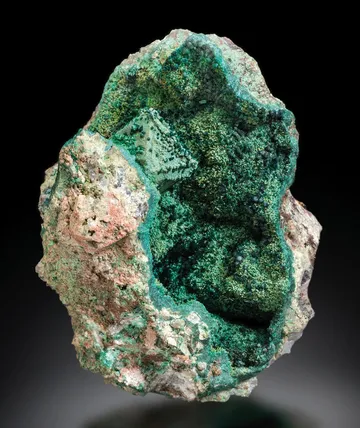
Malachite is the most familiar secondary copper mineral in Mufulira’s oxidized assemblage, but specimens from the mine are generally collected for association and locality character rather than for huge botryoidal display pieces. It occurs in oxide caps, oxidized quartzite, and copper-bearing cavities as green coatings, crusts, earthy to fibrous masses, and occasional divergent acicular overgrowths; it is commonly seen with native copper, cuprite, chrysocolla, plancheite, quartz, and limonitic matrix. Good Mufulira malachite pieces are those that provide contrast—green malachite accenting reddish copper and dark cuprite, or malachite accompanying rare plancheite from Mufulira West—while ordinary material is massive, friable, or visually indistinct oxide ore.
Aragonite is a scarce and distinctive accessory specimen mineral at Mufulira, far rarer on the market than copper or cuprite. Documented examples are gemmy to colorless prismatic crystals, including large-cabinet specimens with crystals reported to several centimeters in length, recovered in very limited numbers from late-1970s material. The finest pieces are valued as unusual locality specimens: transparent to translucent aragonite crystals with good form, minimal cleaving, and clean matrix relationships, sometimes noted for fluorescence under longwave ultraviolet light. Because Mufulira is not a standard aragonite locality, provenance is especially important; a colorless aragonite without an old label or credible chain of custody is easy to detach from its locality story.
Other documented minerals from Mufulira include the primary sulfides bornite, chalcopyrite, chalcocite, carrollite, cobaltite, pyrite, and the tennantite subgroup, along with albite, anhydrite, dolomite, gypsum, quartz, rutile, zircon, rhodonite, chrysocolla, azurite, limonite, and plancheite. Chalcocite is notable as platy, iridescent intergrowths and as part of the supergene copper suite. Gypsum is represented by colorless selenite crystals from cavities in the C Orebody and footwall rocks of Mufulira West, with some crystals reportedly reaching 30 cm and occasional associations with filigree native copper and small cuprite. Plancheite is one of the most attractive rarities: cerulean-blue fibrous radiating globules from Mufulira West, including material from the 640-meter level in the 1970s. Mufulira is not known as a type locality for a valid mineral species, but it is an important occurrence for a compact and very recognizable Zambian copper-cobalt secondary assemblage.
Mufulira specimens reward labels. A native copper described only as “Zambia” may be attractive, but a specimen labeled 660 m level, 29 Block, Mufulira West, 640 m level, or 20m P3 drive, 730 m level carries a much stronger collector story and is easier to distinguish from material from Nkana, Nchanga, Konkola, or Democratic Republic of the Congo localities. Good provenance names associated with the better documented pieces include mine geologists and collectors such as Dave Kershaw, and later collections in which the specimens were preserved with mine-level data.
Mislabeling is the main authenticity concern. There is no widely documented industry of manufactured Mufulira fakes, but copper specimens are among the easiest minerals to misattribute because many localities produce branching copper. Mufulira copper should be compared for habit and associations: spinel-law twinned branching copper, cuprite crusts or octahedra, occasional calcite, gypsum, quartz, malachite, plancheite, and old Zambian/Copperbelt labels are more persuasive than a generic copper mass. Be cautious with pieces that look like heavily acid-cleaned copper with no cuprite, no patina, and no documented history; aggressive cleaning can remove exactly the alteration and matrix details that make Mufulira material recognizable.
Condition issues are predictable for the species. Native copper can be bent, broken, or cleaned too brightly; the finest Mufulira pieces often have delicate spear-like or branching terminations that are vulnerable to handling. Cuprite can be abraded on crystal edges, especially where it forms crusts over projecting copper. Chalcotrichite-like acicular cuprite is fragile and should be protected from brushing or repeated packing. Malachite, plancheite, and limonitic matrix can shed or powder if damp or roughly handled. Gypsum and aragonite from the locality require extra care: gypsum is soft, easily scratched, and water-sensitive; aragonite cleaves and bruises readily. Aragonite specimens reported to fluoresce under longwave ultraviolet light should be tested gently and stored away from heat, impact, and high humidity.
Availability is limited but not impossible. Native copper and cuprite appear periodically from old collections and dealer archives, while aragonite, gypsum, and plancheite are much scarcer. The best Mufulira pieces are not usually recent mine-run material; they are recycled historical specimens from the 1970s and early 1980s, with occasional earlier and later pieces surfacing through British, American, South African, and online dealer networks. For serious collectors, the premium belongs to specimens that combine aesthetics with exact mine data, because Mufulira’s specimen history is inseparable from individual pockets and working levels.
The discovery story begins with a small, almost absurdly modest object for such a giant orebody: green-stained organic matter by a stream. In August 1923, prospectors James Moir and Guy Bell were working the country around the Kafue River under Raymond Brooks. They had found little of consequence on the northward leg of their traverse, but while returning south they camped beside the Mufulira Stream. There they noticed a clump of peat moss stained green by copper minerals and, nearby, slight copper-carbonate staining on rock outcrop. Samples were sent back to the Nkana laboratory, where Lewin Tucker received them; more than two decades later Tucker would become general manager of the Mufulira Mine. The visible evidence was meager, but later drilling revealed the scale concealed below the surface. By 1930 the property had been drilled into one of the great copper discoveries of the Copperbelt.
Mufulira’s geological story is full of hidden landscapes. Long before mining, the Lower Roan sediments were laid over an irregular Precambrian basement surface of rounded hills, ridges, valleys, and shallow marine depressions. Later mine geologists could read that ancient topography in isopach maps, cross-bedding, and mineral zoning. In the C Orebody, the largest of the three main orebodies, cross-bedded sandstones once interpreted as windblown dunes were reinterpreted by Jan van Eden as subaqueous dunes and nearshore marine sands. The most ore-favorable rocks were not the clean, showy sand bodies but darker, carbonaceous wackes and mottled sandstones—quiet, reducing places where copper-bearing fluids met chemical traps. For the collector, that ancient shoreline survives only indirectly: in copper spears, red cuprite, selenite cavities, and the rare blue plancheite nodules that escaped the crusher.
The most haunting Mufulira story is the disaster of 25 September 1970. At about 2:55 a.m., mud and tailings entered the Peterson Section of the mine between the 434-meter and 580-meter levels. Within roughly fifteen minutes, large parts of the eastern half of the workings were overwhelmed. About 1,500 miners were underground at the time. Witnesses described an unfamiliar violence: not normal blasting, but a sound remembered as “thunder,” “an explosion,” “a shaking,” and a “blasting sound.” Electrical cables snapped, ventilation stopped, and darkness followed the rush of mud.
The numbers are stark. Rescue teams from Copperbelt mines, led by Greg Phimister, the Mufulira Division ventilation engineer, searched for three days. When rescue operations were finally called off, 89 men remained missing and were presumed dead: 64 employees of Mufulira Division and 25 employees of Cementation Limited, a contractor working on shaft rehabilitation. The total volume of sludge and mud in the working areas was estimated at 450,000 m3. On the 580-meter level alone, 30 of the 39 men at work were killed.
Survivor accounts preserve the event more powerfully than statistics. Abel Musonda, a 24-year-old crane driver, later described reaching the point where he could go no farther as wet mud flowed beneath him, his chest burning and breath failing. He survived because he found dripping water, continued upward, and was pulled to safety by another man clinging to a pipe. Winnel Chishe, a 38-year-old pump operator, escaped with others by holding onto a wire only “as thick as a pencil.” Kenani Kabanda remembered the violent noise, the muck and water, the snapping cables, the stopped fans, and “total darkness underground.” James Kazembe, working with a group of nine men in a crosscut, saw mud and water rushing toward them; the group split and ran, and the rest of the men disappeared.
The cause was not a sudden freak from nowhere. Tailings had accumulated in a surface depression over caving ground. Earlier warning signs included a 60-meter-diameter sinkhole observed in November 1968, unusual pressure conditions on the 518-meter level in January 1970, and mud extrusion in the 17 Block area on the 533-meter level in March 1970. One underground manager warned in April 1970 that tailings might follow the mud intrusion and should not be ignored. After the disaster, investigators concluded that disposing tailings over caving ground was fundamentally wrong. The tragedy reshaped mine-safety thinking in Zambia, particularly around caving methods beneath tailings dams, swamps, drainage channels, and waterlogged unconsolidated material.