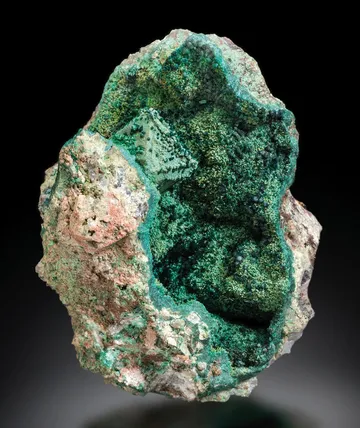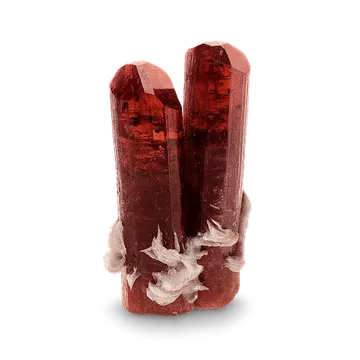
Kagem Emerald Mine, Zambia — home to specimen-grade emerald beryl with deep blue-green to golden-green color, and distinctive schist geology prized by collecto…
Key facts
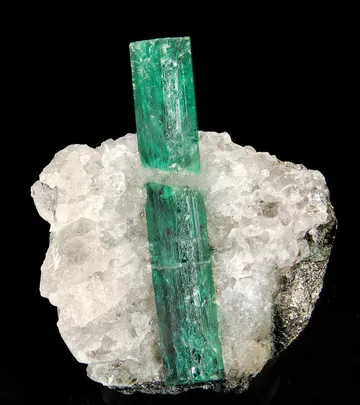
Beryl from the Kagem Emerald Mine is, for collectors, essentially the modern Zambian emerald story in crystal form: saturated blue-green to golden-green emerald prisms emerging from pale quartz, dark mica-rich schist, or altered reaction-zone rock. The best pieces have the immediate visual drama serious collectors want from emerald specimens—deep color, visible hexagonal form, and a geological contrast that is quite unlike the classic Colombian calcite-and-pyrite aesthetic.

Photo: Rob Lavinsky / iRocks.com via Wikimedia Commons
The mine lies in Zambia’s Copperbelt Province within the Kafubu emerald district, a schist-hosted emerald province where beryllium-bearing pegmatites and quartz-tourmaline veins interact with chromium- and vanadium-bearing mafic-ultramafic rocks. That reaction-zone origin gives Kagem emeralds their characteristic identity: many are iron-rich compared with Colombian emeralds, commonly bluish green, and associated with phlogopite-biotite schist, talc-magnetite schist, quartz, feldspar, tourmaline, actinolite, magnetite, and related alteration minerals.
Kagem matters historically because it is not merely a famous occurrence; it is one of the few colored-stone localities that has combined large-scale mechanized mining with deliberate recovery of specimen-grade crystals. Gemfields acquired a controlling interest in 2008 in partnership with the Zambian government, and the mine’s output has since helped stabilize the international supply of Zambian emerald. For mineral collectors, an especially important chapter began when Gemfields worked with Collector’s Edge Minerals to recover and market specimen pieces, with the first Kagem emerald specimens presented to collectors at the 2009 Denver Gem and Mineral Show.
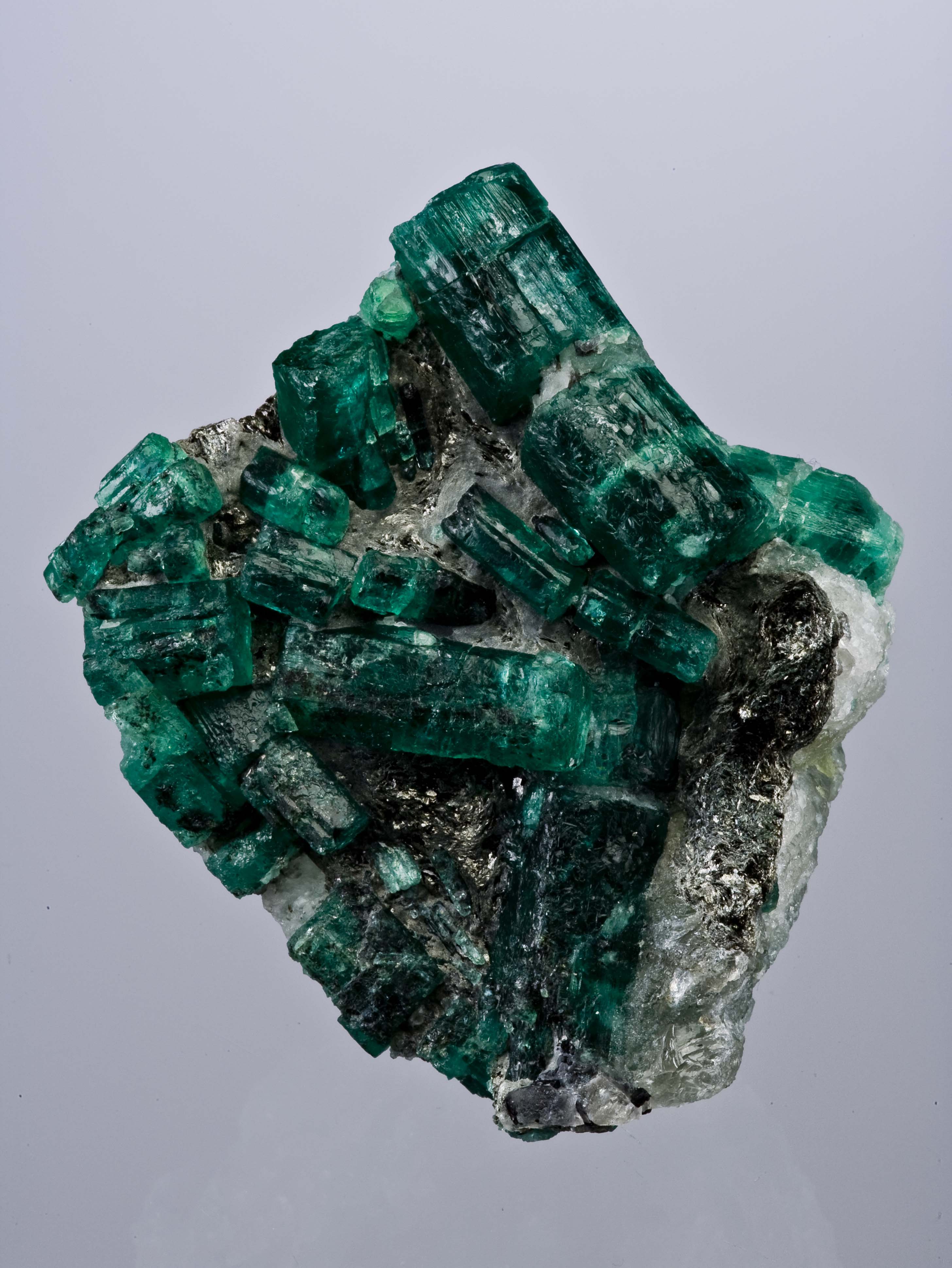
Photo: Rob Lavinsky / iRocks.com via Wikimedia Commons
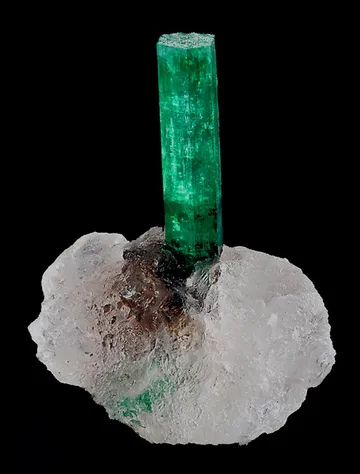
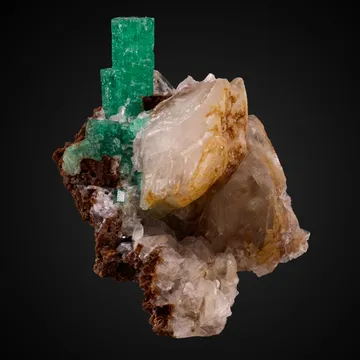
The finest collector specimens are not simply pieces of emerald rough. They are architectural: a single sharp prism standing upright from white quartz; a cluster of stubby to elongated emerald crystals on dark mica-rich matrix; or a partially embedded crystal whose green edges glow through the host. Collectors look for undamaged terminations, strong luster, natural attachment, attractive contrast, and color that remains rich rather than blackish when viewed under normal display lighting.
Search for specimens: View all beryl specimens from Kagem Emerald Mine, Zambia
Kagem is in the Kafubu emerald mining district of Lufwanyama District, Copperbelt Province, Zambia, south of Kitwe and west of Ndola. The Mindat locality coordinates place the mine at approximately 13° 5' 21'' South, 28° 8' 19'' East. In modern company reporting, Kagem’s principal operations are Chama, Chibolele, and Fibolele, with Chama the best-known large open pit.
The deposit is a classic schist-hosted emerald system. The emerald-bearing rocks belong to the broader Kafubu emerald field, where Mesoproterozoic Muva Supergroup metabasites and ultramafic-derived schists were intruded by beryllium-bearing pegmatites and quartz-tourmaline veins during Pan-African tectonism. At Kagem, emerald and common beryl form mainly where pegmatite or quartz-tourmaline material meets talc-magnetite schist and related phlogopite-biotite reaction zones. The chromium and vanadium needed for emerald color are supplied by the host rocks; beryllium comes from the pegmatitic system.
The ore geometry is unusually important to understand because it controls both production and specimen quality. Emeralds occur in soft phlogopite-rich reaction zones and in quartz-tourmaline veins. The soft altered mica rock can protect crystals during growth and recovery, while the quartz veins can yield sharper, more aesthetic crystals on white matrix. GIA’s 2014 field report records Kagem senior geologist Robert Gessner’s view that the best emeralds are usually found in the quartz-tourmaline veins, a point that matches what collectors see in the most admired Kagem matrix specimens.
Beryl was first reported from the Kafubu area in 1928 by geologists Dicks and Baker. Exploration followed in the 1940s and 1950s, but the district did not become a major emerald producer until the 1970s. The Kagem company was established in 1980, and the mine operated under earlier management for roughly two decades before Gemfields entered the picture. In 2007 Gemfields was awarded a management contract, and in 2008 it acquired 75% ownership, with the remaining 25% held by the Government of Zambia through the Industrial Development Corporation.
The transformation of the Chama pit is one of the defining operational stories of the locality. When Gemfields took over, GIA reported that the principal open pit had a poorly excavated 60-meter highwall, waste soil obscured the geology, and earlier mining had followed only the obvious outcropping contact zones. Gemfields spent a year cleaning and re-engineering the pit, exposing emerald-bearing contact zones and establishing benched highwalls. The same report described the pit as roughly a kilometer long and deepened to about 105 meters at that time.
Kagem is primarily an open-pit mine, although underground exploratory work has also been carried out. The open-pit method is significant for collectors because it allows systematic exposure of contact zones and makes recovery of individual crystals more controllable than in many small-scale emerald operations. Recovery is still highly manual at the critical moment: once emerald-bearing rock is exposed, workers use hand tools such as hammers and chisels to free crystals and emerald-bearing pieces.
Collecting access is not comparable to a hobby locality. Kagem is an active industrial gemstone mine in a restricted emerald mining area, and specimens reach collectors through controlled commercial channels, auctions, dealers, and past collaborations such as the Gemfields–Collector’s Edge specimen program. Field collecting by visitors should not be expected, and any specimen represented as freshly collected from Kagem should be accompanied by credible provenance.
Production is large by colored-stone standards. In 2022 the mine produced 37.2 million carats of emerald and beryl, including 259,500 carats of premium emeralds. In 2024 Gemfields reported 40.3 million carats of emerald and beryl, including 159,351 carats of premium emeralds. Mining was paused during the difficult emerald market of early 2025, then focused open-pit mining resumed to target more premium emeralds.
Kagem is also known for a series of named giant emeralds: Insofu, the “elephant” emerald discovered in 2010; Inkalamu, the 5,655-carat “lion” emerald discovered in 2018; Chipembele, the 7,525-carat “rhino” emerald discovered in 2021; and Imboo, the 11,685-carat “buffalo” emerald introduced in 2025. These are gem-crystal discoveries rather than typical cabinet specimens, but they underscore the scale and quality potential of the deposit.
Kagem beryl is best known as emerald, the chromium- and vanadium-colored green variety of beryl. The collector-grade crystals are typically hexagonal prisms, ranging from small embedded crystals to fine miniatures and occasional cabinet-scale matrix pieces. The most desirable crystals show strong prism faces, intact flat or slightly modified terminations, and a saturated green to bluish green body color.
Color is one of the locality’s strengths. Kagem emeralds may be rich bluish green, deep evergreen, or green with a slight golden warmth. The best crystals are vivid without becoming too dark. Compared with many Colombian emeralds, Kagem material can show a cooler, iron-influenced tone, and its refractive index and specific gravity values are generally higher than those of many classic Colombian stones.
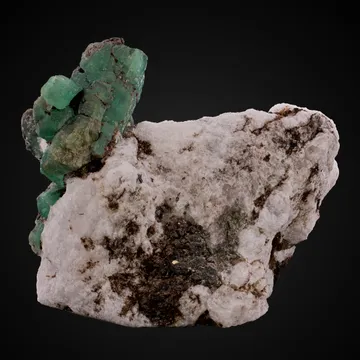
Matrix is a major part of the locality’s appeal. White quartz matrix gives the most dramatic contrast and produces specimens that photograph beautifully: green hexagonal prisms standing against snowy quartz. Dark phlogopite-biotite schist and talc-magnetite schist create a more geological, “in situ” look, with mica flakes and black accessory minerals setting off the emerald color. Quartz-tourmaline vein pieces may show black tourmaline or tourmalinite, while altered reaction-zone specimens may include mica-rich, soft, dark to bronze-brown material.
Associated minerals documented from the Kagem locality and its immediate paragenesis include quartz, phlogopite, muscovite, talc, magnetite, graphite, dolomite, feldspar-group minerals, tourmaline including schorl, tremolite, and spessartine in the broader Kafubu assemblage. In gemological studies of Kagem emeralds, common internal inclusions include two-phase fluid inclusions, actinolite needles, graphite, magnetite, and dolomite. Partly healed fissures may show iridescent films.
The best Kagem specimens tend to fall into several visual types. The first is the single crystal on quartz: one prominent emerald prism perched naturally on pale matrix, prized when the crystal is sharp and the attachment is convincing. The second is the clustered matrix piece: multiple emeralds of varying size arranged across quartz and dark mica-rich matrix. The third is the embedded crystal: a lustrous green prism partly enclosed in quartz or schist, attractive when enough crystal is exposed to show form and color.
Typical collector sizes range from thumbnails with crystals around a centimeter or less, to miniatures with 2–4 cm crystals, to larger cabinet specimens with multiple crystals or substantial matrix. Individual emerald crystals from Kagem can be much larger, but most large high-quality crystals enter the gem trade as rough rather than remaining intact as mineral specimens. This is one reason undamaged, well-composed matrix specimens from the early specimen-production period remain especially desirable.
Quality factors are different for a mineral specimen than for faceting rough. Transparency helps, but an emerald specimen can be excellent even if included, provided the color is rich, the form is clear, and the matrix is attractive. For specimens, the hierarchy is usually: natural attachment, color, termination, luster, composition, absence of obvious repairs, and matrix contrast. A slightly included but lustrous, undamaged crystal on quartz can be more collectible than a cleaner loose fragment with no matrix or termination.
Kagem emerald specimens occupy a strong position in the market because they combine a famous modern mine, attractive color, and a credible specimen-production history. Fine quartz-matrix pieces from the Gemfields–Collector’s Edge period are particularly sought after, and the best examples are no longer common in ordinary dealer stock. Smaller embedded crystals and commercial-grade matrix pieces remain available, but truly sharp, unrepaired, well-composed specimens are much scarcer than Kagem’s total emerald production might suggest.
Condition must be examined carefully. Emerald has no cleavage in the way many feldspars or carbonates do, but it is brittle, naturally fractured, and commonly included. Edges, terminations, and contact points can be chipped. Kagem crystals on quartz may have broken or abraded prism corners, etched or pitted surfaces, and incomplete terminations. On dark mica-rich matrix, it can be harder to judge whether a crystal is naturally seated, repaired, or merely glued into a prepared cavity.
Authenticity is a real concern in emerald specimens from Zambia and similar schist-hosted localities. The most dangerous fakes exploit the very features collectors expect: green prismatic “emerald” set into mica-rich rock. Documented imitations include dyed or coated quartz, green glass, synthetic material, and assembled fragments decorated with mica, sand, clay-like coatings, or fake matrix. SSEF reported a rough “emerald” allegedly from Africa that proved to be dyed quartz with mica and sand glued to the surface to mimic mica-schist emerald matrix. GIA’s older Gem News reports described Zambian emerald-rough imitations made from quartz fragments glued with green epoxy, five-sided glass “crystals” with mica and clay-like matrix, and coated smoky quartz masquerading as emerald.
For Kagem specimens, inspect the crystal-matrix junction first. Natural emerald on quartz or schist should show believable geological integration: quartz or mica wrapping the crystal, intergrowth textures, staining, and no continuous glue meniscus. Suspicious signs include a glossy transparent film around the base, matrix grains stuck to the crystal surface with resin, mismatched orientation, overly perfect isolated crystals sitting in shallow sockets, rounded face junctions caused by coating, or green color concentrated in cracks and glue.
Treatments are more relevant to cut stones than to mineral specimens, but they still matter. Emeralds are commonly treated with oil or other fillers to improve apparent clarity, and a 2023 study of 30 Kagem emerald samples noted that five had oil and wax fillings. For display specimens, oiling may darken fissures or improve transparency, while resin or wax at the crystal base may also be confused with repair. Serious specimens should be described honestly: natural, repaired, stabilized, oiled, or restored where applicable.
The strongest provenance for collector pieces is early documented specimen production, old dealer labels, auction records, museum-quality photography, or a chain of custody from established mineral dealers. Because Kagem is an active restricted mine with controlled commercial output, vague stories of tourist-collected or hand-carried material should be treated cautiously.
In September 2014, GIA’s field team stood at the rim of Kagem and saw a kind of colored-stone mining that still feels unusual in the emerald world: a vast mechanized pit rather than a hand-dug scramble of small workings. The team had already been through Zambia’s smaller emerald scenes, including Musakashi and the broader Kafubu area, where Vincent Pardieu remarked that there were “maybe 400 mines, and maybe less than 10 are active.” Then came Kagem, where the scale changed completely. From the rim, the visitors watched explosions ripple through the pit to loosen ore for processing. Gemfields geologist Robert Gessner summarized the operation in a sentence collectors should remember: “Geology is dictating our mining here.”
The same visit captured the peculiar tension of Kagem: industrial scale at one end, hand recovery at the other. Trucks, benches, pushbacks, and ore processing define the mine, but emerald still comes down to a worker recognizing the right contact zone and freeing the crystal without destroying it. GIA field gemologist Andy Lucas put the thrill simply: “It’s exciting to touch a stone coming out of the ground.” For anyone who has handled a Kagem matrix specimen, that sentence explains part of the appeal. These are not just facetable roughs; the best preserve a moment of contact between the emerald and the rock that made it.
The most vivid transformation story is the Chama pit itself. When Gemfields arrived, the pit had been operating for 19 years under other management. GIA recorded a 60-meter highwall, waste soil covering the geology, and mining focused on outcropping contact zones. Miners had reportedly been lowered into contact zones in excavator buckets. Gemfields spent a year cleaning the pit and removing pegmatite and talc-magnetite schist to expose the emerald-bearing contacts. By the time GIA described the modernized operation, the highwall was 120 meters high, built in 10-meter benches, and the pit had been deepened to 105 meters.
For specimen collectors, the 2009 Denver Gem and Mineral Show was a landmark. Gemfields had begun working with Collector’s Edge Minerals to identify and prepare specimens rather than sending every attractive emerald-bearing piece straight into the rough pipeline. The first Kagem specimens from that collaboration debuted at Denver in 2009. Among the most admired examples were emeralds on quartz—crystals that had survived mining with their matrix attachment intact, the white quartz acting not only as a display base but also as the protective cradle in which the crystal had grown.
The giant named emeralds from Kagem read almost like a bestiary carved in green. Insofu, meaning “elephant” in Bemba, was discovered in 2010 and weighed 6,225 carats. Inkalamu, the “lion” emerald, followed in 2018. It weighed 5,655 carats and was discovered at 10:15 a.m. on 2 October 2018 in the eastern part of Kagem’s largest open pit by geologist Debapriya Rakshit and veteran miner Richard Kapeta. Gemfields described it as having remarkable clarity and a balanced golden-green hue, and named it in honor of conservation work involving the Zambian Carnivore Programme and the Niassa Carnivore Project.
Then came Chipembele, the “rhino” emerald. Discovered on 13 July 2021 by geologist Manas Banerjee and Richard Kapeta’s team, it weighed 7,525 carats, or 1.505 kilograms. The moment was memorable enough that Gemfields preserved the miners’ reaction: the discovery “left everyone speechless,” and Kapeta shouted, “look at this rhino horn!” Chipembele was later verified on 22 April 2022 as the Guinness World Records title holder for largest uncut emerald. Its sale also supported black rhinoceros conservation through the North Luangwa Conservation Programme.
In 2025, Kagem introduced an even larger named stone: Imboo, the “buffalo” emerald, weighing 11,685 carats. Gemfields presented it for its high-quality emerald auction running from 25 August to 11 September 2025. Adrian Banks, Gemfields’ Managing Director – Product and Sales, described how even under the strong light needed to illuminate a stone of that size, Imboo showed “an intense, verdant green touched with golden warmth.” For collectors, Imboo is not a cabinet specimen in the conventional sense; it is a reminder that Kagem’s geological system can still produce emerald crystals at a scale that feels almost implausible.
J. C. (Hanco) Zwaan, Antonín V. Seifert, Stanislav Vrána, Brendan M. Laurs, Björn Anckar, William B. Simmons, Alexander U. Falster, Wim J. Lustenhouwer, Sam Muhlmeister, John I. Koivula, and Héja Garcia-Guillerminet, “Emeralds from the Kafubu Area, Zambia,” Gems & Gemology, Vol. 41, No. 2, 2005, pp. 116–148. DOI: 10.5741/GEMS.41.2.116. GIA article and PDF
Antonín V. Seifert, V. Žáček, Stanislav Vrána, V. Pecina, J. Zachariáš, and J. C. Zwaan, “Emerald mineralization in the Kafubu area, Zambia,” Bulletin of Geosciences, Vol. 79, No. 1, 2004, pp. 1–40. Mindat reference entry
Ran Gao, Quanli Chen, Yan Li, and Huizhen Huang, “Update on Emeralds from Kagem Mine, Kafubu Area, Zambia,” Minerals, Vol. 13, No. 10, 2023, Article 1260. DOI: 10.3390/min13101260. MDPI full text
Tao Hsu, Andrew Lucas, Vincent Pardieu, and Robert Gessner, “A Visit to the Kagem Open-pit Emerald Mine in Zambia,” GIA Research & News, 2014. GIA field report
Gemfields Plc and Collector’s Edge Minerals, “Les émeraudes de la mine Kagem, District minier de Kafubu, Ndola, Province du Copperbelt, Zambie,” Le Règne Minéral, Vol. 16, No. 92, 2010, pp. 27–29. Mindat locality reference
Wikimedia Commons file record for a 3.0 × 2.7 × 2.6 cm emerald-on-quartz miniature from Kagem, photographed by Joe Budd and credited to Rob Lavinsky / iRocks.com; the file description notes its connection to the first specimen production from the mine and to a 2010 Mineralogical Record feature. Wikimedia Commons specimen record
“Explore Zambia’s Emerald Mines” — GIA — Field-video page from GIA’s September 2014 Zambia expedition, including the Kagem operation, pit blasting, hand recovery, underground exploratory workings, and sorting facilities. URL: https://www.gia.edu/gia-news-research/visit-zambia-emerald-mines-field-gemology
“A Visit to the Kagem Open-pit Emerald Mine in Zambia” — GIA — Long-form illustrated field report with photographs of geology, mining, recovery, processing, and the Chama pit. URL: https://www.gia.edu/gia-news-research-kagem-emerald-mine-zambia
“Kagem Emerald Mine” — Gemfields — Official Gemfields mine page with embedded video material and an overview of mining, sorting, environmental restoration, and the emerald route to auction and cutting. URL: https://gemfields.com/about/our-mines-and-brands/kagem-emerald-mine/
“Emerald on Quartz” — Wilensky Exquisite Minerals / Vimeo — Dealer video of a Kagem emerald-on-quartz specimen from the 2009 Gemfields production. URL: https://vimeo.com/1072532973
Mindat: Kagem Emerald Mine, Kafubu emerald mining district, Zambia — Locality page with coordinates, species list, references, photographs, and production notes.
Gemfields: Kagem Emerald Mine — Official mine overview from the operator, including mining process, geology, sorting, auctions, and current corporate context.
Gemfields Group: Kagem Mining Limited asset page — Investor-focused source for ownership, production, auctions, and operating areas such as Chama, Chibolele, and Fibolele.
GIA: A Visit to the Kagem Open-pit Emerald Mine in Zambia — Essential field account for geology, pit development, mining method, recovery, and specimen context.
GIA: Emeralds from the Kafubu Area, Zambia — Foundational gemological and geological paper on the Kafubu emerald field.
MDPI Minerals: Update on Emeralds from Kagem Mine, Kafubu Area, Zambia — Detailed 2023 study of Kagem emerald inclusions, chemistry, spectroscopy, and origin-tracing characteristics.
Wikimedia Commons: Kagem Emerald Mine media category — Openly licensed photographs of Kagem emerald-on-quartz specimens.
SSEF: Dyed quartz imitating emerald — Useful authenticity note documenting a quartz imitation with mica and sand glued on to mimic African mica-schist emerald rough.
Gemfields: Chipembele, the 7,525-carat rhino emerald — Official account of one of Kagem’s most famous named emerald discoveries.
Gemfields: Imboo, the 11,685-carat buffalo emerald — Official account of the largest exceptional gemstone introduced from Kagem in 2025.
Guinness World Records: Largest emerald mine — Record summary noting Kagem’s scale, pits, ownership, and premium emerald production.