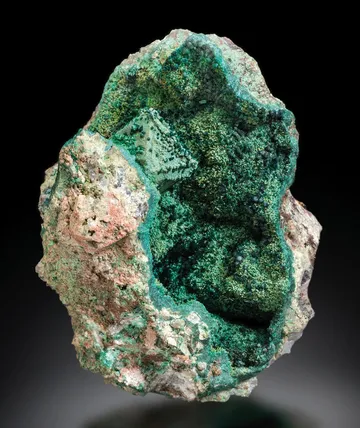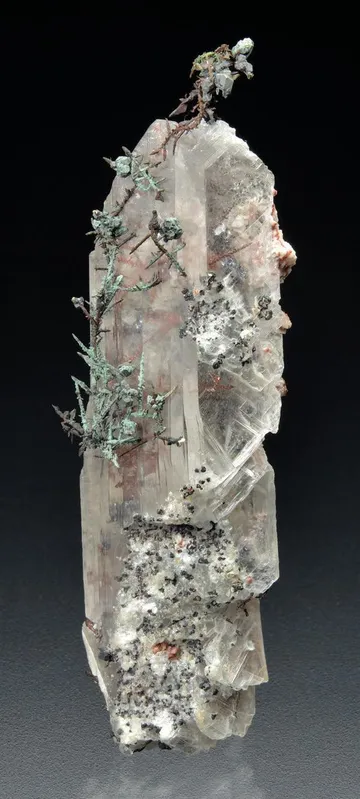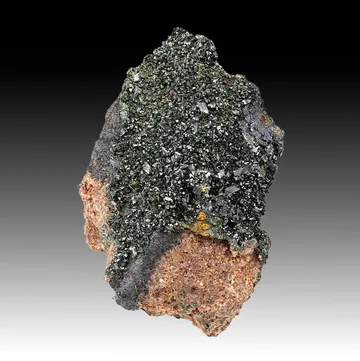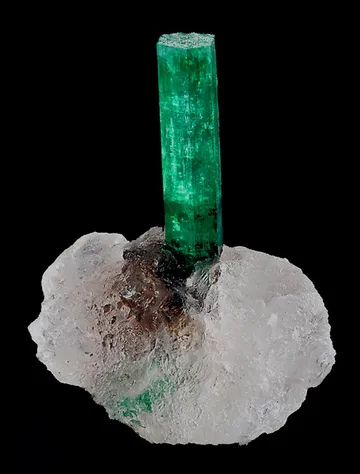
A collector's guide to Kabwe Mine, Zambia: its geology, mining history and notable minerals, illustrated with the 58 specimens documented from this locality on EarthWonders.
Key facts
Kabwe Mine—known to generations of collectors as Broken Hill, Northern Rhodesia—is one of the great oxidized lead-zinc localities of Africa. Its fame rests on a rare convergence: a carbonate-hosted Pb-Zn-Ag-V deposit in Neoproterozoic dolomite, spectacular supergene mineralogy, and an early mining history that brought museum-grade specimens into circulation just as systematic mineralogy was entering a modern descriptive phase. The deposit produced massive sulfide ore of sphalerite, galena, pyrite, and minor copper and germanium-bearing sulfides, but collectors remember Kabwe for the oxidized zone: tarbuttite, hopeite, parahopeite, smithsonite, pyromorphite, cerussite, descloizite, hemimorphite, vanadinite, and a suite of scarcer secondary phosphates and vanadates.
Kabwe is especially important for zinc phosphates. It is the type locality for tarbuttite and parahopeite, and the later-recognized type locality for zincolibethenite. Although hopeite was first described from the Altenberg-Vieille Montagne district of Europe, Kabwe is the locality that transformed it from a mineralogical curiosity into a collector species of consequence. The best Kabwe hopeites—glassy to honey-brown, orange-stained, or colorless orthorhombic crystals—are still the standard by which large, attractive hopeite specimens are judged.
Visually, the locality has a distinctive look. Fine specimens often place water-clear to milky zinc phosphates against dark, cavernous, iron-rich gossan; pale yellow tarbuttite sheaves sparkle on black-brown goethite; hopeite forms blocky, tabular, and sometimes frostwork-like aggregates; parahopeite appears as white platy rosettes or needlelike encrustations on hopeite; and Kabwe smithsonite ranges from massive and botryoidal ore material to unusually large rhombohedral and scalenohedral crystals. Pyromorphite is less abundant in modern cabinets but historically produced brown, green, whitish, and golden-yellow crystals, including divergent sheaves from deeper workings.
Regional View
Country View
The mine lies close to the modern town of Kabwe, roughly north of Lusaka, and its specimen story is inseparable from the mine’s industrial and human story. Mining exposed caves, gossan cavities, bone breccias, and later underground vugs; it also left one of southern Africa’s most notorious lead-contaminated landscapes. For collectors, Kabwe pieces are historic minerals from a closed and environmentally sensitive locality, not casual field-collecting material.

Photo: Wikimedia Commons

Photo: Wikimedia Commons
Search for specimens: View all specimens from Kabwe Mine, Zambia
Kabwe is a carbonate-hosted lead-zinc-silver-vanadium deposit developed in steeply dipping late Neoproterozoic dolomites of the Kabwe Dolomite Formation, with shales and phyllites on either side and older metamorphic basement below. The principal ore hosts are in Massive Dolomite. The main sulfide bodies were pipe- to veinlike, trending northeast and plunging moderately to steeply. In simplified form, the classic ore architecture is a central massive sulfide core, a surrounding zinc-silicate zone rich in willemite, and an outer jasperoid or ferruginous siliceous envelope.
The old mine was originally recognized at surface as a group of numbered kopjes. Nos. 1 and 2 were the most conspicuous: No. 1 was a lead-rich gossanous hill, and No. 2 was the larger, zinc-rich kopje dominated by carbonate and silicate zinc ores. Deeper work showed that several surface outcrops merged into composite orebodies. The major mine nomenclature includes Nos. 1, 2, 3/4, 5/6, No. 8, E, X, South, Airfield, and No. 2 Hanging Wall. No. 1 is the mineralogical heart of the early collecting story because its lower gossan contained caverns with bone breccia, phosphate mineralization, pyromorphite, cerussite, descloizite, vanadinite, hopeite, parahopeite, and tarbuttite. No. 2 became crucial for later tarbuttite, hopeite, parahopeite, and smithsonite specimens, while No. 5/6 was especially important for crystallized smithsonite. The X orebody is notable for the mid-1970s discovery of massive botryoidal vanadinite at the 430-meter level.
Ore genesis at Kabwe has been debated because the zinc silicate ores are exceptionally developed. One school has emphasized hypogene nonsulfide zinc mineralization, particularly early willemite; another has stressed extensive oxidation and replacement of original sulfides. The most balanced modern view recognizes multiple stages: early alteration of sphalerite to willemite under comparatively high-temperature conditions, later lower-temperature willemite formation, and a much younger supergene assemblage that produced smithsonite, cerussite, hemimorphite, pyromorphite, descloizite, vanadinite, and finally the zinc phosphates. That late phosphate stage is the collector’s treasure: it is where bones, gossan, zinc-rich fluids, and open cavities created the rare mineral suite for which Kabwe is famous.
The deposit was discovered in 1902 by T. G. Davey while prospecting for copper. Mining began under the Rhodesia Broken Hill Company in 1904 and reached full-scale production in 1906, aided by the arrival of the railway. The mine and town were known as Broken Hill during the colonial period and were renamed Kabwe after Zambian independence. Across its working life, the mine produced roughly 1.8 million tonnes of zinc, 0.8 million tonnes of lead, significant vanadium oxide, silver, cadmium, and minor copper. Underground mining ceased in 1994, by which time the mine was owned by Zambia Consolidated Copper Mines. After closure, artisanal recovery and commercial interest in tailings and waste persisted, but the old specimen-producing workings were no longer an ordinary collecting destination.
Historically, the most important specimen moments came in pulses. The early removal of No. 1 Kopje exposed open fissures and caves lined with pyromorphite and cerussite, with descloizite and vanadinite also common. The Bone Cavern yielded hopeite directly on bone breccia and within bones and teeth, an association that is essentially Kabwe’s signature. In 1907, material sent and donated to the Natural History Museum in London formed the basis for L. J. Spencer’s classic 1908 description of tarbuttite and parahopeite. The late 1920s brought important museum specimens, including tarbuttite from the No. 2 workings and smithsonite from No. 5 Kopje. In 1959 and 1960, excellent No. 5/6 smithsonites entered the NHM through Dr. K. F. G. Hosking of the Camborne School of Mines. In the 1970s, collectors and mine geologists still encountered good zinc phosphate specimens, especially from No. 2 and its nearby dump, but the best material had already become historical.
Collecting access today should be regarded as closed, hazardous, and dependent on legal permission rather than casual entry. The site is an industrial legacy area with severe lead and cadmium contamination, derelict workings, waste piles, tailings, and continuing sensitivity around remediation and waste reprocessing. Kabwe specimens on the market are therefore mostly old-stock pieces from historic collections, mine employees, museum exchanges, or dealer inventories rather than fresh field-collected material.
Kabwe tarbuttite is the classic material for the species and, despite the rise of fine Skorpion Mine tarbuttite from Namibia, remains the historic type-locality standard. It occurs as colorless, white, pale yellow, peachy, reddish, or iron-stained triclinic crystals, commonly in sheaves, nearly parallel aggregates, rounded “brick-like” individuals, ball-like groups, and sparkling druses on cellular or stalactitic goethite. The No. 2 Kopje and adjacent dump 100 meters east of the open pit are especially associated with modern collector material, where late-1970s collecting produced profuse, well-defined colorless crystals in porous goethite, sometimes with lathlike hemimorphite rosettes. Earlier museum specimens show tarbuttite with descloizite, smithsonite, pyromorphite, cerussite, and hopeite; the finest examples combine sharp, glassy crystals with strong contrast against dark gossan, while ordinary pieces are granular, bruised, iron-dulled, or composed of indistinct crusts rather than crisp sheaves.
Smithsonite was a major zinc ore mineral at Kabwe and is represented by both massive ore and refined collector specimens. Early material included dark brown to gray friable masses mixed with limonite and white, pale yellow, or brown mammillary material with concentric structure, but as mining advanced the locality produced larger crystallized examples. The best Kabwe smithsonites include pale yellow to buff rhombohedra, colorless, white, gray, and yellow rhombs from No. 5 Kopje, botryoidal and mammillary aggregates on iron-rich gossan, and scalenohedral specimens from the No. 5/6 orebody collected underground in the late 1950s. Exceptional historic crystals reached cabinet size, including a Harvard specimen with individual rhombohedra to 7 cm, while late No. 2 material includes unusual pale greenish-blue druses in massive smithsonite ore. Good Kabwe smithsonite is judged by distinct crystal habit, scale, luster, color contrast, and associations with pyromorphite, descloizite, quartz, tarbuttite, or hopeite; common pieces are massive, earthy, or visually indistinct despite their economic importance.
Kabwe pyromorphite is a historic rather than abundant modern marketplace mineral, but it is deeply tied to the No. 1 Kopje fissures, caves, and bone-breccia environment. Early specimens included brown and green crystals exceptionally to about 3 cm, and the large cave and fissure finds of the early mining period made pyromorphite one of the minerals that first advertised Broken Hill to collectors. Its Kabwe habits include long prismatic crystals with bright but slightly hummocky faces, tapered composite crystals formed by parallel to subparallel growth, stout color-zoned microcrystals, and green to gray-green to whitish coatings on cavernous limonite. In the 1970s, underground workings yielded divergent sheaves of golden-yellow to orange-yellow pyromorphite, sometimes associated with elongated brown smithsonite; some such material was historically mislabeled as mimetite, but later analysis confirmed pyromorphite with arsenic below detection. The most desirable pieces show recognizable hexagonal prisms or sheaves, saturated green or golden color, and contrasting gossan or smithsonite matrix; ordinary examples are drusy, pale, abraded, or visually lost in friable iron oxide.
Hopeite is not a Kabwe type mineral, but Kabwe is the locality that made hopeite collectible at world-class scale. In the Bone Cavern of No. 1 Kopje it encrusted bone breccia as brilliant, water-clear, vitreous crystals up to about 1 cm, scattered singly or grouped in showy clusters, commonly resting on vanadinite or on thin crusts of hemimorphite, tarbuttite, and smithsonite. Later and deeper material, especially from No. 2 Kopje, produced semi-transparent to opaque iron-stained crystals with orange-red surfaces, colorless-white to pale yellow crystals on goethite, slender elongated crystals to about 12 mm, and larger crystals in old museum collections, including a doubly terminated NHM crystal 4.1 cm long. Kabwe hopeite may also form porous, layered, dendritic, or frostwork-like aggregates and stalactitic masses of tiny crystals. The best collector pieces have distinct, damage-free crystals with translucency, warm iron coloration, or strong contrast on dark gossan; lesser specimens are chalky, corroded, or largely replaced by parahopeite without preserving good crystal form.
Parahopeite is a Kabwe type-locality mineral and the triclinic dimorph of hopeite, but it is much scarcer as a display species than tarbuttite or hopeite. Spencer’s original material was limited enough that only two early NHM specimens showed significant parahopeite development, and those are regarded as type specimens. At Kabwe it occurs most commonly as acicular crystals coating, encrusting, or replacing hopeite; such growth may form epimorphic crusts or hollow replacements, including spectacular pseudomorphous replacement of hopeite crystals to 5.2 cm by minute radiating parahopeite needles. More conspicuous but rarer specimens show colorless to off-white platy or bladed crystals, spherical aggregates, or rosettes on pale blue botryoidal smithsonite from No. 2 Kopje; exceptional platy crystals in old museum material measure around 12–15 mm, with one reported to 2.1 cm. Good Kabwe parahopeite requires eye-visible crystal form, preserved association with hopeite or smithsonite, and minimal iron smearing; ordinary material is easily overlooked as white crusts or needles and can be mistaken visually for hemimorphite without testing.
Beyond the headline species, Kabwe has a deep confirmed and historically reported mineral list. The type-locality trio of tarbuttite, parahopeite, and zincolibethenite anchors the locality’s systematic importance, while hopeite, scholzite, spencerite, hemimorphite, cerussite, anglesite, descloizite, vanadinite, mottramite, rosasite, malachite, corkite, and native copper broaden the supergene suite. The primary sulfides include sphalerite intergrown with wurtzite, galena, pyrite, chalcopyrite, bornite, tetrahedrite, and the germanium-bearing minerals briartite and renierite. Modern analytical work also confirmed clausthalite and recorded klockmannite and naumannite from a museum specimen, a reminder that old Kabwe pieces can still contain mineralogical surprises. Several reported species are best treated cautiously: some early “beudantite” is now believed to be corkite, phosphophyllite from Kabwe has been questioned, and recently marketed azurite attributed to the mine lacks convincing support from the older museum record.
Kabwe specimens should be bought with locality history in mind. Old labels reading Broken Hill, Rhodesia Broken Hill, Northern Rhodesia, or Broken Hill Mine, Kabwe can all refer to this Zambian locality, but confusion is possible with the far more famous Broken Hill in New South Wales, Australia. A correct Kabwe label usually includes Zambia, Northern Rhodesia, or Broken Hill Mine/Kabwe; an unlabeled “Broken Hill” zinc, lead, or silver specimen should not be assumed to be Zambian without supporting matrix, species, and provenance.
Several Kabwe-specific attribution issues are documented. Larger, more lustrous, stacked-arrow descloizites found at the nearby Carmarnor mine west of Kabwe were likely misattributed to Kabwe in some older collections because Kabwe had the stronger name recognition. Some golden-yellow pyromorphite was historically labeled as mimetite, a mistake that has been corrected analytically in at least one museum specimen. “Kabwe azurite” offered as old 1960s material has been questioned because comparable specimens are absent from major Kabwe holdings such as the Natural History Museum, London, and the Johannesburg Geological Museum. For rare zinc phosphates, visual identifications can also be treacherous: parahopeite needles can look like hemimorphite, tarbuttite crusts can be nondescript, and small spencerite may be overlooked in vugs.
Condition is central to value. Kabwe’s best zinc phosphate specimens are commonly perched on friable, porous, iron-rich gossan, so matrix loss, old glue, edge crumbling, and dusting are common. Tarbuttite has perfect cleavage and can bruise or cleave along lustrous planes; sharp colorless crystals show contacts readily. Hopeite is softer and more easily damaged than quartz-like minerals, and its iron-stained surfaces can tempt overcleaning—avoid aggressive acids or mechanical cleaning unless performed by a conservator familiar with zinc phosphates and gossan matrices. Pyromorphite and smithsonite are more robust chemically, but Kabwe examples often sit on unstable iron oxides or cavernous ore.
Fluorescence can be helpful but should not be treated as a simple diagnostic. Kabwe cerussite has been documented with a moderate pale yellow response under medium-wave ultraviolet. Some parahopeite shows weak pink fluorescence under longwave UV, and associated smithsonite may show lilac fluorescence under shortwave UV. Kabwe pyromorphite has shown off-white to pale yellow fluorescence under medium-wave UV in documented specimens. Tarbuttite fluorescence is variable in reported collector material, and the lack of a response does not invalidate a specimen.
Because Kabwe is a heavily contaminated lead-zinc mining site, old specimens should be handled with ordinary toxic-mineral discipline. Wash hands after handling, keep friable pieces in boxes, avoid inhaling dust from gossan or tailings matrix, and never trim, grind, or ultrasonic-clean powdery ore indoors. This is not only a lead locality but also a cadmium-bearing one; the hazard is mainly dust and ingestion rather than casual display behind glass.
Market availability is uneven. Tarbuttite remains the most obtainable Kabwe zinc phosphate, often appearing as thumbnails to small cabinet pieces from old stocks. Hopeite is scarcer in attractive crystallized examples but still appears regularly enough that serious collectors can be selective. Smithsonite is available in massive or botryoidal material, but large discrete crystals from No. 5/6 or historic No. 5 Kopje labels are substantially harder to replace. Parahopeite, spencerite, zincolibethenite, and fine Kabwe pyromorphite are specialist pieces; the best examples generally move through old collections, museums, or high-end dealers rather than bulk supply.
The first great Kabwe story begins not with a mineral collector but with a prospector looking for copper. In January 1902, T. G. Davey came across a set of low, bare kopjes rising from otherwise flat country. Two of them, later called No. 1 and No. 2, stood out because they were nearly vegetation-free and made not of ordinary hill rock but of ore. No. 1 was a mass of lead carbonate with zinc carbonate; No. 2, larger and about three-quarters of a mile away, was chiefly high-grade zinc carbonate and silicate. Davey gave the place the aspirational name Rhodesia-Broken Hill, consciously or unconsciously invoking the tremendous Australian lode discovered seventeen years earlier. For collectors, that naming decision has caused a century of label confusion—but it also fixed Kabwe in the mythology of great “Broken Hill” mineral localities.
When mining attacked No. 1 Kopje, it opened a world that had formed in darkness. By 1906, workings had broken into what became the Bone Cavern, a chamber containing mammalian bones, primitive stone implements, and rare zinc phosphate minerals. The bones were not simply lying among minerals; many were cemented and encrusted by them. Hopeite grew directly on bone breccia, inside bones, and even in teeth, making Kabwe hopeite chemically and visually tied to its source of phosphorus. That strange union of fossil bone and zinc phosphate is one of the locality’s defining images: vitreous, water-clear crystals scattered across ancient bone material in a lead-zinc mine.
The Bone Cavern later yielded something that carried Kabwe far beyond mineralogy. In 1921, as mining reached lower cave deposits about 24 meters below the surface of the plain, a Swiss miner named Tom Zwiglaar was credited with finding the fossil skull now known as Kabwe 1, or Broken Hill Man. The skull, registered at the Natural History Museum in London, was found with soft lead ore and had once carried a thin coating of hemimorphite. Mineralogy, paleoanthropology, and industrial mining converged in that one object. Later studies added a grim twist: long before modern smelting contaminated Kabwe, Broken Hill Man himself appears to have suffered from lead poisoning.
Specimen history at Kabwe moved quickly. By 1907, Percy C. Tarbutt of the Broken Hill Exploration Company was sending and donating material to the British Museum. Those batches formed the foundation for L. J. Spencer’s 1908 study of the zinc phosphates. Spencer saw enough tarbuttite to describe it as abundant and varied, but parahopeite was another matter: only two specimens available to him showed substantial development of the mineral. Those two NHM pieces became the essential type specimens for parahopeite, while a tarbuttite specimen given specifically for Spencer’s examination has been treated as holotype material. Few localities can point to such a compact moment when mine, collector, company director, and museum mineralogist all left a traceable paper trail.
The 1920s added a connoisseur’s chapter. A field excursion in 1929 recorded that most of the beautiful mineral specimens for which Broken Hill was renowned had come from No. 1 Kopje, where earlier removal of the upper hill had exposed fissures and caves lined with pyromorphite and cerussite, with descloizite and vanadinite common. Around the same period, F. N. Ashcroft and Spencer obtained important pyromorphite and smithsonite material for the Natural History Museum. The fourth Vaux Expedition from the Philadelphia Academy of Natural Sciences visited southern Africa in 1929/1930 and returned with Kabwe specimens, including tarbuttite believed to be from the No. 2 workings. These are not anonymous old pieces: many can still be followed through accession numbers, expedition history, and surviving labels.
One particularly charming museum trail leads to royalty. A pale yellow tarbuttite specimen on iron-coated gray smithsonite, with descloizite and probable cerussite matrix, was donated to the Natural History Museum by Her Royal Highness Princess Marie Louise, granddaughter of Queen Victoria. It is a reminder that in the early 20th century, Kabwe specimens were not just mine curiosities; they circulated through elite and institutional networks at a time when colonial Africa, mineral wealth, and public museum building were tightly entwined.
Kabwe also produced late surprises. In the 1970s, well-formed hopeite was still being collected from No. 2 Kopje, although the crystals were often made semi-transparent to opaque by iron staining. Tarbuttite could be found in the No. 2 open pit and, more conveniently, on a small dump about 100 meters east, where colorless crystals were scattered through cellular goethite. Around the same decade, underground workings yielded divergent sheaves of yellow to orange-yellow pyromorphite. One such specimen, formerly in the William B. Sanborn collection and now in the Carnegie Museum of Natural History, carried an old mimetite label; later EDS analysis confirmed it as pyromorphite with arsenic below detection. Kabwe’s old labels are valuable, but they are not infallible.