A collector's guide to Nchanga Mine, Zambia: its geology, mining history and notable minerals, illustrated with the 32 specimens documented from this locality on EarthWonders.
Key facts
Nchanga is one of the great industrial names of the Zambian Copperbelt, but for collectors it occupies a more selective, almost understated place: a vast copper-cobalt system that yielded relatively few specimen pieces compared with its ore tonnage, yet produced memorable secondary copper minerals when the right oxidized cavities and replacement textures were encountered. The mine lies at Chingola on the northwestern edge of the Kafue Anticline, within the Neoproterozoic Katangan Supergroup, where Lower Roan siliciclastic-carbonate rocks host stratiform copper-cobalt mineralization. Its principal collector appeal is not a single spectacular abundance, but a distinctive suite: malachite, azurite, libethenite, pseudomalachite, cuprite, chrysocolla, and the type-locality copper chloride claringbullite.
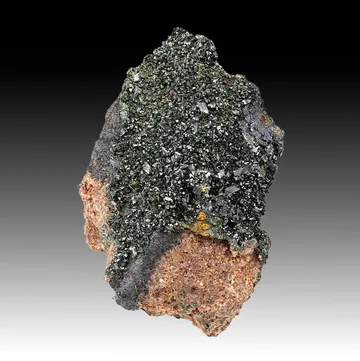
The best Nchanga specimens have a Copperbelt look that is unmistakably mineralogical rather than ornamental. Malachite may be bright, fibrous, velvet-surfaced, or preserved as sharp pseudomorphs after octahedral cuprite. Libethenite tends toward dark bottle-green to green-black, sharply dipyramidal crystals sprinkled or densely drused across oxidized matrix, especially with pseudomalachite and malachite. Azurite is less common than malachite here, but the documented pieces include rich royal-blue to midnight-blue nodules, rosettes, blocky crystals, and blades partly altered to malachite. In hand, the finest specimens are often compact, sculptural, and high-contrast: dark phosphate sparkle against botryoidal green, blue azurite over fibrous malachite, or pseudomorphs that keep the ghost of an earlier cuprite crystal.
Regional View
Country View
Nchanga’s specimen history is inseparable from the engineering scale of the mine. The open-pit phase exposed large volumes of near-surface oxide and supergene ore, while the underground workings followed deeper sulfide zones and orebodies beneath a complex water-bearing stratigraphy. That scale did not translate into easy collecting. Nchanga is a major operating industrial site, not a public collecting ground, so older pieces with credible mine, engineer, dealer, or collection provenance carry special weight.
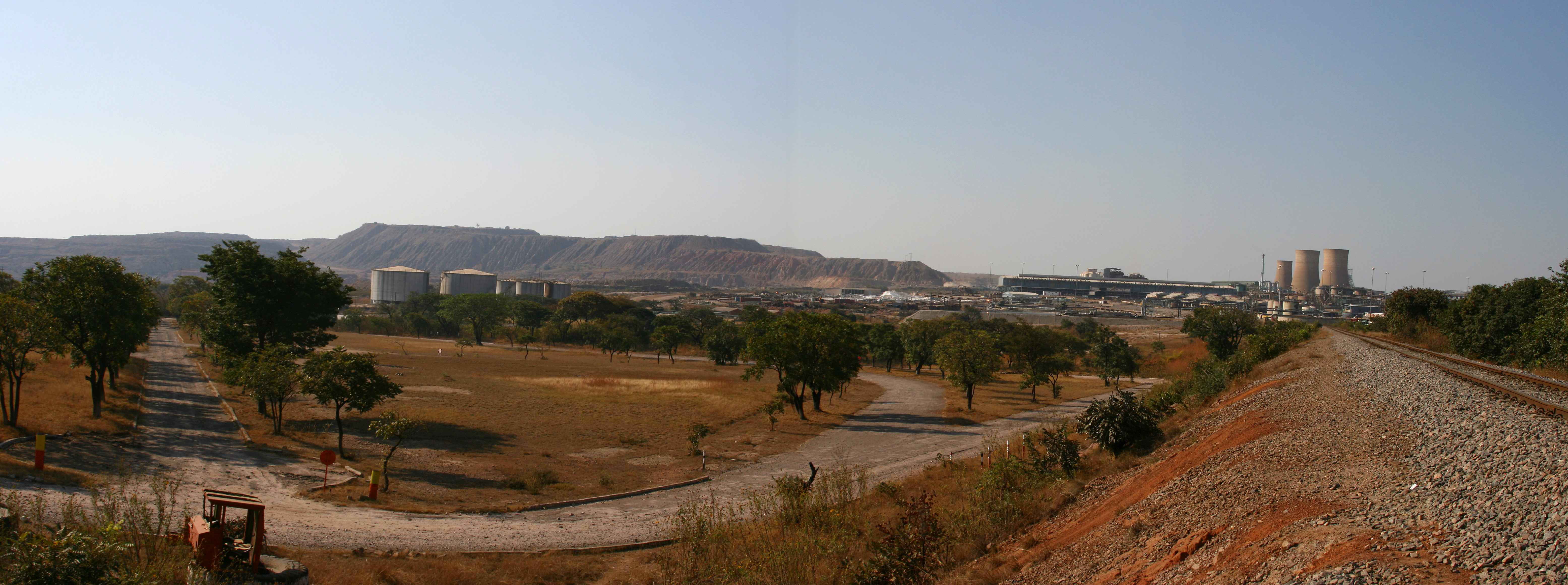
Photo: BlueSalo / Wikimedia Commons
Search for specimens: View all specimens from Nchanga Mine, Zambia
Nchanga is a sediment-hosted stratiform copper-cobalt deposit in the Zambian portion of the Central African Copperbelt. The mine is situated near Chingola in Copperbelt Province, at the northwestern end of the Kafue Anticline, within folded and thrust-influenced rocks of the Katangan Supergroup. The economically important mineralization is hosted in the Lower Roan Subgroup, especially arkosic and feldspathic quartzitic units and the basal parts of overlying shales. In simplified collector terms, this matters because Nchanga is not a vein locality in the alpine sense; its collectible minerals come from oxidation, replacement, and cavity development superimposed on a very large stratabound ore system.
Two major ore horizons define the classic geology: the Lower Orebody and the Upper Orebody. The Lower Orebody is chiefly a copper orebody, while the Upper Orebody is the copper-cobalt horizon. Published work emphasizes that these orebodies occur near the tops of arkosic units and within the base of the overlying shales. Primary ore minerals include chalcopyrite, bornite, chalcocite, carrollite, and pyrite, with supergene and oxidized zones carrying chalcocite, covellite, malachite, chrysocolla, azurite, cuprite, and related secondary species. For collectors, that vertical zoning explains the locality’s split personality: Nchanga is an ore giant because of sulfides, but its specimen fame rests mainly in the oxidized and supergene copper suite.
The mine area is structurally and hydrologically complicated. Nchanga sits among synclinal sedimentary packages flanking basement granite, with porous dolomites and sandstones alternating with less permeable quartzitic and shaly units. Groundwater has been a defining practical problem from the earliest development onward. Mine-water studies recognize multiple aquifers, including footwall, banded sandstone, upper banded shale, Chingola dolomite, and upper Roan dolomite aquifers. The banded sandstone and upper banded shale aquifers overlie important orebodies, making dewatering a condition of safe extraction rather than a peripheral engineering detail.
Modern development began with exploration in the 1920s. Underground development started in 1927, and early mining began in 1931, but work was soon suspended because of flooding and depressed copper prices. Nchanga Consolidated Copper Mines was formed in 1937, the mine was dewatered, and underground mining resumed. Chingola developed around the expanding operation, and open-pit mining began in the mid-1950s with the Nchanga Open Pit. Additional pits around the Chingola arc followed, and Nchanga became one of Africa’s largest open-pit copper operations, while underground work continued below.
Ownership and operation have passed through several corporate eras. Nchanga belonged to the Anglo-American/Nchanga Consolidated Copper Mines lineage, then to Zambia Consolidated Copper Mines under state ownership, and later to Konkola Copper Mines after privatization. KCM is now controlled by Vedanta Resources through its majority shareholding, with ZCCM-IH retaining the state minority interest. Recent technical reporting treats Nchanga as part of the broader KCM integrated complex, including open-pit and underground mining areas, concentrators, the Nchanga Tailings Leach Plant, the Nchanga smelter, and related infrastructure.
For collectors, access is essentially historical and secondary-market based. This is a controlled mining and processing complex with open pits, underground workings, tailings operations, heavy equipment, water hazards, and security restrictions. Specimens that reach the market generally did so through mine personnel, engineers, older collections, or dealer dispersals rather than through casual collecting. Locality-secure labels are therefore unusually important: “Nchanga Mine,” “Nchanga Open Pit,” “Chingola,” “Copperbelt Province,” and older references to Chingola or Northern Rhodesian/Zambian Copperbelt provenance should be weighed against the specimen’s style and any known collection history.
The notable specimen finds are scattered rather than famous as a single modern pocket. Documented examples include malachite pseudomorphs after cuprite, fibrous malachite from the Nchanga Open Pit, azurite nodules partially replaced by malachite, azurite with malachite collected in the late 1970s, and libethenite on pseudomalachite associated with old collector and mine-engineer provenance. A particularly important non-display-size occurrence is claringbullite, first described from tiny blue plates on a cuprite specimen attributed to Nchanga Open Pit, with quartz and malachite in the cavity. That type-locality status gives Nchanga a mineralogical importance far beyond the number of cabinet specimens it produced.
Malachite is the signature collector mineral from Nchanga, but the best pieces are not merely green copper ore: they are textural specimens from the mine’s oxidized zone, including compact fibrous aggregates, botryoidal to drusy surfaces, and especially complete pseudomorphs after cuprite that preserve octahedral crystal form while replacing the original Cu2O with Cu2(CO3)(OH)2. Documented Nchanga malachite ranges from small thumbnails around 25 mm to substantial cabinet pieces approaching 19 cm, with notable associations including azurite, libethenite, pseudomalachite, chrysocolla, cuprite, bornite, and carrollite. Ordinary Nchanga malachite is massive, crusty, or ore-like; the pieces collectors chase have sharp inherited cuprite geometry, undamaged edges, velvety or lustrous surfaces, strong saturated green color, and enough matrix or association to anchor them unmistakably to the Chingola Copperbelt setting.
Libethenite from Nchanga is a dark, refined Copperbelt phosphate occurrence rather than a large-crystal showpiece locality: the typical good specimen carries sharp deep-green to green-black dipyramidal crystals, commonly only a few millimeters across, scattered over or richly drusing oxidized matrix with pseudomalachite and malachite. Documented pieces include small-cabinet examples with crystals around 3–7 mm, and a Fabre Minerals specimen measuring 11.4 × 8.4 × 6.2 cm with sharp dipyramids around 2 mm, while an especially rich example on pseudomalachite from the William Pinch Collection carried green-black libethenite crystals to about 3 mm on a bubbly deep-green phosphate surface. What separates good Nchanga libethenite from ordinary material is crystal sharpness under magnification, bright luster, dark uniform color, dense coverage, visible association with pseudomalachite or malachite, and a credible Nchanga or Nchanga Open Pit provenance rather than a vague “Zambia” label that could belong to Nkana/Mindola or another Copperbelt source.
Azurite is less abundant from Nchanga than malachite, which makes well-crystallized examples especially desirable; recorded specimens include late-1970s azurite-malachite nodules, sharp blocky miniature crystals with royal-blue to midnight-blue color, dark-blue crystals on compact fibrous malachite from the Nchanga Open Pit, and radiating bladed aggregates partly altering to lustrous green malachite. Size varies from miniatures around 3.2 × 2.8 × 2.4 cm to cabinet-scale rosettes and nodules exceeding 10 cm, with one documented azurite specimen described as a complete spherical floater composed of countless acicular crystals. The best Nchanga azurites are not judged by size alone; they need strong blue color, visible crystal texture, attractive azurite-to-malachite alteration, and good integrity, because many ordinary pieces are simply mixed blue-green oxidized copper masses without distinct form.
Beyond these three collector anchors, Nchanga is documented for a broader Copperbelt assemblage that includes bornite, chalcocite, chalcopyrite, carrollite, pyrite, cuprite, chrysocolla, pseudomalachite, baryte, dolomite, quartz, microcline, muscovite/sericite, phlogopite, rutile, chlorite-group minerals, tourmaline-group material, and torbernite. The locality’s most important rarity is claringbullite, Cu4ClF(OH)6, for which Nchanga is a type locality; the original Nchanga material was described as tiny soft blue plates associated with cuprite, quartz, and malachite. Cuprite itself is important not only as a collectible red oxide from the mine but also as the precursor to some of the locality’s most attractive malachite pseudomorphs.
Nchanga specimens are provenance-sensitive. The mine is famous industrially but not a prolific specimen locality, so a vague label reading only “Zambia,” “Copperbelt,” or “Zaire” is not enough for higher-end pieces. Old Central African labels can be geographically imprecise, and at least one documented Nchanga libethenite specimen has been noted with an erroneous label placing the locality in Zaire rather than Zambia. That sort of mistake is understandable in older Copperbelt material, but it matters when the specimen is being valued as Nchanga rather than simply as African copper mineralization.
The most common confusion is not outright fakery but locality drift. Libethenite from Nchanga can be confused with the larger and better-known Zambian material from Nkana/Mindola, while malachite pseudomorphs after cuprite invite comparison with Tsumeb, Onganja, Chessy, Bisbee, Katanga, and other classic copper localities. A good Nchanga malachite-after-cuprite should be judged by the style of the matrix, associated species, documented label chain, and the plausibility of its crystal habit. A good Nchanga libethenite should usually show the smaller, sharp, dark, drusy-to-scattered habit on copper-rich matrix or pseudomalachite, not the larger pseudo-octahedral Nkana look unless unusually well documented.
Condition is a real issue. Malachite pseudomorphs may show pitting from replacement; pitting is not automatically damage, but bruised edges, abraded terminations, and fresh chips are significant. Libethenite crystals are small and unforgiving: minor rubs that disappear in hand can be obvious under a loupe, especially on lustrous green-black faces. Azurite from Nchanga should be protected from repeated wetting, strong heat, and unstable display environments; pieces partly altered to malachite are chemically normal, but powdery surfaces, flaking, or dull rubbed terminations reduce collector value.
No major, well-documented Nchanga-specific treatment tradition is apparent for these species, but general malachite concerns still apply: avoid oiled, waxed, lacquered, dyed, or reconstructed material unless disclosed. Dense green massive material is easily sold as locality material without proof, so higher confidence belongs to specimens with older labels, known dealer records, mine-engineer provenance, or inclusion in documented collections. Claringbullite and torbernite-bearing specimens should not be handled casually: claringbullite is a delicate copper chloride/hydroxide species, while torbernite is radioactive and should be stored and handled using appropriate uranium-mineral precautions.
Market availability is uneven. Malachite from Nchanga appears periodically, especially as small pseudomorphs, fibrous pieces, and mixed azurite-malachite specimens. Libethenite is distinctly scarcer and tends to appear as small-cabinet matrix pieces rather than abundant loose crystals. Azurite is rarer still in convincing, attractive Nchanga form, and fine examples with strong blue color, crystal texture, and old provenance can command a premium because they stand apart from the much more common DRC and other Copperbelt azurites.
In 1973, a small blue mystery arrived at the British Museum. The host specimen was cuprite, said to be from the Nchanga Open Pit, with tiny blue platy crystals tucked onto one corner. At first the blue mineral was thought to be gerhardtite, but its powder X-ray pattern refused to match. Then a remarkable chain of coincidences unfolded: the same pattern matched a blue mineral from Bisbee in the collection of S. A. Williams, and within days another blue mineral from the M’sesa mine at Kambove, Katanga, on loan from the Sorbonne, produced the same result. The Nchanga and Katangan pieces became type material for claringbullite, named for Sir Frank Claringbull of the British Museum. The Nchanga occurrence was minute but elegant: a slightly divergent group of soft blue plates filling a cavity in quartz and malachite on cuprite. One note in the original paper adds the kind of uncertainty locality historians know well: S. Korowski believed the specimen came from the Nchanga deep mine rather than the open pit.
Water is the other great Nchanga story. The deposit sits beneath and among porous dolomites and sandstones, and early underground mining could not simply be driven forward like a dry tunnel in competent rock. Mining began in 1931 and then stopped after flooding combined with weak copper prices. When Nchanga Consolidated Copper Mines was formed in 1937, dewatering was not a maintenance task; it was the act that made mining possible again. Decades later, mine-water engineers still described Nchanga as a place where aquifers had to be deliberately drawn down ahead of production, where underground diamond-drilled dewatering holes were placed from crosscuts, and where some boreholes encountered pressures up to 30 bars.
The 1993 mine-water account reads like a practical anatomy of a wet copper giant. Five main aquifers were recognized. The banded sandstone and upper banded shale aquifers together supplied most of the water made underground from boreholes. Dewatering levels had to be spaced three mine levels apart, roughly 186 m, with crosscuts at 120 m section intervals. Pumping from underground workings between April 1992 and March 1993 averaged 76,962 m3 per day. Even with an extensive dewatering system, water controllability was reported at 81%, improving to 91% in the dry season. The mine also had an unusual problem: open pits directly above underground workings. Water from the Nchanga Open Pit sump, falling onto a catchment area of about 3.8 km2, could seep or recharge downward into underground works, carrying silt, clogging pumps, and in one season contributing to the abandonment of production blocks on the east side of the mine.
The specimen record has its own quieter stories, told through old labels and collector provenance. A libethenite-on-pseudomalachite miniature from Nchanga was recorded from the William Pinch Collection and was said to have been obtained from mine engineer Warren Taylor. Its appeal was not size alone: a thin matrix crust completely covered by bubbly, lustrous, deep-green pseudomalachite, with green-black libethenite crystals perched on top. Another Nchanga libethenite specimen was noted with an old label that incorrectly placed the mine in Zaire, a reminder that Copperbelt specimens often traveled through hands, countries, and decades before collectors tried to pin them back to the exact mine. In Nchanga material, a good old label is often almost part of the specimen.