Mount Xuebaoding, China — renowned W-Sn-Be vein locality yielding sculptural scheelite, beryl, cassiterite, and other rare minerals prized by collectors.
Key facts
Mount Xuebaoding is one of the defining Chinese specimen localities of the modern collecting era: a high-elevation W-Sn-Be hydrothermal vein system whose best pieces combine the drama of alpine pocket minerals with the chemistry of an evolved rare-metal granite. Collectors know it first for orange to honey scheelite perched on silvery muscovite, but the full personality of the locality is broader and more unusual: tabular colorless to pale blue beryl, jet-black lustrous cassiterite, fluorite, fluorapatite, quartz, albite, feldspar, tourmaline, and a small suite of tin-bearing rarities including kësterite and mushistonite.
The mineralization belongs to the Xuebaoding-Pingwu rare-metal system in northern Sichuan, near Huya in Pingwu County and southeast of the higher snow peaks that give the locality its name. The specimen-producing veins are associated with the Pankou and Pukouling leucogranites and their contact with Triassic marble and schist. In collector language, “Mount Xuebaoding,” “Pingwu,” “Huya,” “Pingwu beryl mine,” and “Mount Little Xuebaoding” have all been used on labels; the best modern labels try to separate the scenic mountain name from the actual mine locality in the W-Sn-Be vein field.
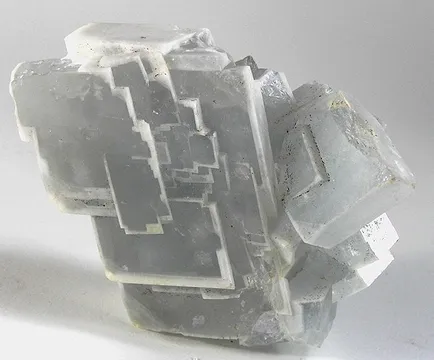
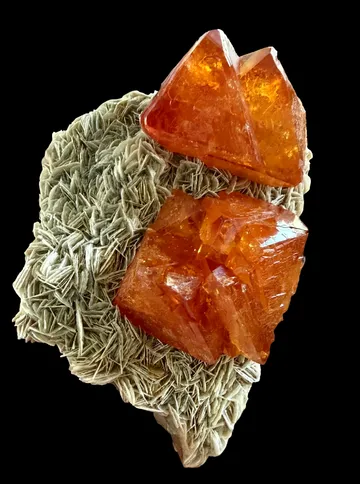
The locality matters because its principal collector minerals are not merely present, but sculptural. Fine scheelite occurs as lustrous pseudo-octahedral tetragonal crystals, commonly translucent to gemmy and saturated golden-yellow to vivid orange. Beryl breaks the usual pegmatite expectation by appearing as thick tabular hexagons rather than long aquamarine prisms. Cassiterite forms bright black twins and complex crystals that contrast sharply with pale mica. The great pieces look composed rather than chaotic: warm orange scheelite, cool blue or colorless beryl, black cassiterite, and pearly muscovite in the same small stage.
Regional View
Country View
The finest specimens are also scientifically distinctive. Xuebaoding is not a typical granite pegmatite locality, even though its specimen habits can mislead the eye in that direction. Research on the deposit treats it principally as a greisen-related, magmatic-hydrothermal system derived from highly fractionated, peraluminous, Li-F-rich S-type granites. The veins are zoned by wall rock: beryl-muscovite assemblages in granite; beryl-cassiterite-muscovite assemblages near the granite-to-marble transition; and the main collector assemblage of beryl, cassiterite, scheelite, fluorite, apatite, tourmaline, quartz, and mica in marble-hosted vein zones.


Search for specimens: View all specimens from Mount Xuebaoding, China
Mount Xuebaoding specimens come from a high mountain rare-metal district in northern Sichuan, generally described in the mineral trade as the Pingwu beryl mine or Huya W-Sn-Be deposit near Mount Little Xuebaoding. The broader geographical name is somewhat deceptive: the mountain Xuebaoding itself, the 5,588 m “Snow Treasure Crown” peak of the Minshan range, lies several kilometers northwest of the specimen-producing area, and the peak visible from the workings is Little Xuebaoding. That label confusion is old enough to be part of the locality’s collecting history, and older specimens may carry simplified labels such as “Mt. Xuebaoding, Pingwu, Sichuan, China.”
Geologically, the deposit sits in the Songpan-Garzê orogenic belt at the eastern margin of the Tibetan Plateau, in an area of extreme relief and active tectonism near the Huya fault system. The specimen veins are tied to small Mesozoic leucogranite intrusions, especially the Pankou and Pukouling granites, which intruded Triassic metasedimentary rocks including schist and marble. These granites are highly fractionated, peraluminous, and enriched in rare-metal and volatile components such as W, Sn, Be, Li, Rb, Cs, B, F, and P. That chemical evolution is the key to the locality’s unlikely collector assemblage: tungsten, tin, and beryllium all reached specimen-forming concentrations in the same hydrothermal system.
The ore bodies are best understood as fracture-controlled and vein-hosted rather than as broad replacement ore. Mineralized veins occupy extensional joints and fractures in granite, marble, and schist. A typical vein has a quartz-rich center and a coarse-grained mineralized margin, with a muscovite fringe separating the vein from the host rock. Published descriptions give crystal-size ranges in the veins on the order of 0.5–15 cm for beryl, 1–30 cm for cassiterite, 1–30 cm for scheelite, 1–25 cm for K-feldspar and albite, 1–10 cm for fluorite, 0.5–3 cm for apatite, and 1–3 cm for muscovite plates. Those figures are not market hyperbole; they explain why the locality became famous so quickly once good pieces reached international collectors.
The vein zoning is especially important for interpreting specimens. In granite-hosted parts of the system, the main visual assemblage is muscovite with beryl and tourmaline. At the transition from granite into marble, beryl and cassiterite become prominent with muscovite and tourmaline. The most prized collector assemblage, containing orange scheelite with beryl, cassiterite, fluorite, apatite, quartz, tourmaline, and mica, belongs to the marble-hosted part of the system. In practical collecting terms, the whitish to silvery mica matrix is not just a support: it is a genetic marker of the vein margin environment in which the best display crystals had space to grow.
The area was explored from the 1950s, but Xuebaoding became a household name in the fine-mineral trade only after Chinese minerals began reaching the international market in quantity in the 1990s. Early labels and dealer accounts from the mid- to late 1990s are attached to some of the classic scheelite, cassiterite, and beryl specimens now in major private collections. Published and exhibition-documented pieces include a 20 cm aquamarine on muscovite found in 1998, a 385 ct faceted scheelite cut from rough found in 1998, a 17 cm scheelite crystal on muscovite found around 2000, and 16.5 cm scheelite crystals on matrix found in 2006 and photographed in both incandescent and fluorescent light. Dealer records also document important specimen production continuing through the 2000s and early 2010s, with occasional later material appearing as old-stock pieces, collection specimens, and more recent small finds.
The literature and market record do not point to a single continuously operating industrial specimen operator in the way one might describe a classic North American mine. Instead, the accessible English-language record emphasizes exploration, prospecting, and artisanal to small-scale mining of pockets and veins in a difficult alpine setting. The locality lies well above normal casual collecting terrain, commonly described around 3,800–4,300 m for the specimen-producing zone, with some related field localities and approaches even higher. Work seasons are limited by altitude, snow, weather, slope instability, and access. For collectors today, Mount Xuebaoding is a purchase locality, not a realistic weekend field-collecting destination; meaningful collecting access would require local permission, mining access, logistical support, and careful attention to Chinese regulations and safety.
Scheelite is the signature mineral of Mount Xuebaoding: lustrous pseudo-octahedral tetragonal crystals in honey-yellow, golden-orange, and vivid tangerine tones, most prized when translucent to transparent, sharply complete, and naturally framed by bladed silvery muscovite. The best crystals are cabinet-scale showpieces, with published vein descriptions allowing scheelite crystals from centimeter size up to several tens of centimeters, though most collectible matrix specimens show crystals in the 1–6 cm range. Classic associations are muscovite, tabular beryl, black cassiterite, quartz, fluorite, calcite, albite, feldspar, and fluorapatite; the richest scheelite belongs to the marble-hosted main mineralization zone rather than the simpler granite-hosted beryl-mica zone. Good Xuebaoding scheelite is separated from ordinary material by saturated orange color, waxy to glassy luster, high transparency at the edges, clean placement on matrix, lack of distracting bruising, and strong blue-white shortwave fluorescence; lesser pieces are contacted, buried in mica, dull, chipped on pyramid edges, or represented by colorless to pale fragments lacking sculptural presence.
Muscovite is the indispensable stage on which Xuebaoding’s best minerals perform, occurring as pearly, silvery, cream, tan, or lightly iron-stained blades and books that line vein margins and frame crystals of scheelite, beryl, cassiterite, fluorite, quartz, and albite. In published vein descriptions, muscovite plates are commonly smaller than the major ore crystals, but visually they dominate many specimens because the blades grow in tight rosettes, sheaves, nests, and stacked plates along the vein wall. The best muscovite-bearing specimens preserve crisp mica edges, a fresh pearly sheen, and enough open structure to show that the associated scheelite, cassiterite, or beryl is seated naturally rather than merely glued into a mound; ordinary pieces show flattened mica, rubbed or greasy surfaces, broken books, sawed backs too close to the display face, or an unbalanced mass of mica that hides rather than enhances the focal crystal.
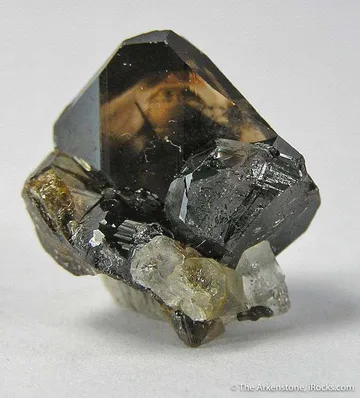
Cassiterite from Mount Xuebaoding is the dark counterpoint to the locality’s orange scheelite and pale beryl: bright black to brown-black, highly lustrous crystals, often twinned or complexly intergrown, seated on pale muscovite and sometimes associated with beryl, scheelite, quartz, albite, and fluorite. The species is most characteristic of the granite-to-marble transition and marble-hosted mineralization, where the Sn-rich hydrothermal fluids also produced the locality’s unusual tin-bearing accessory minerals. Published descriptions allow cassiterite crystals from about 1 cm to exceptional multi-centimeter sizes, and documented collector specimens include large, showy twins and cabinet specimens with main crystals around several centimeters. Good examples here have sharp twin form, mirrorlike luster, strong contrast against clean muscovite, and a natural upright composition; ordinary examples are massive-looking, edge-worn, buried in mica, too dark to read crystallographically, or represented by isolated broken black crystal masses without the classic Xuebaoding matrix.
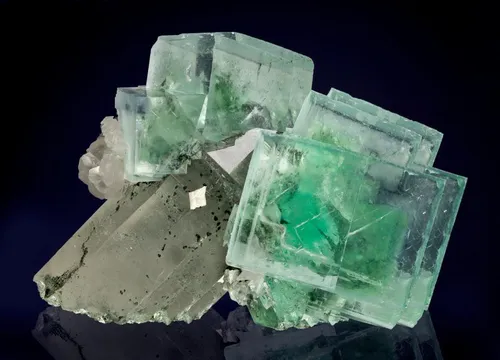
Beryl from Mount Xuebaoding is famous for its thick tabular habit, a striking departure from the long prismatic aquamarines that dominate many pegmatite localities; crystals are typically colorless goshenite to pale blue aquamarine, transparent to translucent, and flattened parallel to the basal pinacoid. The habit is so characteristic that a good Xuebaoding beryl can often be recognized before the label is read: a broad hexagonal plate or stack of plates on muscovite, albite, quartz, or matrix, sometimes accompanied by orange scheelite or black cassiterite. Published work documents crystals from small plates to large examples, with the vein environment allowing beryl in the 0.5–15 cm range and exhibition records showing major aquamarine-on-muscovite pieces up to 20 cm overall. The finest pieces combine glassy luster, pale but definite blue color or water-clear goshenite transparency, undamaged broad faces, and elegant placement; lesser specimens are cloudy, cleaved, overly contacted on the basal faces, or so thin and embedded that the famous tabular habit is lost.
Kësterite, Cu2ZnSnS4, is one of the locality’s important rarities and appears in the Xuebaoding system as small metallic greenish-black to black crystals, commonly partly or completely coated by pale to green mushistonite and set on muscovite, beryl, quartz, or other vein minerals. It is not a large-specimen mineral in the way scheelite, cassiterite, or beryl can be; fine locality examples are miniature to thumbnail mineralogical specimens, with documented crystals and groups on the centimeter scale and some sphenoidal crystals reported to about 1.5 cm. Its best pieces matter because they preserve identifiable kësterite form beneath or beside the mushistonite coating, show a clean association with the classic muscovite-rich matrix, and carry credible locality data from the Xuebaoding-Pingwu system; ordinary examples are visually obscure green coatings, indistinct dark patches, or specimens sold on association without enough crystal form or analytical confidence for a serious rarity collector.
Beyond the five EarthWonders species above, the broader Mount Xuebaoding-Pingwu beryl mine system has produced a compact but fascinating supporting cast: fluorite, fluorapatite, quartz including rock crystal and smoky quartz, calcite, albite, microcline and other feldspar, dravite-schorl-foitite-group tourmalines, malachite, varlamoffite, chalcopyrite, galena, sphalerite, pyrite, molybdenite, magnetite, rutile, titanite, zircon, and several rare or specialized species reported from the Pingwu beryl mine such as mushistonite, magnesio-foitite, oxy-dravite, oxy-schorl, vismirnovite, bournonite, boulangerite, geocronite, wulfenite, bixbyite-(Fe), and an unnamed Fe-Sn oxide. The locality is not celebrated as a type locality; its rarity value is instead paragenetic, built on the unusual coexistence of W, Sn, Be, F, P, B, and Li-enriched mineralization in a vein system capable of growing large, euhedral crystals.
The main authenticity issue with Mount Xuebaoding is not wholesale imitation of the minerals themselves; it is repair, reconstruction, and label looseness. Scheelite, beryl, and cassiterite from the locality are real enough on the market, but the matrix is fragile, the pocket crystals are heavy relative to muscovite, and older specimens often traveled a long way before reaching Western dealers. Reattached crystals, filled cracks, and restored scheelite faces are therefore realistic concerns, especially on high-value cabinet pieces.
Inspect scheelite under strong white light, raking light, magnification, and shortwave UV. Natural Xuebaoding scheelite commonly fluoresces blue to bluish white under shortwave ultraviolet; epoxy-filled breaks, reconstructed matrix joins, and restored areas may respond differently, fluoresce unevenly, or interrupt the natural glow. A documented repaired Xuebaoding scheelite sold through the mineral auction market specifically described a hidden matrix join and UV-fixed epoxy restoration on the lower part of the main crystal, which is a useful reminder that excellent restoration can be visually convincing in normal light.
Condition matters intensely. Scheelite has good collector durability once mounted and handled sensibly, but Xuebaoding crystals commonly show small bruises on pyramid edges, contacts where they grew into pocket walls, cleaved-looking chips, or bruised corners that only appear when the piece is rotated. Beryl is harder but broad tabular faces expose scratches, bruises, and edge nicks. Cassiterite is tougher, but black luster exaggerates edge wear and makes repairs hard to see without magnification. Muscovite is the weak link: it cleaves easily, sheds blades, and can look tired if rubbed, washed aggressively, or handled often.
Do not clean Xuebaoding specimens casually. Avoid ultrasonic cleaning, acids, long soaking, and stiff brushing unless you are prepared to sacrifice mica edges or loosen hidden joins. Dust should be removed with a bulb blower or very soft brush. Keep specimens supported under the matrix rather than by the main crystal, and mount heavier scheelite or cassiterite pieces on a custom base if they have an unstable mica bottom.
Fluorescence is a useful but not absolute diagnostic feature. Many Xuebaoding scheelites show medium to strong blue-white shortwave fluorescence, while longwave response is often weak or absent in yellow-orange material. Variation in molybdenum content and rare-earth activators can complicate the response, and a non-ideal UV lamp can mislead the owner. Treat fluorescence as one line of evidence, not the sole proof of locality or authenticity.
Mislabelling is common in two ways. First, the precise locality wording varies: Mount Xuebaoding, Mount Little Xuebaoding, Pingwu beryl mine, Huya township, and Songpan-area labels may all appear on specimens tied to the same collector tradition. Second, other Chinese scheelites are sometimes casually compared with or attributed to Xuebaoding, but the classic Xuebaoding look is quite specific: orange pseudo-octahedral scheelite with bladed muscovite, often with beryl, cassiterite, fluorite, or quartz. Pale scheelite in quartz without muscovite, beryl, or cassiterite may belong to related but distinct Pingwu-area tungsten occurrences rather than the famous W-Sn-Be specimen mine.
Market availability is uneven. Small orange scheelites on muscovite and modest beryl-mica pieces appear with some regularity, especially as older stock. Good cassiterite on muscovite is much less common. Fine combination pieces with scheelite and aquamarine, or cassiterite with aquamarine, are scarce and increasingly expensive. Top-tier cabinet specimens with large, undamaged, well-placed scheelite or thick tabular aquamarine belong to the classic modern Chinese suite and are now more often encountered through collection dispersals than fresh production.
The first story every careful Xuebaoding collector has to learn is a story of names. “Mount Xuebaoding” sounds straightforward until you stand in the terrain. The great snow peak is not the mine. The specimen locality lies several kilometers southeast of Xuebaoding itself, in a world of ridges, cirques, marble bands, schist, and granite outcrops where the mountain actually visible above the mining area is Little Xuebaoding. Researchers have noted that the confusion between the peaks persisted into the 1980s and still echoes locally, a natural consequence of landscape on a scale that scrambles ordinary map sense: valley floors and adjacent summits can differ by as much as 4,000 m, and many peaks crowd the skyline at similar heights.
The second story is the altitude. This is not a mine reached by a short walk from a paved road and a lunch cooler. Field descriptions and lecture abstracts place the specimen workings high above the adjacent valleys, around and above 4,000 m, in country above tree line where weather, landslides, snow, and exposure can decide whether fieldwork happens at all. Markus Raschke’s “Mining above the clouds” title is not poetic exaggeration. One club abstract for his talk described the locality as a full-day trip, almost 3,000 m above the valley floor, and singled out field-trip adventures in pouring rain and landslide obstacles. It is a good reminder that the bright orange crystals in a case began as pocket minerals in a physically severe place.
The third story belongs to the specimens that announced the locality to the collector world. In the late 1990s and early 2000s, Xuebaoding pieces entered the international market with a look no other locality quite matched. A 20 cm aquamarine on muscovite found in 1998, later in the Steve Smale collection, showed that the tabular beryl was not a curiosity but a serious display mineral. A 385 ct faceted scheelite, cut from rough found in 1998 and later documented from the Daniel Trinchillo collection, showed that some of the orange scheelite was not only crystalline but gem-grade in the lapidary sense. A 17 cm scheelite crystal on muscovite found around 2000, from the Bruce Oreck collection, and 16.5 cm scheelite crystals on matrix found in 2006 became the sort of pieces that fixed the locality in collector memory.
Another distinctly Xuebaoding detail is the color contrast. The locality’s best combinations can sound almost too arranged: orange scheelite, pale blue aquamarine, black cassiterite, silvery muscovite, white feldspar, colorless quartz, occasional purple or pale fluorite, and green mushistonite coating dark kësterite. But the arrangement is geological, not decorative. The veins moved through granite into marble; the chemistry cooled, mixed, and reacted with Ca-bearing host rocks; mica fringes grew at vein margins; and open space let the coarse crystals stand free. The resulting specimens look designed because the pocket environment did what collectors wish they could do by hand: it gave each mineral both contrast and room.
The most cautionary story is the quiet one told by restored specimens. A large Xuebaoding scheelite can be beautiful enough that even a repaired example remains a serious collector object, but only when the work is disclosed. One documented auction specimen described both a hidden repair join under the main scheelite and restoration on the lower half of the crystal using UV-fixed epoxy. The description even noted that an unrepaired example would be worth far more. That is the Xuebaoding market in miniature: great crystals, fragile mica, high values, and a premium on honesty.