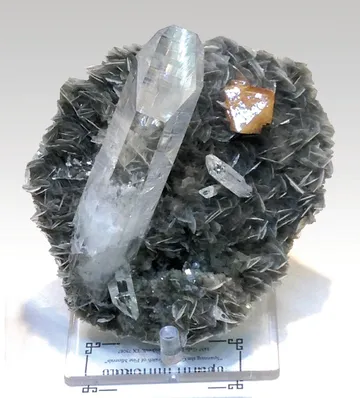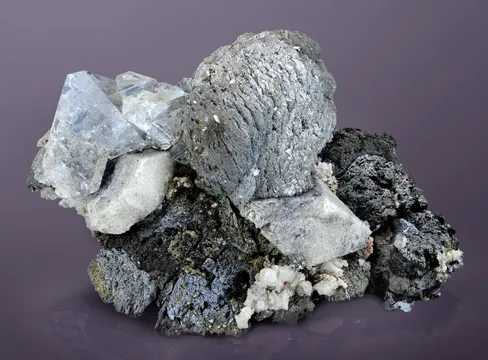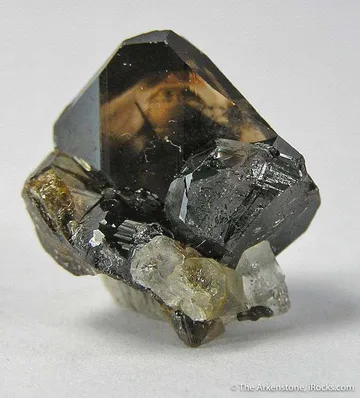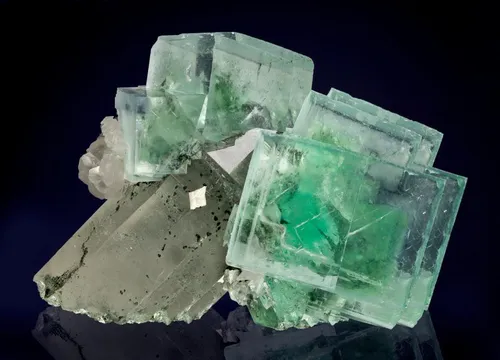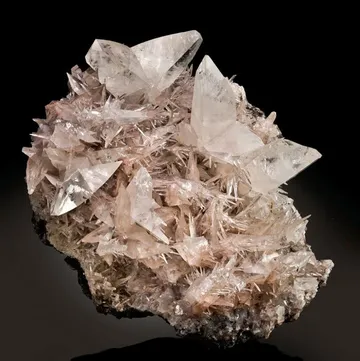
Mount Xuebaoding scheelite, China — renowned for large, euhedral yellow-orange crystals against silver muscovite, a flagship locality prized by collectors.
Key facts
Mount Xuebaoding scheelite is one of the defining Chinese mineral classics: rich golden-orange to honey scheelite, generally in sharp tetragonal dipyramids that read visually as “pseudo-octahedra,” perched on shimmering bladed muscovite and often accompanied by the locality’s other prestige species—aquamarine, cassiterite, quartz, fluorite, apatite, and feldspar. The best pieces have a theatrical contrast that is immediately recognizable: warm, dense, glassy scheelite against cold silver mica, sometimes with pale-blue beryl or jet-black cassiterite adding a second focal point.

Photo: Wikimedia Commons
Strictly speaking, many collector labels saying “Mount Xuebaoding” refer to workings on the Pingwu side of the Xuebaoding massif, particularly the Pingwu beryl mine and closely related Xuebaoding W-Sn-Be veins around Mount Little Xuebaoding. The commercial name has persisted because it is useful, famous, and tied to the spectacular mountain landscape; the careful collector should understand that “Mount Xuebaoding,” “Pingwu,” “Huya,” and “Mount Little Xuebaoding” may appear on labels for the same collecting tradition.
Geologically, the appeal is not accidental. The deposit belongs to an unusual W-Sn-Be system in which highly evolved granitic intrusions, marble, schist, and hydrothermal vein cavities combined to grow coarse, open-space crystals. In many tungsten deposits scheelite is granular, embedded, or industrially mined rather than collected as freestanding display crystals. Xuebaoding is different: scheelite, beryl, and cassiterite occur as large, euhedral, transparent to translucent crystals in pockets and vein margins, making the deposit a mineral-specimen locality of international importance rather than merely a tungsten occurrence.
The color is a major part of the locality’s identity. Analytical work on Xuebaoding scheelite has tied the yellow-orange hue to rare-earth element substitution, especially light rare earths such as La, Ce, Pr, and Nd replacing Ca in the crystal structure. That chemistry gives collectors more than a pretty color story: it helps explain why the best Xuebaoding crystals can show such saturated butterscotch, orange, and golden tones while retaining transparency and strong luster.

Photo: Wikimedia Commons
Collectors look first for crisp form, saturation of color, transparency, and intact terminations. A single sharp, gemmy, orange pseudo-octahedron on silver muscovite is already a classic; a balanced combination with aquamarine, cassiterite, fluorapatite, fluorite, or quartz moves into the realm of serious cabinet collecting. Under shortwave ultraviolet light, many Xuebaoding scheelites show the expected bright blue to bluish-white response, while rare-earth-related fluorescence may add more complex longwave or midwave behavior in selected pieces.
Search for specimens: View all scheelite specimens from Mount Xuebaoding, China
The collector locality lies in Sichuan Province, China, in the high country north of Longmenshan and within the Songpan–Ganzi orogenic region. In collector usage it is usually called Mount Xuebaoding or Pingwu; more precise modern locality wording often places the specimen at the Pingwu beryl mine, Huya township, Mount Little Xuebaoding, Pingwu County, Mianyang, Sichuan, China. The workings are reached from the Pingwu side, and Huya is the closer township name encountered on careful labels.
The deposit is a W-Sn-Be system associated with the Pankou and Pukouling granites, which intruded Triassic metasedimentary rocks. Mineralization is hosted mainly in hydrothermal veins cutting marble, and in breccia bodies and pods in schist. The vein architecture is important to understanding the specimens: quartz-rich centers are bordered by zones of coarse beryl, cassiterite, scheelite, feldspar, albite, muscovite, fluorite, and apatite. A muscovite fringe commonly separates vein from host rock, and the collectible crystals often grew on or near that mica-rich selvage.
The mineralized veins are commonly divided into three assemblage zones. The granite-hosted zone is dominated by muscovite, tourmaline, and beryl. The transitional zone from granite into metamorphic rock carries beryl, cassiterite, tourmaline, and muscovite. The marble-hosted zone is the richest specimen zone for scheelite, with beryl, cassiterite, scheelite, fluorite, calcite, tourmaline, apatite, and related minerals. That marble-hosted environment supplied calcium and clean open space, two reasons the scheelites could become large, sharp, and visually clean.
Specimen production entered the international collector consciousness in the 1990s, when abundant coarse beryl, scheelite, cassiterite, apatite, fluorite, muscovite, and related crystals began appearing from the Xuebaoding deposit. The early 2000s were particularly important for high-end combination pieces, and pieces bought during that period are now often described in the trade as coming from the peak years. By the 2010s and 2020s, top examples were still circulating, but most of the finest pieces were old-stock, collection releases, or auction specimens rather than fresh mass production.
Mining and collecting access should be treated as restricted. This is not a casual field-collecting destination: it is a high-altitude mining area, connected with protected mountain country and private or regulated workings. Serious collectors should acquire specimens through established dealers with clear provenance rather than attempting independent access.
Notable finds include large orange scheelite crystals on muscovite; aquamarine-and-scheelite combinations; cassiterite-scheelite-muscovite plates; uncommon scheelite with fluorapatite, calcite, or schorl; and the famous associated kësterite-mushistonite material once nicknamed “pandaite” before proper identification.
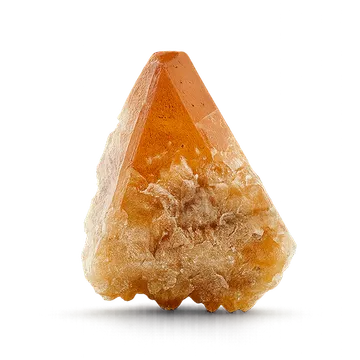
Xuebaoding scheelite is best known for pseudo-octahedral tetragonal dipyramids, commonly golden-yellow, honey, butterscotch, orange, or burnt orange. Some crystals are pale yellow or nearly colorless; others are deeply saturated and glow warmly when backlit. The most desirable crystals combine strong color with transparency or translucency, bright luster, and sharp edges.
Crystal size is one of the locality’s strengths. Scientific descriptions of the veins record scheelite in the 1–30 cm range within the mineralized assemblage, while collector specimens commonly show individual crystals from about 1–5 cm. Fine dealer and auction examples include sharp crystals around 2.5 cm, 4.7 cm, 5.0 cm, 5.7 cm, and larger groups, and locality summaries have reported lustrous translucent to gemmy orange crystals up to roughly 8 cm on an edge. As always, size alone does not make a great Xuebaoding specimen: a slightly smaller, complete, gemmy, well-positioned crystal is usually preferable to a larger but bruised or poorly displayed one.
The classic matrix is pearly, silvery, bladed muscovite. This mica matrix can form a nest or plate around the scheelite, giving the best pieces an almost architectural display. Quartz may appear as clear or milky crystals; beryl may be goshenite or pale aquamarine, often tabular rather than long-prismatic; cassiterite is usually dark, highly lustrous, and sharply formed; feldspar and albite can provide white contrast; fluorapatite, fluorite, calcite, and tourmaline are less common but important associations.
Scheelite from this locality may show color zoning or internal banding. Research on faceted and polished Xuebaoding samples described color groups from colorless through pale yellow to orange, and one pale-yellow sample showed parallel color bands. Rare-earth mapping showed stronger REE enrichment in more saturated zones, giving a useful scientific explanation for the collector’s eye: the deepest orange areas are not merely lighting effects, but reflect trace-element variations within the crystal.
Fluorescence is an additional quality factor. Under shortwave ultraviolet, Xuebaoding scheelite may show medium to strong blue-white or light blue fluorescence. Longwave response can be weak or inert in many yellow-orange examples, but individual specimens with rare-earth activation may show different longwave and midwave colors. For collectors, the most useful test is simple: examine the specimen under daylight, strong raking light, backlight, and shortwave UV. A top piece should have presence in all of those viewing conditions.
Quality is judged by a cluster of traits: crystal completeness, sharpness, transparency, luster, color saturation, placement on matrix, association, and lack of distracting repairs. The best Xuebaoding scheelites have a composed, “finished” look—the crystal seems naturally framed by muscovite rather than buried in it, and the matrix supports the focal point without overwhelming it.
Authenticity is usually less about species identity than about condition, repair, and locality precision. Scheelite is dense, relatively soft for a display mineral, and brittle; edges and terminations can chip, and mica matrices are easily broken during extraction, transport, or remounting. Use a loupe to inspect high points, reentrant angles, and the contact between scheelite and muscovite. Small chips on orange crystal edges are common; undisclosed regluing or restoration is more serious.
Documented restoration exists on Xuebaoding scheelite specimens. One auctioned small-cabinet scheelite on muscovite was described with an expert repair join to the muscovite matrix and restoration across part of the large scheelite crystal, using UV-fixed epoxy with color, luster, and translucency matching. That kind of restoration can be difficult to spot in normal light and may require magnification, UV examination, and careful inspection of surface continuity. Repairs are not automatically disqualifying if fully disclosed, but they change value dramatically.
Watch especially for three issues. First, mica plates can be reassembled or stabilized, and a repaired matrix join may be hidden below the main crystal. Second, chips on scheelite can be disguised by orientation, lighting, or selective photography. Third, older labels may say “Mt. Xuebaoding” or “Songpan” even when the more precise modern locality is Pingwu beryl mine, Huya township, Mount Little Xuebaoding; this is usually a labeling convention rather than a deception, but it should be understood and recorded accurately.
No broad, locality-specific industry of fake Xuebaoding scheelite has been documented in the sources reviewed for this guide. The more realistic concerns are undisclosed restoration, polished or improved faces on cuttable material, glued matrix repairs, and vague locality labels. Buy from dealers who disclose repairs in writing, provide multiple photos including side and back views, and are willing to discuss UV response and provenance.
Availability is moderate but uneven. Small to mid-size Xuebaoding scheelites appear regularly through dealers and auctions, especially single crystals on muscovite or quartz, while top matrix combinations with aquamarine, cassiterite, fluorapatite, or exceptional crystal size are much scarcer. Current market listings and recent auction records show everything from a few hundred dollars for modest pieces to several thousand dollars for strong cabinet specimens, with elite associations and old-stock showpieces reaching five-figure asking prices.
Care should be conservative. Handle by the matrix, not the crystal; avoid pressure on mica blades; keep specimens out of crowded drawers; and never clean with ultrasonics or harsh chemicals. A stable custom base is often worth the cost, especially for muscovite plates with elevated scheelite crystals. For display, Xuebaoding scheelite rewards both normal lighting and UV presentation, but use UV lamps responsibly and avoid heat buildup near repaired or delicate pieces.
The first story every Xuebaoding collector should know is that the name on the label is only half the geography. “Xuebaoding” means “Snow Treasure Crown,” a suitably grand name for the highest peak of the Minshan range, rising to 5,588 m. Yet the specimen workings long sold under that name are not simply on the summit itself. The mineral localities sit around 3,900–4,200 m in a landscape of ridges, domes, valleys, and confusing sightlines. The main Mount Xuebaoding peak lies several kilometers away from the collecting area and is separated by high ridges and another major mountain. The peak visible to the northwest of the locality area is Little Xuebaoding, itself 5,443 m high. Even local usage has long blurred the distinction between the two mountains, a confusion reinforced by extreme relief of up to 4,000 m between valley floors and adjacent peaks.
That name confusion became part of the mineral culture. Specimens may be labeled Pingwu, Songpan, Huya, Hujia, Mount Xuebaoding, or Mount Little Xuebaoding. A locality nickname, Shuijingchang, is said to mean “crystal site,” which may be the most poetically accurate label of all. In a specimen drawer, that label history matters: an old “Mt. Xuebaoding” tag is not necessarily wrong in the collector’s sense, but a modern catalog should preserve the old label while adding the more precise Pingwu/Huya/Mount Little Xuebaoding wording.
The mining camp itself has been described as a high-altitude operation with roughly 100 miners living near the site, about a third of them spending their time on specimens for the collector market. That number gives a sense of the deposit’s odd dual identity. It is a tungsten-tin-beryllium occurrence, but it is also a place where miners learned that an intact orange scheelite on mica could be more valuable as an object of beauty than as ore.
One small Xuebaoding find became famous precisely because it did not look quite like the usual material. A 6.2 x 4.4 x 3.3 cm small-cabinet scheelite, photographed by Rob Lavinsky and later shared on Wikimedia Commons, was described as coming from a small find on the “other side of the mountain” from the former main adits to the Pingwu mines, within the panda preserve country of Sichuan. The crystals were not the expected equant pseudo-octahedra. They were distorted into fat triangular forms, slimmer in one dimension, with crystals to 2 cm and gemmy terminations. The note attached to that specimen captures the excitement of a new pocket: news had circulated for about a year, only a small trickle had emerged, and the piece was valued in the $1,500–2,000 range in 2009.
Another Xuebaoding story belongs not to scheelite alone but to the locality’s habit of surprising mineralogists. Between 2001 and 2003, miners recovered specimens of kësterite coated by greenish mushistonite, both rare copper-tin minerals. Before they were correctly identified, the material was called “pandaite,” a nickname that could only have come from this landscape of world-class minerals, giant-panda country, and collector folklore. Once identified, the kësterite was recognized as among the largest and finest known crystals of the species.
The market history has its own cautionary tale. A striking 9.3 x 7.8 x 4.3 cm scheelite on muscovite, auctioned in 2016, carried an unusually frank description: the crystal was rich burnt-orange, translucent, sharp, and beautifully set on pearly muscovite, but it also had an expert repair and restoration right through the middle of the crystals. The restorer had matched color, luster, and translucency so well that the repair reportedly escaped the buyer’s eye in China. It is the kind of episode collectors repeat because it says so much about high-end Xuebaoding material: the crystals can be magnificent, the damage can be subtle, and disclosure is everything.