






Mockingbird Mine, California — renowned for crystallized native gold in clay-filled pockets, arborescent octahedra, and Mother Lode style specimens.
Key facts
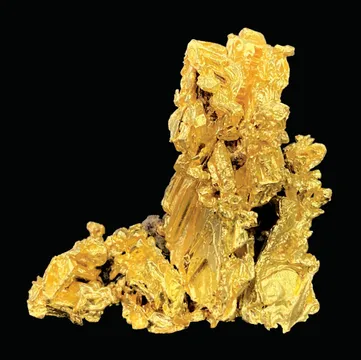
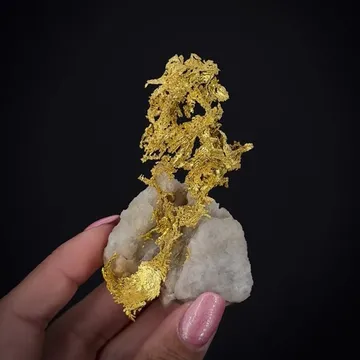
Mockingbird Mine is one of the great modern names in California crystallized gold. The mine lies in west-central Mariposa County, California, in the Colorado area of the Whitlock district, on the same famous Colorado dike trend that links it mineralogically and historically with the Colorado Quartz and Artru mines. For collectors, Mockingbird matters because it is not simply a gold mine that occasionally yielded attractive pieces: it is a pocket locality where brilliant native gold grew in clay-filled vugs along thin, gently dipping quartz “floor” veins cutting an altered mafic dike and graphitic slate wall rocks. Its best specimens have the unmistakable Mother Lode look—rich yellow to dark yellow gold standing on or emerging from white quartz—but they add a particular Mockingbird signature of wiry, arborescent, skeletal, flattened, and sometimes chunky octahedral crystals, often with dazzling mirror luster.
The locality’s modern fame rests especially on discoveries made after John and Lucretia Emmett acquired the claim in the 1990s. A major 2006 find on the third level, about 30 meters below the surface, yielded an extraordinary suite of crystallized gold specimens from clay-filled pockets; the following year brought additional world-class pieces, including the celebrated “Golden Coral.” Earlier production is poorly recorded and much early specimen gold was reportedly melted, which gives surviving pre-modern Mockingbird pieces an added aura. Today, a top Mockingbird specimen is judged less by bullion content than by architecture: free-standing leaves, skeletal octahedra, crisp spinel-twinned forms, three-dimensional lattices, and the quality of contrast between brilliant gold and clean white quartz matrix.
Regional View
Country View

Photo: Peter D. Tillman / Wikimedia Commons

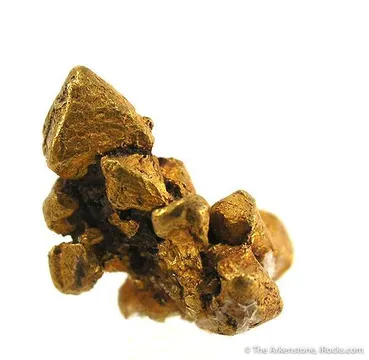
Photo: Rob Lavinsky, iRocks.com / Wikimedia Commons
Search for specimens: View all specimens from Mockingbird Mine, USA
The Mockingbird Mine, also historically known as the Mocking Bird Quartz and as the Talc and Lacy claim, is a small gold-vein deposit in Mariposa County, California. It is situated about 18 kilometers north of Mariposa and northwest of Midpines, west of California Highway 140, near the old Colorado mining camp. The claim is adjacent to the Colorado Quartz and Artru properties, and all three are tied to the Colorado dike system, the structural-mineralogical feature that explains much of the district’s specimen gold history.
Geologically, the mine sits in a subsidiary gold belt east of the main Mother Lode trend rather than in the main Mother Lode proper. The productive structure is the northwest-trending Colorado dike, an intensely altered mafic dike described in the literature as propylitically altered greenstone. At Mockingbird it cuts or is enclosed by silty graphitic slate known locally as the Briceburg formation, regarded as equivalent to the Mariposa formation and probably Late Jurassic in age. In the mine area the dike strikes approximately N50°W to N70°W and dips steeply, though its thickness changes markedly in the workings, from roughly 1 meter to as much as 13 meters.
The ore bodies are not broad, continuous veins in the usual sense. The collector-grade gold came from small pockets and vugs developed in thin quartz veins locally called “floor” veins. These veins are typically milky white quartz, commonly 2 to 25 centimeters thick, and are most productive where they meet the dike-slate contact, especially on the western side of the dike. Miners also recognized crosscutting fractures called “cutters”; the most favorable sites were places where cutters intersected floor veins at or very near the dike-slate contact. This is classic pocket-mining geology: small volumes, unpredictable geometry, and enormous specimen potential when open space, clay, quartz, and late gold crystallization coincide.
The MRDS-derived mine record describes gold at the border of a nearly vertical chloritic, altered greenstone dike where gently dipping quartz stringers cross the dike and pass into slate wall rocks. That older description also notes a patented 20-acre claim, an underground mine, one shaft with drifts, and a tunnel several hundred feet long. The early discovery year is given as 1890, but detailed production records are sparse. Published accounts emphasize that the mine produced wiry and arborescent specimen gold rather than large documented tonnages.
Mining history at Mockingbird is episodic. Before 1900 the property was known as the Talc and Lacey or Talc and Lacy claim. Fine gold specimens reportedly came out in the early 1890s and around the turn of the century, but many were melted, a common fate for gold specimens before the modern mineral-collector market properly valued crystallized gold. In 1915, the Weston Brothers recovered a widely noted pocket said to contain about 145 ounces of crystallized gold. The mine then fell in and out of dormancy.
A modern revival was attempted in the mid-1980s when Philip A. Rivera formed the Mockingbird Gold Mining Company to operate the Mockingbird and adjacent Artru mines. A crew from the Kellogg, Idaho, silver district was brought in, and equipment was installed, but the effort produced little and the property again lapsed. The decisive modern collecting era began when John and Lucretia Emmett acquired the claim in 1996. John Emmett had already been associated with the nearby Colorado Quartz mine and understood both the mining problem and the specimen value of carefully extracted crystallized gold.
Under the Emmetts, the outcrop of the Colorado dike was systematically worked, including trench-like surface excavation to depths of several meters and renewed underground development. Metal detectors played an important role in locating gold-bearing pockets missed by earlier miners. By the time of the major modern discoveries, the workings included old shallow cuts, drifts and stopes, a modern decline, ventilation and access shafts, slusher drifts, and a large stope associated with the 2006 pay zone.
The famous April 2006 discovery came from the third level, about 30 meters below surface, in a pay zone approximately 6 by 12 meters on the southwest side of the dike. A string of pockets occurred in a fold in the dike, associated with a clay seam about 15 to 25 centimeters wide. Small gold grains in the clay signaled that better crystalline material might be nearby. The specimens ranged from tiny pieces only a few millimeters across to cabinet-size masses; some crystallized gold masses approached a kilogram. Many pieces were coated or embedded in greenish chlorite-rich clay, while the best came from a black-clay-filled vug. The major vugs were described as occupying the corners of an imaginary three-dimensional cube tilted about 20 degrees from horizontal, and metal detectors helped guide the miners to specimens within about a meter of the pocket positions.
Collecting access today should be considered closed. Published locality notes state that the Mockingbird and surrounding mines are privately owned and not open to collecting. Specimens on the market therefore come from historic production, Emmett-era recoveries, prepared and marketed material from the 2006–2007 discoveries, and later dispersals through dealers, auctions, and private collections.
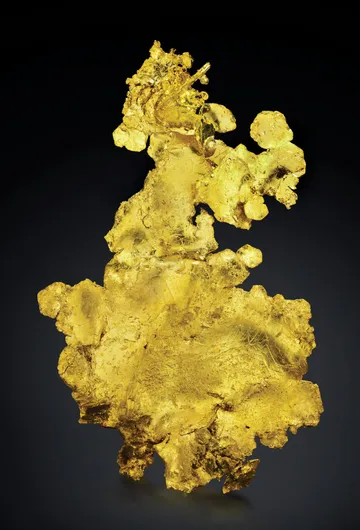
Gold is the reason Mockingbird Mine is known internationally: it occurs as native gold in wire, arborescent, leafy, skeletal, flattened octahedral, spinel-twinned, and chunky crystalline masses, either free of matrix or perched on and intergrown with milky white quartz, locally with arsenopyrite and clay or chlorite residues from the pockets. The 2006 third-level discovery produced specimens from a few millimeters to cabinet size, with individual crystals reported to nearly 2 centimeters and crystallized masses approaching a kilogram; the best Mockingbird pieces show mirror-bright, sharp-edged crystals in three-dimensional form rather than merely hackly gold. Fine examples are distinguished by strong yellow color, undamaged crystal edges, open sculptural architecture, original quartz matrix, and convincing provenance to the Colorado dike workings, especially the 2006–2007 pocket material.
Quartz is the dominant vein mineral at Mockingbird and the stage on which the gold performs: most of it is massive milky white vein quartz in the thin floor veins, but vugs near the Colorado dike–slate contact have produced collectible crystals and crystal groups. Published descriptions record quartz crystals up to about 4 centimeters across, groups to about 25 centimeters, and exceptionally limpid, mirror-faced chlorite-included quartz crystals seen at the mine up to about 6 centimeters in diameter and 9 centimeters long; many crystals carry chlorite inclusions or phantoms. The most desirable quartz specimens from Mockingbird are those that either host crystallized gold aesthetically or preserve clean vug texture and inclusions from the pocket environment, while ordinary massive quartz without gold is mostly of geological rather than specimen interest.
The documented associated minerals are a compact gold-vein assemblage: arsenopyrite, calcite, chlorite-group minerals, clay minerals, galena, pyrite, pyrrhotite, quartz, and manganese-iron oxide material described as wad. Arsenopyrite is especially relevant because it is commonly associated with gold-bearing pockets, though generally as coarse massive material rather than handsome crystals. Calcite is the most collectible non-gold accessory, occurring with quartz crystals in floor-vein vugs as colorless transparent crystals and as creamy tan to yellow crystals to about 2 centimeters. Galena is rare and nondescript, pyrite occurs sporadically in host and dike rock and in fine-grained nodular masses in the Briceburg formation, and pyrrhotite has been noted as massive narrow stringers near some floor-vein margins—memorable to miners because it could interfere with metal-detector discrimination.
Mockingbird gold should be bought first as a locality specimen and only second as precious metal. Weight matters, but form, crystallization, matrix, luster, and provenance matter more. Labels may reasonably vary—Mockingbird Mine, Talc & Lacy claim, Whitlock district, Colorado area, Mother Lode belt, Mariposa County—but serious specimens should not be casually confused with Colorado Quartz or Artru, even though all three are closely related along the Colorado dike. Because the neighboring mines produce visually similar gold-on-quartz, old labels, dealer history, publication references, and collection provenance are unusually important.
No widely cited Mockingbird-specific fake scandal dominates the literature, but the normal problems of the crystallized gold market apply: over-etched pieces, repaired or reattached gold on quartz, incomplete locality labels, and specimens sold as “Mockingbird style” or “Mariposa County” without a firm mine attribution. Some Mockingbird specimens were prepared by removing enclosing quartz and clay; at least one noted spinel-twinned example was described as having quartz removed physically rather than by hydrofluoric acid. Acid preparation is not automatically disqualifying for gold specimens, but collectors should distinguish natural pocket surfaces from etched surfaces, ask whether quartz was removed, and inspect matrix contacts carefully for glue, artificial seating, or suspiciously clean junctions.
Condition issues are mostly mechanical. The very features that make Mockingbird gold desirable—leafy projections, skeletal octahedra, raised ridges, thin wires, and arborescent sprays—are vulnerable to bending, abrasion, and pressure damage. A fine piece should be handled by its base or mount, not by the gold. Quartz matrix may show trimming, bruised edges, or iron-manganese staining; clay and chlorite residues can be part of the locality character and should not be assumed to be dirt that must be removed. Native gold itself is stable and non-fluorescent, but associated quartz, calcite, and clay-rich pocket material should be cleaned conservatively. The market supply is thin: EarthWonders has only a modest number of Mockingbird gold and quartz records, and outside the platform the locality appears chiefly through high-end dealer archives, old auction listings, and occasional single specimens.
The Mockingbird story is inseparable from the changing fate of crystallized gold itself. In the 19th and early 20th centuries, many beautiful gold specimens were simply gold. Their value was metal value, and their destiny was the crucible. Published accounts of Mockingbird note that much of the fine material recovered in the early 1890s and around the turn of the century was melted down. That single fact explains why the mine feels younger to collectors than its workings really are: the geology was producing specimens long before the specimen market was mature enough to save them.
One early pocket did survive in memory. In 1915 the Weston Brothers reportedly opened a pocket containing about 145 ounces of crystallized gold. In a pocket-gold mine, that figure is not just a production statistic; it is a scene. Imagine the small workings on the Colorado dike, the floor veins and clay seams, and then a sudden concentration of crystalline metal large enough to be weighed by the pound. The find was well-publicized, but the mine still did not become a continuous source of world-class specimens. It remained one of those tantalizing California claims that had proved what it could do, then went quiet.
The modern chapter began with John and Lucretia Emmett. John Emmett was not approaching Mockingbird as an ordinary small gold mine. He had already been involved at the Colorado Quartz mine and had helped in the era that produced “the Dragon,” the famous Colorado Quartz gold specimen now associated with the Houston Museum of Natural Science. That background mattered. At Mockingbird he hunted pockets with a specimen miner’s eye, using metal detectors and subtle underground signs rather than simply chasing ore. In 2006, that method intersected the Mockingbird “Mother Lode.”
The April 2006 pocket zone is one of the great modern California gold episodes. The best pieces came from the third level, roughly 30 meters below surface, in a pay zone about 6 by 12 meters on the southwest side of the Colorado dike. The clue was modest: small grains of gold in a 15-to-25-centimeter clay seam in a fold in the dike. But above and around that seam were the pockets. Two of the finest specimens were found about 4.5 to 6 meters above the fold, while other pieces lay closer to the fold itself. The vugs were not vast caverns. Many productive pockets were only up to about 20 centimeters, though barren vugs could reach about a meter. Yet from that confined geometry came gold from millimeter size to cabinet specimens, with crystallized masses approaching a kilogram.
The pocket geometry became almost mythic. The major vugs were described as if they sat at the corners of an invisible three-dimensional cube tilted about 20 degrees from horizontal. In practical terms, that meant the miners were not just following a vein but solving a spatial puzzle inside a dike-wallrock contact zone. Metal detectors were crucial; they helped locate specimens within about a meter of the pockets in all four corners of that imagined cube. It is one of those rare mining stories where modern technology did not make the find less romantic—it made the invisible architecture of the pocket more vivid.
Then came the public unveiling. Collector’s Edge Minerals prepared and marketed many of the 2006–2007 Mockingbird specimens at the 2007 Tucson Gem and Mineral Show. Bryan Lees displayed five of the top 2006 specimens, but the excitement was so immediate that two reportedly sold before they were even shown in the case. For a mine that had been little known to most collectors a generation earlier, Mockingbird had suddenly entered the short list of California localities capable of competing aesthetically with the most famous crystallized gold mines in the world.
The 2007 “Golden Coral” pushed the story further. This cabinet-size gold occurred as a floater in a black-clay-filled vug and was described as having extraordinary color and a rare degree of mirror-brilliant luster. It measured about 14 centimeters wide by 18 centimeters tall. The piece was so striking that it sold immediately and did not receive a public debut at the time. It later entered the MIM Museum in Beirut, where a major Mockingbird gold specimen is recorded with brilliant sharp-edged hexoctahedrons and dendrites, a 14.0 by 11.0 by 12.5 centimeter size, main crystals to 1.5 centimeters, and an analysis of 88 percent Au and 12 percent Ag.
Another named specimen, “the Cobra,” shows how quickly great Mockingbird gold entered the language of trophy collecting. In a Heritage Auctions catalog, the Cobra was described as a mass of shining, razor-edged crystals rising from a base of pure white quartz, measuring 5 1/2 by 2 1/2 by 1 1/4 inches. The catalog compared its importance to the Colorado Quartz “Dragon” and emphasized the criteria that still govern top Mockingbird gold today: crystal presence, crystal sharpness, luster, original matrix, and overall aesthetics. The name may be fanciful, but the collecting logic is sober: only a handful of modern localities have produced gold specimens with that combination of size, brilliance, and sculptural complexity.
.jpg)
