






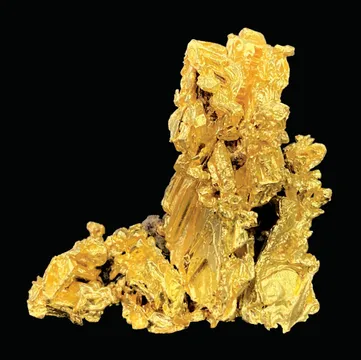
Eagle’s Nest Mine, USA — crystallized California gold in quartz seams, renowned for flattened octahedra and sprays, making it highly prized by serious collecto…
Key facts
Eagle’s Nest is one of the defining modern localities for crystallized California gold: a lode-gold specimen mine on the Foresthill–Michigan Bluff side of Placer County, in the northern Sierra Nevada foothills, where native gold is recovered from quartz-bearing seams rather than from waterworn placer gravels. For collectors, its importance is not merely that it produces gold, but that it has repeatedly produced gold with recognizable crystal architecture—flattened octahedra, triangular plates, herringbone and arborescent sprays, dendritic sheets, wires, and stout crystalline masses—often rising from or embedded in white quartz. Good Eagle’s Nest specimens have the visual grammar of classic California pocket gold: bright yellow metal, sharp reflective faces, and a sculptural relationship to matrix that makes even thumbnail pieces feel animated.
The mine occupies a storied part of Gold Rush country near Michigan Bluff and Foresthill, close to districts where hydraulic placers, ancient channels, and hard-rock lode work overlapped for more than a century. Historic reports on the older De Maria/Garbe workings describe crystallized gold in quartz seams and pockets in decomposed rock; modern collector literature treats Eagle’s Nest and the older De Maria property as parts of the same unusual multi-level crystallized-gold deposit. That matters on labels: “Mystery Wind” appears on older specimens as a concealment name, but serious modern labeling places the material at Eagle’s Nest Mine, Sage Hill, Michigan Bluff Mining District, Placer County, California, USA, while preserving older De Maria, Garbe, or Mystery Wind provenance when documented.
Regional View
Country View
The best specimens from Eagle’s Nest are not nugget gold and should not be judged like nuggets. Their value lies in crystal development, completeness, luster, and the way the gold stands in space. Many pieces are essentially flattened growths along a seam; the exceptional ones break that plane, presenting branching three-dimensional sprays or stout octahedral clusters on quartz. Matrix pieces are especially coveted when the quartz is not merely a white support but part of the story—showing gold seams penetrating it, gold emerging from it, or gold left exposed by careful preparation.

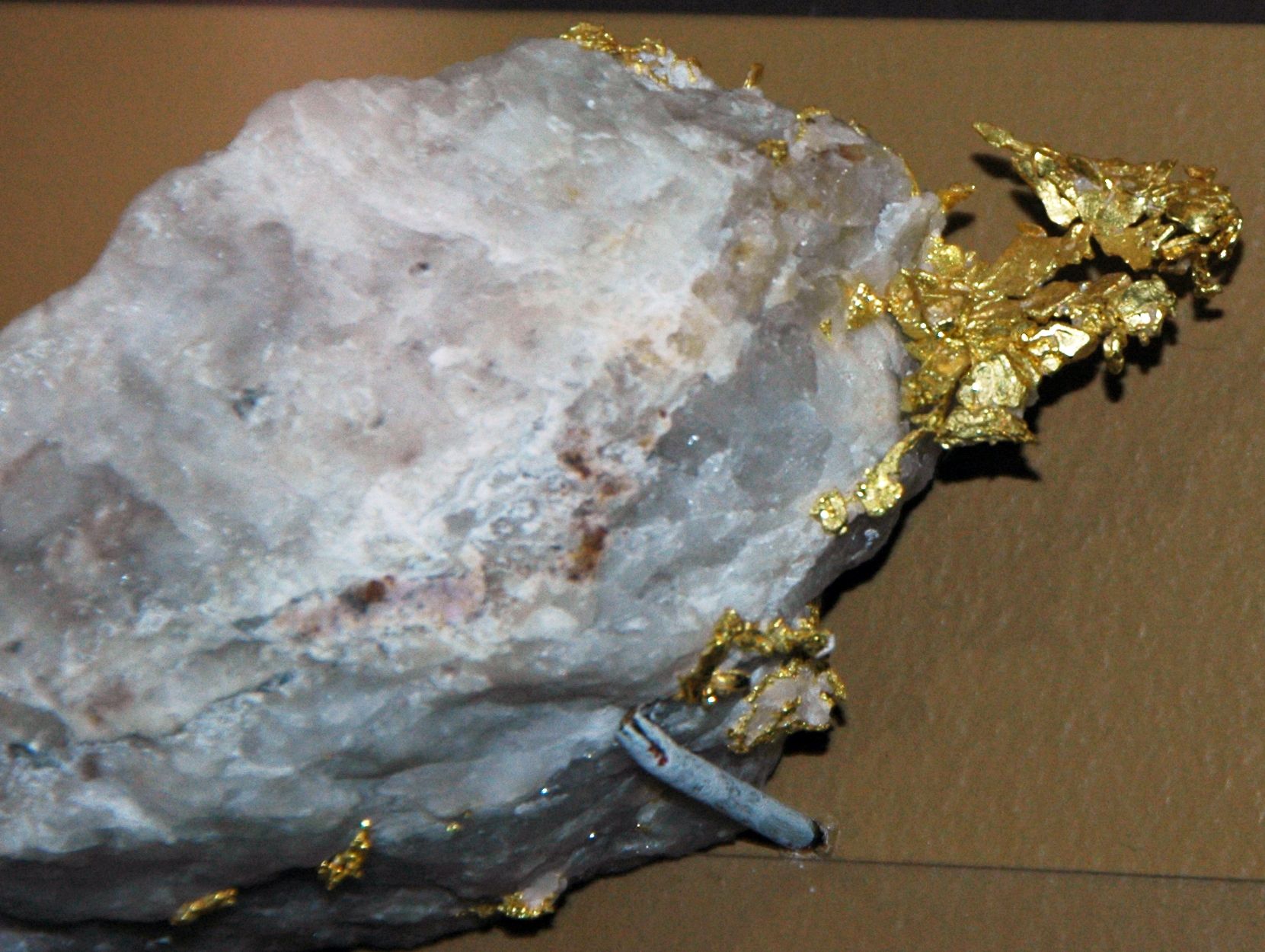
Photo: James St. John / Wikimedia Commons
Search for specimens: View all specimens from Eagle’s Nest Mine, USA
Eagle’s Nest Mine is in Placer County, California, in the Sage Hill–Michigan Bluff area of the northern Sierra Nevada foothills. Modern public records place the operating mine on Mosquito Ridge Road near Foresthill, within the Tahoe National Forest area, and county environmental documents identify it with the Red Ink Maid and Big Seam mines under California mine ID 91-31-0020. The locality sits within a broader gold-bearing landscape where placer deposits, hydraulic-mining scars, and hard-rock lode occurrences are superimposed on Paleozoic and Mesozoic metamorphic and ultramafic terranes of the Sierra Nevada foothills. District-level descriptions classify the Michigan Bluff area as a low-sulfide Au-quartz vein environment, with lode deposits consisting of free-milling gold-bearing quartz veins and placer deposits carrying dust to large nuggets.
The specimen-producing ore is best understood as pockety native gold in quartz seams and narrow veins, not as a uniform bulk orebody. Historic descriptions of the De Maria or Garbe mine recorded free crystallized gold in quartz seams in a porphyry dike, worked by a placer-style washing process because the enclosing rock was deeply decomposed. Later reporting on the Garbe & de Maria mine emphasized “pockets” of coarse crystallized gold in a network of crooked drifts in the oxidized zone, on a low-angle seam dipping east. Modern accounts of the Eagle’s Nest workings describe gold in irregularly distributed zones within narrow quartz veins averaging about five centimeters thick, with exploration following nearly horizontal seam intervals through the host rock. Massive quartz is common; open quartz-lined pockets are less common; and free-growing gold into a cavity is the prize.
The name history is unusually important. The older De Maria/Garbe mine is the low-level, historic expression of the same broader crystallized-gold system, while Eagle’s Nest specimens are associated with the upper levels of the De Maria property. “Mystery Wind Mine” appears on older labels, but published locality practice treats Mystery Wind not as a separate mine, but as a concealment name used to obscure the actual source of specimens. Labels that say “Mystery Wind” should not be discarded—old labels are provenance—but the modern locality should be made explicit.
Historically, the ground is tied to early twentieth-century claim work and older mining families in the Foresthill-Michigan Bluff area. Public environmental documents state that mining at the site dates to the initial mine-claim filing in 1907, and that the mine has operated under a U.S. Forest Service Plan of Operation since 1987. Collector literature records that specimens from the modern Eagle’s Nest source first reached wider mineral-collecting attention in the early 1980s, initially labeled only as from the Michigan Bluff Mining District. By the 2004 Mineralogical Record article by Wayne C. Leicht and Robert B. Cook, the locality had become established as one of the important modern sources of fine crystallized California gold.
Current access is not a field-collecting proposition. Eagle’s Nest is an active, regulated mine, not a public dig site. The 2025 reclamation-plan amendment record identifies Eagle’s Nest Mining, LLC as the operator/applicant, describes an existing vested underground operation, and states that the project allows expansion into new ore bodies and provides emergency access to an underground emergency exit portal. County records also describe active operations with employees, waste-rock dump management, reclamation requirements, and post-mining revegetation. Collectors should acquire specimens through reputable dealers, documented mine releases, collection deaccessions, and auction records rather than attempting access.
The most important recent find is the Valentine Pocket, discovered on February 14, 2024. Public accounts describe it as a major new specimen discovery after years of inactivity, producing more than one hundred fine gold and gold-in-quartz specimens across sizes from thumbnails to cabinet pieces. The material shown publicly in 2025 displayed the traits collectors want from Eagle’s Nest: lustrous flattened octahedra, dendritic and herringbone gold, arborescent sprays, white quartz matrix, and in the better examples, unusually strong three-dimensionality rather than a simple flat seam plate.
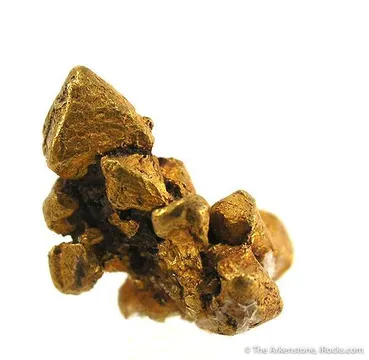
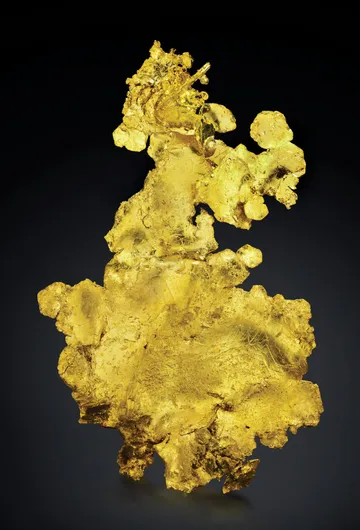
Gold from Eagle’s Nest is the locality’s reason for fame: bright, high-luster native gold in crystalline rather than waterworn form, typically as flattened octahedra, triangular plates, dendritic sheets, arborescent growths, herringbone aggregates, wires, and occasional sharper octahedral crystals to centimeter scale; many specimens are partly on or in milky white quartz, and historic and modern accounts agree that the gold occurs irregularly in pockets and seams within quartz-bearing zones of the De Maria–Eagle’s Nest system. Ordinary pieces may show attractive yellow metal but remain flat, incomplete, or visually confused; the finest Eagle’s Nest gold has clean crystallography, reflective faces, branching or sculptural form, and enough quartz association to anchor the specimen without overwhelming it. The 2024 Valentine Pocket reinforced the locality’s reputation by producing a wide range of well-crystallized pieces, including substantial matrix specimens and unusually coherent thumbnails, while older classic pieces from the 1980s through early 2000s remain highly desirable when they carry Leicht, De Maria, Arkenstone, Green Mountain, Currier, or other strong provenance.
Quartz at Eagle’s Nest is chiefly the gangue and matrix that makes the gold legible: white to gray-white, commonly massive, locally seam-like, and only occasionally developed as small quartz-lined pockets or visible crystal terminations. In specimen terms, Eagle’s Nest quartz is rarely collected as a stand-alone aesthetic species; its importance is in hosting, contrasting, and protecting the native gold. The best gold-on-quartz pieces show gold emerging from white quartz in a natural, balanced composition, or expose native gold running through the quartz as veinlets before rising into crystalline sprays. Preparation often determines the final look: too much quartz can hide the crystallized gold, while over-etching can leave gold visually unsupported or suspiciously “floater-like”; the strongest pieces retain enough quartz to prove their lode context and enough exposed gold to show the locality’s distinctive flattened octahedra, dendrites, and arborescent forms.
Standard locality records for Eagle’s Nest list a small assemblage dominated by native gold and quartz, with dolomite and pyrite also documented. Dolomite and pyrite are not the collector draw here, and they rarely define the market identity of a specimen; they are useful mainly as part of the broader low-sulfide gold-quartz context. No type-locality mineral is associated with Eagle’s Nest in the standard collector-mineral records consulted; the locality’s mineralogical importance rests on unusually fine crystallized native gold rather than on species diversity.
Eagle’s Nest gold is a connoisseur locality where labeling and preparation matter. The first authenticity issue is locality terminology: specimens may be encountered as Eagle’s Nest, Eagles Nest, Mystery Wind, De Maria, Garbe, or Michigan Bluff District. These names are not all equivalent in a simple way. Mystery Wind is best treated as an older concealment name, not a separate mine. De Maria/Garbe is historically and geologically tied to the same broader deposit, but the published collector locality for upper-level specimen material is Eagle’s Nest. A strong label should give the full locality and preserve any older name as provenance, rather than replacing it with a vague “California gold” label.
The second issue is preparation. Eagle’s Nest gold commonly begins enclosed or partly enclosed in quartz. Modern specimen recovery may use metal detection to locate hidden gold in quartz, X-ray imaging to understand distribution, and acid preparation to reveal the gold. Properly prepared pieces show natural crystal surfaces, convincing emergence from quartz, and no crude tool marks in the wrong places. Over-prepared pieces may look skeletal, excessively isolated, or too uniformly exposed. Hydrofluoric acid is used in professional preparation of quartz-hosted gold; collectors should not attempt it casually. HF is extremely dangerous, and even finished specimens should be handled with the assumption that acid-prepared cavities and crevices were professionally neutralized only if the preparer or dealer is reputable.
Condition is a serious consideration. Gold is soft, and Eagle’s Nest specimens may have delicate dendritic edges, thin plates, and protruding wires. Even apparently sturdy crystalline masses can have vulnerable terminations and seam-grown edges. Watch for bent plates, flattened tips, broken herringbone branches, solder-like joins, suspicious repairs, and unnatural brightening in protected recesses. Matrix pieces should be checked where gold meets quartz: a natural contact is irregular and geologically convincing, while a repaired or mounted fragment may show adhesive, mismatched luster, or an improbable contact geometry. Because many fine Eagle’s Nest pieces are displayed in custom mounts or clutch bases, examine the specimen off its base when possible.
Fluorescence is not a collecting factor for Eagle’s Nest gold; native gold does not fluoresce, and the locality is not pursued as a fluorescent assemblage. Handling concerns are instead mechanical and chemical. Avoid ultrasonic cleaners, aggressive brushing, jewelry-cleaning solutions, and repeated handling with bare fingers. Store fine pieces in a box or case that prevents vibration, and never allow gold plates or wires to bear the weight of the specimen. For thumbnails, a well-made removable mount can be protective rather than merely cosmetic.
Market availability fluctuates sharply with pockets. For long stretches, Eagle’s Nest was represented mainly by older collection pieces and occasional dealer offerings. The Valentine Pocket brought a major new pulse of material to the market in 2024–2025, including thumbnails, miniatures, and cabinet specimens, many with strong crystal development and quartz matrix. Even so, truly top pieces remain rare and expensive: substantial, three-dimensional, highly lustrous specimens on quartz can reach five or six figures, while attractive thumbnails and miniatures occupy a more accessible but still premium tier. Ordinary gold-in-quartz from California should not be priced like Eagle’s Nest crystallized gold unless the crystal form, locality documentation, and provenance justify it.
Eagle’s Nest has always lived in the tension between secrecy and revelation. The first collector-market specimens did not arrive with the polished locality name now printed on labels; they circulated as Michigan Bluff material, and some later carried the evocative but misleading “Mystery Wind” name. That name did its job: it suggested romance while hiding the source. In the end, the mine became too important to remain a whisper. The De Maria ground, the upper Eagle’s Nest levels, and the old concealment labels were sorted into the locality history, and collectors learned to read an Eagle’s Nest label as a small document of both geology and secrecy.
The old reports have their own Gold Rush flavor. In 1917, the De Maria or Garbe mine was described as a place where free crystallized gold occurred in quartz seams in a porphyry dike and was washed by the placer process. That is a memorable hybrid image: hard-rock specimen gold being treated with placer methods because the rock around it had weathered into something soft enough to work. By 1936, the Garbe & de Maria mine was described as having long been noted for occasional pockets of coarse crystallized gold. The workings were not a tidy engineered grid but a network of crooked drifts in the oxidized zone, following a flat seam through decomposed rock. The collector’s dream—bright, coarse, crystallized gold—was embedded in a miner’s reality of low-angle seams, bad ground, and pocket luck.
The modern revival added a new chapter. Daniel Trinchillo acquired the mine in 2019, brought in mine manager Keith Wentz and lead geologist Ian Merkel, and reopened the locality with modern modeling, technology, and specimen-conscious mining. On Valentine’s Day 2024, the mine delivered the find that gave the pocket its name. Public accounts describe a discovery unlike anything seen from Eagle’s Nest in more than a decade: complex, large, three-dimensional gold specimens and a broad run of smaller pieces with unusually consistent quality. When the Valentine Pocket material appeared publicly, it was not a single trophy surrounded by rubble; it was a suite, with thumbnails, miniatures, and cabinet pieces all carrying the Eagle’s Nest look.
At Tucson in 2025, a case of Valentine Pocket gold became one of the show’s talked-about displays. About twenty-five specimens were shown in the Green Mountain Minerals room at Mineral City and later at the Main Show. The reported output exceeded one hundred first-rate pieces, and by late July 2025, many of the Green Mountain examples had already sold. One 11.6 cm gold specimen was offered at $250,000. A 5 cm miniature was priced at $55,000. A 3 cm thumbnail inspired the dealer’s memorable description of “a clarinet-playing goblin tip-toeing across the stage.” That little line captures why Eagle’s Nest matters: these are not merely precious-metal specimens. At their best, they are recognizable natural sculptures.
Auction records provide another kind of field note: the biography of specimens after they leave the mine. A 2019 Heritage Auctions sale offered a crystallized Eagle’s Nest gold described as nearly six inches long, weighing 308 grams, with unusually thick crystallization, vibrant luster, and excellent octahedra. It sold for $187,500. Another Heritage record for an Eagle’s Nest native gold on quartz specimen from the Rock H. Currier collection documented the movement of a classic piece through one of the great modern mineral collections. These public sales are useful not because every collector is chasing six-figure gold, but because they establish the locality’s place in the hierarchy of American crystallized gold.
_(17032464855).jpg)
_(17035851812).jpg)